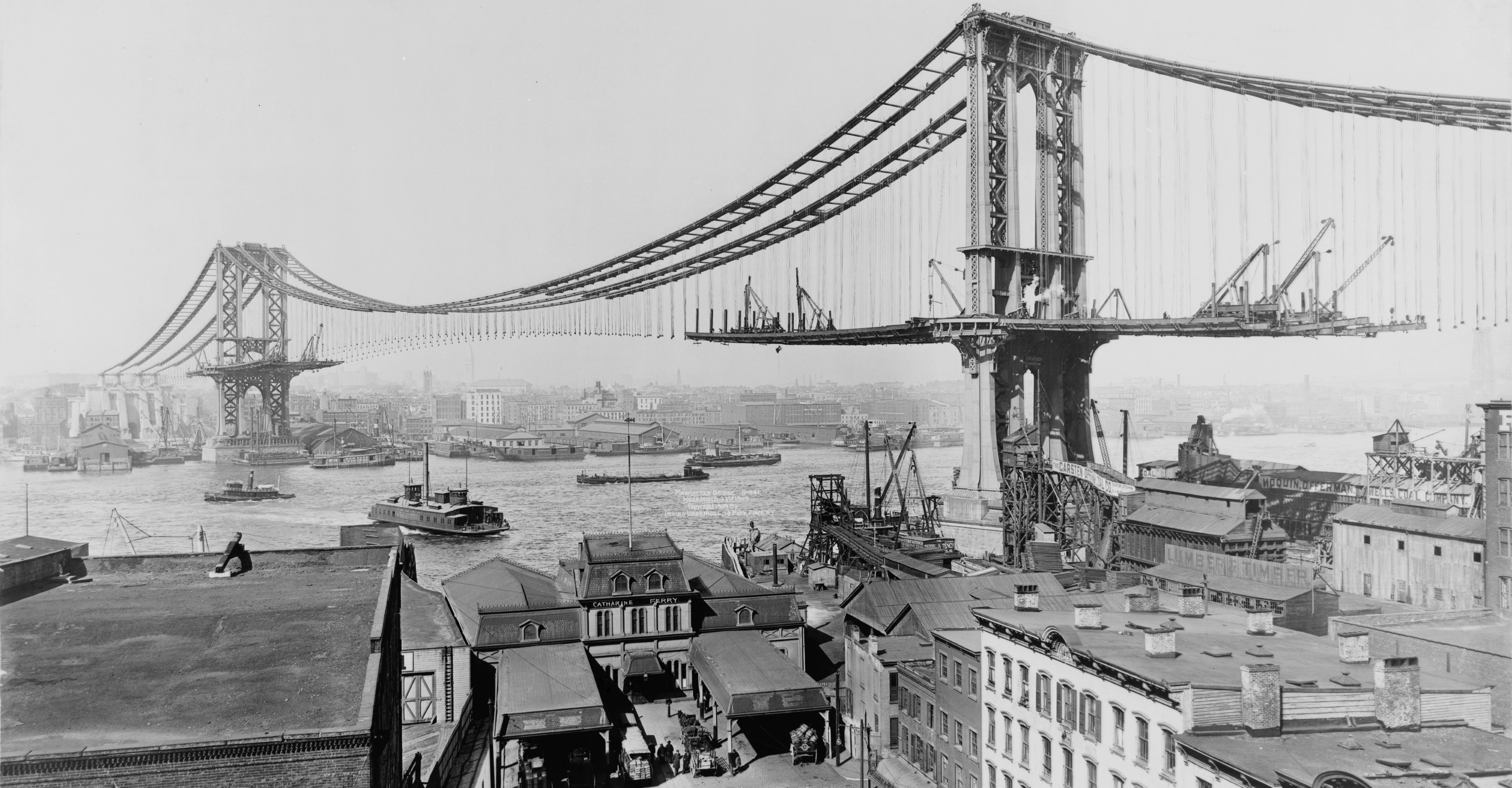
One of over twenty to die in its construction, fellow-worker John McShane is blown off a footway to his death as the Manhattan Bridge nears completion.
‘First Death on New Bridge’ from The New York Daily Call. Vol. 3 No. 88. April 13, 1909.
John McShane, Bridge Worker, Blown From Footway by Compressed Air, Killed by 115-Foot Fall.
The first fatality on the new Manhattan Bridge occurred yesterday when a sudden blast of compressed air blew John McShane, a bridge worker, from the narrow footway along which he was walking, and he fell 115 feet to his death on the Brooklyn side of the structure.
It was Blue Monday, the one day of the week when bridge iron workers expect accident and tragedy in their trade–and usually realize the expectation. McShane was one of a gang of probably a hundred men at work for Terry & Tench, the bridge contractors, about fifty feet west of the Brooklyn anchorage, He was standing on a temporary wooden walkway, laid on the steel girders of the permanent structure, and assisting in handling an automatic riveter. This riveter was operated by compressed air, which, with a pressure of 240 pounds to the square inch, sped through a wire-bound rubber hose.
Under the tremendous force the hose twisted and writhed and finally blew off a brass coupling. Out shot the blast of air, striking McShane, who was perhaps two feet away, squarely in the stomach. It was as if he had been dealt an uppercut by a giant arm. With a cry he shot straight out bent forward until he was almost doubled, with his legs contorted under him. Some of the men say he was hurled at least ten feet into space.
Then he fell, crashing past the arms stretched out to save him on the narrow perilous perch, and passing between two of the beams dropped down a well-like lattice of meshed false-work. From above, his companions peered down between the cracks in the bridge flooring, watching his flight. Ten feet from the earth he struck the end of a two-inch plank, snapped it off square, rebounded and fell into a mortar bed just abandoned by the concrete people.
Although every bone in his body seemed to be broken the man was still alive when the others reached him. He died before an ambulance from the Brooklyn Hospital arrived.
McShane was thirty-seven years old and unmarried. He boarded at 454 Wythe Avenue, Brooklyn. Even in a craft filled with daring men, he was noted for his defiance of danger.
The New York Call was the first English-language Socialist daily paper in New York City and the second in the US after the Chicago Daily Socialist. The paper was the center of the Socialist Party and under the influence of Morris Hillquit, Charles Ervin, Julius Gerber, and William Butscher. The paper was opposed to World War One, and, unsurprising given the era’s fluidity, ambivalent on the Russian Revolution even after the expulsion of the SP’s Left Wing. The paper is an invaluable resource for information on the city’s workers movement and history and one of the most important papers in the history of US socialism. The paper ran from 1908 until 1923.
PDF of full issue: https://www.marxists.org/history/usa/pubs/the-new-york-call/1909/090413-newyorkcall-v02w088.pdf
 Revolution's Newsstand