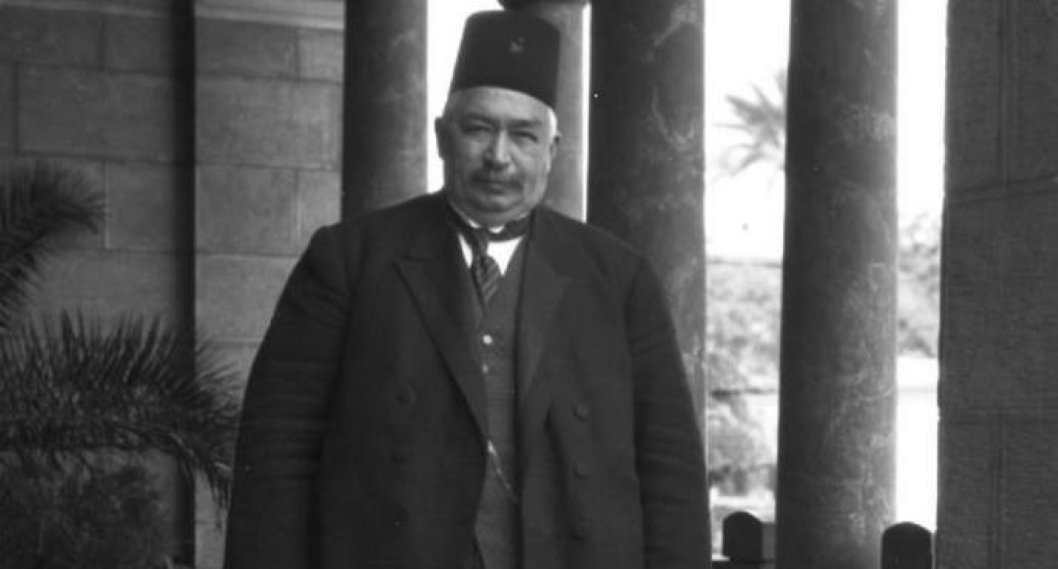
Pro-imperialist Egyptian autocrats are a type. Although with more democratic pretenses, Ahmed Ziwar Pasha was something of the Abdel Fattah el-Sisi of the 1920s. Another of Joseph Berger’s illuminating reports.
‘The Dictatorship of the Bankers in Egypt’ by Joseph Berger from International Press Correspondence. Vol. 5 No. 73. October 8, 1925.
The Zivar Pasha Government has been at the helm in Egypt for ten months. Having been put in its present position by the power of the English bayonets, which drove out Zaghlul Pasha, and supported by them alone, the Zivar Government is merely a pseudonym for English rule in Egypt. The English Government, in all confidence, gives the widest pseudo-autonomy to this handful of Egyptian feudalists and bankers who support it, and especially to the conceited and unpopular King Fuad. The English Government is well aware of the fact that Zivar and the bankers are much more closely connected with English bank capital than with the Egyptian people, and that for this group of parasites English imperialism in Egypt is not only a question of their political power but also a purely economic question of obtaining for themselves the utmost possibility of exploitation and profit.
As long as Fuad and Zivar rule in Egypt, the Egyptian constitution, jurisdiction, civil service, embassies, consulates, diplomatic representatives and missions abroad are in better hands from the English point of view than if all these offices were occupied by English officials. A transgression of the pseudo-autonomy is scarcely to be feared except in one direction; the foreign power could hardly of itself, in its own name, commit so many atrocities, so many acts of oppression as the “native Government” is guilty of without scruple. There is an ever present danger that Zivar’s servile government might, in its unlimited fear of the masses of the people and in its unprecedented thirst for revenge against the revolutionary parties, overstep the bounds which are “absolutely necessary” for the preservation of peace and order.
These bounds have been seriously threatened for a long time; Zivar drove the Egyptian Parliament asunder at a moment’s notice for no reason whatever, after his party, in spite of unprecedented terror, had been worsted by Zaghlul’s in the election campaign. Zivar has passed a number of laws gagging the Press, which make Press lawsuits a daily occurrence in Egypt and destroy all free expression of opinion. Zivar has worked out a rascally franchise law according to which 60% of the broad masses of the people are excluded from active voting, among them the broad masses of the rural population and the workers and students in towns with revolutionary tendencies.
By means of provocation and provocative agents, Zivar had seven young Egyptians, members of a revolutionary organization, condemned for the assassination of the English Sirdar Stack Lee, and did not rest until, in spite of the protests of the whole country, they had been executed. Zivar has introduced harder conditions into the regime for political prisoners. He alone is responsible for the martyr’s death of Anton Maroun who died in consequence of a hunger strike which he had declared in protest against the harder conditions of the prison regime. At Zivar’s instigation juvenile members of the national revolutionary Zaghlulist party have been arrested wholesale, and young students have been condemned to six months’ penal servitude for distributing manifestoes.
With the aid of the police and the military, Zivar suppressed all wages movements of the workers, for instance the strike of the coal-workers in Alexandria and of the fishermen in Damietta. Zivar ordered that unusual severity should be exercised in the collection of the agricultural taxes, which has brought the Egyptian small peasantry to the brink of destruction. Zivar, using once more his method of employing provocative agents, has prepared a great communist trial, in which, according to the charge which has just been published, the accused come under nine paragraphs of the criminal law, for terrorist plans of assassination (!), premeditated murderous attacks (!!), inciting the population to insurrection, high treason etc., all crimes which are punishable with ten to fifteen years penal servitude. It was Zivar who, with ferocious brutality carried out raids against foreign, especially Russian subjects and threw whole families into prison for months, had them ill-treated and forcibly deported on perfectly unfounded and fictitious accusations.
The English appreciate to the full the services of their private bandit. On the occasion of his last stay in London, Zivar had honours and invitations showered upon him.
And, still more important, Zivar in common with other Egyptian finance magnates has made brilliant agreements in Lancashire this year. Whilst on the one hand the high taxes in the country compel the peasant to sell his cotton at ridiculously low prices, the Anglo-Egyptian banks on the other hand keep the price of cotton as high as possible, thus making fabulous profits. During this year no less than 78,000 bales of cotton, 20,000 more than last year, were imported to the account of the “National Bank of Egypt” alone (Anglo-Egyptian capital).
This explains the fact that banking circles are so well satisfied with the Zivar Government. At the same time however it explains the deep dissatisfaction of the broad masses of the people, of the exploited peasants and workers, of the aspiring intelligenzia with revolutionary tendencies and of those circles among the Egyptian bourgeoisie who are interested in the independent development of Egypt and who regard the dictatorship of Zivar and the banks as the greatest obstacle to development. The exasperation of all the strata of the people mentioned is directed not only against the Zivar Government but, beyond it, against the autocratic King, and it was without doubt this mood of the people which was at the bottom of the last ministerial crisis which recently broke out.
II.
The Zivar Pasha Ministry was in form a coalition of two parties. Apart from the so-called United Party (“Ittehad”), the party of the King, the feudalists and the bankers, which was only founded in 1924 with the specific object of supporting the Zivar Government and establishing its authority among the people, three Ministers of the Liberal Constitutional Party held office in it. The latter is the party which was entirely discredited by its collaboration with the English in the years 1919-1923, and which disappeared completely from the horizon during Zaghlul Pasha’s short Government, the party which was very poorly represented in the first Egyptian Parliament. It also represents a section of the large bourgeoisie (that with liberal tendencies) and, in its fundamental principles, especially as regards such problems as England, the Soudan, the fight against revolutionary currents, hardly differs from the Ittehadists.
At the time of Zaghlul’s fall, the “Liberal Constitutional Party” seized the favourable opportunity of taking part once more in the Government and, during the whole time has obediently followed the policy of the Ittehadists. From time to time it attempted to exercise a moderating influence on the Ittehadist dictatorship, in order at least to keep up appearances (thus for instance it tried to keep Parliament alive in some form or other, to ameliorate the laws for gagging the Press, etc.). The Ittehadists on the contrary–especially King Fuad and Neshaat Pasha, the President of the Ittehad party–never desisted from their efforts to drive out the Coalition Party and to seize the sole power, A favourable opportunity was offered by a conflict within the Cabinet which, though originally insignificant, led to a Cabinet crisis.
One of the professors of the religious university “El Ashar” had published a book in which he suggested certain reforms in Islam and the abolition of the Caliphate. The college of professors of the University thereupon removed him from his office. The Minister of Justice of the Zivar Cabinet however, who was at the same time President of the Liberal Constitutional Party, declined to endorse the verdict. The Ittehadists made the best of this, and the Minister who had acted so arbitrarily was dismissed by royal decree without further ceremony. The two other members of the party on their part, handed in their resignations and were joined by Ismail Sidky Pasha, the Minister for Home Affairs in the Zivar Cabinet who was actually its most capable and energetic minister, but who was not prepared to recognise the Ittehad dictatorship.
Zivar Pasha, who had not yet returned from his foreign travels, undertook the reconstruction of the Cabinet by telegram. The Ministers who had resigned were replaced by officials of the Ittehad party and the King confirmed the new list without questioning it.
To outward appearances, the Ministerial crisis seems settled. The whole Egyptian Press however as well as the leading English papers regard the new Cabinet as being very unstable. It seems, it is true, very unlikely that the combination spoken of by some papers, according to which the Liberal Constitutional Ministers who were expelled from the Government, will try to join the Right wing of the Zaghlul party will come about, as the fundamental differences between the two parties are too deep- rooted. It is however probable that the Liberal Constitutionals will in future be in opposition to the Cabinet. Already they are demanding that the apparatus of government which has so far officially supported the propaganda of the Ittehad Party, should hold a strictly neutral attitude in the party struggle. They maintain, and in this they have the masses of the people behind them, that the expulsion of the Liberal Constitutional Party from the Cabinet was carried out with the consent of Mr. Neville Henderson, the Representative of the English High Commissioner in Cairo, and that his approval was asked before that of the King. For the English on the other hand, it is not pleasant to support the dictatorship of a single party with their bayonets, and they do not wish to bring things to a head. This accounts for the friendly advice of the English Press to Zivar, to return to Egypt and to reestablish contact with the Anglophile elements which share his views, putting personal or party ambitions into the background.
The present Ministerial crisis may therefore be regarded as the beginning of new political complications in Egypt. Even though at the moment it represents the beginning of a still more cruel reactionary dictatorship, it shows anyhow that the bourgeois groups will necessarily devour one another. The popular movement however is only waiting for the right moment in which, in defiance of all measures of oppression, it will break forth and finally sweep away the exploiting governments and their English protectors.
International Press Correspondence, widely known as”Inprecorr” was published by the Executive Committee of the Communist International (ECCI) regularly in German and English, occasionally in many other languages, beginning in 1921 and lasting in English until 1938. Inprecorr’s role was to supply translated articles to the English-speaking press of the International from the Comintern’s different sections, as well as news and statements from the ECCI. Many ‘Daily Worker’ and ‘Communist’ articles originated in Inprecorr, and it also published articles by American comrades for use in other countries. It was published at least weekly, and often thrice weekly.
PDF of full issue: https://www.marxists.org/history/international/comintern/inprecor/1925/v05n73-oct-08-1925-inprecor.pdf
 Revolution's Newsstand