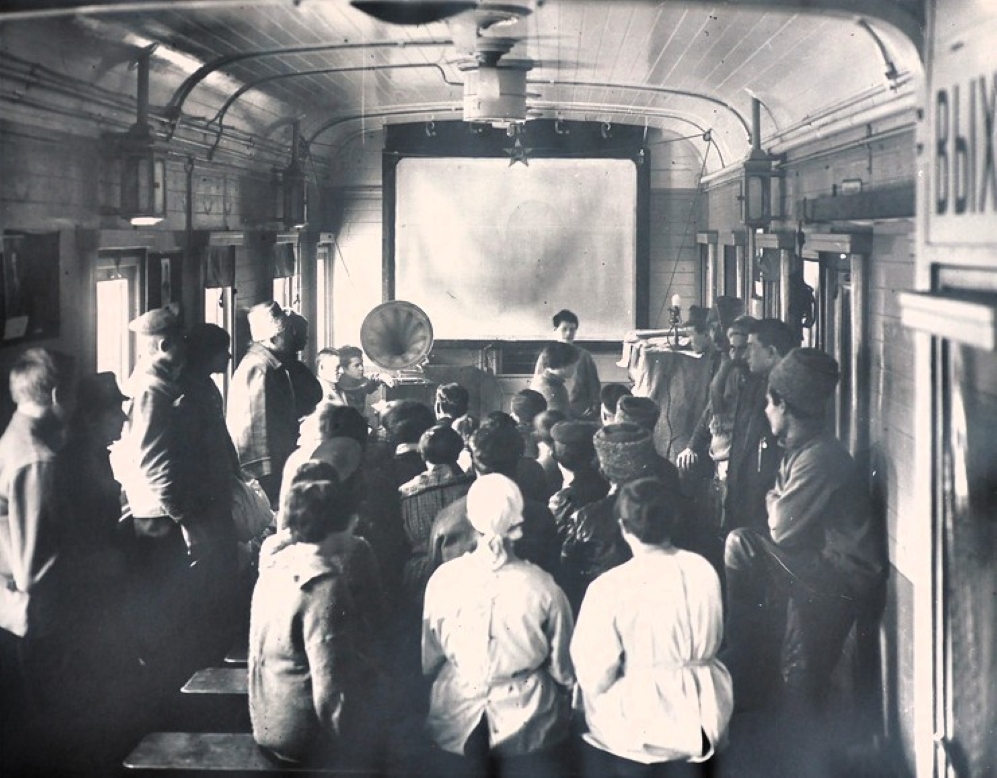
Edwin Hoernle of the Comintern’s Education Commission looks at the problems and potential that film plays in the class struggle.
‘The Proletarian Film’ by Edwin Hoernle from International Press Correspondence. Vol. 3 No. 36. May 9, 1923.
The cinema is a child of modern technics. Within a very brief period it has won a leading place among the ideological weapons of the bourgeoisie. The film possesses the suggestive power of the theatre, without requiring its costly apparatus. It has an advantage over the theatre, in being capable of unlimited and comparatively cheap multiplication. It is thus not without reason that the cinema has been named the “poor man’s theatre”. And above all the cinema possesses, in common with the church and the theatre, the quality enabling it to gather the masses together, and to exercise mass suggestion.
The revolutionary proletariat has long since recognized the dangers of the film as dominated by the bourgeoisie. We are perfectly agreed, theoretically, that it does not suffice to merely criticize the bourgeois film, and to combat its most provoking forms; it is imperative that the reactionary bourgeois film be opposed by the revolutionary proletarian film. The suggestive power of the film must serve the purposes of revolutionary propaganda, precisely as it has hitherto served the purposes of reactionary propaganda. Why has the revolutionary proletariat, even in Soviet Russia, the land of proletarian dictatorship, done so very little towards obtaining control of this means of mental domination over the millions?
Until the fighting proletariat has won complete power, it can only obtain control of the film in exceptional cases. The technical manufacture of the film requires large capital. The film industry is at the present time in the hands of a small number of powerful and well organized capitalist companies. Even before conquering complete power, the class conscious proletariat may save its pence here and there and call into existence this or that film of a proletarian tendency, but it cannot hope to compete with the bourgeois film, neither in extent nor in technical devices, nor in the dramatic form of representing its world of ideas, its actions, sufferings, and struggles. The dramatic film is the core of every cinematagraph performance, and is the sole film capable of attracting the masses to the cinema day by day; it is solely the dramatic film which renders the cinema a paying concern, both as regards finance and propaganda–and it is the dramatic film which remains the exclusive weapon of the ruling class until the proletariat seizes power.
If we now, in the country of proletarian dictatorship, are calling into existence a proletarian cinematagraph undertaking, for the purpose of creating, for the first time, the “proletarian film” on a broad basis, then this signifies that we intend to utilize the economic force of the victorious proletariat for creating a film surpassing all first attempts and beginnings, and actually capable of competing with, or even surpassing, the bourgeois film. We shall consciously employ the film as a means of mass propaganda of mass propaganda. We must therefore not content ourselves with the line hitherto pursued, the filming of demonstrations, congresses, Red Army parades, sport performances, etc., or with more or less successful representations out of the lives of revolutionary workers, of their Soviets, their factories, their children’s homes, we must systematically carry our efforts into every sphere of film art, must enter into competition with bourgeois film undertakings, and substitute the reactionary film drama by the revolutionary dramatic film.
With the proletarian film drama as a central piece, other films of a more real character can be grouped around it, as is already done in the case of the bourgeois film. Films informing the spectators on the economic, social, scientific, political, or military events occurring throughout the world. Our revolutionary informatory films will differ from the bourgeois informatory films, in openly refusing to wear the mask of party political or world philosophical neutrality, and in representing all events from the standpoint of the revolutionary proletariat. Ultimately, we may accompany the presentation of our informatory films by short explanations from a communist propagandist.

For purposes of educational work in a narrower sense, we shall create the proletarian instructive film. The bourgeoisie utilizes the instructive film to a wide extent at the present time. Even in the elementary schools, for which the worst is generally good enough, the instructive film has been introduced, for its suggestive power has been recognized.
We revolutionary proletarians shall devote special attention to the economic film. The economic instructive films made by bourgeois companies, for bourgeois schools and instructive institutions, are useless for our purposes. All they show is the externals of up-to-date technics and of up-to-date giant undertakings; they say nothing of the real working process, of the inner organization of the factory, of the class struggle going on between workers and employers in every capitalist undertaking. For us, the economic film will be a means of making the spectators at once familiar with the actual working process, and with the organization of the work, the constant struggle between capital and labor.
We must not forget the comic film! The comic is an important medium of suggestive influence. The masses want to laugh. Laughter is equally valuable as a means of releasing tension as weeping It is true that during the period of acutest class war, of civil war, and of extremest tension, our laughter will be laughter of a very special character, a bitter-sweet laugh, a fighting laugh. It will not be humor which is contained in our films–humor is a specifically petty-bourgeois phenomenon–but satire, ridicule, irony, and the merriment of the conscious victor. The worker must learn to laugh at his enemies, at the short-sightedness and narrow-mindedness of his exploiters, at his own mistakes. The working masses of today are lacking the confident consciousness of victory. And this is possessed in the highest degree by the ruling class. But the working class must prepare to become a ruling class. The proletarian film must bring laughter onto the side of the revolutionists, must use laughter systematically as a revolutionizing medium. We shall also apply to the film the art of revolutionary caricature, which we have hitherto only employed for posters and newspapers.
In conclusion, a few remarks on the relations between are and the proletarian cinema. So far, we have intentionally omitted to mention the word “art” in connection with “cinema”. At the present juncture, it is of secondary importance to discuss whether it is really possible for the cinematagraph to be art. For the proletarian film this is not the question of the moment; the proletarian film is to be suggestive in effect, true to life, striking. It is to be filled with the warm breath of proletarian revolution, it is to manifest the great ideas and aims of revolution by such means as the cinema has at its disposal. And if it fulfils this object–then it is art. If it remains lame, if it possesses no go and vital energy, then it is not art, not even if our leading writers, directors, and actors take part in its production.
The proletarian cinema requires the zealous and positive co-operation of all revolutionary workers. They must not only visit and criticize the performances, but must co-operate in collecting the material and in drafting the librettos. Only then can the proletarian cinema be really proletarian, not only for but of the proletariat. The revolutionary proletariat must create its own cinema as it has created its own press as it is now creating its theatres, its schools and universities, in a word, its new culture, and it must do this out of the needs of the struggle and the revolutionary propaganda, out of its own powers.
International Press Correspondence, widely known as”Inprecorr” was published by the Executive Committee of the Communist International (ECCI) regularly in German and English, occasionally in many other languages, beginning in 1921 and lasting in English until 1938. Inprecorr’s role was to supply translated articles to the English-speaking press of the International from the Comintern’s different sections, as well as news and statements from the ECCI. Many ‘Daily Worker’ and ‘Communist’ articles originated in Inprecorr, and it also published articles by American comrades for use in other countries. It was published at least weekly, and often thrice weekly.
PDF of full issue: https://www.marxists.org/history/international/comintern/inprecor/1923/v03n36[18]-may-09-Inprecor-loc.pdf#page=9
 Revolution's Newsstand