
The First World War was fought, in part, over the ‘Balkan Question.’ The end of that war did not solve the question. Each new state was a cauldron of unresolved class and national conflicts leading to cross-border and civil wars. Below is an admirably thorough survey of the situation at the beginning of 1925 from the Communist International.
‘Events in the Balkans and Prospects of a Workers’ and Peasants’ Revolution’ from Communist International. Vol. 2 No. 10. March, 1925.
THE Balkan “volcano” is smoking again. Recent events in Albania have recalled the role which the Balkans have played for centuries in the conflicts of European States, and especially the role they played in the recent world war which was caused by events which took place on the territory of the Balkan Peninsular; first of all, the Balkan War in 1912 and 1913, and then the events in Sarajevo in Bosnia in 1914. The Balkans are again destined to be the theatre of historical events, if not immediately, then in the near future.
Albanian Events.
We will deal with Albanian events first. Albania is the most Western country of the Balkan Peninsula, and geographically and economically occupies a very important position; geographically because it occupies a large section of the East coast of the Adriatic; economically because in addition to its agricultural wealth, Albania has oil deposits in the South. Racially the Albanian tribe (Shkipetars) is one of the most ancient races of the Balkan Peninsula. By their religion the Albanians are divided into three unequal groups; Catholics, Orthodox and Mahomedans. The latter formed the overwhelming majority of the population. According to its economic relations, Albania is one of the most backward agrarian-feudal countries of the world. Its agrarian feudalism has an admixture of the clan system which still holds sway in Albania and by which the Albanian population is divided into a large number of clans held together by the system of mutual responsibility and the blood oath—”Bessa” which converts Albania into a second Corsica. Hence the strength and the vitality of the Albanian agrarian feudalism which enables it to hold the Albanian peasantry in subjection.
Economic exploitation is not the only weapon of feudalism, it also exploits the clan ideology of the peasants. Under the Sultans who were very well disposed towards the Albanian beys, Albania was one of the bulwarks of the Turkish autocracy. The Sultan’s bodyguard was recruited from the Albanians, although beys occupied important political and especially military posts in the Turkish administration.
But the struggle against the Turkish bureaucratic-military feudalism, the struggle of the peasants and of the bourgeoisie, which was gradually coming into being through the development of trade and industry, a struggle which began in Serbia, Greece and subsequently in Bulgaria, after the “Great French Revolution,” and continued throughout the 19th century, awakened also the Albanian people to national consciousness. This found encouragement from the powerful neighbours of Albania–Italy, and chiefly Austro-Hungary which, like Russia, were intent on making use of the struggle of the Balkan peoples for national liberation from Turkish political and economic domination for the extension of their own economic and political control over these countries, as well as for the extension of their territories at their expense. After the Young Turk Revolution in 1908, the Austro-Hungarian Government began the intensive cultivation of Albania. It did not rely on the progressive, but rather on the reactionary elements, seeing in the triumph of the Young Turks a danger for its own political and social privileges. A further development of the Turkish Revolution could lead to the abolition of feudalism in Albania, to the liberation of the Albanian peasants from their beys, and, with it to the abolition of the administrative arbitrariness of the Albanian beys, practically independent as far as the government of the Sultan was concerned. As a result of the work of the agents of the Austro-Hungarian Government, the Albanians rose against the Young Turks in 1910. The Austro-Hungarian Government, acting upon the recipe applied by the Tsarist Government to the Ballan countries, placed before international diplomacy the question of Albanian autonomy and independence. The Austrian Minister for Foreign Affairs, Baron Ehrenthal came forward with a “reform” plan. All the Albanian State provided for in this plan was the absorption of parts of the territory of West and South Macedonia; the Serbs, Greeks and Bulgarians, who for their part were intent on seizing Macedonia, regarded Ehrenthal’s plan as an attempt to interfere with their rights, and circumvented Austro-Hungarian diplomacy by forming among themselves the first Balkan Alliance. They declared war on the Young Turk Government, taking advantage of the fact that it had not yet recovered from the effects of the war with Italy.
During the first Balkan war, each of the Balkan allies occupied a part of Albania; the Northern part with town of Shkodra was occupied by the Serbs, the central part with the town of Elbason by the Bulgarians, and the Southern part with the town of Valona by the Greeks. At that time the Balkan governments contemplated the partition of Albania. But, the inevitable collapse of the Balkan Alliance, which was pre-destined because of the partition of Macedonia, as well as the intervention of the Great Powers, especially of Austro-Hungary and Italy, who did not want to jeopardize their chances of penetrating Albania, saved the latter from partition. Albania was declared an independent State, with the German Prince von Wied as ruler, who during the world war was compelled to take refuge with his kinsmen in Germany; and who subsequently shared with them the fate of the German Emperor and all the German kings and princes.
After the world war, Albania was declared a Republic, but the Serbs remained in Shkodra, the Greeks occupied large territories in South Albania, while the Italians fortified themselves opposite Valona occupying the isle of Sesano. The seizure of the isle of Sesano was confirmed by one of the many peace treaties, while the Seros and Greeks, were compelled to withdraw from the parts of the Albanian State which they had occupied. Already since the time of the Balkan War a partition of Albanian territory, the so-called Kosovo ground, plus districts of Western Macedonia adjoining Albania populated pre-eminently by Albanians was annexed by the Serbian kingdom. Serbia, making use of its political diplomatic and financial resources, whose power had increased by the addition of provinces of the former Austro-Hungarian Empire, continued its efforts to strengthen its influence in Albania and to prepare the ground for its absorption. For this purpose the Serbs made use of the services of the Albanian feudal lords who were kept by them, such as the notorious Isad Pasha who acted as a Serbian agent, and subsequently Akhmed Zoglu, who was in power and assumed power later, thanks to the support of Yugo-Slavia.
In 1923, important historical events took place in Albania which were bound to bring a great change in the internal as well as external life of the country. The Albanian peasantry, regardless of religious differences, rallied round the rebellious leaders, made an end of the feudal government of Akhmed Zoglu and placed another government in power. In this rising, valuable help was given by the rebellious Kosovo partisan bands under the leadership of Bairan-Zur.
As already stated, Kosovo is a province which forms part of the Yugo-Slavish kingdom, but is mainly populated by Albanians who saw in the existence of an independent Albania a guarantee of their own national and economic liberation from the foreign yoke. Agrarian reform occupied first place in the programme of the new Albanian Nolli government. But during the short period of its existence for reasons among which its own vacillations played a considerable role, this reform was not introduced. The Nolli government had the support of Italy and its orientation was also towards the Soviet Union and the national revolutionary organisations of Macedonia, as well as towards the national liberation movements in Croatia, Slovenia, Bosnia and Herzgovina. Although the new government was a bourgeois-nationalist government with relics of feudal tendencies, its existence brought a revolutionary-progressive element into the Balkans. Its orientation was towards Italy not only because Italy was not as direct a menace as Yugo-Slavia, Albania’s immediate neighbour, but also because Italy with its highly developed industries and trade could contribute to the development of Albanian industries and to the consolidation of the Albanian commercial bourgeoisie. The orientation towards the Soviet Union and the national movements in Macedonia and Yugo-Slavia had its explanation in considerations of a national as well as of a class character, for the internal revolution in Albania itself could only be brought to a conclusion if these factors were victorious in the Balkan Peninsula. Any possible revolutionary events in the Balkans might have given back to Albania the Albanian provinces which had been temporarily given to Serbia and Greece. On the other hand, the consolidation and development of an independent Albanian State became in its turn a bulwark of the national-revolutionary struggle in Macedonia and Kosovo. That is why an independent Albania for the Serbian bourgeoisie was the greatest obstacle to the consolidation of its own power, as well as to territorial expansion at the expense of Albania. Therefore, the feudal lords expelled from Albania headed by Akhmed Zoglu did not only find refuge in Yugo-Slavia, but also active support on the part of the Serbian Government for the establishment of their power over the Albanian peasantry. Akhmed Zoglu’s bands were armed quite openly on Serbian territory. Everyone knew that the Serbian Government was preparing a restoration in Albania. But for this purpose the support of the small Albanian forces who were grouped around Akhmed Zoglu did not suffice, hence the Yugo-Slavian Government, to ensure success, gave its own soldiers and the remnants of the Wrangel forces which had been al-ready re-organised as Serbian frontier forces serving on the Albanian frontier.
All information confirms the fact that the recent “rising” against the Nolli Government was not a rising, but actual war by Yugo-Slavia against Albania. The breach of the front on the Albanian frontier was effected by regular Serbian troops. Penetration into Albanian territory was entrusted to the Wrangel detachments which included a small number of Albanians. According to information received by the foreign press, not less than 50,000 Wrangel soldiers and officers participated in this attack.
This is the only explanation for the fact that the forces of the Albanian Government were totally beaten by Akhmed Zoglu’s detachments in eight days. Akhmed Zoglu’s government cannot remain in power long, as it is not essentially an Albanian Government, but a nominee of Yugo-Slavia. It is to be expected that Albania will again shortly be the theatre of revolutionary events. Of course, much will depend on the attitude of Italy towards the new government. By this we do not, of course, mean the formal declarations which on such occasions make use of the formula of non-intervention in the internal affairs of other states, but the real intentions of the Italian government of which we cannot judge at present because of lack of data. But one thing is certain: the existence of antagonism between Italy and Yugo-Slavia on the Albanian question. This antagonism has threatened already more than once to develop into open conflict, and efforts have also been frequently made by the Serbian and Italian governments to come to some sort of an agreement on the question of Albania. But has such material materialised? During the visit to Rome of the Yugo-Slavian Minister of Foreign Affairs, Ninchich, which took place a few weeks before the recent Albanian events, the Italian and Yugo-Slavian governments declared to the whole world that they have come to an agreement on the question of Albania on the basis of the formula of non-intervention in the internal affairs of Albania. But such an empty formula could not deceive anyone. The bourgeois press expressed the assumption that this formula was a screen for another and more substantial agreement concerning the partition of Albanian territory between Italy and Yugo-Slavia.
When events were developing in Albania, it was generally expected that together with the advance of the military forces of the Yugo-Slavian government, disguised as Albanian partisans, Italy would lend a force in South Albania. Has Serbian diplomacy succeeded in cheating Italian diplomacy in the question of Albania, as was stated in the Italian press, or has the right moment for the application of the agreement, provided such an agreement exists, not yet come, and must be synchronised with future inevitable events in Albania—at the present juncture it is extremely difficult to find an answer to these questions. In any case, the situation in Albania is becoming again revolutionary. If the Yugo-Slavian government has succeeded in deceiving the Italian government, another rising in Albania may be expected in the very near future with the support of Italy, or the Italian and Serbian governments will in the very near future partition Albania and then the Albanian people will be forced to fight on two fronts.
Agrarian and Political Relations in the Balkans.
The workers’ and peasants’ rising in Bulgaria, the peasant risings in South Bessarabia, and the Albanian events, show that a political and social conflict is brewing in the Balkans which can become the point of departure for a powerful workers’ and peasants’ movement, capable of drawing into its orbit not only the Balkan countries proper, but also the provinces situated to the North of the Danube from the Carpathians to the Aegean Sea, considered geographically to be outside the Balkans. This struggle for liberation is similar to the struggle of the Russian workers and peasants, but it is not only directed against capitalism, but even to a still greater extent against the existing agrarian conditions which are complicated by all sorts of administrative measures, as for instance, artificial colonisation and settlement of the peasants of the ruling nationalities among the peasants of the subject peoples to the detriment of the latter. Many people expected, among them Lenin, as shown by his article in the Berne “Social-Democrat” that the Balkan war of 1912 would liquidate the relics of the feudal-bureaucratic regime which existed in the old Turkish Empire, and would provide opportunities for bourgeois-capitalist development in the Balkans. But in reality the Balkan bourgeoisie proved incapable of accomplishing this process not only after the Balkan Wars, but even after the world war. Thus, the solution of this question in the Balkans has been left to the workers’ and peasants’ revolution.
Even the efforts which were made on the part of the Balkan bourgeois governments in the direction of creating favourable conditions for the development of the Balkan bourgeoisie, have only made the class relations between the peasantry and the bourgeois power more complicated and more acute. This applies only to some of the Balkan States, while no attempts were made in the remaining States to bring about these reforms. No agrarian reform worth mentioning has been introduced in Yugo-Slavia, Macedonia and Bosnia, which under Austro-Hungarian rule retained the old feudal agrarian conditions. More was done in this direction in Rumania. Already after the peasant rising in 1907, the Rumanian bourgeoisie was confronted with the question of agrarian reform. But until the Russian revolution, the Rumanian government was content with palliative measures which amounted to giving to the peasantry a small part of the land of the big landowners who in Rumania own more than half of the arable land. It was only after the February, and still more after the October Revolution in Russia, that under the threat of another peasant rising in Rumania, all the more dangerous as the conduct of the war was absorbing the attention and the resources of the Rumanian government, that the latter turned its attention to agrarian reform. But as the revolutionary peril diminished in Rumania agrarian reform become more restricted. Under the pretext of preserving “intensive culture,” estates where rational methods of agriculture are applied, the landowners of Rumania and Bessarabia retained enormous areas of land. On the other hand, the land which the reform act assigned to the peasantry got mostly into the hands not of bona fide peasant population, but of the new village bourgeoisie consisting of petty officials, merchants, teachers, priests, former officers and non-commissioned officers. Agrarian reform was applied in such a distorted form that even the Rumanian Peasant Party, the so-called Tsaranists, which is the most moderate of all moderate peasants parties, was induced to introduce into its programme a paragraph concerning another agrarian reform.
The Bulgarian government of Stambolinsky went much further on the way of agrarian reform. Even before the reform introduced by Stambolinsky, big landownership was practically non-existent, with the exception of some districts in North and East Bulgaria, and in the vicinity of the Black Sea in South Bulgaria. The Stambolinsky government liquidated also the remaining big estates and fix a maximum of 40 dessiatins for the landowners. But after the overthrow of the Stambolinsky government, the new Zankoff government began the liquidation of agrarian reform.
Agrarian conditions became very acute in the Balkan countries, due to the policy adopted towards the peasantry by the Balen States in the territories of the more important national minorities. This policy, which was a policy of colonisation, assumed truly monstrous proportions. Not only tens and hundreds of thousands, but millions of peasants were removed from localities where they could have obtained land from their own landowners, where they had lived for centuries, where the methods of labour were familiar to them, and with which they were connected by the memories of the past. They were transferred to other districts populated by national minorities. This policy was systematically pursued by the Rumanian government more than by any other Balkan government. It transferred Rumanian peasants from Transylvania, Wallachia and Moldavia to the other bank of the Pruth or the Danube, to Bessarabia or the Dobrudja. Thus, the land which had been confiscated from the landowners of these provinces did not tend to increase the inadequate plots of land of the local peasants or to give land to landless peasants, but was utilised to accommodate Rumanian emigrants. In the so-called Bulgarian quadrangle, or the New Dobrudja which the Rumanians took away from Bulgaria in 1913, the Rumanian government, which excels in reactionary ingenuity found means and methods to confiscate the land of all landowners including the peasants to increase the available land destined for Rumanian emigrants. This confiscation was carried out on the assumption that the Bulgarian civil code did not recognise the absolute right of land ownership, but only the absolute right to hold land. The Rumanian parliament promulgated a special law on the strength of which all landowners in the New Dobrudja had to cede to the government one-third of their land in order to become the absolute owners of their remaining two-thirds of land.
This unheard of act of robbery, the chief victims of which are the peasants, is being, of course, resented, and the consequence is that the peasants of the Dobrudja have been fighting desperately against it for the past seven years. Although the so-called quadrangle represents only a territory of from six to eight thousand square versts, and although the Bulgarian administration and military authorities support the Rumanian authorities in every possible way, the Rumanian administration has not yet been able to cope there with the so-called “banditry.” Rumanian newspapers are full of descriptions of acts of “banditry” in the quadrangle. Sometimes these acts take the form, as for instance, in the neighbourhood of the town of Silistria, of the guerilla bands seizing a motor-car occupied by the land commission. They burnt the archive of the commission, stripped the members of the commission naked, and sent them like this back to Silistria. There were also cases when the guerilla bands killed particularly obnoxious officials, gendarmes and officers. There was also a third case when the local population and not the guerilla bands compelled the Rumanian immigrants in the Dobrudja to renounce their newly-acquired land and to return to Rumania. There was, for instance, one case when Rumanian shepherds sent from Transylvania with their flocks of sheep to the Dobrudja were systematically boycotted by the population who compelled them to return with their flocks to Transylvania. When they reached the town of Cernomodi, where a bridge connects the Dobrudja with old Rumania, the Rumanian authorities refused them entrance, and they remained there for over a fortnight, when they were at last permitted to return to their own homes. The Rumanian law courts chronicle is replete with law suits caused by the existing agrarian conditions. The Yugo-Slavian government pursues in Macedonia, ceded to Serbia already after the Balkan wars, a policy similar to that of the Rumanian government in the Dobrudja. This policy meets here with the same resistance from Macedonian peasants as the Rumanian policy on the part of the peasants of the Dobrudja. Last year, in the vicinity of the town of Shpita, in East Macedonia, the guerilla bands cut 25 people to pieces. In South Macedonia, which was ceded to the Greeks, immigration and emigration assumed enormous proportions. As a result of the Turco-Greek war about a million Greek peasants had to emigrate from Asia Minor. The Greek government settled them in South Macedonia and Thrace, evicting for this purpose the Bulgarian and Turkish peasantry. Such an arbitrary disposal of human lives and interests as is now taking place throughout the Balkan Peninsula was hardly known even in the historic epoch of the migration of peoples, when nomadic tribes in their search for pasture land carried on a sanguinary struggle for existence.
Bureaucratic and Financial Oppression.
Another factor connected with the discontent of the peasantry in the Balkan countries is bureaucratic and financial oppression. Proportionately the bureaucratic class has very considerable weight. In capitalist countries of West Europe, civil bureaucracy developed together with the development of capitalist production, while in the Balkan countries it took precedence of the latter. State revenue was one of the means of capitalist accumulation. Local capitalism came into being chiefly with the assistance of state subsidies or extreme protectionism which raised excessively prices for foreign manufactured articles greatly needed by the peasantry. Taxation in the Balkan States was always out of proportion with the resources of the population, but the state of affairs grew even worse during and after the war. The bourgeoisie did its utmost to place the burden of the recent war on the shoulders of the peasantry. In addition to the numerous direct and indirect legal taxes which the peasantry has to pay for the upkeep of a military-bureaucratic apparatus far beyond the resources of the country, the system of collecting illegal taxes flourishes in the Balkans more than anywhere else. Every official has, in addition to the taxes provided for in the estimates, additional taxes which he pockets by robbing the peasantry. The numerous military divisions stationed in the subjected provinces—the Dobrudja, Bessarabia and Macedonia live chiefly at the expense of the population from which they requisition and confiscate anything they want. The central authority does not only wink at this procedure, but even gives them encouragement which obviates the necessity to increase state expenditure.
National-political Relations.
The truth that the national question is a peasant question receives confirmation also in the Balkans. The struggle for national liberation is a peasants’ struggle against landowners and the military and civil bureaucracy, as well as a struggle against the exploitation of labour and excessive taxation. The solution of the national question always encountered great difficulties in the Balkans because of the mosacial ethnographic condition of the Balkan States. Dozens of nationalities belonging to various creeds live on this comparatively small territory. After the war conditions became more mosaic than before. The Balkan States which had taken part in the war on the side of the Entente, annexed new territories twice or three times as large as their own. Rumania, which previous to the war had a population of barely eight million, has now a population of eighteen million, more than a third of which is non-Rumanian. The Rumanians themselves belong to two creeds—the Orthodox and the Unist. Serbia which annexed Bulgarian Macedonia after the Balkan war of 1912-1913, after the imperial war became the head of a new state with a population two and a half times larger than the population of the old Serbia. Croatia, Slovenia, Bosnia, Dalmatia and Montenegro form part of this State. A typical example of the hypocrisy of international diplomacy is the fact that Montenegro, according to international treaties, exists even now as an independent state, for not a single treaty establishes the incorporation of Montenegro with Serbia. Moreover, Montenegro was one of the allies who participated in the fight against the Central Powers. Serbia also after the war seized another portion of Bulgarian territory with the town of Tsarebrod, as well as part of Macedonia incorporated with Bulgaria, in the Strumnitza Valley.
To continue, Greece in addition to South Macedonia, annexed Thrace where the Greek element of the population was in a minority, the majority being Turks and Bulgarians. Bulgaria itself is interspersed with territories inhabited by considerable Turkish minorities, not to mention the fact that in Bulgaria the so-called Pomaks are Moslems. in Yugo Slavia, Rumania and Greece the national struggle developed immediately after the war and is bound to grow as it goes on. This struggle assumes various forms, illegal as well as legal from the struggle for national schools and a national church down to the struggle for complete separation. The various compromises which may be arrived at between various national parties, can only be of a temporary nature. The landowners’ and bourgeois parties of the ruling nations as well as of the national minorities may, of course, enter into all sorts of compromise agreements. But the only possible result of this will be to transfer the national struggle more and more to the national peasant parties and ultimately to the Communist Party—the only Party which does not betray the national interests of the masses.
During the entire post-war period we have had a series of risings in the group of States with which we deal in this article from North to South: a rising in North Bessarabia in 1919, guerilla warfare in the Dobrudja in Macedonia and in the Kosovo Plain. Then there was the recent rising in South Bessarabia and guerilla warfare in South Macedonia. At the same time the most important parties of the national minorities are active in Transylvania, Croatia, Bosnia, Slovenia and Dalmatia. The only State where the question of national minorities is not yet acute, is Bulgaria, and only because Bulgaria itself was partitioned. But in Bulgaria, too, there is a considerable national minority—the Turks, and it is only because of their general cultural and political backwardness that they have not yet brought forward their national demands. The national question is the second mine threatening to explode the bourgeois States in the Balkans.
The Danube-Balkan Federation.
Already in the ’60’s and ’70’s of the last century, the radical elements of the bourgeois-nationalist parties in all Balkan countries, especially in Serbia, Rumania and Greece, as well as in Bulgaria, at that time Turkish provinces, made the establishment of a Balkan Federation their fighting slogan. It seemed as though such a federation of the Balkan States could not only become the best means of counteracting the annexationist policy of Russia and Austro-Hungary, but would also make it possible to solve the national question in the Balkans, provided strict equality were observed among the various nationalities. Moreover, at that time such an amalgamation of all the diplomatic forces in the Balkans seemed to be the only means to resist Turkish domination, as not one of the Balkan States was strong enough to fight by itself against Turkey. This national-revolutionary movement of the ’60’s and ’70’s of the last century was on the one hand connected with the Italian national movement, and on the other, with the Russian revolutionary movement. The Balkan Federation satisfied also the needs of capitalist development in the Balkan States, in as far as they can be regarded as one territorial whole, for the productive forces of the Balkans could only develop within the limits of such a comparatively large State unit, which could place at their disposal all the resources of the various Balkan countries. Turkish domination was overthrown with the help of Russia, and as to the preservation of their independence, the Balkan governments used for this purpose the antagonism between Austro-Hungary and Russia, entering into the sphere of influence of one or other of these States and coming to agreements or even formal treaties with them. Thus the incipient national capitalism of the Balkan States was kept within narrow national limits which proved irksome to it and which it endeavoured to extend at the expense of its neighbours. The whole history of Balkan capitalism in the period succeeding the Russo-Turkish war of 1877-78 is a fierce struggle for the seizure of the remnants of Turkish territories in European Macedonia and Thrace. In this struggle there were two military episodes: the war between Bulgaria and Serbia in 1885, and the war between Bulgaria on the one side and Serbia, Greece and Rumania on the other side in 1913. The latter broke out after a short-lived, and as subsequent events showed, a very unstable federation of all the Balkan States against Turkey.
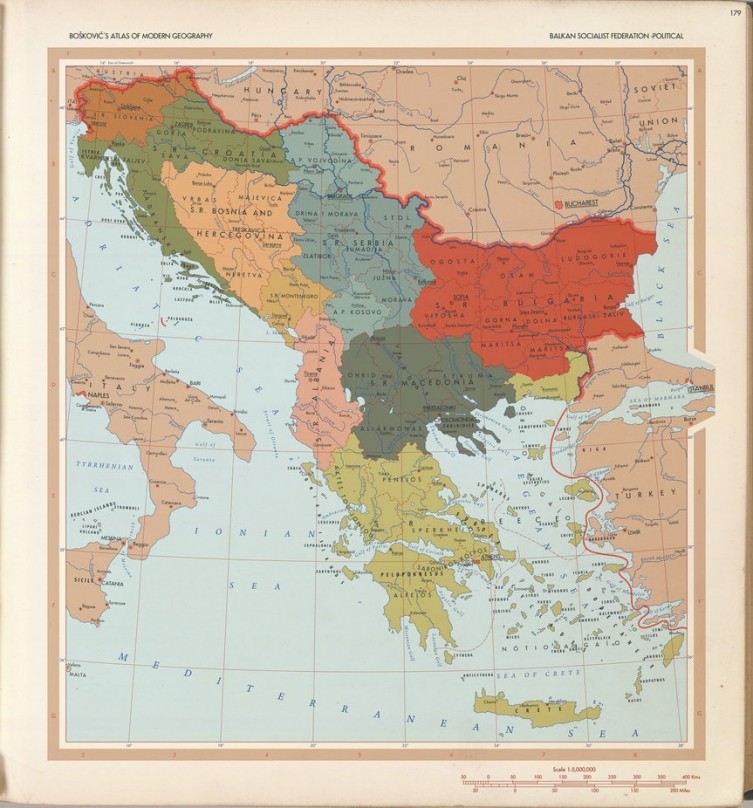
The history of the diplomacy of the Balkan States during that period is a history of continuous Balkan civil war. Even if any political grouping took place between the Balkan States, this grouping was of a purely negative character, namely it aimed at diverting some direct outside peril, and not by any means at removing the irreconcilable contradictions within their national-capitalist development. After the temporary grouping in 1912-13, which soon broke up, the Balkan States formed a new diplomatic group as a result of the world war. The alliance of mutual support between Greece, Rumania and Serbia against Bulgaria which existed before the war, was revived in a new form as the group of the so-called Little Entente, consisting of Serbia—the present Yugo-Slavia, Rumania and Czecho-Slovakia. On the one hand this alliance was directed against Hungary, as far as the whole group of three is concerned, and on the other hand against Bulgaria on the part of Rumania and Serbia. The treaty signed by Greece and Serbia in 1913, which was also directed against Bulgaria, continued in existence. But parallel with these groupings each of the Balkan States carried on its own policy which brought them frequently into serious conflicts. There is an insurmountable antagonism between the so-called allies—Rumania and Yugo-Slavia and between Yugo-Slavia and Greece. Yugo-Slavia seeks an outlet to the Aegean Sea. The Southern frontier of Yugo-Slavia is only 60 versts from Saloniki—the most important port in the Balkan Peninsula, in the possession of Greece. The question of Saloniki occupies first place in the diplomatic relations between Greece and Yugo-Slavia.
Already in 1913, Greece refused to grant certain privileges to Serbia in Saloniki. On its part the Serbian government endeavoured to receive and extend its privileges in Saloniki until such a time when it would be able to seize Saloniki and its hinterland, namely, South Macedonia. A very important episode in this struggle between Greece and Yugo-Slavia is the recent revocation of the treaty of alliance between these two States which was made in 1913. The actual reason for the revocation of this treaty was the so-called Geneva Protocol signed between Greece and Bulgaria. Last summer, during the League of Nations Session in Geneva, the representatives of Bulgaria and Greece signed an undertaking on the strength of which they gave each other some mutual guarantees concerning the Greek minority resident in Bulgarian territories, and also concerning the Bulgarian minority resident in the South of Greek Macedonia. The fact alone that Macedonian Slavs, living on Greek territory, were recognised as of Bulgarian nationality, was looked upon by Serbia, which has always asserted that Macedonian Slavs are Serbs, as an infringement of its rights even within the limits of Serbian Macedonia.
There is a great deal of interest between Rumania and Serbia with relation to Bulgaria. Rumanians are afraid of a possible inclusion of Bulgaria into the federated Yugo-Slavian State. Certainly if the federalist principle will be vindicated in the national struggle conducted now against the Serbian oligarchy by the Croatian people, a situation will be created favouring the inclusion of Bulgaria in this Federation. It is a well-known fact that Stambolisky pursued a policy of rapprochement with Serbia, to the extent of the inclusion of Bulgaria in the Yugo-Slavian State. If this policy were victorious and if on the other hand Yugo-Slavia became a federative State, there would arise in the Balkan Peninsula a powerful Federation of States whose territory would stretch along the whole Balkan Peninsula from the Danube to the Aegean Sea and the Adriatic. The existence of such a Federation would be on the one hand a great obstacle to the extension of Italian domination in the Balkans, and on the other hand to the retention by Rumania of the old and new Dobrudja, annexed at the expense of Bulgaria.
The military plot as a result of which Stambolisky was killed and the fascist Zankoff government became established in Bulgaria, had no doubt the direct support of the Rumanian and Italian governments. Nowhere was the fall of Stambolisky greeted with such joy as in Rumania, and not only because his death put an end to the peasant government in the immediate vicinity of Rumania which was setting the example to analogous aspirations among the Rumanian peasants, but also because the possibility of creating a powerful and durable Slav State in the Balkans would be postponed for a long time. It is this which has made the polemics between the Rumanian and Belgrade press so acute. The Belgrade press virulently attacked its former and present allies—the Rumanians, having recourse in its articles to all the abusive epithets the Balkan dictionary can provide, calling the Rumanian rulers parasites of the Balkans, Tzigans (Gypsies) and marauders. These differences between the Rumanian, Greek and Yugo-Slavian bourgeoisie are so intense and time-honoured that soon or later they are bound to lead to an armed conflict between them. The fight will be waged for the Bulgarian heritage, and also because of South Macedonia. After Albania, Bulgaria, which has been left without an army and economically exhausted and diplomatically isolated, is the tempting bait as far as the development of Serbian imperialism is concerned. The eyes of the Serbian bourgeoisie are directed to the Permin coal mines only 60 versts distant from the Serbian frontier and the richest coal mines in the whole Balkan Peninsula.
At the last Session of the League of Nations in Rome, the Serbian government succeeded in achieving a considerable diplomatic victory owing to French and partly Italian support. In order to set itself free with respect to its Western neighbour—France, Italy came to a much desired agreement with the Serbs with respect to Fiume. Serbia was entrusted with the control over the disarmament of Bulgaria, and thereby was given the first mortgage on Bulgaria.
It is on these lines that the following policy of the Balkan States developed. They have long ago relegated to the past the slogan of the Balkan Federation. However, this slogan is not extinct. Previous to the war it was the slogan of Balkan Social-Democracy, which, however, brought it forward in a somewhat different form, namely, as the Republican Democratic Federation. The pre-requisites of such a federation would be a workers’ and peasants’ victory.
After the October Revolution which placed before the working class of all countries, as its nearest prospect, the task of establishing a Soviet social order, the section of Bulgarian Social-Democracy which has joined the Third International altered its formula and gave it its present complete form establishment of a Balkan-Danube Soviet Socialist Federation.
Already before entering the war in 1914, a congress took place in Bucharest in which only the Left Social-Democratic Balkan Parties took part and from which the Bulgarian opportunists known as the broad Social-Democrats were excluded. At this Congress the Rumanian and Serbian Social-Democratic parties gave up their former intention of collaborating with the Bulgarian opportunists.
The Anti-Soviet Bloc.
Everyone knows what a cry was raised during the last few weeks in the bourgeois press on the occasion of the establishment of an anti-Soviet Balkan Bloc between Bulgaria, Yugo-Slavia and Rumania with the close co-operation of Great Britain and France. Greece was to be subsequently added to this Bloc. All this hue and cry is but a storm in a teacup. Of course, no one doubts the anti-Soviet and anti-proletarian aspirations of the Balkan governments. In no other countries is there such an exceptional regime against Communist tendencies as in the Balkan countries. Nowhere are political conditions for direct Communist activities as propitious as in the above-mentioned three Balkan countries. But there is also nowhere such mutual organic and cynical hatred as exists in these three Balkan countries. This hat red was instilled by the Balkan governments into the masses during many decades by systematically inciting one nationality against another. Hence all diplomatic combinations between governments can only be of a temporary character. A Federation of the Balkan peoples for the purpose of any durable and harmonious collaboration can only be achieved by the victory of the masses under the leadership of the Communist Party.
What happened in Belgrade and Bucharest at the time of Zankoff’s recent visit to these cities, is more or less known. Zankoff sought support from his neighbours against the deep discontent which exists not only among the workers and peasants, but also among the Bulgarian petty-bourgeoisie with the fascist government in Bulgaria. The interviews which took place during this visit showed that State opportunism and the principle—that’s no business of mine, have triumphed in Rumania and Yugo-Slavia. All were agreed, there is no doubt about that, in their unlimited hatred of Communism. But when the question arose what methods should be adopted in the fight against Communism, the clash of interest which exists among them came to the surface. Long ago, and especially during the recent Session of the League of Nations at Geneva, the Bulgarian government endeavoured, under the pretext of keeping down Communism, to yet permission to have a permanent regular army and to be freed from the restrictions imposed on it by the Neuilly Treaty which disarmed the defeated Bulgaria leaving it with an armed force of 30,000 men, including the gendarmerie. This new Bulgarian army, which is an army of mercenaries and, therefore, expensive, was to be a professional army with a twelve years’ service as a minimum. The purpose was to prevent the Bulgarian government from giving a military training to large contingents of the Bulgarian population.
As it is evident from newspaper and other information in these interviews in Belgrade, and Bucharest the Bulgarian Premier sought the support of his neighbours for the purpose of changing that part of the Neuilly Treaty which deals with the armed forces of Bulgaria. And the Rumanian and Serbian governments preferred Bulgaria to use in its fight with Communists any other means but the creation of a regular army whose bayonets might be turned to-morrow against Yugo-Slavia and Rumania which possess large portions of Bulgarian territory. For its part the Rumanian government proposed as a means of effective opposition to Bolshevism to conclude a military alliance with Yugo-Slavia against Soviet Russia. For Rumania the real Communist peril is in the first instance the peasant movement in Bessarabia which has the moral support of the Soviet Union which has not relinquished its right to take an interest in the fate of the Bessarabian workers and peasants. The Yugo-Slavian government has to reckon with the hostile attitude of the Serbian peasantry towards Rumania, as well as with its profound sympathy with the Russian masses. Finally, the real peril to the Yugo-Slavian government is for the present the guerilla movement in Macedonia and the Macedonian committee which supports it. This committee has its seat in Sofia, and is the ally of the Bulgarian fascist government in the internal policy of Bulgaria. Although the Zankoff government has done its utmost to destroy this ally without whose help it could not have assumed power, it is nevertheless afraid to renounce openly all solidarity with the Macedonian Bulgarians, for this would be tantamount to antagonising the half-million Macedonian immigrants in Bulgaria.
These reasons frustrated the attempt to establish an anti-Soviet Bloc to the great chagrin of international imperialist diplomacy, and especially of British and French diplomacy.
Conclusion.
The agrarian-feudal, as well as the class and national conditions prevailing in the Balkan Peninsula already before the war, were extremely favorable to the development of the revolutionary movement. This explains the great importance and influence which the Communist Parties obtained in the internal life of the Balkan countries in spite of the fact that capitalist development there was weak and the industrial proletariat very small. The Balkan war, and subsequently the world war with the territorial changes which followed it and the increased oppression on the part of the civil and military bureaucracy together with the crisis in all the branches of the economic life, made the class and national struggle in the Balkans very acute. The workers and peasants rising in Bulgaria in the autumn of 1923, the revolutionary episodes of the struggle of the Communist Party in Yugo-Slavia and Rumania together with the revision of their tactics have shown that the only leading revolutionary force is Communism. But at the same time all these events opened the eves of the Balkan Communist Parties to their own errors and shortcomings. Their chief error was that they did not take into consideration that if even the most developed capitalist countries have to reckon with all revolutionary social elements and their proper utilisation if they want to be victorious, this is all the more necessary in the Balkan countries where the industrial proletariat is but small and where Communist Parties are obliged to depend in their decisive struggles mainly on the reserve forces of the peasantry and the oppressed nations.
The ECCI published the magazine ‘Communist International’ edited by Zinoviev and Karl Radek from 1919 until 1926 irregularly in German, French, Russian, and English. Unlike, Inprecorr, CI contained long-form articles by the leading figures of the International as well as proceedings, statements, and notices of the Comintern. No complete run of Communist International is available in English. Both were largely published outside of Soviet territory, with Communist International printed in London, to facilitate distribution and both were major contributors to the Communist press in the U.S. Communist International and Inprecorr are an invaluable English-language source on the history of the Communist International and its sections.
PDF of full issue: https://www.marxists.org/history/international/comintern/ci/new_series/v02-n10-1925-new-series-CI-riaz-orig.pdf
 Revolution's Newsstand