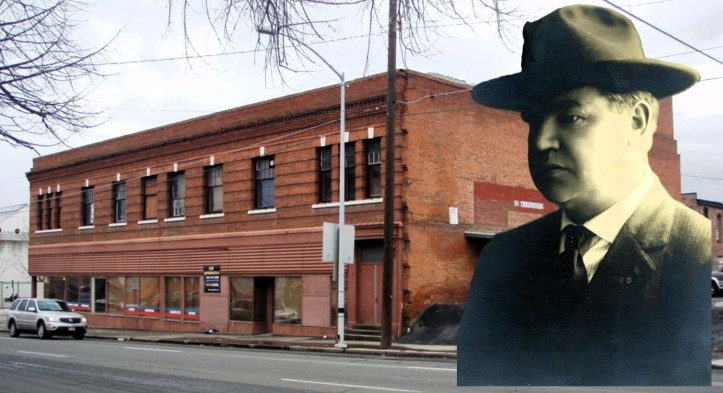
Haywood wrapping up his cross-country I.W.W. agitational tour at Spokane’s Foresters’ Hall would have been a speech to hear.
‘Haywood Speaks in Spokane’ from Industrial Worker. Vol. 4 No. 47. February 13, 1913.
The Big Miner was at his best in the Foresters’ Hall on Sunday, February 9, in Spokane, Wash. The large audience forgot to shuffle Its feet, or cough, or whisper, or do the thousand and one things that mark an uninteresting speech. There was perfect silence among the audience, broken only by spontaneous applause at the most telling points. It would have been impossible to have applauded each separate well-expressed idea. While there is no doubt that Haywood’s personality swayed the audience to some extent, still it was evident that it was his subject that held the audience breathless for considerably more than an hour. He spoke constructively and instructively. While no name was announced as the title of his lecture it can be appropriately called “Building a New Society.”
Despite the bitter criticism heaped upon Haywood by the yellow section of the Socialist Party and the servile section of the A.F. of L. there was no trace of any personal feeling in the talk. It was a masterly criticism of capitalism and its institutions, including reform legislation and craft unionism, and an advocacy of direct action that in no way dodged the question. Haywood gave several definitions of sabotage.
“Sabotage,” said Haywood, “means to render the capitalist system profitless.”
“Sabotage is against profit, interest and dividends, and is used to hammer back, pull out or break off these fangs of Capitalism.”
As an example of how sabotage might best be applied he gave the case of the Alaska Salmon Packers, who ship for the season at $140 and are not accompanied by any capitalist where they do their work. These underpaid workers catch, cook and can the salmon. There are three classes: First class, second class and working class. By a simple transfer of the first-class labels to be third class cans and the third-class labels to the first class cans the parasites will be eating the poorest grade of goods, which is even more than they deserve, while the workers will get the best. This may surprise the stomachs of the workers, but surely it will do them no harm.
Haywood pointed out that the dues, assessments, initiations, and contributions to the A.F. of L. in the past ten years had been nearly $480,000,000, and while the money wages had increased in a few instances, the real wages had declined, for a dollar would not purchase as much as formerly. This tremendous sum was paid for the privilege of having a lower wage than ten years ago. Other absurdities of the craft union movement were clearly pointed out and the declaration made that the A.F. of L. is not a labor movement. The fact that its headquarters were moved to Washington, D.C., where there are no industries shows that it is merely a political conglomeration. Also owing to the fact that it was built to protect skilled workers at the expense of the unskilled it was in the curious position of being weaker with each increase of membership.
Haywood also made it plain that the only laws worthwhile were those passed in the economic organization of the workers. Such regulations or laws could at one stroke cover the entire United States, its island possessions, and Canada, were the workers to have a sufficiently well organized and militant minority in each locality. Lawrence, Mass., was cited as a case where the women, the children, the unnaturalized foreigner and those debarred from the ballot by residence and other restrictions, all voted on the “common” on vital propositions that affected their lives, and then proceeded to put their votes into effect through the power of the One Big Union.
But the larger part of Haywood’s talk was not devoted to criticism. The entire trend was toward the setting forth of the idea that the workers are creating their own ethics and institutions, and that within the Industrial union will be found the means of performing every necessary function of society.
One industrial department after another was taken and its relationship to the other industries and to society as a whole thoroughly set forth. The public service industry was shown to contain the germ of the future management of civic affairs, as well as the means of handling questions or sanitation, education, amusement, etc.
The lecture concluded with a simple but forceful plea for more members and additional energy and self-development on the part of those who are already a part of the I.W.W.
The Industrial Union Bulletin, and the Industrial Worker were newspapers published by the Industrial Workers of the World (IWW) from 1907 until 1913. First printed in Joliet, Illinois, IUB incorporated The Voice of Labor, the newspaper of the American Labor Union which had joined the IWW, and another IWW affiliate, International Metal Worker.The Trautmann-DeLeon faction issued its weekly from March 1907. Soon after, De Leon would be expelled and Trautmann would continue IUB until March 1909. It was edited by A. S. Edwards. 1909, production moved to Spokane, Washington and became The Industrial Worker, “the voice of revolutionary industrial unionism.”
PDF of full issue: https://www.marxists.org/history/usa/pubs/industrialworker/iw/v4n47-w203-feb-13-1913-IW.pdf
 Revolution's Newsstand