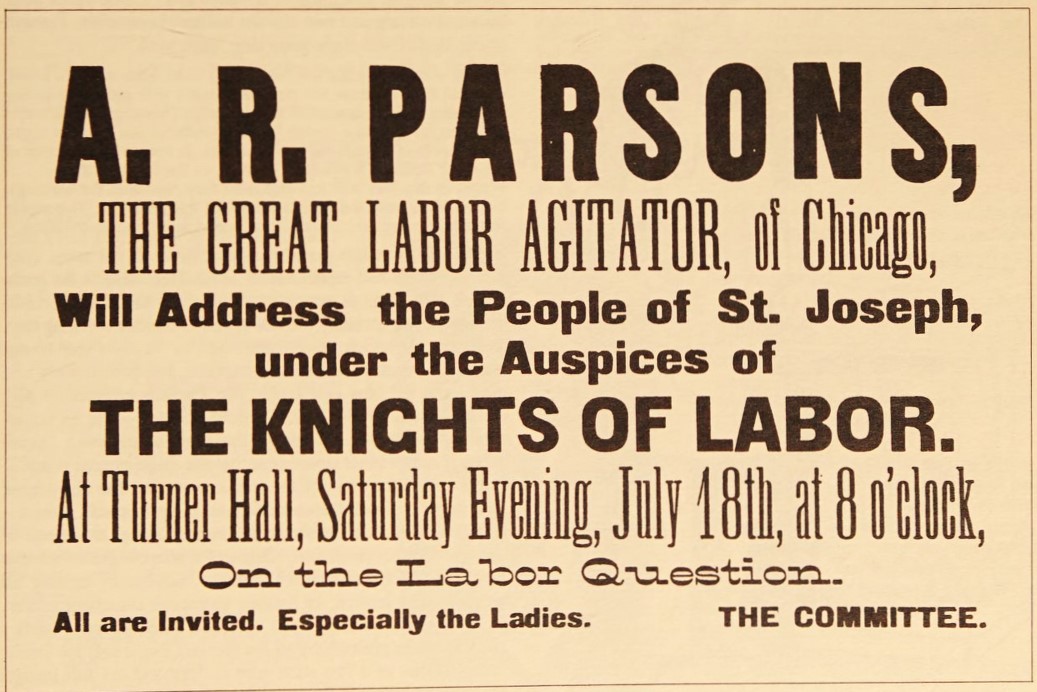
A window into the lost world of the Knights of Labor as Albert Parsons is invited to address a July 4 picnic under their auspices in Ottawa, Kansas.
‘July 4, 1885: Great Demonstration of Kansas Working People’ by Albert Parsons from The Alarm (Chicago). No. 26. July 11, 1885.
Ten Thousand Persons Protest Against the Domination of Capital
PLEDGE THEMSELVES MAKE ALL MEN FREE AND EQUAL
How Kansas Workmen are Treated by Corporations and Capitalists.
The Workers Revolt and Declare for the Social Revolution.
SCENES AND INCIDENTS.
Ottawa, Kas., located 60 miles west of Kansas City, on the Mise de Sine river, is one of the loveliest valleys and amid the richest agricultural region of the west, is a town of some 7,000 inhabitants, where the roundhouse and machine-shops of the Southern Kansas railroad are located, as well as a few embryonic manufacturing establishments. The place is popular as a general resort for gatherings of a public and social character throughout the state, and among the most active and intelligent of its population are the workingmen, the foremost of whom are organized into Franklin Assembly 2557, Knights of Labor.
Under the auspices of these men, it was decided prior to July 4, that the day should be consecrated anew to the cause of human liberty and the freedom of labor. Accordingly preparations were made on an extensive scale, and invitations to labor organizations were issued and sent all over the states of Kansas and Missouri.
The following was the heading of their programme:
“The Day we Celebrate, 1776-1885. Grand Anniversary labor day! In Forest Park, Ottawa, Kansas, on July 4th, under the auspices of Franklin Assembly 2557. Admission Free.”
PROGRAMME.
Morning Salute–Sunrise Gun.
9:00 a.m.–Grand rally in the park. Band, “Rally ’round the flag.”
10:00 a.m.–Reading declaration of independence, by W.L. Parkinson, of Ottawa. Remarks by citizens, local speakers and others. Band, “America.”
11:00 a.m.–Address by Bro. Richard Griffiths, of Chicago, G.W.F., K. of L. Band.
12:00 p.m.–Dinner, Refreshments, lunch, basket picnic, etc. Band, “Auld Lang Syne.”
On the morning of the 4th the sun rose bright and clear, and the day bid fair to be most auspicious, and by noon of that day fully 10,000 persons were assembled in the park.
On approaching the gate which gave entrance to the grove, your reporter observed above it the following motto, painted in large letters on twenty feet of canvas by three feet wide, viz:
“No system of religion, government or society, which builds up one person by despoiling another, is worthy of the support of true Christians, patriots or philanthropists.”
Small red flags were suspended in clusters on either side of the entrance, on which were printed in golden letters the Communist motto, viz: “Liberty, Equality, Fraternity.”. Entering the grove a most inviting scene presented itself. The broad and beautiful shade trees, the soft and inviting green grass, the beautiful river meandering through the booths, tents, and the large tabernacle, where 3,000 persons could be comfortably seated, make up the attractions of Forest Park.
On reaching the platform of the speaker’s stand we found it draped with the American flag, bordered on either side with clusters of the red flag, bearing the motto of “Liberty, Equality, Fraternity.” Suspended above the center of the platform was a large canvass, on which was pasted the following motto: “Labor is prior to and independent of capital. Capital is only the fruit of labor, and never could have existed had not labor first existed. Labor is much the superior and deserves much the higher consideration.” Abraham Lincoln.
On the left was this motto in large letters: “The corruption of the best and most divine forms of government must be the worst.” Aristotle.
On the right of the platform was this motto: “An injury to One is the Concern of All.”
The following mottos were painted on canvass in large letters and suspended in conspicuous places throughout the park:
“Wise men form judgment of the present from the past.” Sophocles.
“I confirm it as my conviction that class laws, placing capital above labor, are more dangerous to the republic at this hour than the chattel slavery system in the days of its haughtiest supremacy.” A. Lincoln.
“Justice has no recourse to brute compulsion and armed mobs to enforce its decrees. But wrong cannot long obtain by any other means.”
A large, conspicuous banner, 20 feet long and three feet wide, of blood-red hue, had painted on in large gold letters, “Liberty, Fraternity, Equality.”
At 9 o’clock. a.m. Mr. P.P. Elder called the vast assemblage to order, stating that this day had been set apart to honor the principles for which our forefathers had sacrificed so much to maintain. He introduced Mr. W.L. Parkinson, who read the “Declaration of Independence,” when Comrade Wakefield of Enterprise, Kansas, was introduced. He dwelt upon the fact that all men are by natural law equal, but that these inalienable rights had been taken from the people by statute law and class legislation. He asked if that person was free who was compelled to work from 10 to 15 hours per day in order that another person could grow rich, and loaf upon the laborer’s product. He denounced the existing Society as slavery in its worst form, as the poor were doomed to a life of toil and misery and early death, that a few might roll in wealth and splendor, and ease, and he urged his hearers to organize and put an end to such infamies. He said the entire world was in deep convulsions on this question, and humanity was about to witness great events. The whole world is a powder magazine, and the sparks are flying in every direction which were sure to ignite somewhere and create an explosion which would involve the human race. He said that in America the military power had been placed above the civil, and is now at the command of Capital. In the State of Kansas the statute law had made it optional for any captain or officer of the militia on their own motion to order out the state troops and fire upon and slaughter the people. That these officers were invariably holding positions under corporations, and that such a state of affairs was a disgrace to even Russia.
The chairman introduced Richard Griffith, of Chicago, G.M.W. of the K. of L., who stated that he had been requested to place before his audience the objects and aim of the Knights of Labor. He spoke of the absolute necessity for thorough organization among wage workers, and gave a history of the order. He said the order had become a necessity because of the exclusive character of trades unions, which for that reason could not benefit the condition of the laborers. The trades unions he said were exclusive; they looked out only for themselves; they reminded him of the pig:
“The well-fed pig who in the sty doth lie, Cares naught for the hungry one that passes by.”
The K. of L. takes in and cares for all. Its application is universal. He said the capitalistic press were latterly praising the trades unions and defending them and encouraging their formation, and this was pretty good proof that unions were no longer useful to laborers, whatever may have been their merits in the past. He related how Comrade T.V. Powderly, the grand master workman of the order, was discharged some years ago because he was considered a troublesome man to the bosses, and compelled to tramp for many months through three states in search of employment and how one of his children, a little daughter, perished of starvation, He said, however, that the K. of L. was a conservative organization; that it meant to educate the workingman to a knowledge of his interests and then settle the difficulties by the ballot and arbitration. He urged his hearers to work for an eight hour work day, abolition of child, female and convict labor; that the public lands were the heritage of the people and should not be stolen by corporations.
At the conclusion of his remarks there was music by the quartette, when an adjournment was had for dinner..
At 1.30 p.m. there was music by the band, after which a labor song by the ladies’ quartette, when C.B. Hoffman, of Dickinson county, addressed the audience on the land question. Mr. Hoffman is a young man well educated and is a member of the Bourgeoisie. He is a very intelligent and eloquent speaker and is thoroughly in earnest for radical reform and might on the slightest occasion become a powerful co-worker in the social revolution. He held substantially, the. views of Henry George on the land question.
After his speech he was followed by David Eccles, of Kansas City, in an address on the evils of the existing society, Mr. Lee, of Mound Valley, followed with a short address, when the meeting adjourned to 7:30 p.m.
The immense crowd were enjoying themselves to the utmost, when at 5 o’clock a furious storm of wind and rain suddenly burst upon the park, scattering the audience like dried leaves before a hurricane. The rain fell in torrents for about two hours, when by nightfall all the persons in the park had been driven out by the inclement weather. It was impossible to proceed with the exercises and it was announced that Comrade Parsons’ speech would have to be postponed until the next day. Accordingly, on Sunday, at 2:30 p.m., a good sized audience gathered in the park, where they waded through mud and water to hear the speaker from Chicago.
On motion of Comrade Semple, James W. Johnston was made chairman. He introduced C.B. Wakefield. who addressed the audience for a few moments, after which A.R. Parsons was introduced. Comrade Parsons said that as the committee of arrangements had left it to him to select his own subject, he had chosen the “Social Revolution” as the topic for discussion. It was well known by those present that he was an Anarchist Communist, said the speaker. He asked their attention to a few of the many reasons why not only himself but others should sooner or later become revolutional.
The Alarm was an extremely important paper at a momentous moment in the history of the US and international workers’ movement. The Alarm was the paper of the International Working People’s Association produced weekly in Chicago and edited by Albert Parsons. The IWPA was formed by anarchists and social revolutionists who left the Socialist Labor Party in 1883 led by Johann Most who had recently arrived in the States. The SLP was then dominated by German-speaking Lassalleans focused on electoral work, and a smaller group of Marxists largely focused on craft unions. In the immigrant slums of proletarian Chicago, neither were as appealing as the city’s Lehr-und-Wehr Vereine (Education and Defense Societies) which armed and trained themselves for the class war. With 5000 members by the mid-1880s, the IWPA quickly far outgrew the SLP, and signified the larger dominance of anarchism on radical thought in that decade. The Alarm first appeared on October 4, 1884, one of eight IWPA papers that formed, but the only one in English. Parsons was formerly the assistant-editor of the SLP’s ‘People’ newspaper and a pioneer member of the American Typographical Union. By early 1886 Alarm claimed a run of 3000, while the other Chicago IWPA papers, the daily German Arbeiter-Zeitung (Workers’ Newspaper) edited by August Spies and weeklies Der Vorbote (The Harbinger) had between 7-8000 each, while the weekly Der Fackel (The Torch) ran 12000 copies an issue. A Czech-language weekly Budoucnost (The Future) was also produced. Parsons, assisted by Lizzie Holmes and his wife Lucy Parsons, issued a militant working-class paper. The Alarm was incendiary in its language, literally. Along with openly advocating the use of force, The Alarm published bomb-making instructions. Suppressed immediately after May 4, 1886, the last issue edited by Parson was April 24. On November 5, 1887, one week before Parson’s execution, The Alarm was relaunched by Dyer Lum but only lasted half a year. Restarted again in 1888, The Alarm finally ended in February 1889. The Alarm is a crucial resource to understanding the rise of anarchism in the US and the world of Haymarket and one of the most radical eras in US working class history.
PDF of full issue: file:
 Revolution's Newsstand