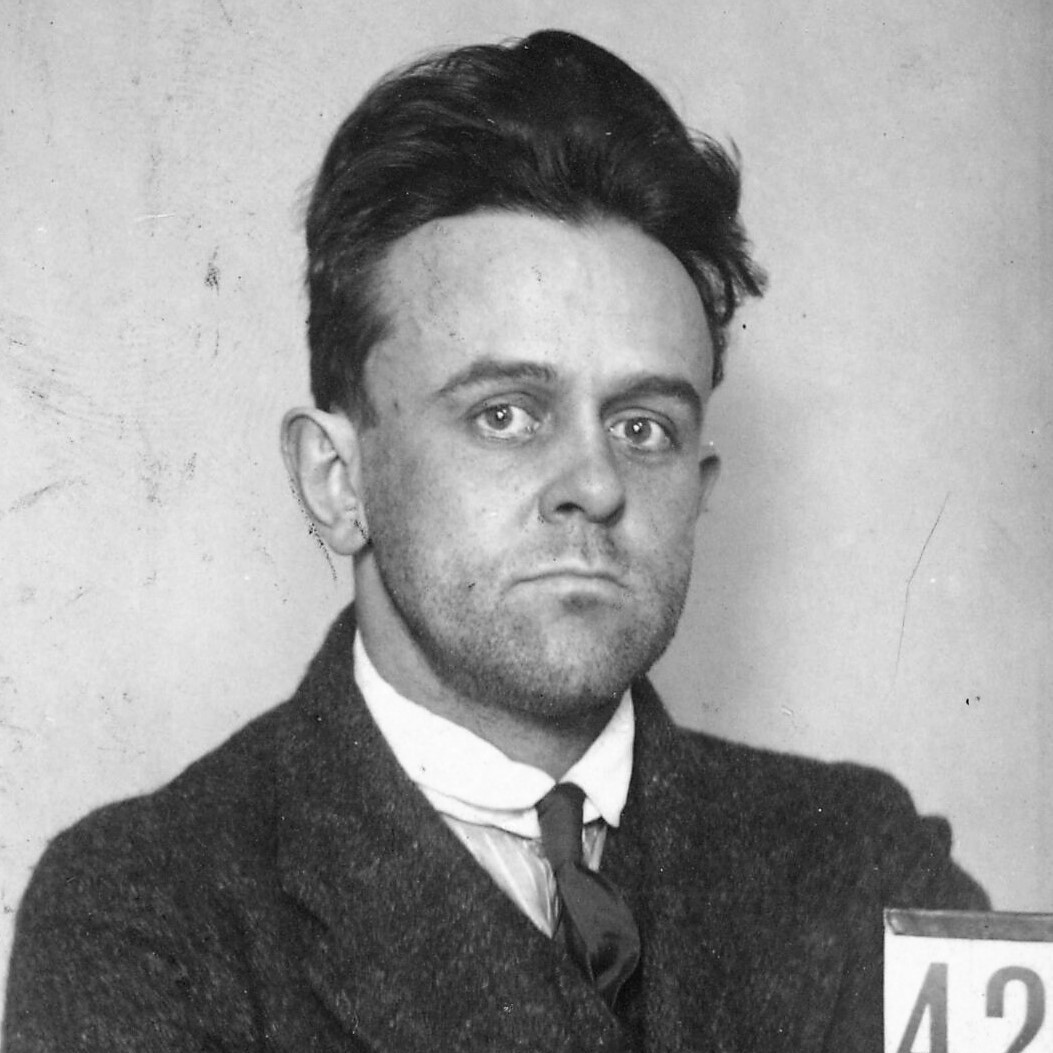
Those liberal illusions a radicalizing John Reed still held would quickly fall as the U.S. entered World War One in the summer of 1917. From today’s perspective, this article on patriotism’s mob mentality reads just as urgently as when it was written.
‘Militarism at Play’ by John Reed from The Masses. Vol. 9 No. 10. August, 1917.
WE always used to say that certain things would happen in this country if militarism came. Militarism has come. They are happening.
I am going to describe briefly what I witnessed at two “peace” meetings before the draft registration day.
The first one was the great meeting in Madison Square Garden, held by the American Conference on Democracy and Terms of Peace, with such respectable (no longer) persons on the platform as Daniel Kiefer, of Cincinnati, Rabbi Magnes, Bolton Hall and John Milholland. There were at least 15,000 people in the hall and half as many again outside.
The seats back of the platform were reserved for delegates to the Conference, and the ushers were instructed to that effect. Four or five big, ugly-looking men brushed their way past one of the girl ushers, and when she remonstrated, one of them snapped at her:
“Go to hell, you damned little kike!”
In tears, she came and told the head usher, who went over just in time to hear one of the men say to another usher–this time a young boy, who was asking for their tickets: “Say, God damn you, you shut your mouth, or something’ll happen to you!”
The head usher proceeded to throw them out of the section; but as they reached the rope, the spokesman turned to him. “Look out what you’re doing, young feller. We’re Government Secret Service men!” He flipped his coat open and showed his badge. The head usher asked who was in charge, and the thug pointed to the platform, where a pleasant-faced but shifty-eyed individual was parading around with a badge on labelled “Delegate.” “Who are you?” asked the head usher.
“I represent the Farmers’ Associations of North Dakota,” responded the other, cordially.
“That’s not true. You’re a Government Secret Service man.” The “delegate” scowled evilly, and snarled at him, “You shut up, or we’ll get you!”
Two Russian sailors from the Variag, the first Russian Warship to join the revolution, now lying in New York harbor, were invited to sit upon the platform, and for the first time seeing Liberty dawn in their own land, to watch it snuffed out in America. They were not disappointed.
Three Federal stenographers sat at the front rail, taking down the speeches in shorthand. Round about were hundreds of Federal Secret Service men, many of them stirring up what ever trouble they could. (By the way, it was at that meeting that I heard that the Government had just hired thirty thousand strike-breakers and private gunmen as Secret Service operatives.)
Across the hall sat a little knot of a dozen or so soldiers and sailors. As the great hall slowly filled, they shouted and sang patriotic songs, waving American flags about. Nobody objected. Indeed, when they first entered the place, we all thought they had come because they believed with us–and we cheered them thunderously.
However, hardly were we seated than two young sailors. detached themselves from the group, came across the hall and climbed to the platform.
“Say,” they said, blustering down front and pointing to the Russian sailors. “We can’t allow those fellers to sit here. This meeting is against the Government, and we won’t have any uniforms sitting up here—”
The crowd was very patient. It was explained solemnly that these men were revolutionists, liberals–that they had been invited to the platform. The sailors were nice, stupid boys. “Well,” they said, “if they’ve been invited–” It was a poser for the naval intellect.
Ten minutes later two soldiers appeared, also young, also arrogant.
“We’re going to take these two men out of here, you understand?” bawled one. “I don’t give a damn what they’re here for. It’s an insult to the uniform to have them here.”
Morris Hillquit stepped up. “Where’s your warrant?” he asked smoothly.
“Warrant,” sneered one of the soldiers. “Say, you open your face to me again, you dirty yid, and I’ll knock you cold!” Whereat, he doubled his fist and hauled back. At this point one of the Government stenographers took hold of the boy and began to whisper in his ear.
“Well,” said the soldier, finally. “I’ll ask them if they want to go.”
During all this time the Russians had looked on with pleased incomprehension. Somebody translated the soldier’s invitation; smilingly they shook their heads…
All the rest of the meeting, the bunch of soldiers and sailors across the hall shouted, yelled, sang and interrupted in other ways. Every time the speaker proposed something liberal or democratic, the soldiers hissed. For example, they hissed loudly when it was proposed to tax the rich to pay for the war, and contrary-wise, whenever there was mention of bloodshed, tyranny, suppression and starvation, the soldiers and sailors cheered.
This was extremely puzzling to the Russian sailors…
Next day some boys and girls, arrested distributing literature, were placed on trial, and as a witness a certain Sergeant Silverman, of the Eighth Coast Defense Command, testified that he had received orders from his superior officer to go around to these lawful “pacifist” meetings and break them up.
From that time on, Sergeant Silverman and his little band of soldiers and sailors appeared at all meetings of protest in the city.
On June 4th, Emma Goldman and Alexander Berkman held a meeting at Hunt’s Point Palace, up in the Bronx, to protest against conscription and ask for the repeal of the draft law; again it was a monster crowd that gathered–tens of thousands. The day before the meeting I got a private tip that there were to be two hundred soldiers and sailors sent up to Hunt’s Point Palace to break up the meeting. I called up Police Headquarters and informed the Commissioner’s secretary, also Deputy Commissioner Lord. The Commissioner’s secretary, as well as the Chief Inspector’s office, informed me that no police would be inside the hall, and that no police protection could be given the speakers against the soldiers–unless trouble started. Deputy Lord, however, promised police protection.
By the time the meeting was called to order the hall was packed, and fifteen thousand people had gathered in the streets all round, surging back and forth and singing the “Internationale.” As soon as they could, the police closed the hall to the public, on the plea that it was overcrowded–but they kept freely admitting anybody who wore a uniform, until there were more than a hundred soldiers and sailors inside.
Unmolested by the police, these men in uniform went up to the front of the galleries and began to shout at the speakers and interrupt affairs. Pretty soon they began to throw things. Among other things, they threw three electric light globes onto the platform.
I went downstairs and found the captain of police, and told him. “Will you go up there and stop that?” I asked. “The crowd is getting ugly, and I’m afraid of trouble.”
He looked at me sourly. “I will if I feel like it,” he said. The moment the meeting was over the militia boys made a rush for the platform, and began to jostle people around, “frisking” the pockets of some people for “incendiary literature.” Up in the corner was a poor, half-mad little old woman, a familiar sight around the Federal building for years. She was giving out circulars, which she had had printed herself, which were just incoherent jumbles of crazy words.
A big brutal soldier had her by the arm, bawling, “Sergeant Silverman! Sergeant Silverman!” Another soldier came bustling up, and gave the old lady a shove. “Keep hold of the old bitch!” he shouted, with a string of curses. They led the old lady away, and three or four reporters pressed forward eagerly to give their names as witnesses against the old lady if they were wanted.
Afterward the soldiers and sailors formed a little parade and marched insolently up and down, shoving the crowd around. Under the Elevated station they resumed their rifles, fixed bayonets, and marched some more. A man on the sidewalk laughed as they passed; one militiaman dashed into the crowd after him. There was a fight, and suddenly men and women, shrieking, were scrambling back in a panic before the clubbed rifles of the soldiers and the billies of the police. They filled three ambulances with the wounded…
I was crossing the street when a hand fell on my shoulder It was the police captain.
“Say,” he said, severely, “You’re the feller that told me they was throwing electric light globes off the gallery, wasn’t you?”
“Yes.”
“How many did you say was thrown down there?”
“It looked like three to me.”
“Well,” he said, sternly, “You was wrong. It wasn’t three. I went up there, and all I could find out about was two.”
To date, Sergeant Silverman’s squad has grown bolder and bolder at meetings, until it has taken over the powers of the police, made arrests on any or no charge, and has so mauled and bullied citizens without warrant that in many cases the police have had to interfere to protect civilians. On June 14, at Emma Goldman’s Forward Hall meeting, Police Inspector O’Brien saved a young girl from the clutches of the soldiers. Since the close of draft registration, the soldiers have been attending meetings, arresting young men and demanding their blue cards. They have jammed them against the wall by the neck, kicked and beaten them.
Wednesday, June 13, some soldiers, without warrant invaded Socialist headquarters in the 26th Assembly. District, placed the members there under arrest, tarred the door, and turned the desks inside out, confiscating many private papers.
Friday night, June 15, soldiers invaded a meeting at Arlington Hall, made a disturbance so the meeting had to stop, and then tried to search the audience going out for registration cards. On the street outside the soldiers took rifles and fixed bayonets, and began to march up and down, until a riot was started when the clubbing and beating began again. But this time the crowd was not so docile.
Just wait, boys, until the crowd finds that clubs and butts, and even bayonets, don’t hurt so much, and that there are too many heads to crack!
The Masses was among the most important, and best, radical journals of 20th century America. It was started in 1911 as an illustrated socialist monthly by Dutch immigrant Piet Vlag, who shortly left the magazine. It was then edited by Max Eastman who wrote in his first editorial: “A Free Magazine — This magazine is owned and published cooperatively by its editors. It has no dividends to pay, and nobody is trying to make money out of it. A revolutionary and not a reform magazine; a magazine with a sense of humour and no respect for the respectable; frank; arrogant; impertinent; searching for true causes; a magazine directed against rigidity and dogma wherever it is found; printing what is too naked or true for a money-making press; a magazine whose final policy is to do as it pleases and conciliate nobody, not even its readers — There is a field for this publication in America. Help us to find it.” The Masses successfully combined arts and politics and was the voice of urban, cosmopolitan, liberatory socialism. It became the leading anti-war voice in the run-up to World War One and helped to popularize industrial unions and support of workers strikes. It was sexually and culturally emancipatory, which placed it both politically and socially and odds the leadership of the Socialist Party, which also found support in its pages. The art, art criticism, and literature it featured was all imbued with its, increasing, radicalism. Floyd Dell was it literature editor and saw to the publication of important works and writers. Its radicalism and anti-war stance brought Federal charges against its editors for attempting to disrupt conscription during World War One which closed the paper in 1917. The editors returned in early 1918 with the adopted the name of William Lloyd Garrison’s The Liberator, which continued the interest in culture and the arts as well as the aesthetic of The Masses/ Contributors to this essential publication of the US left included: Sherwood Anderson, Cornelia Barns, George Bellows, Louise Bryant, Arthur B. Davies, Dorothy Day, Floyd Dell, Max Eastman, Wanda Gag, Jack London, Amy Lowell, Mabel Dodge Luhan, Inez Milholland, Robert Minor, John Reed, Boardman Robinson, Carl Sandburg, John French Sloan, Upton Sinclair, Louis Untermeyer, Mary Heaton Vorse, and Art Young.
PDF of full issue: https://www.marxists.org/history/usa/pubs/masses/issues/tamiment/t76-v09n10-m74-aug-1917.pdf
 Revolution's Newsstand