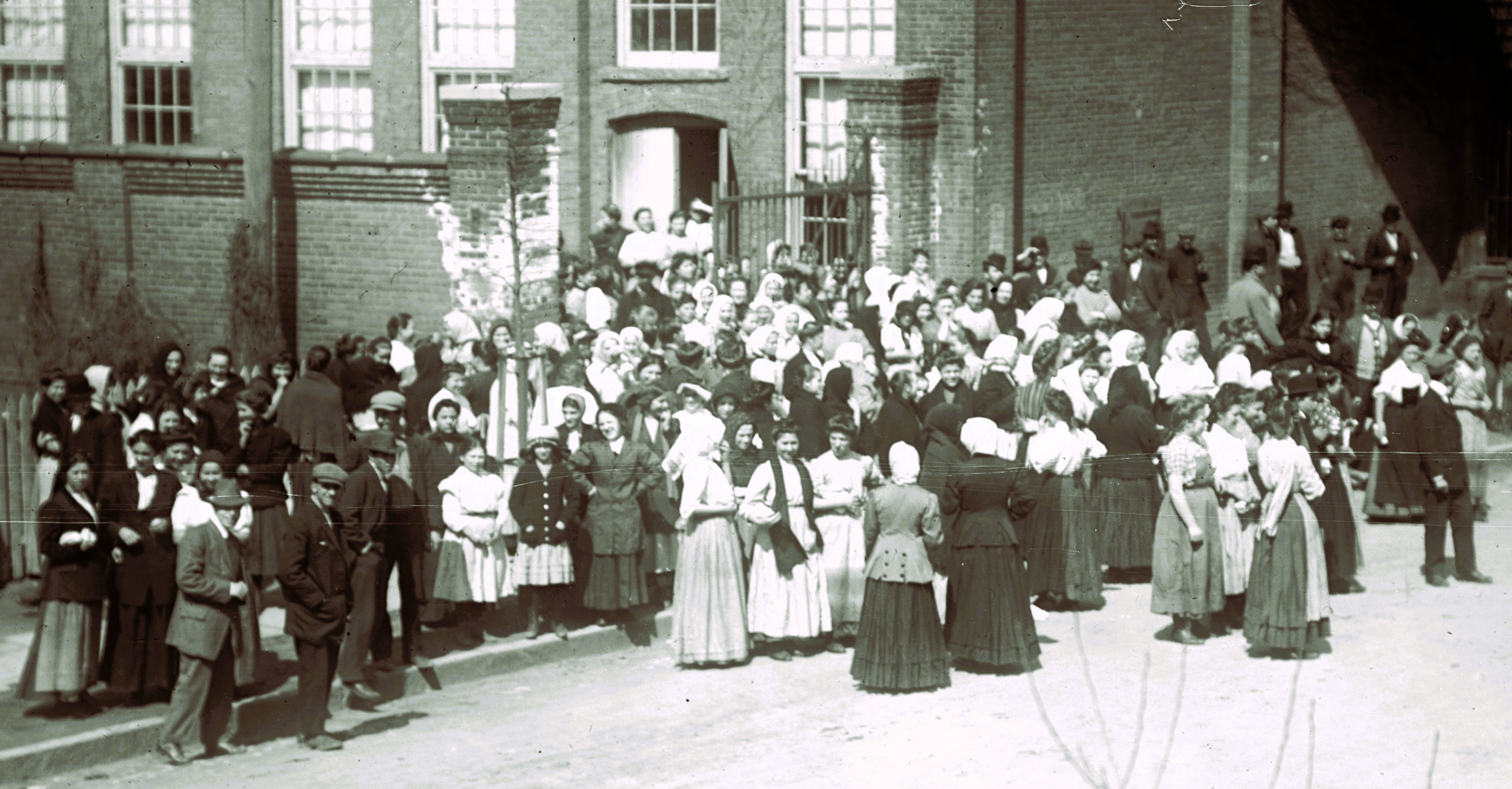
The T.U.E.L.’s August Erdie reports on the situation in Passaic, New Jersey’s textile mills two years after the hard-fought Communist-led struggle, one of the most radical moments in the workers’ movement of the 1920s, was fought there.
‘The Mills of Passaic Today’ by August Erdie from Labor Unity. Vol. 2 No. 4. May, 1928.
HERE is Passaic, New Jersey, a little quiet town 11 miles from New York City, with its big mills surrounded by high grim walls, inside which toil thousands of textile slaves, under the whip and lash of the mighty lords, the textile barons. After the 1919 strike the workers were afraid of their own shadow, abused and spied upon by the hirelings of the bosses. Wages were low and wage cuts followed each other.
Then thousands of textile workers cried, “If we have to starve we will not starve working.”
Zober Takes Field
Chief Zober, the Passaic Police Chief, the agent, and stock holder in the Botany mill, viciously ordered his cossacks to attack the workers, and boasted that he would break the strike in a few weeks, and have all the leaders in jail.
Police clubs, water hose, and gas bombs all failed to break the strike, the workers throughout the nation rallied behind the workers of Passaic in their struggle against the mill owners. It was indeed a class struggle, the workers learned that not only were they fighting the textile barons* but the machinery of the local and state governments was used by the bosses and their agents to crush the workers into submission. Martial law, injunctions, brutal cossacks headed by the sheriff of Bergen County, were what the textile workers had to contend with.
For the sake of unity against the bosses, the strike leaders persuaded eleven thousand textile workers to join the United Textile Workers of America, knowing all the time that its officials were reactionary, but desiring to rally the A.F. of L. around the strike.
Finally strike settlements were reached, and promises of no discrimination given by the bosses, most of which have not been kept.
The strike is over in the textile mills of Passaic and again quiet settles over the battlefield of yesterday. Chief Zober the cossack chieftain and the tool of the mill barons of Passaic, stands today suspended as the Chief of the Passaic police, accused of stealing cars and selling them at a handsome profit. The charge is that while the chief was “upholding law and order,” cracking the skulls of working men and women who were struggling in a perfect legal way to get a little more bread and butter for themselves and their children, he was making very good business for a certain “ring” of auto thieves. Not only Chief Zober but all the most vicious tools of the mill owners have fallen by the wayside. Sheriff Nimmo who read the riot act, and closed the halls in Garfield is dead, Judge Davidson of Passaic, Judge Baker of Garfield, and Judge Barbour of Clifton, all of them well known by the workers for handing out heavy sentences during the strike, are removed from office. The chief of police in Garfield is dead while in Clifton the throne wavers under the once mighty political boss, and chief of police, and the workers say of him, “It won’t be long now.”
Fights Workers, Not Boss
James Sarr, vice president of the United Textile Workers of America, a definite right winger, has been out in Passaic for over a year, trying very hard to “clean out the Reds.” At the time the Botany mills settled an agreement was made with the International office of the U.T.W. that the active and militant workers, and all those that may look “Red,” must not go back into the mills. This is one of the reasons that we cannot build up a strong militant union, the workers who have taken an active part in the struggle cannot find employment in the textile mills, by agreement between the mill bosses and the officialdom of the United Textile Workers international office.
Thomas Regan, another antique from the international office, was sent in to organize the textile workers of Passaic, but all day long he snoops around the union headquarters watching other peoples’ business, trying to get the “dope” on all the Reds and left wingers in the union, looking into all the papers and books, and even into the waste basket for “Red propaganda.” Visiting the bar rooms, drinking good beer, walking from store to store looking for the union label, that’s the way our friend Regan, international organizer of the United Textile Workers of America, is organizing the textile workers of Passaic and vicinity.
Since the ending of the strike a few thousand workers have been hired, the mill owners say that lack of work and depression in the industry compels them to place working men on parttime work, many of the workers are hired, work only a few weeks, get laid off, and are told that if they are needed they will be sent for. In a few weeks or months probably,, they are called back to work with less pay, the union has tried to remedy this condition but the bosses say that the worker is hired into another department and so he must start at a lower rate.
In this way a 20% cut was put over at the Gera-New Jersey Spinning Co., reducing the wage to 40c. The Botany Mill also now forces workers to pay 40c to 50c a week insurance.
It is evident that the bosses are trying to smash the union. A few months ago in the Botany mill, the bosses made an attempt to establish the company union, a few of the chief suckers were called together and an association was formed, the company issued leaflets among the workers urging them to join this new union, where no dues need be paid, and all kinds of schemes were offered to the workers.
This company union lived only to see two meetings, at each meeting hardly a dozen workers were present, half of them being our own boys sent there to size up the affair. The workers just gave the whole thing a laugh, and the bosses were compelled to drop the idea.
Workers Fight Anyway
The union rank and file, not its leaders, force organization.
A large building has been rented in which will be located the Union headquarters, offices, meeting hall and billiard rooms—only one block away from the Botany mills. Despite the efforts of the textile barons to crush the union, intimidating the workers by holding the club of unemployment over their heads, the textile workers of Passaic are determined to organize all the textile workers in Passaic and vicinity, and carry on the fight against the mill owners until a complete recognition of the textile workers’ unions is secured.
Labor Unity was the monthly journal of the Trade Union Educational League (TUEL), which sought to radically transform existing unions, and from 1929, the Trade Union Unity League which sought to challenge them with new “red unions.” The Leagues were industrial union organizations of the Communist Party of the United States (CPUSA) and the American affiliate to the Red International of Labor Unions. The TUUL was wound up with the Third Period and the beginning of the Popular Front era in 1935.
PDF of full issue: https://www.marxists.org/history/usa/pubs/labor-unity/v2n04-w23-may-1928-TUUL-labor-unity.pdf
 Revolution's Newsstand