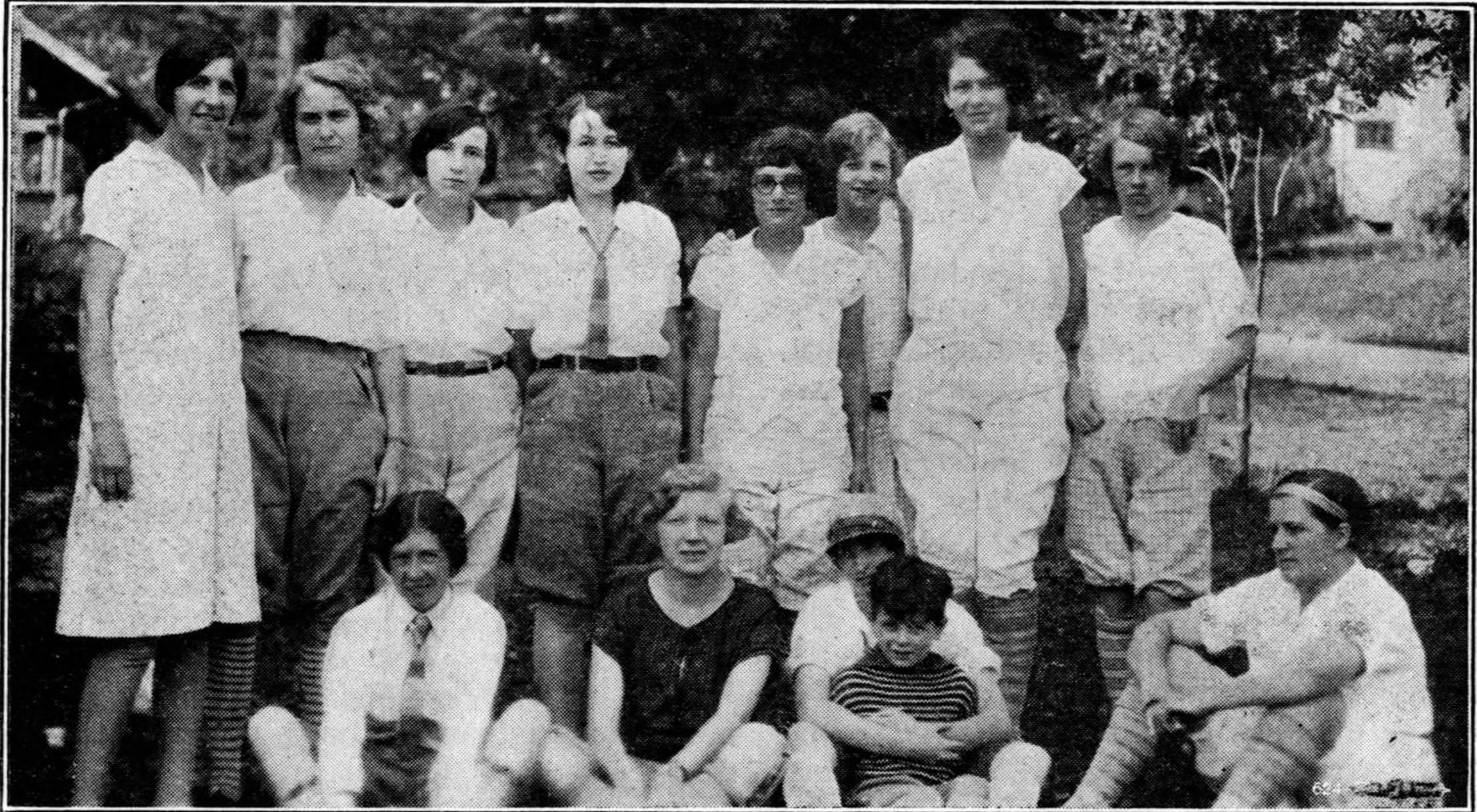
A report on the women workers’ summer school, organized by the Brookwood Labor College, held in Burnsville, N.C. during 1928.
‘A School in the Old South: Women Workers Study Industrial Problems’ by Louise Leonard from Labor Age. Vol. 17 No. 12. December, 1928.
UNTIL recently little attention has been given to Workers’ Education by organized labor in the South, although Central Trades bodies have sponsored classes in Atlanta, Ga., Louisville, Ky., and Lynchburg, Va., and recently we have been hearing of mass education efforts on the part of the Piedmont Organizing Council (N.C.), also a few southern men and women have attended Brookwood and other schools for workers in the north, but the great majority of organized workers are still unaware of the workers’ education movement.
Realizing the need for Workers’ Education in their section; an independent committee of Southern men and women, have, for the past two years sponsored the Southern Summer School for Women Workers in Industry which held its first session at Sweet Briar College in Va., and the second, this summer just past, at Carolina New College at Burnsville, N.C. Each summer the committee has rented campus and equipment and the Summer School has had no connection with the college administration.
From the beginning about two-thirds of the committee members have been workers, mostly women from garment factories, knitting mills, silk mills, etc., and the majority of these are members of trade unions.
The purpose of this school is to help industrial women to realize the position in which women workers of the South are placed at the present time and to fit them to assume their special responsibilities.
Students came in 1927 and 1928 from eight southern states; from textile mills, including silk, cotton, rayon, came spinners, spoolers and weavers; from cigarette factories, packers; from hosiery mills, loopers; from garment factories, button and button hole operatives, overall, coat and shirt workers; from cigar factories, skilled cigar makers; from shoe factories, French “folders” and fancy stitchers; from glove factories, laundries, telephone offices, box factories, and men’s clothing factories girls also came so that in a group of twenty-five students, all typical southern industries were represented by girls from some of the largest plants in the South.
From economics to health education, the courses of study were especially designed for industrial workers. After studying industrial history since before the invention of machinery, these worker-students saw their jobs in a new light, as parts of a great modern industrial movement which is revolutionizing the South even as it has wrought changes in Europe, in New England, and of which beginnings are now evident in the Orient and darkest Africa. They learned economics in relation to their own jobs and labor problems in terms of their own long hours, low wages, unemployment and other handicaps, compared and contrasted with conditions surrounding other workers in other places.
English composition and public speaking, teaching worker-students to read more intelligently, to write more clearly, and to speak in public, were closely correlated with Economics and drew upon the girls’ industrial experience. Among subjects for public speeches were “The Time I Was Asked to Sign a ‘Yellow Dog Contract’,” “The Effect of Low Wages Upon Workers,” “The Advantages of a Trade Union,” “Industrial Reesor in My Plant,” “The Mill Village in Which I live.”
An hour a day was given to physical education for the group with emphasis upon such exercises as teach relaxation and muscular control; this work was supplemented by talks on personal health habits, social hygiene and care of children; also individual help was given each student regarding exercise and diet suitable for the special needs growing out of her type of job.
A week’s course supplementary to economics was given by A. J. Muste, dean of the faculty at Brookwood labor College, covering the position of the worker in different stages of history, labor problems in the United States at the present time, and the structure and functions of the American Federation of Labor.
The faculty of the Southern Summer School is made up of teachers who have not only a wide knowledge of subject matter to be taught, but experience in teaching workers. Their work was supplemented by talks by visiting labor leaders and educators among whom are Broadus Mitchell of Johns Hopkins University, Elbert Russell of Duke University, J.L. Kesler of Vanderbilt University, W.C. Birthright, Secretary of State Federation of Labor in Tennessee, T.A. Wilson, President of State Federation of Labor in North Carolina, Mary C. Barker of Atlanta, Georgia, President of American Federation of Teachers, etc., etc.
All members of the school, students, tutors, teachers, attended most of the classes; discussion was free and the contribution of the student from her industrial life as enlightening to the group as that of the discussion leader who had spent more time studying theory. There were tutorial hours, individual conferences for each student about her written work, projects undertaken by a student or a committee of students working with faculty members. Thus the program was flexible, adjustable to needs of students as they appeared and progressive educational methods were followed.
Over one week end in August, a conference of labor men and women from three states, met at the Southern Summer School in response to the call of the President of the North Carolina Federation of Labor. They considered the present status of labor organization in southern states in the light of reports from Georgia, Tennessee, Virginia and North Carolina and tried to face problems to be met in organizing. Under A.J. Muste’s leadership they discussed Workers’ Education as a tool in the hands of workers. Visiting trade unionists and students found the discussions of mutual benefit and in a number of cases organized and unorganized saw chances to cooperate in educational work in their home towns.
The Summer School is supported by contributions from interested organizations and individuals in local southern communities from which students come as well as from other places where there is interest in the South and in Workers’ Education. The committee is encouraged by the support that has come from organized labor as well as from other sources. This next year the director of the school will travel in the South working with local committees to secure funds and applicants and offering workers’ classes as a means of following up the work begun during the summer.
The school is not large—the aim is to have forty students next summer, and its contribution as a pioneer in Workers’ Education in the South is significant only in so far as it releases the powers of southern women workers and sends them back more able to function in the labor movement of the South in this important period in its economic history.
Labor Age was a left-labor monthly magazine with origins in Socialist Review, journal of the Intercollegiate Socialist Society. Published by the Labor Publication Society from 1921-1933 aligned with the League for Industrial Democracy of left-wing trade unionists across industries. During 1929-33 the magazine was affiliated with the Conference for Progressive Labor Action (CPLA) led by A. J. Muste. James Maurer, Harry W. Laidler, and Louis Budenz were also writers. The orientation of the magazine was industrial unionism, planning, nationalization, and was illustrated with photos and cartoons. With its stress on worker education, social unionism and rank and file activism, it is one of the essential journals of the radical US labor socialist movement of its time.
PDF of full issue: https://www.marxists.org/history/usa/pubs/laborage/v17n05-may-1928-LA.pdf
 Revolution's Newsstand