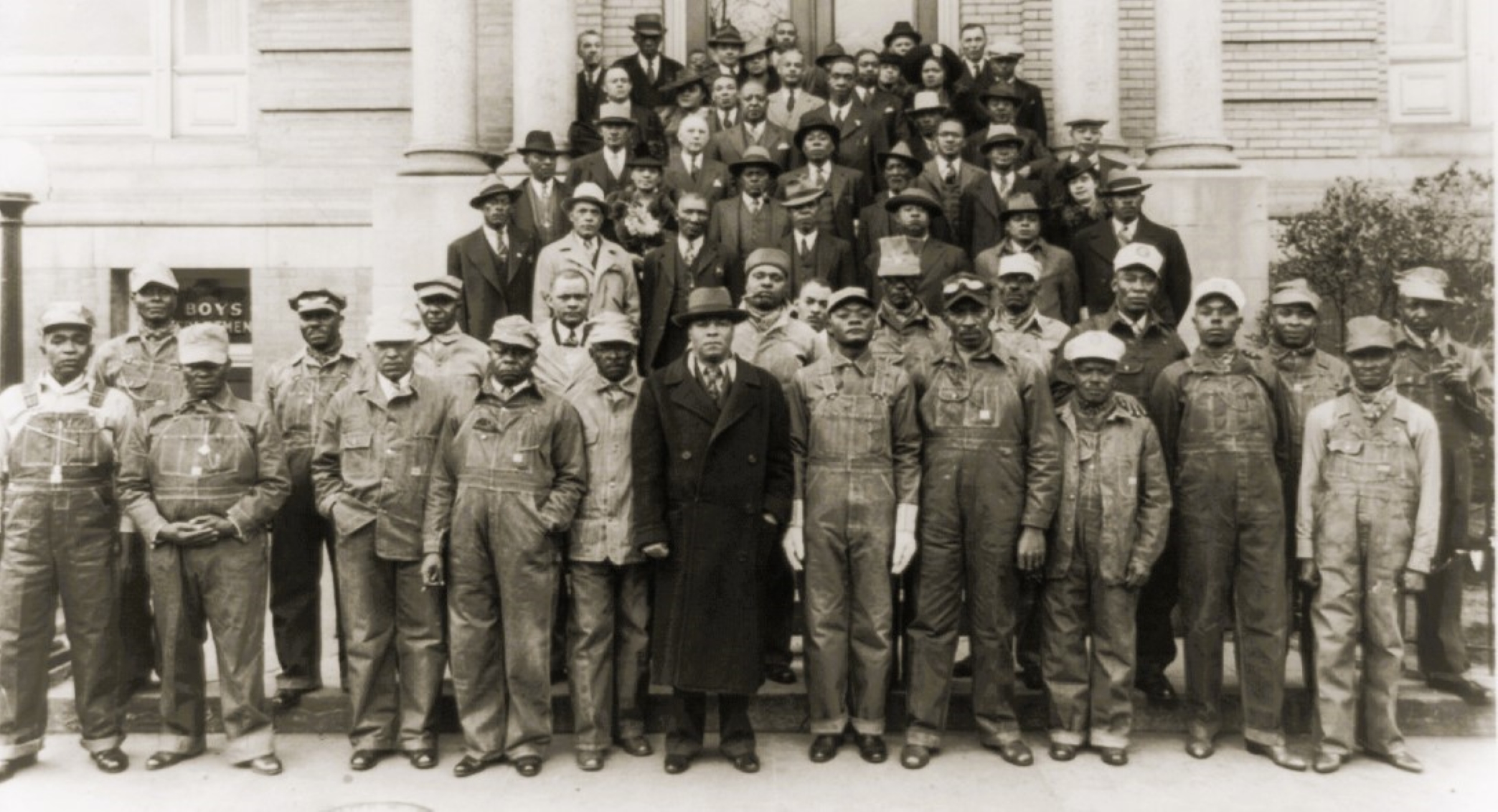
After a decade-long fight, union representation is finally put to a vote on June 1, 1935 and the Brotherhood of Sleeping Cars Porters soundly defeat the company union.
‘After 10 Years, The Pullman Porters Win’ by A. Philip Randolph from Socialist Call. Vol. 1 No. 19. July 27, 1935.
In November of 1934, a letter was directed to the Pullman Company from the Sleeping Car Porters’ Union, requesting a conference for the negotiation of an agreement on wages and rules governing working conditions. This action was taken after the enactment of the amendments to the Railway Labor Act of 1926 by the, 73rd Congress.
The Pullman Company refused to grant the conference, saying that it did not think that the Brotherhood represented a majority of the porters and maids in the service. Thereupon, an invocation was made of the services of the National Mediation Board to intervene and settle the dispute on representation.
Soon thereafter, one of the members of the Board was assigned to institute an investigation of the claims of the Brotherhood to the right to represent the porters. He visited our national headquarters in New York City with a statistician and examined the authorization cards and records purporting to show validity of the Brotherhood’s claim.
The Company Union.
But the Brotherhood was not the only organization which claimed the right to represent the porters and maids. A company union, known as the Pullman Porters’ and Maids’ Protective Association, which was gotten together practically overnight by F.L. Simmons, supervisor of industrial relations for the company, and the former head of the old plan of employe representation, openly financed by the company to the extent of around a hundred and fifty thousand dollars or more a year, also claimed the right to represent the porters.
Since the Pullman Porters’ and Maids’ Protective Association demanded the right to be heard in connection with the disposition of the case of the Pullman porters, the Pullman Porters’ and Maids’ Protective Association’s claims to represent the porters, too, were investigated.
Following this preliminary investigation, the Board delegated Mediator H.H. Reed to check authorization cards of both organizations against the payroll of the Pullman Company, and plan an election to give the porters and maids the opportunity to represent them in dealing with the management of the Pullman Company concerning rates of pay and rules governing working conditions.
The Election.
On the ballot were the names of the Brotherhood of Sleeping Car Porters and the Pullman Porters’ and Maids’ Protective Association. The election began May 27 in New York, Chicago, St. Louis Los Angeles, New Orleans and Jacksonville.
To aid the Pullman Porters’ and Maids’ Protective Association in winning the election, Pullman superintendents posted bulletins stating that the representatives of the company union had successfully settled some minor grievance for some porter, and expressing the pleasure of the company in cooperating in the settlement.
Brotherhood Wins.
While this was done within the law, every porter knew the purpose behind it. It was intended to influence the porters in favor of the company union and wean them away from the Brotherhood.
But despite this transparent strategy of the company, the Brotherhood piled up a huge majority. The next step will be to write an agreement in the interest of securing shorter hours and decent wages and better working rules.
The historic fight of the porters and maids against the Pullman Company has been marked by the loss of jobs by hundreds of men and women in the service, the loss of seniority rights, and the slugging of Brotherhood organizers by gangsters. But the militant Brotherhood men carried on.
Socialist Call began as a weekly newspaper in New York in early 1935 by supporters of the Socialist Party’s Militant Faction Samuel DeWitt, Herbert Zam, Max Delson, Amicus Most, and Haim Kantorovitch, with others to rival the Old Guard’s ‘New Leader’. The Call Education Institute was also inaugurated as a rival to the right’s Rand School. In 1937, the Call as the Militant voice would fall victim to Party turmoil, becoming a paper of the Socialist Party leading bodies as it moved to Chicago in 1938, to Milwaukee in 1939, where it was renamed “The Call” and back to New York in 1940 where it eventually resumed the “Socialist Call” name and was published until 1954.
PDF of full issue: https://www.marxists.org/history/usa/pubs/socialist-call/Call%201-19.pdf
 Revolution's Newsstand