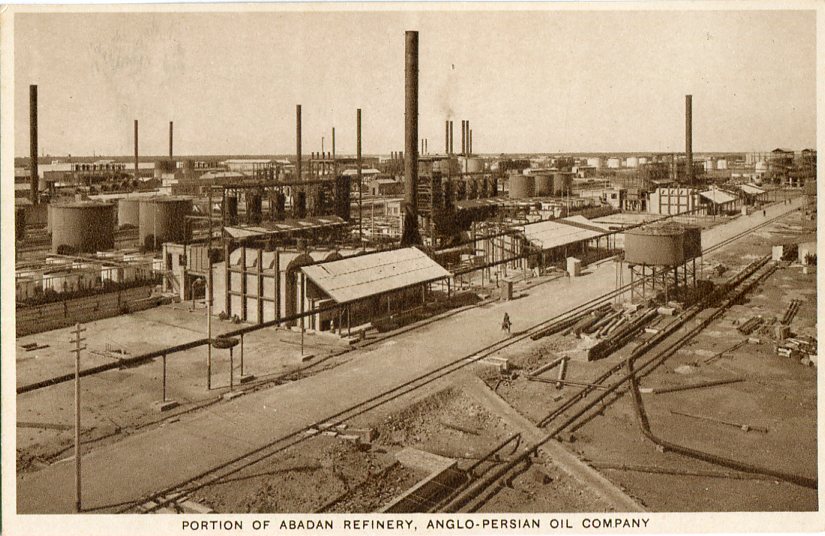
The origins of British Petroleum lie in Iran.
‘Oil and Exploitation in Persia’ from The Daily Worker Saturday Magazine. Vol. 4 No. 151. July 9, 1927.
THE Persian oil wells are the natural continuation of a broad zone beginning in Turkish Armenia and stretching through the Mesopotamian oil fields to the southern extremes of Persia. Oil refining is at present chiefly carried on in the Maidan-i Naftun district, which lies 225 kilometres to the northeast of Mohammeri in the province of Arabistan. The quality of the Persian oil may be judged by the fact that twice as much petrol and kerosene can be extracted from it than from the American or even Mexican oil. Oil is produced in Persia by old fashioned methods of immemorial age. The population used it for fuel and medicine. Persian oil only began to be produced by modern methods in the beginning of the 20th century. The imperialists’ zealous search for oil, intensified by war conditions, gave a violent impetus to the working of the rich Persian oil wells. In 1921 d’Arcy, an Englishman received a concession of the right to exploit a great territory for sixty years, the terms providing for 16 per cent net profit to the Persian government in return for the rights of exploitation.
The production of oil on a really large scale, how- ever, was only begun in Persia in 1909, when work in the Maidan-i Naftun plain, already referred to, was embarked upon. Thus, one of the “57” wells has a capacity of 4,000 tons per day. With the formation in 1909 of the Anglo-Persian Oil Company, with a basic capital of $2,000,000, big-scale work began. The interest felt by British imperialists in Persian oil waxed ever greater. By the time of the Great War the British government had made up its mind to become the real master of the concession: it owns bonds to the sum of $2,000,000 and continued to increase its share, so as to achieve what is practically control by the British government over the Anglo-Persian Oil Company. The war gave a strong stimulus to the development of the Anglo-Persian Oil Company’s concession.
The following statistics bear eloquent witness to this: the output of oil in the company’s works increased from 233,962 tons in 1913-1915, to 1,106,416 in 1918-1919 and 3,714,216 in 1923-1924, these figures rising every year. We would note that the Anglo-Persian Oil Company is one of those powerful capitalist oil concerns controlling the whole of the world production of oil. The income of the company during the last two years has increased as follows: from the report read at the 17th annual meeting of the company’s share-holders, held in London, November, 1926, we see that the assets for 1926 were $4,382,320 as against $3,571,966 in 1925.
There are at present 700 miles of oil pipes in the possession of the company as against 145 in 1912, and 164 miles of railway and 333 oil freight vessels. While the oil company was in process of formation regular oil towns and stations sprang up in Persia, with a mining population. Such is the town of Abadan (on the island), converted into a regular oil town, sending petrol from its refinery to three continents: Africa, Asia and Europe.
During this time enormous contingencies of oil miners, employed in the enterprises of the Anglo-Persian Company made their appearance; there are now over 50,000 workers and employes working for the company, 83 per cent of whom are Persians, about 13 per cent Indians, a few British, Armenians and Chinese. What are the labor conditions on this concession? These are described in the report presented by “The Society of Persian Southern Oil Workers” to the Persian parliament and printed in “Kabul-Matin’’ of the 15th of March, the Persian paper issued in Calcutta. Moral oppression and physical violence are rife in the enterprises of the Anglo-Persian Oil Company. The workers live and labor in terrible conditions. Their working day is over 12 hours. Children from 12 to 14 are widely employed. The pay is miserable and consists of not more than 3 loan a day (a kran is less than 6d.).
The report of the Persian workers is as follows:
“Who is there to see the miserable broken down hovels in which we have to live, to see how we go blind from working in the terrible heat of summer? Who cares that we die from noxious gases, who is there to pay any attention to our naked starving little ones?”
And side by side with these miserable slaves of oil capital dragging out their wretched existence flourish the foreign employes, receiving high pay and enjoying every sort of privilege. The workers have scarcely any federation or organizations, not being allowed to organize and are not yet capable of struggling for their rights.
The Saturday Supplement, later changed to a Sunday Supplement, of the Daily Worker was a place for longer articles with debate, international focus, literature, and documents presented. The Daily Worker began in 1924 and was published in New York City by the Communist Party US and its predecessor organizations. Among the most long-lasting and important left publications in US history, it had a circulation of 35,000 at its peak. The Daily Worker came from The Ohio Socialist, published by the Left Wing-dominated Socialist Party of Ohio in Cleveland from 1917 to November 1919, when it became became The Toiler, paper of the Communist Labor Party. In December 1921 the above-ground Workers Party of America merged the Toiler with the paper Workers Council to found The Worker, which became The Daily Worker beginning January 13, 1924.
PDF of full issue: https://www.marxists.org/history/usa/pubs/dailyworker/1927/1927-ny/v04-n151-new-magazine-jul-09-1927-DW-LOC.pdf
 Revolution's Newsstand