Kostas Karagiorgis on the wave of militant strikes that rocked Greece in 1932, from trams to tobacco workers, inaugurating years of intense class struggle in the country. A major figure in early Greek Communism, then editor of Rizospastis, Karagiorgis would later play a central role as Communist military leader in the Resistance and Civil War.
‘Barricade Fights in Greece’ by Kostas Grypos (Karagiorgis) from International Press Correspondence. Vol. 12 No. 56. December 15, 1932.
Two weeks after the outbreak of the first big strike in Greece the tremendous strike wave has not only lost nothing in intensity, but on the contrary has increased in extent and assumed exceedingly sharp forms. As is to be seen from the frantic declarations of the Ministers, as well as from the nervous, panicky, column-long reports of the whole of the capitalist press, the situation in the country is extraordinarily tense. In the present article I will confine myself to giving only the most important of the items of news, which follow swiftly one after the other and speak for themselves.
In addition to 2,500 tramwaymen, 1,500 gas workers, and over 1,000 bakers assistants in Athens, the bakers assistants and textile workers in Piraeus have gone on strike. Up to now only the strike of the tobacco workers in Agrini has been settled, following the granting of the whole of the workers’ demands. Most of the organisations of the State employees, the railway workers on all lines in the country, the gas workers of Piraeus, the dock workers of Salonica, the most important trade unions in Patras, and a whole number of smaller trade unions have already unanimously adopted strike decisions at their general meetings, elected strike committees and also in many cases paid their contributions to the strike fund.
All the ruthless measures of the government, including the persecution of the strikers and the Communists, the arrest of the whole of the civil servants’ committees, the strict prohibition of any meeting of State employees, and of the railwaymen in particular, have been unable to check the powerful movement. Special measures have been adopted against the Communists, who are playing an important role in all these strike preparations and strikes. The Communist Party, which up to now has been leading a semi-legal existence, is now threatened by the Minister for the Interior with complete illegality. The “Rizospastis“, the daily central organ of the Party, has been prohibited, the whole of its editorial and printing staff arrested, and its offices sealed. Nevertheless the Party was able immediately to issue a smaller daily edition of the “Rizospastis” and to publish the Communist weekly organ of Salonica as a daily. Seven of the ten Communist members of Parliament are in prison; two of them were arrested during the street and barricade fighting in Athens.
As the whole of the bourgeois press is forced to admit, up to the present not a single strike-breaker has been found among the tramwaymen and gas workers. The many hundreds of unemployed tramwaymen and gas workers, some of whom have been out of work for years, who do not receive any unemployment benefit and are actually starving, have not only not performed blackleg work, but stand in one front with their striking fellow workers, take their place in the picket line, and actively participate in the barricade fights.
The government is having the bread for the population of Athens and Piraeus baked by soldiers. The few street cars which have left the depots are driven exclusively by airmen, sailors and naval officers. It is only by having the dangerous work in the gas works performed by sailors, who are compelled thereto by military discipline, that it is possible to secure a limited supply of gas to the town. After a special leaflet of the strikers addressed to the sailors had been distributed by the young Communists, in spite of the greatest difficulties, and 20 sailors lay in hospital with burns sustained in performing the dangerous unaccustomed work in the gas works, it came to a big mutiny. Even the arrest and imprisonment of four, and then 50 sailors proved unable to restore discipline. As the bourgeois press writers, who slander the sailors in the most contemptible manner, admit, fresh mutinies are to be expected.
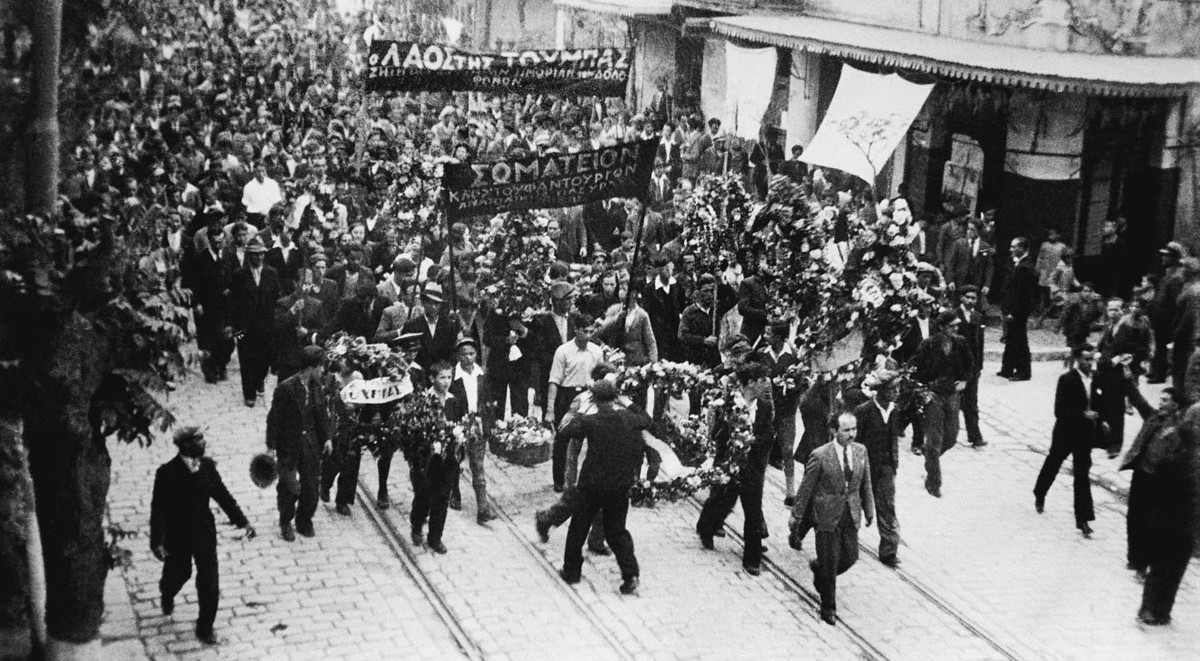
It came to extraordinarily fierce fights between the bakers and the police. Some bakeries which were working with the aid of strikebreakers and under police protection were demolished by the strikers. Many strikers and police have been more or less severely injured in the uninterrupted street fighting. A striker named Adamopulos was so savagely beaten by a policeman that he died on the spot. This did not prevent two eminent medical professors from certifying that Adamopulos died as a result of a chronic illness, and not from the injuries he received. Immediately after Adamopulos’ death it came to great demonstrations of the strikers, who brought his corpse from the mortuary to the trade union house. It was only after fierce fighting that the police were able to bring the corpse back. The cruel death of Adamopulos has increased the indignation of the masses and welded the strike front more closely together.
It came to fierce forms of fighting in the case of the tramwaymen. Uninterrupted struggles, extending over years, by the tramwaymen against the obdurate electricity company, which is working mainly with English capital, have imbued the tramwaymen and their families with strong self-confidence and militancy, which find expression in their present strike. For the first time in the history of their fights there are absolutely no strike-breakers. Moreover, it is the first time that their wives and older children have taken part in the street and barricade fights to such an extent as at present. Of the few agents of the electricity company who ventured to enter the works and depots, 11 are already lying in hospital. 37 of the street cars, which were driven exclusively by sailors and airmen, were, as the government announces, completely demolished by “strikers, communists and other workers”. As the whole of the bourgeois press writes, “the public no longer venture to travel by the street cars”.
The main fights, however, are taking place outside the tram depots. Already on the second day of the strike it came to barricade fighting in Kalithea, at which the Communist member of Parliament Nefeludis, who fought at the head of the strikers against the police, was mishandled and arrested. On the fifth and sixth day it came to fresh and fiercer barricade fighting. Hundreds of strikers with their wives and older children erected barricades in front of the Agia Trias tramway depot in Piraeus, and fought for hours against a large body of police which arrived in 40 motor lorries. One worker was severely injured, many were slightly injured and 300 strikers were arrested. In spite of this the police could not accomplish anything, so that the chief of police had to order the withdrawal of all the blackleg cars which were running.
Astonished beyond measure at the heroism and fighting spirit of the workers in the barricade fights in Agia Trias, the whole of the capitalist press are publishing column-long reports and demanding in their leading articles still more brutal and bloody measures against the strikers. It came again to barricade fighting in Kalithea and in the Piraeus Street in Athens.
The Prime Minister Tsaldaris, who at the beginning of the strike declared: “I shall not negotiate with the strikers until they return to work”, has now been obliged to receive a delegation of workers in his private house, it is true, without result. With the slogan of “life or death”, unintimidated in spite of the wholesale arrests and injuries, the tramwaymen, together with their wives and children, are continuing the fight until final victory.
It is too early yet to sum up the result of the events in Greece. The strike of the railwaymen and civil servants, which is expected to break out shortly, will enormously swell the strike wave and give it greater impetus, so that the Tsaldaris Government, which is already shaky, will in all likelihood be overthrown. The Communists, even where they do not possess the majority on the strike committees, have won the complete confidence of the broad masses of strikers by their active participation in the street and barricade fights, and today are playing the most prominent role on all strike fronts. The next and most important task of the red trade unions and of the revolutionary trade union opposition is, by means of mass pressure, to break the last desperate resistance of the trade union bureaucracy of the railwaymen and post-office employees. In this way this powerful strike wave, which is shaking the whole country, will not only remain a unique and magnificent chapter in the heroic history of the Greek proletariat, but will be followed by a whole series of events of the very greatest importance, which will play a decisive part in the immediate future of capitalist Greece.
International Press Correspondence, widely known as”Inprecorr” was published by the Executive Committee of the Communist International (ECCI) regularly in German and English, occasionally in many other languages, beginning in 1921 and lasting in English until 1938. Inprecorr’s role was to supply translated articles to the English-speaking press of the International from the Comintern’s different sections, as well as news and statements from the ECCI. Many ‘Daily Worker’ and ‘Communist’ articles originated in Inprecorr, and it also published articles by American comrades for use in other countries. It was published at least weekly, and often thrice weekly.
PDF of full issue: https://www.marxists.org/history/international/comintern/inprecor/1932/v12n56-dec-15-1932-Inprecor-op.pdf
 Revolution's Newsstand