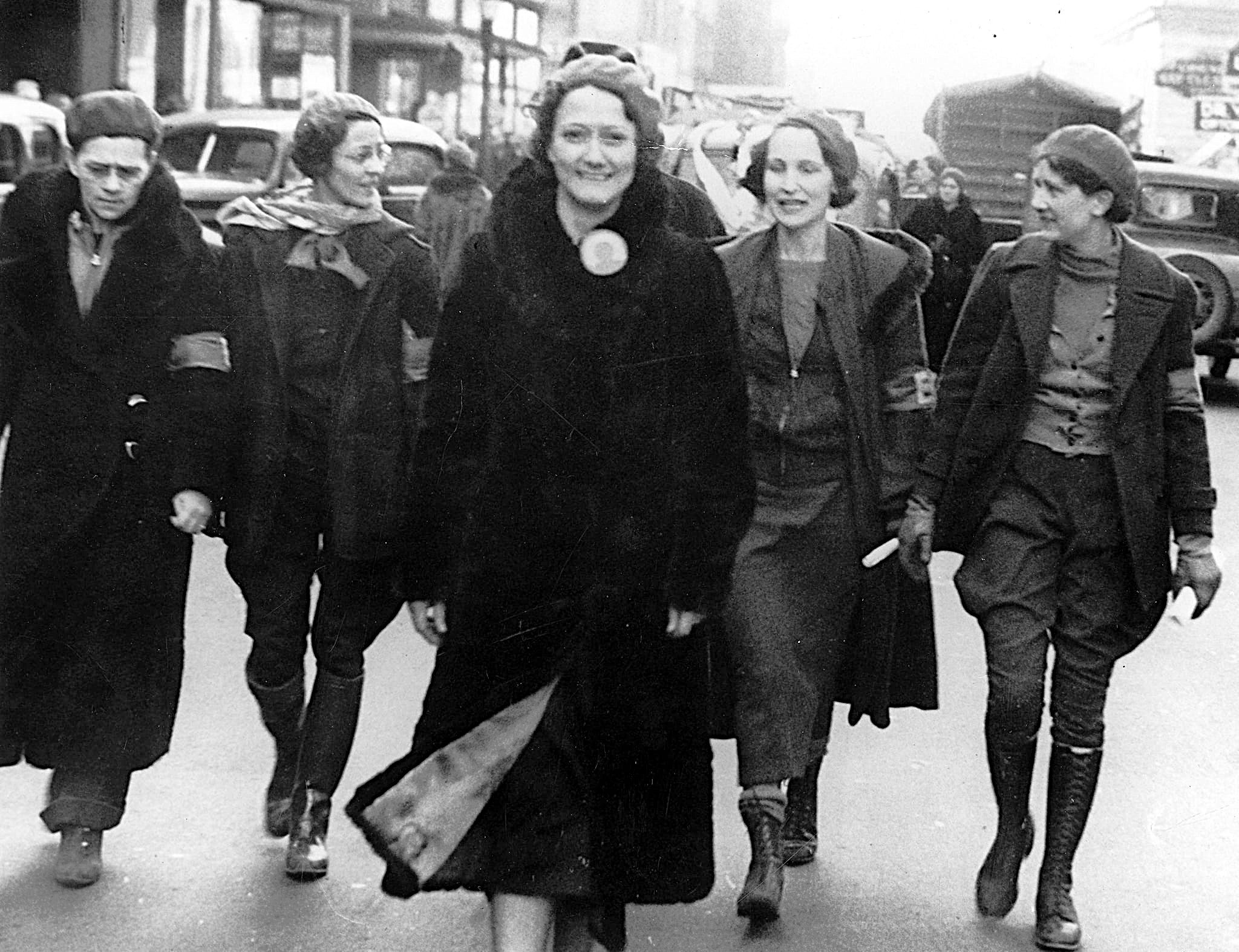
A key to the victory of the U.A.W. at the Flint Sit Downs of 1937, a strike that changed labor history, was the development of the Women’s Auxiliary early in the struggle. Out of the Auxiliary was born the crack-squad of militants, the red-tammed Women’s Emergency Brigade. Captain of the Brigade was the indefatigable Genora Johnson, then a member of the Socialist Party. Your host had the honor of meeting her before her 1995 death. Here is an original recounting of those events by an unnamed member. Wonderful.
‘Minute Women of the Union—The Emergency Brigade’ by E.B. from Workers Age. Vol. 6 No. 12. March 20, 1937.
ON January 11th the call came into the union headquarters asking that all available pickets be sent to Fisher Body plant No. 2. The heat had been turned off at noon and food was kept out. A strong picket line including many women was formed. We demanded that the heat be turned on and that the food we had there be taken in. In reply we found ourselves suddenly surrounded by police with gas masks adjusted, carrying sawed off shot-guns, tear gas guns and service pistols. We were unarmed, but realized we must fight or the Fisher boys would be evicted. We held the picket line until gas forced us to break our lines. Milk bottles and hinges furnished by the sit-down strikers, also coal, rocks, everything and anything we could lay our hands on went flying through the air at those policemen who were not only using gas and sawed off shotguns on us, but were breaking windows and shooting gas into the plant to force the strikers out.
What really saved us all in this four-hour war was the fire hose used by the boys on the second floor of the plant. The water helped to keep the gas down and being a cold night, the police were getting the full benefit of the water, and were handicapped. War it seemed-shots, screams, men falling and being taken away by other union men and women. Many were hurt but the police were finally driven off and the boys in Fisher Body No. 2 had no trouble getting food and heat from that night on thruout the strike.
Birth Of Emergency Brigade
Out of this fight came Emergency Brigade–The Minute Women of the Union! A meeting of the newly organized Women’s Auxiliary was called and the Emergency Brigade was formed as a unit of the Auxiliary. We had to have some way of identifying one another in action so red berets and red armbands with the letters EB in white was decided upon.
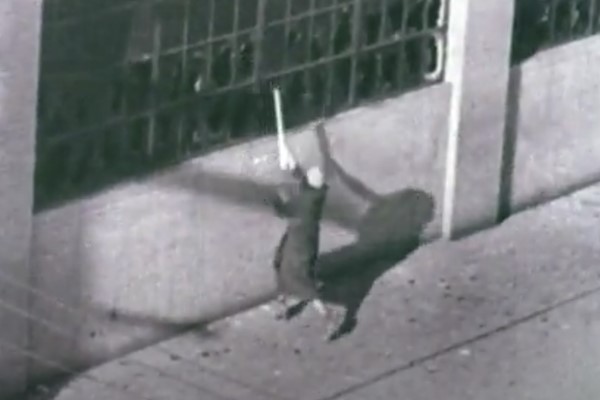
On February 1st a mass meeting was held at union headquarters to protest against the injunction hearings going on at that very hour. We were soon disbanded and sent out to Chevrolet Plant No. 9 to demonstrate against the firing of union members. The Emergency Brigade was standing across the street from the plant, singing Solidarity, when a union man came out of the plant shouting: “They’re shooting and gassing the men, for God’s sake do something!” A woman screamed, “Give them air, they’re gassing our husbands!” All that could be done from the outside was to smash windows. We were stopped by one of our organizers who said, “No property damage, we don’t want trouble.” We were there to help and air was what those men needed! When we got thru no windows within our reach were left intact. The city police were called in. We formed our double picket line and saw that no one went in from the outside to fight those union men who were putting up such a gallant battle.
We Face A Gas Attack
Gas bombs were hurled at the pickets from the inside by the company thugs and shots were heard. Frenzied women jumped up to see what was going on in that plant. One was held up by another Emergency Brigader. What she saw there she will never forget. As she expressed it, “Hell could be no worse.” A man’s bloody, battered face appeared at the window calling for ambulances, and saying “two of our men are done for!”
We marched for hours it seemed, to the tune of Solidarity, which was so necessary at that time. Finally came the call from a sound car “Go back to the Pengelly Building Plant 4 is ours–Protect your Sound Car”.
Our next move was for Plant 4 where we were to guard the gates while the sit-down strikers were erecting their barricades against any attack from the outside. A night watch was arranged for. Thousands were massed around Chevy No. 4 ready to defend the union men on the inside. Food was rushed into plant 4 for those sitting in and for the union men of plant 6, 8 and 10 who joined the men of plant 4 in the sit-down. National Guard trucks arrived and took possession of the entire area surrounding these plants. Martial law was declared.
Stopping The Vigilantes
Then came the injunction to evict the Fisher No. 1 strikers. The Emergency Brigade was called upon to do picket and protection duty. The Women’s Auxiliary declared Wednesday, February 3rd, Women’s Day in Flint as a protest against the enforcement of the injunction. A street parade and demonstration was arranged for. Women from Lansing, Detroit, Pontiac, Clio, Toledo and other nearby towns were invited to take part, and with their help we made this Women’s Day of the UAW a day to be remembered. Many hundreds strong we marched and thousands demonstrated in front of the Fisher Body plant 1. In that parade were seen the green berets of the Detroit women, red berets of the Flint women, and others whose brigades were so new, they had no time as yet to choose their colors, but they were true Brigaders, answering perhaps their first emergency call. We marched up and down, to the front and to the side of the north unit of Fisher No. 1 far into the night. Tired and cold though we were, we felt satisfied that we accomplished our purpose. The injunction was not enforced. But we still had the vigilantes–about 700 of them–to contend with.
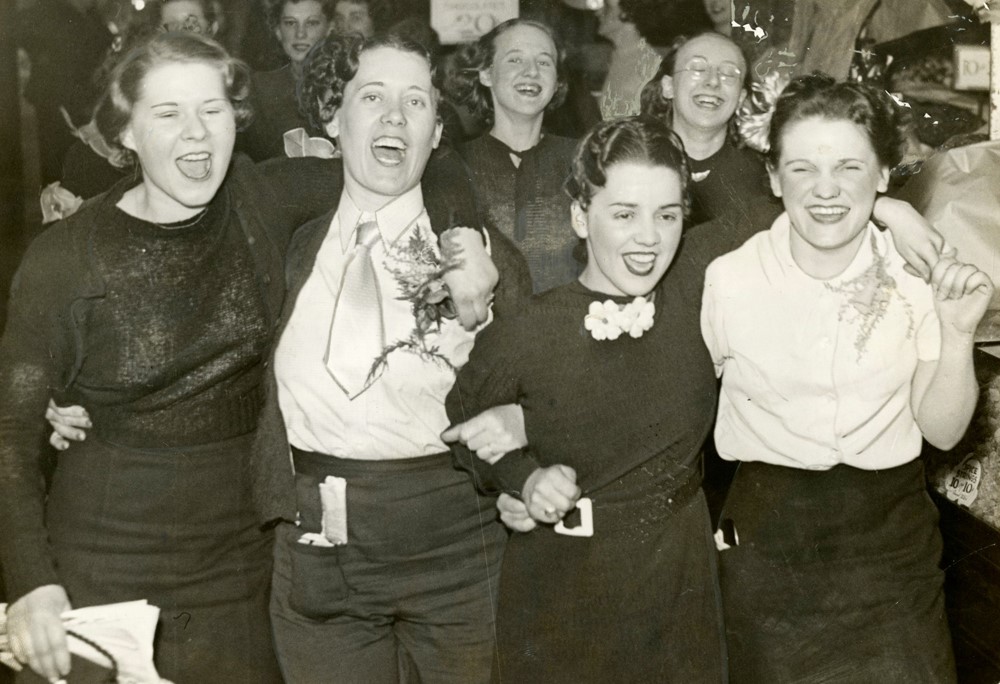
During the two nights when the vigilantes had threatened to make raids on Fisher No. 1, picked members of the Emergency Brigade were on protection duty in the strike kitchen across the street. How strange now to think that we danced and sang and thought nothing of it, even though we knew that 700 armed men might at any time carry out their threat to “come shooting out to Fisher No. 1” as they put it. We were only a handful of men and women compared with the 700. And the law gave them the privilege of carrying arms–privileges we did not enjoy. But we women did have pepper–truly a woman’s weapon!
“We’re In This Fight To Stay”
Our strike is now over. Our battle has been won. The next big job is just begun. There’s a union to build, a women’s auxiliary to organize, our youth to bring under the union’s wing, conditions to maintain.
Ours is not the job of Flint alone. The workers of this country will find the women of the UAW in the first lines when the crucial moments come. We’re in this fight to stay until we’ve won our battle for a better day.
Workers Age was the continuation of Revolutionary Age, begun in 1929 and published in New York City by the Communist Party U.S.A. Majority Group, lead by Jay Lovestone and Ben Gitlow and aligned with Bukharin in the Soviet Union and the International Communist (Right) Opposition in the Communist International. Workers Age was a weekly published between 1932 and 1941. Writers and or editors for Workers Age included Lovestone, Gitlow, Will Herberg, Lyman Fraser, Geogre F. Miles, Bertram D. Wolfe, Charles S. Zimmerman, Lewis Corey (Louis Fraina), Albert Bell, William Kruse, Jack Rubenstein, Harry Winitsky, Jack MacDonald, Bert Miller, and Ben Davidson. During the run of Workers Age, the ‘Lovestonites’ name changed from Communist Party (Majority Group) (November 1929-September 1932) to the Communist Party of the USA (Opposition) (September 1932-May 1937) to the Independent Communist Labor League (May 1937-July 1938) to the Independent Labor League of America (July 1938-January 1941), and often referred to simply as ‘CPO’ (Communist Party Opposition). While those interested in the history of Lovestone and the ‘Right Opposition’ will find the paper essential, students of the labor movement of the 1930s will find a wealth of information in its pages as well. Though small in size, the CPO plaid a leading role in a number of important unions, particularly in industry dominated by Jewish and Yiddish-speaking labor, particularly with the International Ladies’ Garment Workers’ Union Local 22, the International Fur & Leather Workers Union, the Doll and Toy Workers Union, and the United Shoe and Leather Workers Union, as well as having influence in the New York Teachers, United Autoworkers, and others.
PDF of the full issue:
PDF of full issue: https://www.marxists.org/history/usa/pubs/workers-age/1937/v6n12-mar-20-1937-WA.pdf
 Revolution's Newsstand