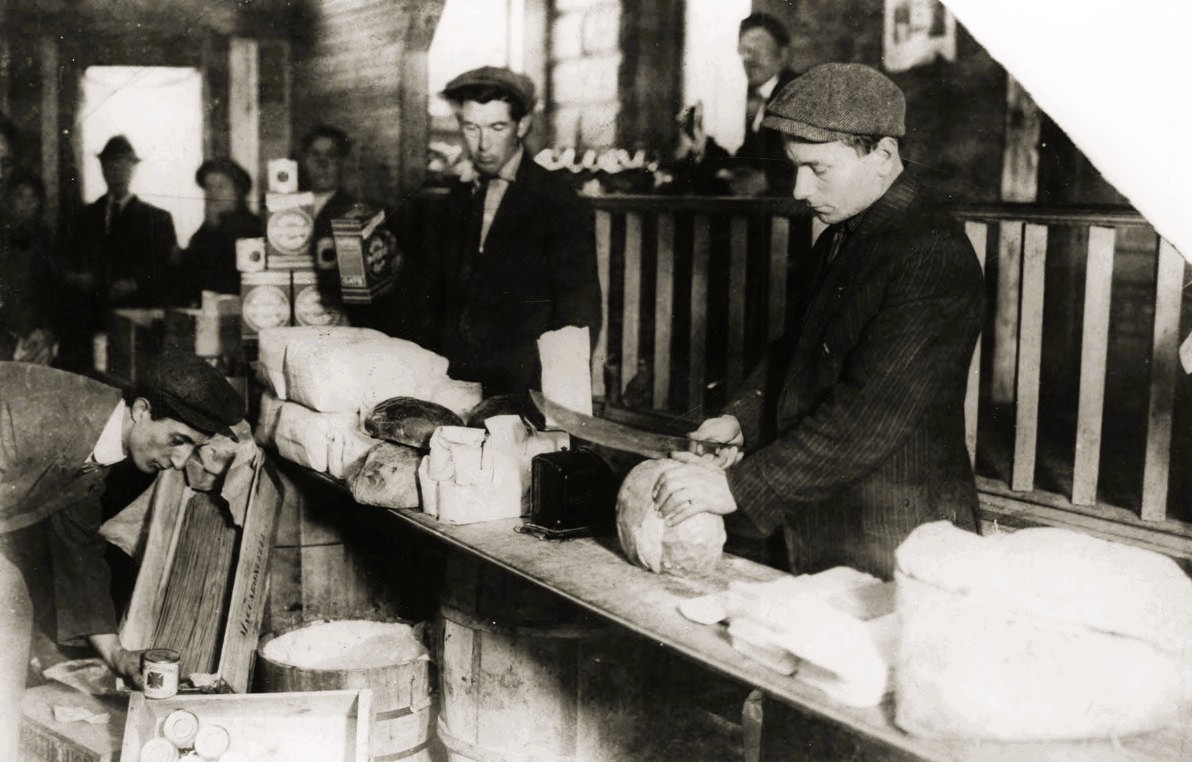
A comrade of Schenectady’s Socialist Women’s Committee on their work to feed the strikers at Little Falls over the winter of 1912.
‘Feeding the Strikers at Little Falls’ by Charlotte Kimball Kruesi from Solidarity. Vol. 4 No. 1. December 28, 1912.
Schenectady has raised and sent to Little Falls $1,400 in money, and will probably send good deal more. We have now turned over the kitchen to the strikers themselves.
During the first 10 days the number of meals served to the unmarried strikers was 696.
The number of grocery orders filed to married strikers in eight days was 180.
The number of shoes and hats and coats given out was indefinite, but filled every chink of time between meals in a room that held 24 dinners at a time, and the distribution of groceries.
What did we weigh and pack for each family of five a fair amount for two days? Two pounds of bread, one pound of pork or lard, half a pound of tea or coffee, one pound of imported macaroni, one pound of prunes, one cabbage, one cake of soap.
The cost of this was about $1 at wholesale rates, and the method was a great advance over that of giving orders for 50 cents on local stores, which had been issued daily to each needy striker.
What sort of meals did we serve? Breakfast at 8 o’clock, after picketing, costs of unlimited quantities of bread, butter, coffee, milk, sugar, herring or “fat back bacon,” or apples.
Dinners at 2:30, before the strikers’ meeting, were a pot roast with potatoes, or pork and beans and cabbage, or a stew of good meat, onions, rice, potatoes, with tea or coffee and prunes or bananas. The cost of each meal per person was 7 cents.
We had no rent to pay and no service charges and no wages, but even then we are proud of ourselves for giving people all they can eat at such a price. Comrade Beubeffsky, now in charge, who also had charge of the kitchens in Lawrence, has reduced the cost somewhat, for which I am reluctant to congratulate him.
He is feeding about 70 persons at each meal against the women’s committee’s 50 persons.
All of the committees have been careful almost to the point of being over-particular about relieving anyone who has any money left.
The women from Schenectady paid for their meals and put their 10 or 15 cents into a box on the table. Visitors and organizers did the same, from a well-known leader who insisted that he ate a quarter’s worth, to special correspondents who drew the line at 10 cents for coffee unless we gave a china instead of a tin cup.
There was no loss, no leakage here, and the relief apparently can be continued all winter.
The victory will go to those who can wait best, and reckon most closely the costs of waiting. The striking women and their class conscious socialist sisters who have given time, money, food, clothing and their liberty to steady them in the game of waiting are working well together and learning to count the various costs in order to add their experience to the common fund needed to determine working class tactics under similar conditions.
The women of Little Falls are daily adding to this fund, and I do not know what greater service they can render now.
The most widely read of I.W.W. newspapers, Solidarity was published by the Industrial Workers of the World from 1909 until 1917. First produced in New Castle, Pennsylvania, and born during the McKees Rocks strike, Solidarity later moved to Cleveland, Ohio until 1917 then spent its last months in Chicago. With a circulation of around 12,000 and a readership many times that, Solidarity was instrumental in defining the Wobbly world-view at the height of their influence in the working class. It was edited over its life by A.M. Stirton, H.A. Goff, Ben H. Williams, Ralph Chaplin who also provided much of the paper’s color, and others. Like nearly all the left press it fell victim to federal repression in 1917.
PDF of full issue: https://www.marxists.org/history/usa/pubs/solidarity-iww/1912/v04n01-w157-dec-28-1912-Solidarity.pdf
 Revolution's Newsstand