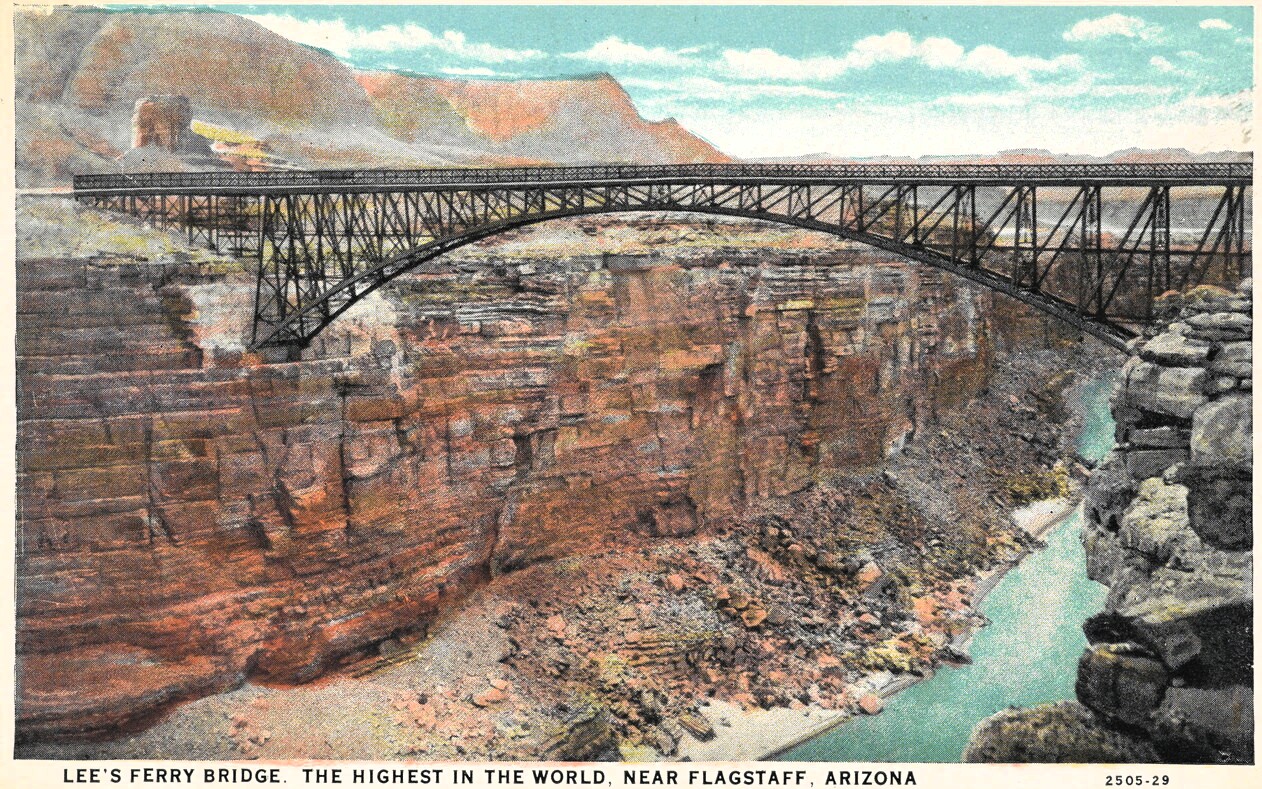
The bridge over the Colorado River in the story below, called the Grand Canyon and later Navajo Bridge, was completed in 1929 and in service until the 1990s. It exists today as a site-seeing pedestrian bridge as part of the Glenn Canyon National Park. Strangely, there is no mention of this history in its interpretation.
‘Senate Tries to Make Indians Pay for Bridge So Mellon Can Develop Oil Lands’ from The Daily Worker. Vol. 3 No. 44. March 4, 1926.
WASHINGTON, March 2. Oil deposits which Congressman Hayden of Arizona declares to be as rich as those in the Osage country have been found beneath the Navajo Indian reservation in New Mexico and Arizona. That is the prize to be won the big oil companies when the supreme court or congress shall open these Navajo lands to development under the oil leasing act. And that is why congress has witnessed a stubborn battle over the item of $100,000 which the urgent deficiency appropriation bill proposed to take from the future revenues of the Navajo tribe to pay half the cost of a bridge over the Colorado river at Lee’s Ferry.
Seek Oil Lands.
Debate before committees and in the senate and house failed to disclose the oil motive in the bridge scheme. It appeared to be a plain case of the grabbing of $100,000 of tribal funds to help pay for a highway bridge which the Indians would never use. The state of Arizona was to pay the other half of the cost, and its politicians were determined that the Indians should be robbed of that $100,000.
But when friends of the Indians objected, showing that the Navajos now have only $116,000 of tribal funds, or about $4 per Indian, the promoters of the bill explained that the $100,000 was to be taken from future royalties on oil. Hayden admitted in a speech in the house, the oil is not now being developed, but it would be, some day.
Fall and Mellon Steal Lands.
The story of the Navajos’ oil is this: Albert Fall, when secretary of the interior, issued an order opening the Navajo reservation to oil leases. He then deprived the tribal council of authority to issue the leases, and took it into his own office, thru the Indian bureau. A lease on the region which geologists pronounced the most promising was promptly given by Fall to one of Mellon’s companies—the Gipsy Oil company. Its first drilling, at Tocito, New Mexico, failed to strike the deposit. A well driven by the Midwest-subsidiary to Standard Oil of Indiana—brought a strong flow of good oil. Then the department of justice held that Fall had exceeded his authority in granting leases, and the decision of a federal court in Utah upholding Fall was appealed to the supreme court, where it now rests.
If Hayden is right in his estimate, and he says he has examined the Osage oil region, then the opening of the Navajo oil deposit will mean hundreds of millions of dollars to the oil companies that secure it. The placing of a lien of $100,000 against future tribal funds would act as a lever upon congress to adopt a bill which Hayden has drafted, to open up the Navajo lands to drilling.
Refuse to Attend Senate.
When the friends of the Indians in the senate on the afternoon of Feb. 25, had 28 votes to kill this Item, against 17 in its favor, and three other senators were noted present, the oil senators made the point that no quorum was present; there were 48, when 49 were required. Vice President Dawes ruled that a motion must be adopted to bring in members who stayed in the cloakrooms. Without a quorum this could not be done. Three senators—Watson and Robinson of Indiana and Smith of South Carolina, stood just inside the cloakroom doors but refused to permit themselves to be counted present, thereby preventing rejection of the oil bridge item. The senate then adjourned.
The Daily Worker began in 1924 and was published in New York City by the Communist Party US and its predecessor organizations. Among the most long-lasting and important left publications in US history, it had a circulation of 35,000 at its peak. The Daily Worker came from The Ohio Socialist, published by the Left Wing-dominated Socialist Party of Ohio in Cleveland from 1917 to November 1919, when it became became The Toiler, paper of the Communist Labor Party. In December 1921 the above-ground Workers Party of America merged the Toiler with the paper Workers Council to found The Worker, which became The Daily Worker beginning January 13, 1924.
PDF of full issue: https://www.marxists.org/history/usa/pubs/dailyworker/1926/1926-ny/v03-n044-NY-mar-04-1926-DW-LOC.pdf
 Revolution's Newsstand