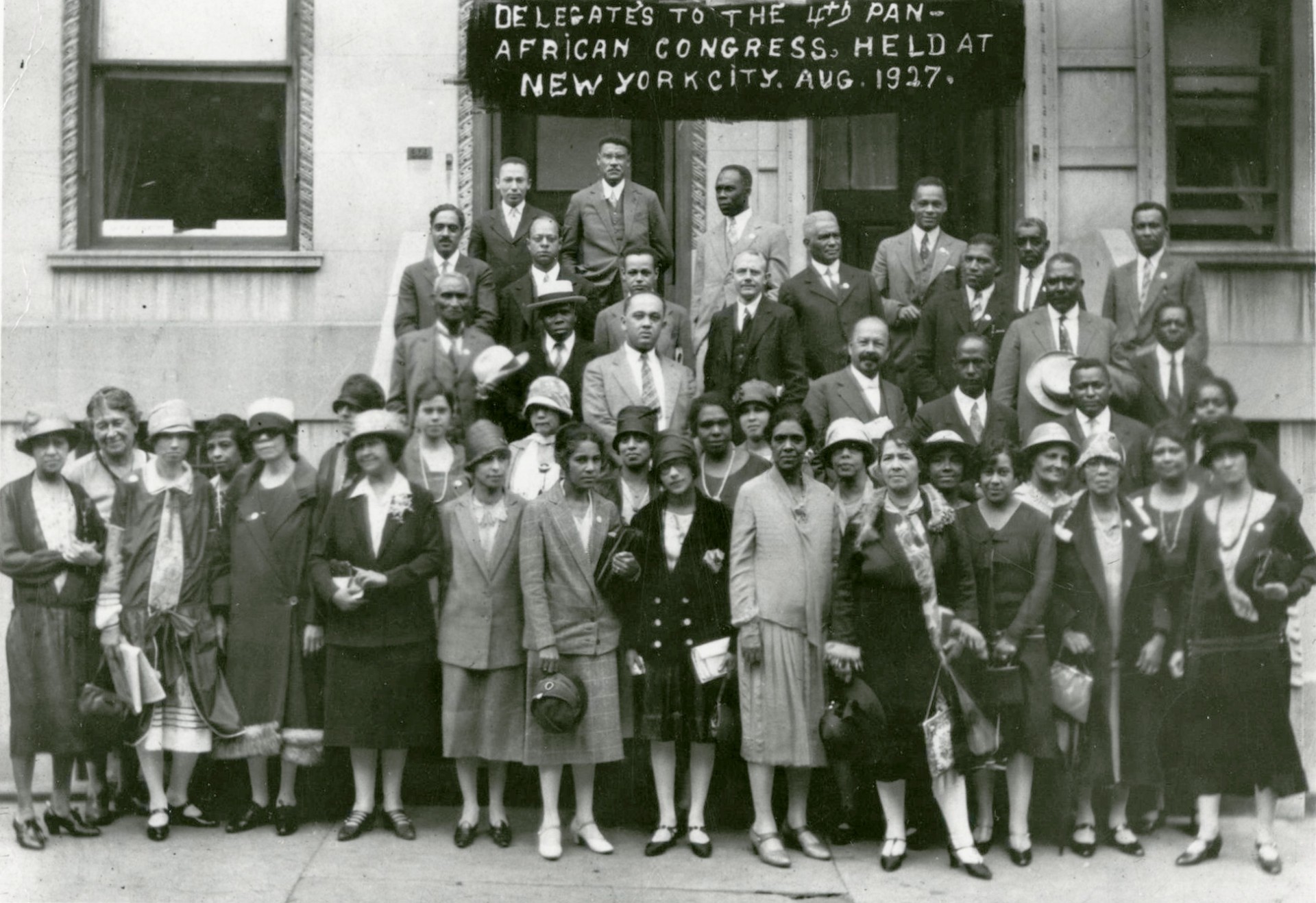
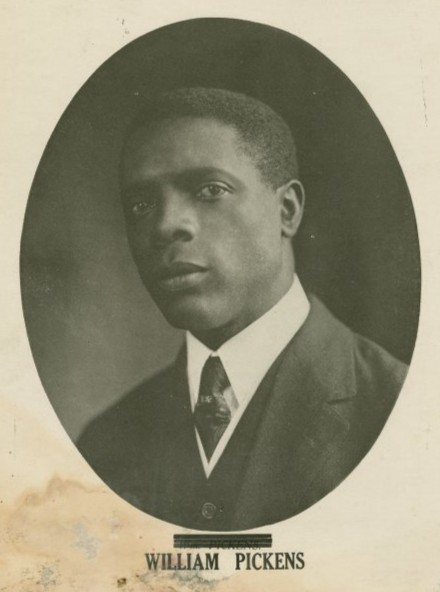
Organized by W.E.B. DuBois and first held in Paris during 1919, the Fourth Pan-African Congress was held in New York City in 1927. Here, William Pickens gives a speech on anti-imperialist, working class solidarity to the over 200 delegates during the opening session. Closely associated with DuBois for decades, Pickens was a major figure in the Black Liberation movement before World War Two and a long a fellow-traveler of the Communist Party.
‘Speech to the Fourth Pan-African Congress’ by William Pickens from The Daily Worker. Vol. 4 No. 189. August 23, 1927.
A CONFERENCE of the oppressed is the beginning of the end of the oppression. The result of mere individual effort at emancipation of any kind is so infinitesimally small that it can be put down as zero—for all the social good it may accomplish.
The beginning of the end of American slavery was not in sight until a group of run-away slaves like Frederick Douglass began to co-operate with white abolitionists like Garrison and Phillips. After nominal emancipation was achieved, repression, disfranchisement and segregation might have gone on un-challenged for generations, had not brave black men, like W.E. Burghardt DuBois, begun to confer and co-operate with just and equally brave white men, like Moorfield Storey.
The devouring of Africa, the raping of Haiti, and the bullying of Nicaragua will go forward as far as human selfishness will carry them, unless those whose welfare is at stake shall begin to confer and co-operate.
The proletariat, the workers, the producers of the goods of human society and beginning to sense a common interest in a common cause, and a need for mutual support—in Moscow, in Hankow, in Paris and in Passaic.
The Workers Know No Race.
THE ultimate causes, then, lie deeper than race or color; and any ultimate success must call for cooperation beyond all racial and color lines.
In spite of the powerful tradition of the myth of race, we wish to say that a likeness in economic condition is far sounder basis for co-operation among men than is a similarity of skin-color or nose-shape.
If there is a factory or a mill that employs many people of many different races, the destiny of those people is far more involved in their work and wages than in their language and birth-places.
But the superstition of race and of nationality is so strong in the minds of men that many movements for the good of mankind still find themselves at first narrowly limited by racial and national lines.
This shows that man’s social development has not kept pace with his scientific advancement: for human science has in the last one hundred years reduced the relative size of the earth and made of it such a small community that everybody is economically elbowing everybody else.
Coal miners in India are helping to fix the wages of coal miners in Wales; for English ships may coal in India and make a trip to Europe and perhaps back to India, without re-coaling. The speed of transportation and the instantaneousness of communication have made mere racial and national policies unstatesmanlike and silly. Human science is fast making of the world one market of goods and one community of social interests, so that enslaved workers in South Africa will surely lower the standard of living for supposedly free workers in the Mississippi Valley.
Self-seeking wealth and capital will find it advantages as water finds its level, with the unerring constancy of natural law. Tariff walls and customs officials are a most pitiful defense against the inevitable. It is like shutting out the tide with a picket fence.
Economic Lines Deeper Than Race.
BUT a movement for improvement must begin sometime, somewhere. The psychology of the masses must be recognized for what it is. The Pan-African Congress, a biennial conference of all the descendants of Africa throughout the World, was conceived by the far-seeing genius of Dr. DuBois and was first organized in Paris in 1919. It recognizes the fact that in a world largely dominated by a group-conscious white men there is a “color problem” for the colored people of the world, and especially for the descendants of Africa.
Perhaps nobody dreams that the problem of the Negro or of the Chinaman can ever be solved simply by the co-operation of Negroes or of Chinese with Chinese. The National Association for the Advancement of Colored People began with the conference and cooperation of a group of colored men styling themselves “The Niagara Movement,” and also headed by W.E. Burghardt DuBois. This movement became a real national power when by protest and publicity it brought some of the more socially-minded white people to see that they had a common interest in the claims and aims of the movement of the colored men. Racial organization is simply local fermentation—a first stage in the evolution of world organization and co-operation along economic lines. Economic lines are societally more fundamental than racial lines. The effective agent is not the theorist and his theory nor the doctrinaire and his doctrine, but human science is the miner and sapper which is laying siege to the whole works of nationalism and racialism. In the end human sciences, rather than religion, will bring to pass, not by persuasion but through necessity, a condition of universal brotherhood.
Congress of Oppressed Peoples.
IT is interesting that the first world’s conference of the oppressed has met in Brussels, Belgium, in February, 1927, eight years after the founding of the Pan-African Congress in Paris. This conference represents the first grouping together of the submerged masses through the barb-wire barriers of racial and national consciousness. This congress of the oppressed was so new that nearly every group which came to it had a different name for it. It was variously called “The Anti-Imperialist Conference,” “The League for the Suppression of Colonial Violence,” the congress of “Oppressed Peoples and the Working Class,” etc.
When the representatives of Indonesia, or the Dutch Indies, presented their resolution to the meeting, they addressed the assembled delegates as “the Congress against Colonial Oppression and Imperialism.” When the Persian delegation got the floor, it addressed the assembly as “the International Congress of Oppressed Peoples.” The South Africans addressed it as the first “International Conference of Workers and Oppressed Peoples in all Imperialist Countries and Colonies.” The Chinese said “the Congress Against Colonial Oppression and Imperialism.”
And the resolution on the Negro Question of the world spoke up in a sort of mixture of French and English and called the gathering “The International Congress contre the Colonial Oppression and imperialism.”
Abolition of Racial and Economic Oppression.
IT is clear that imperialism, oppression, suppression, financial and commercial robbery, colonial and semi-colonial tyranny, are for the first time put into the same rank together, where they belong.
The congress also put race prejudice in the same rank when it called for “Immediate abolition of all racial restrictions, social, political and economic.” This first league of the economically, politically and socially oppressed called for complete racial equality throughout the world. Some day posterity will marvel, not only that such a call was even necessary, but that it should have fallen on deaf and even hostile ears.
French Imperialism Attacked.
IT was noticeable that French Imperialism in Indo-China and in North Africa was just as severely accused as the imperialism of English-speaking nations. Colored people are accustomed to regard the French as especially just to other places. The French may lack a color psychosis and may be more cosmopolitan in their attitude on the abstract subject of “race,” but a French imperialist or economic robber is just like any other. Economic exploitation knows neither race nor color. It will attack that group which is most helpless, most open to exploitation.
The Negroes of Africa were not enslaved because they were Negroes but because they offered the greatest return for the smallest amount of outlay and effort to the slave hunter, The poorly organized and defenseless congeries of tribes appealed to the slave-raider as a Klondike, an El Dorado. They were enslaved not for being black, but for offering a resistance of spearheads to powder-driven lead balls. The French may be careless of race and color in both Paris and North Africa, but they will practice economic exploitation in the place where economic exploitation is most profitable, and that is in North Africa. Capitalistic exploiters are a natural class, not to be distinguished by race, color, language or ancient history. Even an American Negro capitalist, late descendant of raped Africa, is just exactly like other capitalists. He must be like the others. A Negro who owns a thousand acres in Olaliapia or Texas, pays his tenants and “hands” just as little and charges them just as much as any white farm-owner in the neighborhood.
The American Negro and the Pan-African Congress must see common interest and make common cause with the other oppressed and exploited peoples of the world
The world is my country.
To do good is my religion.
The Human Race is my race.
The Daily Worker began in 1924 and was published in New York City by the Communist Party US and its predecessor organizations. Among the most long-lasting and important left publications in US history, it had a circulation of 35,000 at its peak. The Daily Worker came from The Ohio Socialist, published by the Left Wing-dominated Socialist Party of Ohio in Cleveland from 1917 to November 1919, when it became became The Toiler, paper of the Communist Labor Party. In December 1921 the above-ground Workers Party of America merged the Toiler with the paper Workers Council to found The Worker, which became The Daily Worker beginning January 13, 1924.
PDF of full issue: https://www.marxists.org/history/usa/pubs/dailyworker/1927/1927-ny/v04-n189-NY-aug-23-1927-DW-LOC.pdf
 Revolution's Newsstand