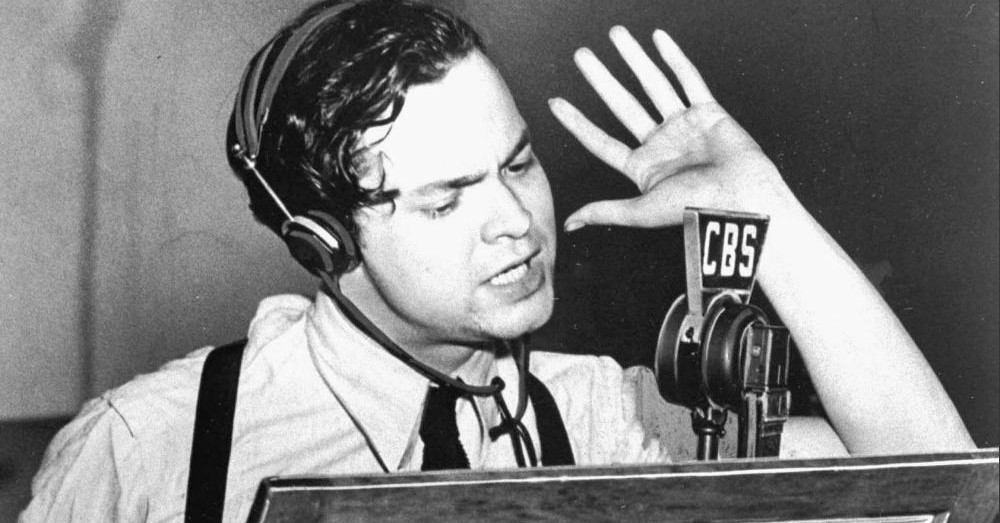
The well-fostered ignorance of an ever-dupable U.S. public has long made this country a hothouse of conspiracies and hard-held fantasy. How illuminating to read this contemporary perspective on Orson Welles’ infamous 1938 ‘War of the Worlds’ broadcast, the ultimate piece of performance art sending up illiterate American gullibility and its dangers.
‘Terror on the Airwaves’ by George Scott from New Masses. Vol. 29 No. 7. November 8, 1938.
The Grimmest Hoax of the Age
“TELL a big enough lie and the whole world will believe it.”
The truth of that axiom invented by Adolf Hitler was proved up to the hilt again last Sunday night when Orson Welles and his “Mercury Theater on the Air” troupe threw the eastern part of the United States into mad panic by a brilliantly realistic presentation of H.G. Wells’ old fantasy, The War of the Worlds.
It is not the broadcast itself, however, but the implication of the extraordinary reaction to it, that is important. The threat of war has become deeply implanted in people’s minds by these years of fascist aggression. No horror is too great, no catastrophe too overwhelming, to appear possible. The calculated terror spread by the manipulators of Munich seemed suddenly to be actually at hand–in an entirely unexpected place, without a moment’s warning–and many thousands of people believed it. It was death on the march, death dropping from the skies, bombardment, poison gas–no one stopped to think exactly what it was–and it fitted perfectly with the threats from Rome, Berlin, and Tokyo, with the stories of Guernica and Canton. This creation of panic among those who mistook a dramatization of an old novel for a news broadcast illustrates all over again the method by which Chamberlain and Daladier accomplished their Munich betrayal. Several nights before the debacle the Columbia network presented Archibald Mac Leish’s equally realistic “Air Raid.” But that story of the wanton destruction of a peaceful village was set somewhere in Spain or China or Ethiopia and the result was that it caused only a flutter of interest among listeners.
Then Welles got the brilliant idea of moving the locale of Wells’ story to the Watchung Mountains of New Jersey and describing the descent of the Martians on New York in the same manner used by radio in covering the Czechoslovakian crisis. Immediately hell broke loose. Listeners, made jittery by the recent war scare, went mad with terror when it seemed that they themselves were to be the victims.
It’s a safe bet that no reader of NEW MASSES was scared out of seven years’ growth by those spectral Martians, but thousands of other people were. Seized by a mass hysteria which has few parallels in American history, they dashed from their homes seeking safety, pleaded with police for gas masks, offered their services to the National Guard, mobbed the churches, and otherwise conducted themselves exactly as the actors in a faraway radio
studio seemed to be doing. Completely out of their senses, they became pawns subject to the will of a superb actor. By this time you know the rest of the story.
Or do you? Listen to this:
Back in 1926, during the general strike in England, a detective-story writer named Father Ronald Knox used this same hair-raising technique in dramatizing a fictitious Communist uprising over the British Broadcasting Corporation network. So cleverly did he depict the rapine and murder supposed to be taking place in London that the entire country was thrown into a frenzy of terror. Of course the BBC apologized for the program later, but it had a great deal to do with the demoralization and defeat of the strike.
And, of course, Hitler and Mussolini used the trick in their attack upon Austria and Spain and Ethiopia and finally Czechoslovakia. Those who listened to the rebroadcasts of fascist programs over WOR during the latter tragedy could see plainly how the Germans were whipped to frenzy, the Sudetens egged on to excess after excess and the morale of the Czechs undermined by the endless barrage.
Luckily for America, it was an actor before that microphone the other night instead of a Huey Long or a D.C. Stephenson. Now that the cry of wolf has been raised over such a comparatively harmless matter, it will be a long time before the American public lets itself be taken in again in the same manner. And yet–the Republican Party, you know, moved heaven, earth, and everything but the Federal Communications Commission, in its effort to be allowed to dramatize campaign programs. And there must be many bright young men studying that radio script today and wondering how they can make capital out of it. At the same time liberals throughout the country have been given a shattering object lesson as to what might happen if the greatest propaganda medium ever invented should fall into hands willing to misuse it.
This does not mean, of course, that censorship by the government is the answer to the problem, as Sen. Clyde L. Herring of Iowa is suggesting as this is written, and as various pressure groups, Catholic and otherwise, undoubtedly will be demanding by the time it is published.
For one thing, the Columbia Broadcasting System has been scared stiff by the storm unloosed about its head and by the threatened FCC investigation and will never make the mistake of being too realistic again. For another, the thing needed is not more censorship, but less censorship and more education for the radio audience. It is entirely possible for the intellectual level of listeners to be raised to the extent that they would stop believing that all radio dramas were real. But that will only come through the vociferous demands of thinking people among that audience and not by government intervention.
And finally, let it be whispered that a great deal of this fuss has been whipped up by those bitter enemies of the radio–the newspapers. As was reported several weeks ago in NEW MASSES, the press took an awful beating by the networks in the coverage of the Czech crisis. As a result the monopoly investigation into broadcasting, for which the publishers had been largely responsible, showed signs of collapse. Is it any wonder, then, that they snatched at the War of the Worlds incident and played it up out of all proportion to its news value just to get even with a rival?
Americans hate to be made to look foolish and there was, undoubtedly, a lot of resentment among those who had been taken in by the broadcast. But if any real movement gets under way to hamstring radio as the result of the incident it undoubtedly will be the work of the press and other groups which long have had their knives out.
Of all the New York papers, only the Post and the World-Telegram had a kind word to say for CBS after the broadcast. Leonard Carleton, radio editor of the former sheet, pointed out that the whole misunderstanding was due to “dialitis”–the habit of switching from one program to another without paying attention to what is being tuned in. It was because of this, he maintained, that so many listeners failed to hear the reiterated announcements that the story was imaginary and were swept off their feet by the sheer force of the drama.
Alton Cook of the World-Telegram commented that the tip-off to listeners should have been that the time elements of the story were telescoped after the first few minutes of the program and also that H.V. Kaltenborn was not cutting into the program with his endless explanations of every phase of the “disaster.”
There is one more curious item to be commented upon before The War of the Worlds broadcast takes its place with Richard Adams Locke’s Moon Men, Edgar Allan Poe’s trans-Atlantic balloon trip, George Hull’s Cardiff Giant, and the ubiquitous Loch Ness Monster as one of the world’s greatest hoaxes. That is the fact that children didn’t believe the yarn for a minute!
Did you read reports of Little Susie, aged ten, running screaming through Central Park, or Little Bobbie, aged twelve, begging a policeman for a gas mask? No, indeed. While their white-faced elders were milling around in circles, the darlings, who have been brought up on a diet of “Buck Rogers,” “Gang Busters,” “The Shadow,” and other realistic horror programs, went on playing with their toy machine guns and bombing planes. All of which suggests that, at long last, radio propaganda may develop its own anti-toxin.
The New Masses was the continuation of Workers Monthly which began publishing in 1924 as a merger of the ‘Liberator’, the Trade Union Educational League magazine ‘Labor Herald’, and Friends of Soviet Russia’s monthly ‘Soviet Russia Pictorial’ as an explicitly Communist Party publication, but drawing in a wide range of contributors and sympathizers. In 1927 Workers Monthly ceased and The New Masses began. A major left cultural magazine of the late 1920s to early 1940s, the early editors of The New Masses included Hugo Gellert, John F. Sloan, Max Eastman, Mike Gold, and Joseph Freeman. Writers included William Carlos Williams, Theodore Dreiser, John Dos Passos, Upton Sinclair, Richard Wright, Ralph Ellison, Dorothy Parker, Dorothy Day, John Breecher, Langston Hughes, Eugene O’Neill, Rex Stout and Ernest Hemingway, Artists included Hugo Gellert, Stuart Davis, Boardman Robinson, Wanda Gag, William Gropper and Otto Soglow. Over time, the New Masses became narrower politically and more journalistic in its tone.
PDF of full issue: https://www.marxists.org/history/usa/pubs/new-masses/1938/v29n07-nov-08-1938-NM.pdf
 Revolution's Newsstand