A persistent political question for the Canadian bourgeoisie, big and petty, is which empire to face. An occasional question for U.S. imperialism is whether to invade and annex Canada, with one war, the ‘War of 1812’, fought with that purpose, and several other close calls.
‘The British Empire or a “Pan-America”’ by Stewart Smith from International Press Correspondence. Vol. 7 No. 12. February 4, 1927.
The overtures of the Pan-American Union to Canada mark a new stage of the political developments within the British Empire. The “older league of nations”, the Pan-American Commercial Union, which has been functioning for thirty-five years as the direct imperialist weapon of American finance, and has a membership of 21 nations with a population of some 200 millions has invited Canada to occupy its presumptuously pre-arranged seat in the new, million-dollar chambers in Washington. The report of the British Imperial Conference, recently concluded in London, was hailed as Canada’s “Magna Charter”, the Canadian equivalent of America’s Declaration of Independence. The appointment of Vincent Massey to the post of “Canada’s Minister at Washington”, was declared by the chairman of the Pan-American Union, Mr. Barrett to be “the most important and significant event in the twentieth century relations of Canada and the United States”. Now that the Imperial Conference “has swept away the sole difficulty” he felt that “the way was opened for the realisation of a perfect organisation and solidarity within the western hemisphere”. So confident is American imperialism of the entrance of Canada, that the permanent construction of the Pan-American Union building will include a plaque for Canadian Arms, a Canadian panel in the Council Chamber and a chair carrying the name and Arms of the Dominion. Toronto, Canada was decided upon as the meeting place for the Union next year.
The Intention of Wall Street.
Mr. Barrett, as the spokesman of Wall Street interests, went on to say, that in 1923 he had secured from 200 leading statesmen and “business men” in the hemisphere a unanimous agreement that Canada should join the Union. While he did “not pretend to know the opinion of Coolidge and Kellogg in this important international question”, he could not believe “especially in view of the rapidly growing relations of Canada with all Latin-America and the great forward step of the appointment of a Canadian minister to Washington, that they will differ materially from their predecessors”.
The words of Mr. Barrett are much more of a threat than an invitation. Now that Canada has side-stepped any entanglement of Imperial obligations, and particularly now that her trade interests are turning more and more to Latin-America, American imperialism does not hesitate to make plain to the Canadian bourgeoisie that the time has come for Canada to step inside the pale of the “Monroe Doctrine”.
The “Sole Difficulty”.
The primary objective of the Pan-American Union is stated as follows; “to maintain the isolation of the Western Hemisphere from foreign encroachment”. It openly boasts of “a higher civilisation, a vaster wealth and great potential, if not actual, naval and military power than the Geneva League”. The big bourgeoisie of Canada offer the following reply through their chief mouthpiece, the “Montreal Gazette” which felicitates itself upon the possession of a first-class crown-colony attitude on all question:
“It is conceivable that Canada is not yet ready, despite the pending departure of Mr. Massey, to revolve around the U.S.A. in even so mighty, wealthy and powerful a constellation. For one thing, the relationship might not be consistent with the newly established principle of national equality, unless someone is prepared to argue that equal status within the Empire is reconcilable with international inferiority.”
This represents a change of front of the Canadian bourgeoisie. Previously, the big capitalist interests have, whether sincerely or not, regarded the loud talk of the liberal politicians about “independent national status” as dangerous tendency. They now present a nationalist front to American imperialism on the basis of the “newly established principle of national equality”.
Clearly Mr. Barrett’s “sole difficulty in the way of the unity of the Western hemisphere”, under the domination of America has not been “swept away”. The “sole difficulty” still remains in the form of the British Empire in the first place, and the interests of the Canadian bourgeoisie in the second place. If the liberal politicians of Canada now begin to represent the American interests in Canada (as a first step, by sending Mr. Massey to Washington), after having developed the nationalist sentiment against British domination, the big bourgeoisie, who still dominate the economic life of the Dominion, now combine their role as the champions of British Imperialism with that of the defenders of the nationalist interests.
The Situation within the British Empire.
The recent British Imperial Conference indicated the coming of age of the Dominion bourgeoisie. The “white” Dominions have become the co-partners of Britain in the exploitation of the black colonies. Their interest in the Empire is now an imperialist interest. The Dominion bourgeoisie finds in the Empire, and in the United Kingdom itself an expanding market. The fundamental principle of English trade policy, that England must be the industrial centre of an agricultural Empire, has been shattered, in part, by the rapidly developing Dominions. In fact this main spring of English trade has started to recoil. As early as 1923, every Dominion had either a balanced or a decidedly favourable trade with England. Since that time Canada’s exports to England have risen by £18,000,000, her imports from England remaining the same: Australia’s exports by £23,000,000, imports by £3,000,000; British Indies exports by £13,000,000 while imports fell by £1,000,000. With these three England has the largest trade. All reveal identical tendencies of a rapidly increasing export trade with England, and a relatively static import trade.
In accordance, with the economic advance of the Dominion bourgeoisie, they have continually advanced their political position. At the Washington Conference they apparently agreed entirely to British policy. At Chanak, the break commenced. At Lausanne there was open friction. At the London conference on Reparations only a hypocritical unity of front was maintained. And finally, at Locarno, the Dominions have indicated their complete refusal to be bound by British foreign policy. The Imperial Conference marked the culmination of this process, bringing the Dominions to a position as close to equality as is possible within the shell of the Empire. The Dominions are still formally bound by the Imperial government, but obviously if the Dominions refuse to sign the Locarno “Peace” Pact, they have no intention of being implicated in British foreign policy, and at the very moment, when the Imperial government will attempt to implicate them, the shell of the Empire will prove too weak to hold the Dominions. Up to that point, the Dominions can have no incentive to leaving the “imperial partnership”, so long as they have the best of the bargain, as at present.
The Dominions and the United States.
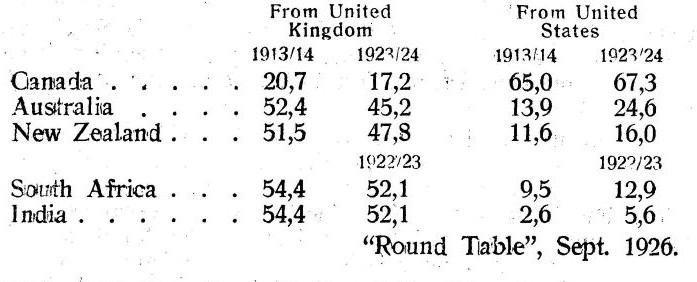
The process of the rise of the economic and political position of the Dominions within the Empire finds its counterpart in increasing economic dependence upon the United States, and the following table shows the imports from the United States and the United Kingdom, compared in percentages:
The distinct tendency indicated here becomes even more sharply defined in purely competitive goods, e.g. the following shows the percentage of Australia’s imports of metal and competitive goods from the United Kingdom and the U.S.A.:
This trade of the Dominions with the United States, however, quite the opposite of that with the United Kingdom, results in an adverse balance for the Dominions. Thus the anomalous situation prevails that the favourable balance with the United Kingdom only succeeds in making up the unfavourable balance with the United States. In spite of the British preference tariffs in the Dominions, England is unable to compete with America on “her own market”. Along with the rapid expansion of the Dominions’ industry has gone an expansion of the market in the Dominions. In the industrialisation, American capital has played a major role in Canada; a minor role in some of the other Dominions. The expansion of the market has fallen almost wholly to America.
The process of the financial domination of the Dominions by American finance has not yet developed far, in others than Canada. The financial dependence upon the United States, however, must inevitably increase. The representatives of the Dominions stated quite openly at the Imperial Conference, that they will have to turn more and more to America for finances. The situation in England indicates that the Dominions will have to turn entirely to America for financing, which cannot be secured within their own boundaries. America on the other hand, sees in the Dominions of the British Empire one of the most profitable fields for investment in the world.
The British Imperialists look askance upon this situation. In spite of the fact that this process has by no means reached its full impetus, the Dominions have begun to indicate distinct political leanings towards the United States. At the time of the abrogation of the Anglo-Japanese Treaty, the Dominions were drawn closer to America, Canada becoming incensed over Curzon’s call to arms. Australia, with her own little “Monroe Doctrine” stands in constant fear of being embroiled in British, Pacific implications. Her extraordinary reception of the American navy in 1925, and her continuous declarations of friendship for Japan indicate her fears.
The Situation in Canada.
Each one of the currents within the Dominions finds its highest expression in Canada. Canada is the most highly industrialised, the largest and richest, and is invested with more American capital than any other country in the world. Geographically, it is the richest and most natural direction for American expansion. More than one-quarter of America’s foreign investments have been placed in Canada, and one eighth of America’s trade is with Canada. American capital has, for the most part, entered Canada since the war, and is to be found in the first place, in the Canadian National (government controlled) Railroad, which was formed from two bankrupt railways, previously under the domination of English capital, and is to-day, in the hands of the liberal politicians, a tool for rate-cutting, as a concession to the farmers. In the second place, it has the pulp and paper industry and metallurgical mining, both of which are now gigantic industries based almost entirely on Canada’s unequalled hydro-electric power generation. and serving the United States market. Finally, American capital has developed the automobile and rubber and such similar industries, which while serving the Canadian market to little advantage, find a large market within the Empire owing to the preferential tariff. The Canadian capital itself, which is the predominant factor (60% of the total, according to average estimates), being invested in all the various fields, has equally diverse interests.
On the political field, these interests congregate in the liberal and conservative parties. The Liberal Party, having split away the right-wing of the Progressive (farmer) Party, represents the agrarian, anti-protectionist interests, the French-Canadian autonomist interests and the American capital, imperial preference interests. The Conservative Party has behind it a unity of interests for high protection against America. Both of these parties are constantly faced with internal differences. The Liberal Party, although successful in maintaining itself in office by clever manoeuvring, is already threatened with destruction by the seductive approaches of the Conservatives to the farmers, and French-Canadians.
The Conservative Party, the representative of the greatest capitalist forces in Canada, must inevitably come in conflict with the interests of American imperialism in Canada. The approach of the Pan-American Union is merely a first indication. The annexation policy of American imperialism was not completed with Texas, California, Oregon and Alaska, five times the original territory of the U.S.A. She has subjected Panama, the Dominican Republic, Haiti, and Honduras, forcing Panama to violate her membership in the League of Nations. Political domination follows economic enslavement. She will not hesitate to exert political domination in Canada. But just as the vacillating liberal politicians of Canada have proven themselves incapable of conducting a struggle against British imperialism, because they represent a confusion of capitalist interests, which are inevitably entangled with the Empire, so the big bourgeoisie of Canada are incapable of resisting American imperialism, with which their interests cannot fail to intertwine.
The Perspective for the Workers and Poor Farmers.
Only the workers and poor farmers of Canada are capable of waging the real fight against imperialist domination. In the first task, that of linking up their forces on a national scale, and organising the masses of the unskilled workers in the new lumber, paper and metallurgical industries, the Canadian workers find themselves confronted with the advance-agents of American imperialism, the bureaucracy of the American Federation of Labour. In their attempt to block the formation of an independent all-embracing trade union centre in Canada, capable of conducting the workers’ struggle on a national scale, and of organising the masses of new unskilled industrial workers, embracing large numbers of the French workers, the A.F. of L. imperialists are destined to failure. The workers of Canada will be forced to unite their forces. While this is taking place, the masses of the impoverished farmers of Canada, “wage-workers” of the banks and mortgage companies, “masquerading in the guise of landed proprietors”, are brought into ever more direct conflict with their enemy, through their wheat-pools. Only the unity of these forces under the leadership of the Communist Party, is capable at one stroke of breaking the bonds of the British Empire, overthrowing the divided forces of the bourgeoisie, ousting American imperialism and establishing an independent Workers and Farmers Government. The perspective of the workers and poor farmers of Canada can be neither to remain within the British Empire, nor to fall under the domination of American imperialism.
International Press Correspondence, widely known as”Inprecorr” was published by the Executive Committee of the Communist International (ECCI) regularly in German and English, occasionally in many other languages, beginning in 1921 and lasting in English until 1938. Inprecorr’s role was to supply translated articles to the English-speaking press of the International from the Comintern’s different sections, as well as news and statements from the ECCI. Many ‘Daily Worker’ and ‘Communist’ articles originated in Inprecorr, and it also published articles by American comrades for use in other countries. It was published at least weekly, and often thrice weekly. Inprecorr is an invaluable English-language source on the history of the Communist International and its sections.
PDF of full issue: https://www.marxists.org/history/international/comintern/inprecor/1927/v07n12-feb-04-1927-inprecor-op.pdf
 Revolution's Newsstand