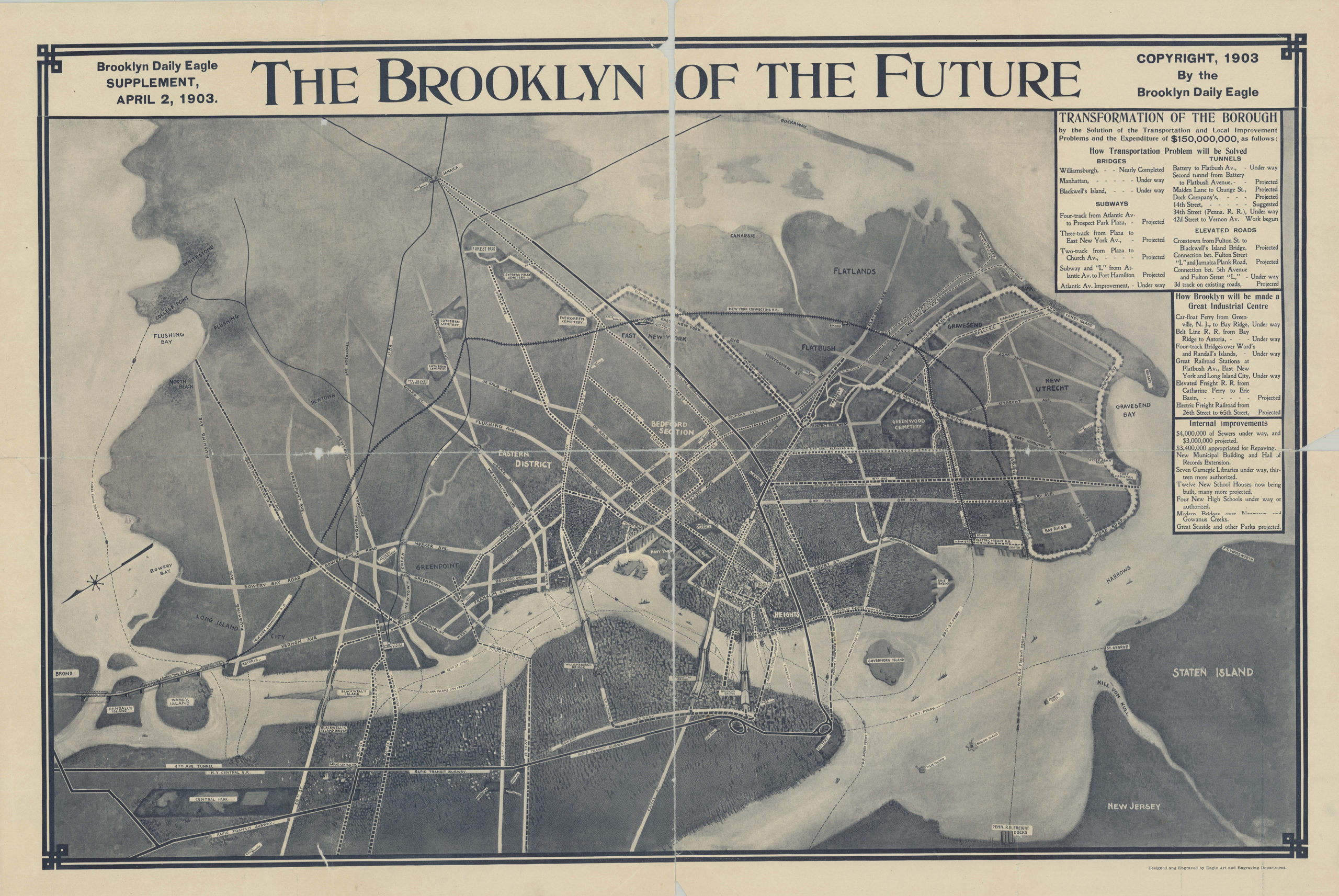
Spinning wheels of progress for the last century with an economic system not only incapable of solving basic human needs, but downright detrimental to them. With a change in the figures, this article on Brownsville’s housing crisis of one hundred years ago could be written today, down to the generation of ‘upwardly mobile’ migrant renters.
‘Brooklyn Housing’ by Will De Kalb from The Daily Worker. Vol. 4 No. 36. February 24, 1927.
Brownsville Tenements Averaging $45 a Month Take 30 Per Cent of Pay
Brownsville, happy little Brooklyn trans-bridge village of a generation ago, today rivals the east side in high rents, congestion and unkempt streets. Violation of building and fire codes is rife, Will de Kalb, DAILY WO’RKER investigator found after a careful survey. De Kalb will cover every important working class district in New York in this series, and promises a few additional on housing for the leisure class.
The emigration from the lower east side to Brownsville was one of the great heroic acts of a past generation of New Yorkers.
Unable to bear the intolerable living conditions in the Ghetto, groups of poor workers moved to the Brownsville section in Brooklyn, in the hope that in the island across the bridge, a homeland paradise could be found.
And the story of their disappointment is further evidence of the terrible condition in which New York finds its housing situation.
Brownsville, contrary to general belief, is essentially a native, not a foreign community. The foreign-born residents of the Ghetto brought with them from Europe a certain animal-like patience and submission that fortunately was lacking in their American offspring. On attaining maturity, the youths rebelled. They moved to Brooklyn. Brownsville prospered, and a thriving community was born.
That was some thirty years ago. The hairs in the proud heads of those rebel youths have turned gray. Not only because of age, however. Long hours of toil, in an endeavor to live in a section where living standards are higher than in the Ghetto, have aged these emigrants before their time.
Landlords Organize.
No sooner did the landlords of Brownsville sense a constant influx of dependable, hard-working, peaceful citizens, than they put their heads together. Here was their opportunity.
They must control the situation. What did they do? What the workers have ever been laggard in doing, organize. They joined the local business men’s organization. A special committee on housing was appointed. The interests of the landlord were to be well looked after—at the expense of the tenant.
More Fire Traps.
Brownsville has grown unaccountably in those thirty years, and yet not one-sixteenth of its houses are modern. Fire escapes, in many cases, I found to be totally lacking in spite of the tenement house laws; and the halls and stairways were so built, if a fire ever broke out, the windows would furnish the only means of escape. For there are as many families on a floor there as in Brownsville; some houses have thirty families.
Almost all of the two and three-story buildings have not only no fire escapes, but no other means of egress except a narrow wooden stairway in the center.
And if officialdom gets its way, Brownsville’s streets will soon resemble those of the east side. On one street, two blocks from the main thoroughfare, a janitor told me that street cleaners and dump-carts were seen only once in three days. This I verified, and found to be true.
But Rents Are Higher.
The homes, of course, are much better than those of the east side. Many have steam heat. Not so many people are crowded into one apartment. But the only difference between Brownsville and the Ghetto was made by the untiring efforts of the workers.
I got my greatest shock when I compiled a list of rentals to strike an average. The average rental is $45 per month, with rents varying between $35 and $75. This, in spite of the fact that the average apartment consists of only three rooms; almost none are larger than four.
These exceptionally high rents for workers’ homes result from but one factor—the aggression of the landlords. At every opportunity, rents were raised. Twelve cases, testing the rent laws from every minute angle, were instigated by Brownsville landlords who wanted to know just how far they could go.
Even then they were not satisfied—hundreds of cases of Brownsville landlord vs. Brownsville tenant were tried in the courts, the landlord seeking to gain by law what he could not sabotage by bluster and trickery. If a powerful tenants’ organization was not formed in Brownsville in 1922, that community would be paying still higher rents today.
No Repairs Made.
And even that organization was unable to force the landlords to make necessary repairs. Of ten apartments I visited in the district, seven had leaking faucets in the kitchens, each hour wasting more of the taxpayers’ money.
Forty-five dollars per month—$15 per room! In spite of the average wage, $38 a week!
Wages vary considerably in Brownsville. Some families had an average wage-income of $20, others $80. It was the latter figure that brought the average wage up to $38. But it must be remembered that few of those who earn more than $55 a week, are employed all year round. And many who earn less than $55 a week, are also employed in seasonal industries.
So that while $45 a month must be paid out for rent all year round, $150 wages are not coming in every month all year round. When the outlay exceeds the income, pinching results. They pinch sometimes in Brownsville. But that’s nothing. They learned how to do that, and grin and bear it, in the Ghetto.
In Soviet Russia, laws make it impossible for gouging landlords to charge more than 10 per cent of the workers’ wages for rent. The minimum is 3 1-2 per cent. Rents average around 5 and 6 per cent. In America, and right here in Brownsville, rents average 30 per cent. What a difference!
In spite of this, there are as few empty apartments as in the Ghetto, I walked three miles—I met only seven “Apartment To Let” signs. What, Assemblyman Jenks, no housing shortage?
Jenks In Swell Albany Hotel.
I wish Jenks were with me when I walked into a real estate office to write this article. The realtor in charge showed me a list of available apartments. It hardly filled three-quarters of a typewritten page. And this realtor is known to have the largest trade among landlords in the Brownsville section.
I asked janitors, and they told me they had lists of people who wanted to move away from their present locations. She often received handsome bonuses from future tenants, she said, by notifying them immediately when a tenant gave her a moving notice. Waiting lists have been in vogue for the past six years.
Brownsville, the community founded by progressive youth, has been lying dormant for the past decade, satisfied with having grown into maturity. But The DAILY WORKER has sounded a call to arms. Progressive workers are massing themselves against the housing shortage, the creature of crooked politicians, money-mad landlords, and dollar-greedy builders.
Brownsville, the product of rebellious youth, will rally once more, and fight for better housing. You see, that’s just the way it’s built. It’s in the Brownsville blood. And maybe it won’t be a fight, eh! It will, if Brownsville can help it.
The Daily Worker began in 1924 and was published in New York City by the Communist Party US and its predecessor organizations. Among the most long-lasting and important left publications in US history, it had a circulation of 35,000 at its peak. The Daily Worker came from The Ohio Socialist, published by the Left Wing-dominated Socialist Party of Ohio in Cleveland from 1917 to November 1919, when it became became The Toiler, paper of the Communist Labor Party. In December 1921 the above-ground Workers Party of America merged the Toiler with the paper Workers Council to found The Worker, which became The Daily Worker beginning January 13, 1924.
PDF of full issue: https://www.marxists.org/history/usa/pubs/dailyworker/1927/1927-ny/v04-n036-NY-feb-24-1927-DW-LOC.pdf
 Revolution's Newsstand