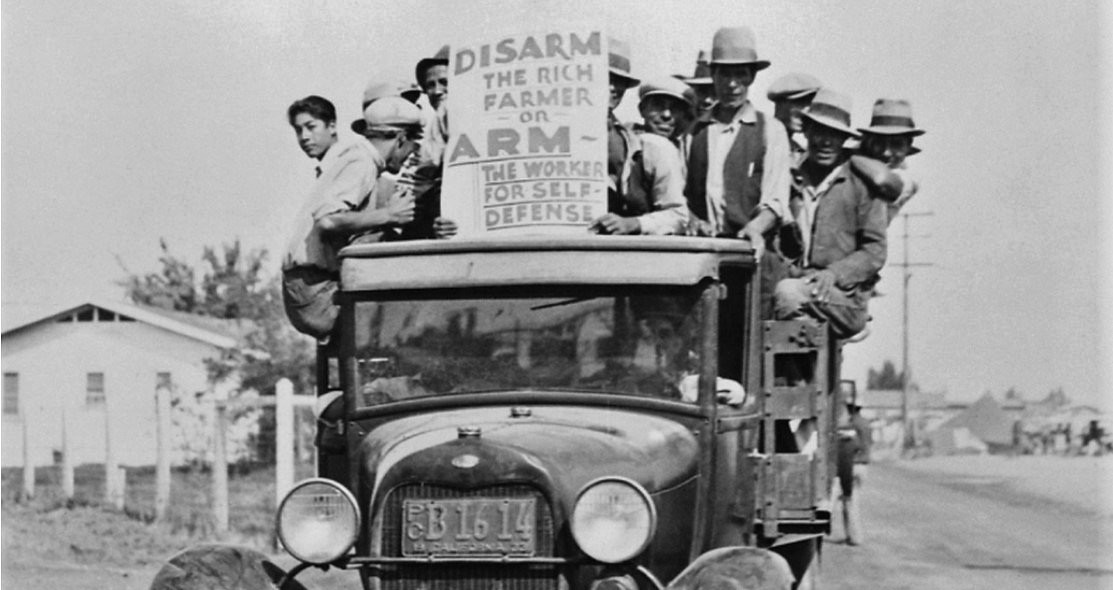
The T.U.U.L.’s Cannery and Agricultural Industrial Union organizes among the most exploited workers in the country, and are confronted by the local forces of legal lynch law.
‘Law and Order in Imperial Valley’ by Roy T. Layton from Western Worker. Vol. 3 No. 10. March 5, 1934.
For “willfully roaming about from place to place without a lawful purpose”, Emma Cutler, brilliant young organizer for the Cannery & Agricultural Workers Industrial Union, is sentenced to serve six months in jail following her conviction in Judge W.H. Lorenz’ court in Calexico.
C.A. Hoffman, on a similar charge, which is vagrancy according to state law, is given a six month’s suspended sentence, with orders to leave Imperial County immediately. Most outrageous of all is the arrest and trial of Clarence Lynch, International Labor Defense attorney of Arizona, who came to Imperial County to represent in court vegetable workers who had been arrested and slugged and jailed merely because they refused to work for wages set by the growers. After a prolonged trial, Lynch was liberated.
Referring to these cases The Los Angeles Times in its issue of Feb. 22, editorially said:
“Such people are a real menace…and must be prevented from effective activity. Almost any method is justified. If these agitators went to Russia and indulged in equivalent activity, they would be snuffed out by at firing squad. Such extreme measures are not needed here yet, but they may become necessary if milder ones are not applied.”
Riverside Frame-Ups.
Illustrating the attitude of the prosecutor in another case, the following is cited.
“If you don’t render a verdict of guilty for these defendants, there are men right here in this court BEHIND THIS RAIL who will ride out at night, and I WILL GO WITH THEM!”
These words were spoken by District Attorney Redwine of Riverside County to the jury which convicted seven workers on the charges of vagrancy for organizing in Riverside County. Redwine’s intimidation was effective. Sentences of from forty days to eighteen months in the county jail were imposed. In all these trials the hostility of the judges and the bias of the jurors were evident. They were not trials; they were simply a judicial slaughter.
During the course of the Riverside trial nine additional workers were arrested on the courthouse steps and placed in jail on charges of loitering and obstructing the sidewalk. They will be tried before this same court on March 1st. Their arrest was made in a most spectacular manner. With a great flourish of revolvers and sub-machine guns, officers surrounded the nine workers, among whom one was a woman, and marched them to jail as if they were criminals. They were searched, given the third degree and subjected to every possible insult. Their only crime was that they wanted to attend an open court where their fellow workers were on trial.
Arrest Emma Cutler.
The arrest of Emma Cutler at Calexico was especially outrageous. As union organizer she went to Calexico, with ample money in her pocket, to ascertain the whereabouts of certain union officials who were missing. She suspected that they were in jail, and she wanted to learn the facts so she could give them assistance. While driving through the streets of the town she was stopped by officers, searched, insulted, and taken to jail. The charge against her read: “Willfully roaming about from place to place without a lawful purpose.”
When she and Attorney Lynch and C.A. Hoffman went to trial, the district attorney of the county and his ablest assistant took charge of the prosecution.
Deliberate attempts to pack the jury were made. On every point, Judge Lorenz ruled against the defense attorney, Grover C. Johnson. Finally, when the jury returned a verdict of guilty, the court imposed the fullest penalty of the law.
Bankers Celebrate.
There was great rejoicing at a banquet at the Planter’s Hotel in Brawley, given by Imperial Valley bankers, business men and vegetable growers, on the night of the day following the conviction. The assembled plutocrats denounced the “agitators” in unmeasured terms and the workers were referred to as “contented cattle” if left alone. Said one grower:
“These Mexicans, N***rs, Filipinos (and, we might add poor white trash) never gave us any trouble until these Red agitators came here and began to stir them up. Why, these people have always been a poor hard-working class of people, contented with their lot, and they never could have kicked at the wages we gave them if it were not for these Reds. These workers don’t need much. A dollar a day for a 12-hour-day is enough for them. Their children don’t need education. What could they do with an education? We growers need them to work, and work they shall, in spite of all the agitation of the Reds. What we ask of these agitators is that they shall stay out of Imperial Valley and let us alone. If they do not, the treatment we have given them in the recent past won’t be a circumstance to what we will hand them in the future!”
Following the refusal of the pea pickers to return to work at the old scale of le a pound, and the passage of stiff anti-picketing the workers were ordinances, herded into what became known as “The Desert Camp”, five miles. northeast of Calipatria. This camp bordered an irrigation ditch. As best they could, the workers improvised rude shacks out of tent cloth and desert grass and settled down five thousand strong, to await developments.
Workers Unarmed
These workers possessed no weapons either for defense or offense. This, the officers and vigilantes well knew. During their residence in camp, heavily armed officers and vigilantes, most of whom were members of the American Legion, and Silver Shirts sent to the Valley from Los Angeles, circled the workers, their revolvers and sub-machine guns drawn, challenging them to fight. Repeatedly, the armed thugs tried to provoke the workers to combat. What they desired, of course, was an opportunity to open fire upon the camp, as was done at Ludlow, Colo., many years ago, with the object of brutally killing the workers and members of their families in cold. blood.
“It was galling to stand there defenseless and hear the jeering taunts of the officers and vigilantes,” said one of the workers. “Were as many of us armed as were the thugs, and were we given a chance to get at them without injury to our families, we could have run that whole cowardly crew into the Gulf of Lower Mexico. As it was, action on our part would have been fatal. We would have been slaughtered like dogs had we resented their provocative activities.”
Evict, Burn.
On Sunday night, Feb. 18, at 10 o’clock, a gang of about three hundred officers and vigilantes entered and thoroughly searched the camp. No resistance was offered. Two rusty old shotguns, with no shells, were unearthed, which were confiscated.
Next morning at about 10 o’clock approximately five hundred armed men, headed by the sheriff of the county and the county health officer, invaded the camp and condemned it on the ground that it was unsanitary. The campers were ordered to get out. Those who made tardy exits were pushed violently and slugged. Women and children were not spared during the procedure. Before the last camper had gotten away the torch was applied, and soon the entire camp was a mass of flames. Many of the campers, poor as they were, lost their all in the fire.
Before applying the torch, however, spokesmen for the invading gang addressed the workers. The workers were told that if they would agree to immediately go back to the pea fields and pick at the old wage of 1c a pound, they and their belongings would be spared.
With a mighty shout, the workers told the invaders that they would starve before they would work at such wages. They demanded an increase of one-half a cent a pound. In turn growers Jacks, Young, Hoover and Gallagher mounted the stands and yelled out that they would let the peas rot in the fields before they would concede one- sixteenth of a cent. They admitted that fully fifty per cent of the crop was already lost.
Workers, who know, assert the loss is nearer seventy-five per cent.
Today, notwithstanding the statements of The Los Angeles Times, less than three hundred pickers are at work in the fields, and these workers were physicals and intellectual underlings–white morons procured from Los Angeles religious institutions and sent to the Valley to try to break the strike in the name of their American flag and Jesus Christ. The organized workers–Mexican, Negro, Filipino and poor white–are holding out for higher wages and better conditions virtually one hundred per cent.
Strikers Still Unbeaten.
Their present status is miserable beyond compare. Five thousand men, women and children are strung out along the roads with little to eat and no place to go. Some of them are riding in tatterdemalion automobiles, but most of them are walking or shuffling along. At night they sleep on the bare ground along the roadside.
Until the “agitators” came to “stir them up”, the workers lived in camps as wretched and as unsanitary as was “The Desert Camp”. So long as they slaved for low wages under unbelievable conditions their poverty-stricken “homes” remained unmolested. The authorities of Imperial Valley didn’t give a damn how the “Greasers”, “N***s”, and “White Trash” lived, what kind of water they drank, whether they used latrines or the open field, whether they survived or perished, so long as they consented to slave in the hot sun, and under conditions so vile as to be indescribable for a wage no human should be forced to accept. Now that the workers have organized for at more abundant life, the growers and the authorities are terribly concerned over the sanitary conditions of their camps. What hypocrisy.
Appeals will be made to the higher courts in the cases of all organizers and workers convicted, and bail will be provided for their release. Meanwhile the workers will prepare for wage demands before picking the May melon crop.
Western Worker was the publication of the Communist Party in the western United States, focused on the Pacific Coast, from 1933 until 1937. Originally published twice monthly in San Francisco, it grew to a weekly, then a twice-weekly and then merged with the Party’s Daily Worker on the West Coast to form the People’s Daily World which published until 1957. Its issues contain a wealth of information on Communist activity and cultural events in the west of those years.
PDF of full issue:https://www.marxists.org/history/usa/pubs/westernworker/1934/v3-n10-13-mar-1934.pdf
 Revolution's Newsstand