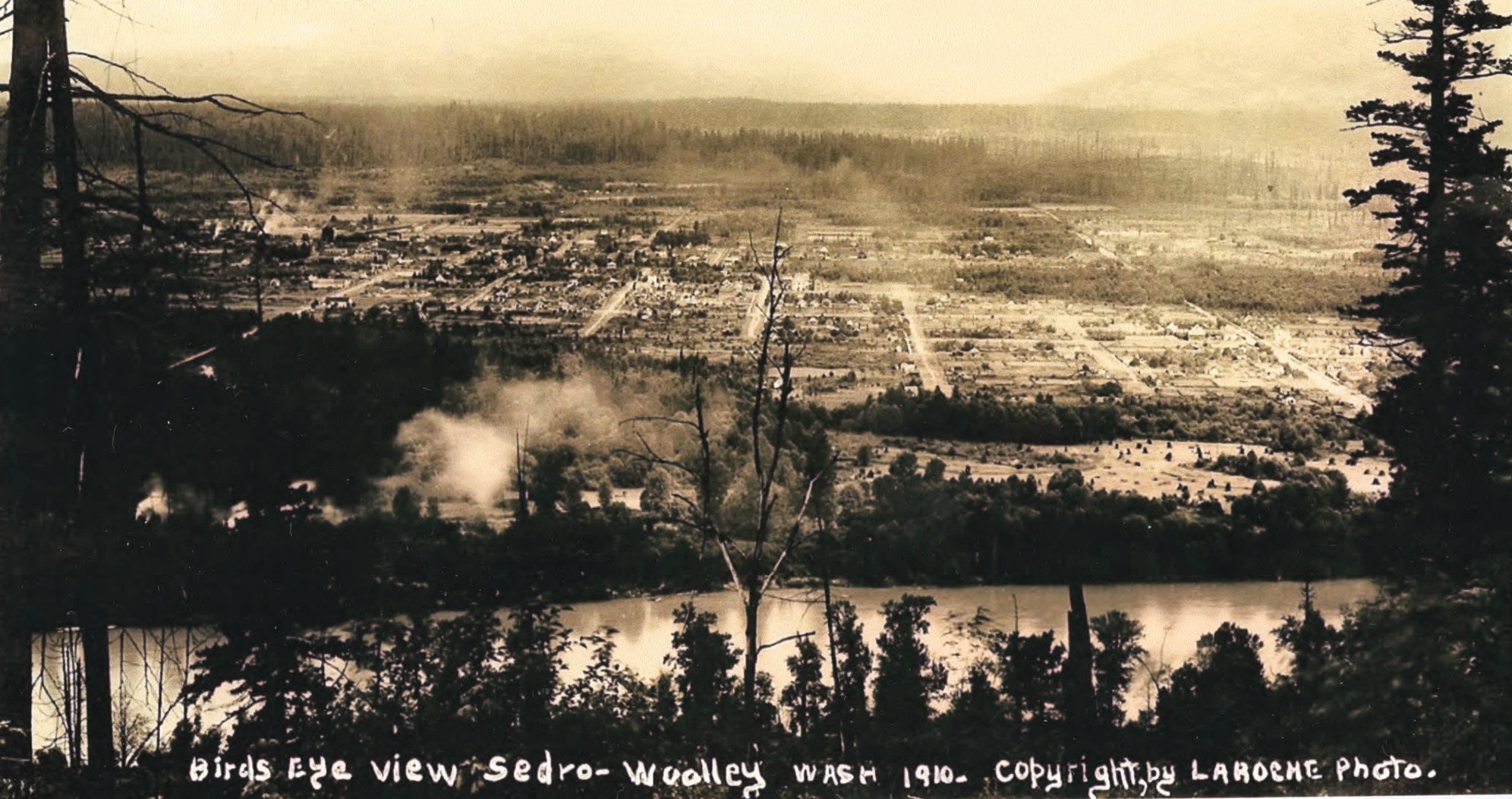
The Sedro-Woolley Socialist Party, I.W.W., and Shingle-Weavers’ Union combined their resources and raised funds in area lumber and rail camps for a local workers’ hall, a Labor Temple, to have meetings and socials in. It was dedicated on May Day, 1911.
‘Sedro-Woolley Celebrates’ by Charles Gardner from Industrial Worker. Vol. 3 No. 10 June 1, 1911.
FROM “SHINGLE WEAVER.” International Labor Day, May 1st, was celebrated in Sedro-Woolley by Socialist Party of Washington, Local 318, I.W.W., and Local 6, I.S.W.U. of A., and the dedication of the new Labor Temple took place on the same day. The ceremonies were opened by singing the “Marseillaise” and the “Red Flag.” Rev. Myers then asked his Lord to give the workers that which the workers had power to take. I expected to see his Lordship stick his head out the bay window of the universe and ask him who was running this old rig anyway.
The first speaker of the day was E.J. Brown of Seattle, who opened his speech in the following words: “We have met here to celebrate Labor Day. This is labor’s Labor Day, the first Monday of September is Capital’s Labor Day. To recognize the first Monday of September as Labor Day is to bow our heads in submission to the capitalist class. To recognize May 1st is to raise our heads from our toil and demand from our toil the full product of our toil.”
Referring to Jas. P. Thompson of the I.W.W., he spoke in the following words: “I am proud to stand on this platform for the first time with the two great wings of the labor movement, because of the fact that labor is beginning to recognize solidarity.” He also spoke on the kidnaping of McNamara. President Folsom was the next speaker, and his talk was short but sweet. He stated it was much easier to show a worker that a raise in wages or shortening of hours is to his benefit, than to show hint how to vote. Nevertheless, he will hear much today that will enlighten him. While Folsom is not a brilliant orator, he made a lasting impression in the gray matter of the workers that set them to thinking.
Immediately after Folsom finished, the chairman of the day called a recess of ten minutes to vote on a watch, and some thinking the speech over left the hall. This incident and the sky pilot were the only two incidents to mar the ceremonies.
The last to speak was Jas. P. Thompson, orator of the day. While Brown made a brilliant speech and Folsom was very instructive, it was conceded by all that Thompson was the orator of the day. Thompson worked as a longshoreman in Chicago. When the I.W.W. was organized he became an agitator for industrial unionism, and later became an organizer for the I.W.W. Thompson opened his address in the following words: “The organization that I represent today (I.W.W.) is not a political but an economic organization. There are child labor laws, but when the in- spector comes around, the children hide under a thimble and the inspectors O.K. the factory. There are laws regulating the hours of labor, but they are not enforced. The only law of any value is the one made in your union hall and enforced on the job.” He told of a strike in Granite City where workers were receiving $1.50 for ten hours and struck for $1.75 for nine hours. Just before the scabs arrived the workers went back to work. The scabs were shipped away, and the next day the workers were out on strike again. The bosses called out a “Slugging Committee,” and the workers went back to work. The next morning they were on strike. The company got behind in its orders and asked the workers what they would settle for. The workers replied, “$200 for eight hours.” They got it. This is the intermittent strike.
He also spoke on the French railroad strike. A great many of the railroads in France are owned by the government. In order to break the general strike a call was issued to the railroaders that they would have to join the reserve army and the army would run the railroads. The general strike was called off and the passive resistance strike or “Pearled Sabotage” was called instead. Goods billed for the northern part of France found their way to the southern part, fruit and perishable goods were delayed or sidetracked until spoiled and then brought in. Transportation demoralized and the railroads lost over $100,000,000. They have conceded the demands of the union, and very near all of the strikers went back to work. Speaking of flags, he said: “The Red Flag was the first flag of the world, was the first flag of this country and is the banner of the labor movement. The origin of the Stars and Stripes is, the stripes were taken from the backs of slaves where the lash had cut its way, and the stars were originated when your head came in contact, with the policeman’s club. I remember when a lad, how they would cheer when the soldiers marched down the street. Mothers felt proud of their sons in blue, and civilization’s greatest degenerate spirit war had taken their sons. Many were the songs that were sung in their honor. Today, when the soldiers march down the street, about the first remark is, “I wonder where the strike is?”
The chairman gave a short speech on “Woman Suffrage” just before the dance. Horace Cupples of Bellingham addressed the audience. Everybody had a good time.
In listening to the speeches one could plainly see that it was not I.W.W. against A.F. of L., but solidarity against craft division. This labor temple will bring different factions of the labor movement together. There are but few shingle weavers who are not Socialists, and there will be a great many debates on unionism which will be very interesting. Yours for Industrial Freedom,
CHAS, GARDNER, Big Lake Wash.
The Industrial Union Bulletin, and the Industrial Worker were newspapers published by the Industrial Workers of the World (IWW) from 1907 until 1913. First printed in Joliet, Illinois, IUB incorporated The Voice of Labor, the newspaper of the American Labor Union which had joined the IWW, and another IWW affiliate, International Metal Worker.The Trautmann-DeLeon faction issued its weekly from March 1907. Soon after, De Leon would be expelled and Trautmann would continue IUB until March 1909. It was edited by A. S. Edwards. 1909, production moved to Spokane, Washington and became The Industrial Worker, “the voice of revolutionary industrial unionism.”
PDF of full issue: https://www.marxists.org/history/usa/pubs/industrialworker/iw/v3n10-w114-jun-01-1911-IW.pdf
 Revolution's Newsstand