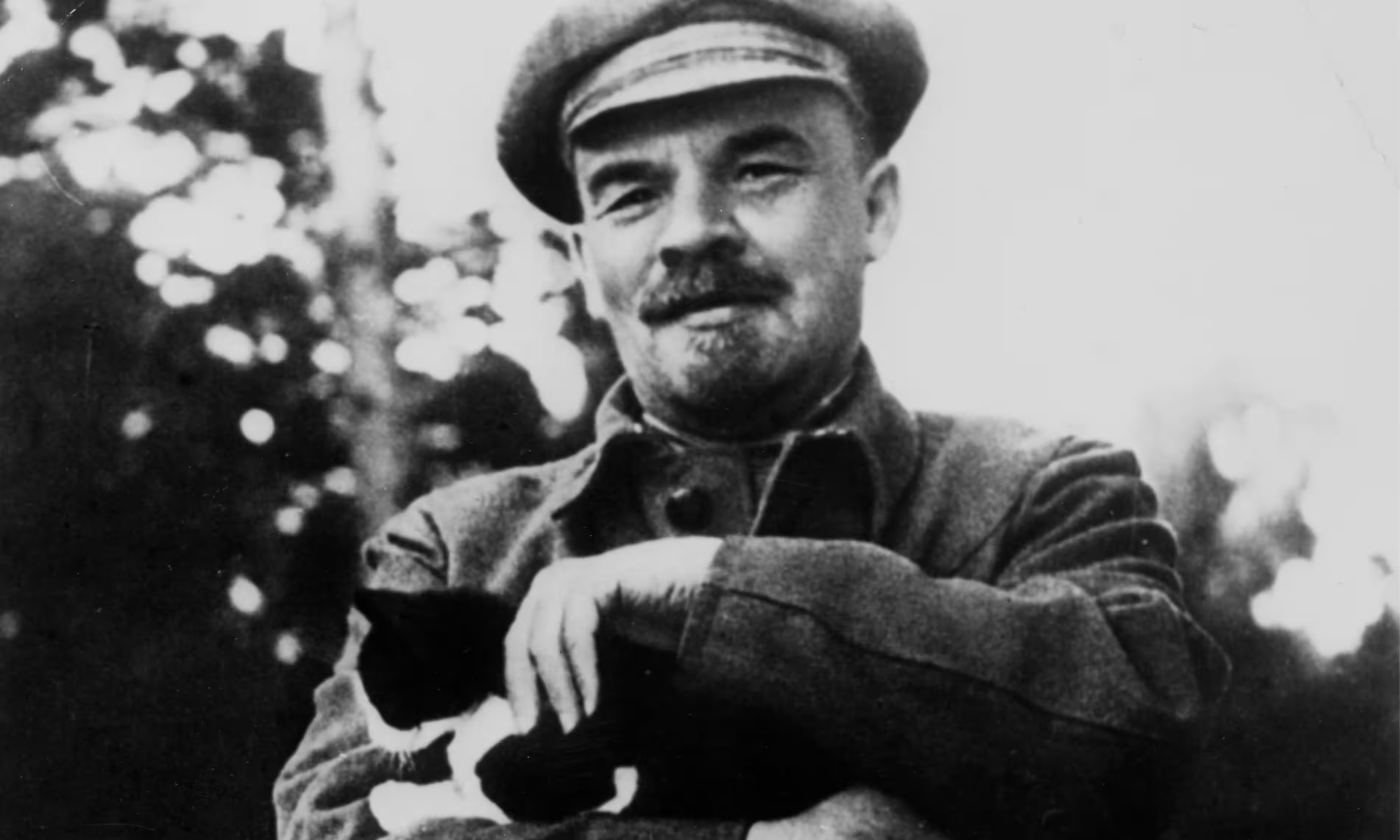
A truly historic debate for Russian and International Socialism. Relocating to Bern, Switzerland at the outbreak of World War One, Lenin traveled to Lausanne on October 11, 1914 to hear Plekhanov’s speech before exiled Russian Socialists on the war. That day Plekhanov spoke for ninety minutes, with Lenin, the only other speaker, making only few short remarks in refutation. Returning three days later, Lenin gave his own talk on Socialist attitudes, ‘The Proletariat and War.’ Below are reports of both of Lenin’s talks from Martov’s Paris-based ‘Golos’ (Voice) Menshevik-Internationalist newspaper.
‘The Proletariat and War: A Debate with Plekhanov’ (1914) by V.I. Lenin from Collected Works, Vol. 18. International Publishers, 1936.
Debate with Plechanov. October 11, 1914.
“Our theses, as prepared by the Central Committee of the party, have been forwarded to the Italians and many of them, unfortunately not all, were incorporated in the Lugano resolution,” thus Comrade Lenin started his speech.
The first part of Plekhanov’s lecture, where he analyses the betrayal of the German Social-Democrats, is very pleasing to the opponent, but he cannot say the same thing of the second part where Plekhanov tries to justify fully the position of the French Socialists.
How can one defend French Socialism which is appealing to the Italians to join the war, Lenin asks. Even in the very elastic resolutions of the International, he says, it is difficult to find passages to justify that appeal.
The present war, he continues, shows what a tremendous opportunist wave has risen from the bottom of European Socialism. To rehabilitate themselves, the European opportunists have resorted to the old threadbare argument about maintaining the organisation “intact.” The German orthodox Socialists have abandoned their position in order to retain the formal unity of the party. He, Comrade Lenin, always points out the opportunism hidden in such an approach to the question; he always fights against conciliation at the price of principles. All the resolutions of Vandervelde and Kautsky suffer from this opportunist tendency to take off the sharp edges of obvious contradictions. Kautsky in his article on the war even goes so far as to justify everybody by declaring that everybody is right from his own standpoint, since subjectively everybody considers himself in danger and subjectively everybody considers his right to existence destroyed. Of course, such sentiment on the part of the Frenchmen can be more easily understood from the standpoint of the psychology of the moment, of humanitarianism and it is therefore more sympathetic; still, Socialism cannot reason this way; it cannot proceed solely from fear of attack; and one must say openly that there is more chauvinism than Socialism in the conduct of the French.
Plekhanov, says Lenin, criticises those comrades who said that it was impossible to decide who was the aggressor. The present war, in his judgment, is not at all an accident; it does not depend upon the aggression of one or the other, but it was prepared by all the conditions of the development of bourgeois society. It had long been predicted in precisely the present combination, and on precisely the same lines. The Basle Congress spoke of it clearly; it even foresaw that Serbia would be the pretext for a conflict.
Comrade Lenin then proceeds to make clear what the duty of the Socialists is in time of war. Social-Democrats, he says, fulfil their duty only when they struggle against the chauvinist poison gases of their own country. The best example of how such duty is to be fulfilled is furnished by the Serbian Social-Democrats.
Remembering the words of Marx that “the workers have no fatherland,” Lenin continues, the proletariat must not participate in the defence of the old framework of the bourgeois states, but it must create a new framework of Socialist republics. The broad masses of the proletariat cannot fail to grasp this by their true instinct. What is going on in Europe is a playing up of the worst and most deeply rooted prejudices. “Our task,” says Lenin, “consists not in swimming with the current; our task is to turn the national, pseudo-national war into a decisive conflict of the proletariat with the ruling classes.”
Lenin then criticises the entrance of the Socialists into the cabinet, and points out the responsibility which Socialists take upon themselves when they identify themselves with all the government’s measures.
“Better go into a neutral country and tell the truth from there. Better address a free, independent word to the proletariat than become a Minister,” were the last words of Lenin’s brief remarks.
First published in Golos [Voice], No. 33, October 21, 1914.
‘The Proletariat and War’ October 14, 1914.
Sew SPEAKER divided his report into two parts: definition of the character of the given war, and attitude of Socialists to this war.
For a Marxist, a definition of the character of the war is essential in order to decide the question of his attitude to it. To make this definition one must first of all establish what are the objective conditions, and the concrete circumstances, under which the given war takes place. One must place this war into the historical surroundings in which it is taking place—only then will it be possible to define one’s attitude to it. Otherwise, one gets not a materialist, but an eclectic treatment of the question.
In accordance with historical circumstances, correlation of classes, etc., one’s attitude to war varies under various conditions. It is absurd to refuse on principle, once and for all, to participate in war. It is just as absurd to divide wars into offensive and defensive wars. In 1848 Marx hated Russia because at that time democracy in Germany could not be victorious and develop; it could not weld together the country into an indivisible national whole, as long as the reactionary hand of backward Russia was hovering over it.
To define one’s attitude to the present war one must understand how it differs from former wars, what are its peculiarities. Has the bourgeoise given such an explanation? It hasn’t, and what is more it will not give it on any account. To judge by what is going on among Socialists, one would think that even they have no notion of the difference between this war and former wars. And, yet, Socialists used to explain it very well, and foresaw it. More than that, there is not a single speech by a Socialist Deputy, nor a single article by a Socialist journalist, which does not contain such an explanation. It is so simple that no attention is paid to it, and yet, it is the key to a correct attitude to his war.
The present war is an imperialist war, this constitutes its fundamental character. To ascertain it one must examine what previous wars were and what is an imperialist war.
NATIONAL AND MODERN WARS
Lenin dwelt at some length on the characterization of the wars at the end of eighteenth and throughout the nineteenth century. All of them were national wars, fought in the interests of national states, and contributing to the establishment of such states.
These wars signalize the destruction of feudalism, and were the expression of the struggle between the new bourgeois society and feudal society. The national state was an inevitable stage in the development of capitalism. Struggle for national self-determination and independence, for freedom of language and national representation served this aim—establishment of national states, which at a certain stage of capitalism is essential for the development of productive forces. Such was the character of wars since the Great French Revolution and up to the Italian and Prussian wars.
This task of national wars was carried out either by democracy itself, or with the help of Bismark, regardless of the will and consciousness of the participants themselves. National wars, wars of the budding capitalism, were necessary for the triumph of modern civilization, for the full development of capitalism.
Imperialist war is a different matter. In regard to this there was no divergence of opinion among Socialists of all countries and all tendencies. At all congresses, when resolutions on our attitude to any possible war were discussed, there was a consensus of opinion that this war will be an imperialist war. All the European countries had reached the same degree of capitalist development, all of them had already given everything that capitalism can give. Capitalism has reached its supreme form and no longer exports goods, but capital.
It has no longer room in, and is bursting out of, its national chrysalis, and the struggle now is for the last available remnants on the terrestrial globe. While the national wars in the eighteenth and nineteenth century signalized the beginning of capitalism, imperialist wars point to its end.
It is imperialism which puts a special imprint on contemporary wars, which makes it different from all the preceding wars.
We can ascertain our attitude to this war only by considering it in its special historical surroundings, as every Marxist should do. Otherwise we will operate with old notions and arguments applicable to other circumstances, which no longer exist. Among such obsolete notions is the notion of the fatherland, and the division of war, which I already mentioned, into offensive and defensive.
There are, of course, freedom in the vivid picture of contemporary conditions, spots painted with the old brush. For instance, of all the belligerent countries, Serbia alone is fighting for its national existence. In India and China, too, conscious proletarians have no other choice but to follow the national path, because their countries have not yet formed themselves into national states. If China had to carry on an offensive war with this aim in view we could not refuse it our sympathy because, objectively, it would be a progressive war. For the same reason Marx was entitled to propagate in 1848 an offensive war against Russia. Thus, the keynote of the end of the nineteenth century and of the beginning of the twentieth was—imperialist policy.
Imperialism is that state of capitalism when, having carried out all it could, it begins to decline. It is a special epoch, not in the consciousness of Socialists, but in actual relations. The struggle is for the division of remnants. Such is the last historical task of capitalism. How long this epoch will last, we cannot tell. Perhaps there will be several wars like this one, but we must realize that these wars are not like former wars and that, accordingly, the tasks confronting Socialists undergo a change.
A proletarian party will probably require an utterly different type of organization for the solution of these tasks.
In his pamphlet “Weg zum Macht” Kautsky subjected to a careful examination economic phenomena, and making very cautious deductions from them, pointed out that we are entering upon a stage utterly unlike the former peaceful, gradual development.
What in conformity with this new stage the new form of organization should be, is difficult to tell now. But it is self-evident that in view of the new tarts, the proletariat will have to create new organizations, or to change the old. Therefore, all the more absurd is the fear to upset one’s organization, which is so prevalent among the German Social Democrats; all the more absurd this legalism at any price.
LEGALITY AND SOCIALIST DUTY
We know that the Petersburg Committee has issued an illegal leaflet against the war. The same was done by the Caucasian and several other Russian organizations. This can, certainly, also be done abroad, and relations need not be broken off.
Legality is, of course, very precious, and it was not for nothing that Engels said: “Gentlemen of the bourgeoisie, be the first to infringe your legality!” What is happening now will probably teach the German Social Democrats a lesson, for the Government, which always prided itself on its legality, infringed it without any compunction all along the line. In this respect the peremptory order of the Governor of Berlin, which he compelled the “Vorwarts” to print on the front page, is likely to prove useful. But the “Vorwarts,” promised not to allude to it to the end of the war, has signed its owne “Golos” which is at present the best Socialist newspaper in Europe.
My frequent and serious disagreements with Martov make it incumbent on me to say that, at present, this writer is doing what a Social Democrat should do. He is criticizing his government, is exposing his bourgeoisie, and is attacking his Ministers. But Socialists, who, having disarmed themselves as far as their own government Ministers and ruling classes of another country, perform the role of bourgeois writers. Sudekum himself plays objectively the role of an agent of the German Government, just as others do in regard to the Franco-Russian allies.
Socialists who have not taken into account that this war is an imperialist war, who do not visualize it historically, will not understand anything in this war, and are capable of taking a childishly naive view of it. It is as if, in the middle of the night, someone seized somebody else by the throat, and the neighbours have either to come to the rescue of the victim of the attack or “lock themselves in” (Plekhanov’s expression) in a cowardly manner so as to keep out of the brawl. We will not allow ourselves to be deceived and will not allow bourgeois counsellors to explain the war so simply.
THE FATHERLAND IDEA
Comrade Lenin read an extract from Luzatti’s article published in an Italian paper. In this article the Italian politician glories in the fact that the great victor in the war happens to be the fatherland, the fatherland idea and declares: one should bear in mind Cicero’s words that “the greatest calamity is civil war.” This is what the bourgeoisie has succeeded in achieving, this is what agitates and pleases it above all.
The bourgeoisie is trying to persuade us that this is the same usual national war. This is not the case. The time for national wars is past. We are confronted with an imperialist war and it is the duty of Socialists to convert “national” war into civil war.
We, all of us, expected this imperialist war, we prepared for it. Since this is so, it does not matter at all who attacked; everyone was prepared for war, and the attack was made by the side which thought it most profitable at the given moment.
Lenin then read extracts from the Communist Manifesto, in which the fatherland idea is treated as a historical category commensurate with the development of society at a definite stage of this development, which subsequently becomes obsolete. The proletariat cannot love what it has not got. The proletariat has no fatherland.
SOCIALIST OBLIGATIONS
What are the tasks of Socialists in the present war? Comrade Lenin read the Stuttgart resolution, which was subsequently confirmed and added to in Copenhagen and Basle. This resolution shows clearly Socialist methods of struggle against tendencies making for war, and defines the duties of Socialists in regard to war when it has already broken out. These duties are defined by the examples of the Russian Revolution and the Paris Commune. The Stuttgart resolution was cautiously compiled, taking into consideration all sorts of criminal laws, but the task was clearly pointed out in it. The Paris Commune—is civil war. In what form, when and where?—is another question, but which way our work should tend is definitely stated.
From this viewpoint Comrade Lenin dealt with the position taken up in reality by the Socialists of various countries. Apart from the Serbs, Russian Socialists have done their duty, as pointed out by the Italian organ “Avanti”; Keir Hardie is also doing his duty by exposing the policy of Sir Edward Grey.
Once war has started it is impossible to get away from it. One must go on doing one’s duty as a Socialist. At the war people think and meditate perhaps even more than “at home.” One must go there to organize the proletariat for the ultimate aim, because it is utopian to imagine that the proletariat will reach it by peaceful means. It is impossible to go from capitalism to socialism without breaking the national structure, just as it was impossible to go from feudalism to capitalism without national ideas.
First published in Nos. 37-38 Paris “Golos” on October 25 and 27.
PDF of full issue: https://archive.org/download/in.ernet.dli.2015.77231/2015.77231.Lenin-The-Imperialist-War-1914-1915_text.pdf
 Revolution's Newsstand