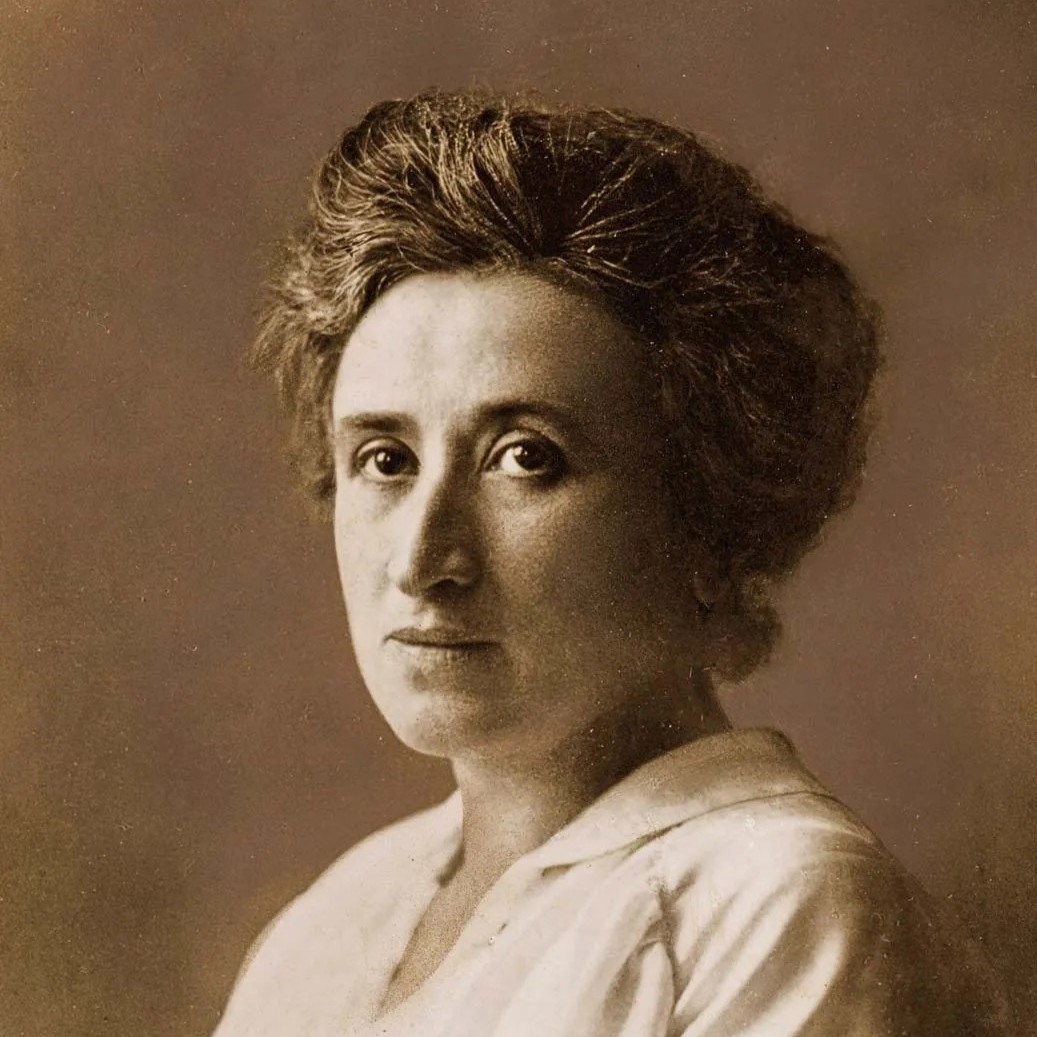
Rosa Luxemburg demands the building of a new International must be on the basis of lessons learned from the defeat, and, above all, must be refounded on the basic Marxist notions of class war and revolutionary transformation.
‘Class War and The International’ by Rosa Luxemburg from New Review. Vol. 3 No. 11. August 1, 1915.
[Before she could finish this article, Rosa Luxemburg was sent to prison to serve a sentence for anti-militarist agitation. It appeared in The International, a magazine started by Franz Mehring and Rosa Luxemburg, and suppressed by the censor upon the appearance of the first issue.]
THE German Social Democracy handed in its political resignation on August 4, 1914. On the same day the Socialist International collapsed. All attempts to deny this fact or to conceal it merely serve to perpetuate the conditions which brought it about.
This collapse is without a parallel in history. Socialism or imperialism—this is the alternative which summed up the political life of the various labor parties of the world during the past decade. In Germany especially it has formed the basis of countless programs, discussions and publications. One of the chief purposes of the Social Democracy has been the correct formulation of thought and sentiment with regard to this alternative.
With the outbreak of the war the word became flesh; the alternative changed from a historical tendency to a political situation. Face to face with this alternative as a fact the Social Democracy, which had been the first to recognize it and bring it to the consciousness of the working class, struck its sails and without a struggle conceded the victory to imperialism. Never before, since there have been a class-struggle and political parties, has there existed a party which, after fifty years of uninterrupted growth, after the attainment of a preeminent position of power, has thus by its own act within twenty-four hours wiped itself off the map.
The apologists for this act, Kautsky among them, maintain that the whole duty of Socialists in time of war is to remain silent. Socialism, they say in effect, is a power for peace, not against war. But there is a logic of events none can elude. The moment Socialists ceased to oppose war they became, by the stern logic of events, its supporters. The labor unionists who have discontinued their struggles for improved conditions, the women who have withdrawn from Socialist agitation in order to help minimize the horrors of war, and the Socialist party leaders who spend their time in the press and on the platform securing support for the government and suppressing every effort at criticism— all of these are not merely maintaining silence. They are supporting the war as heartily as any Conservative or Centrist. When and where was there ever a war which could exhibit a similar spectacle?
Where and when was the disregard of all constitutional rights accepted with such submissiveness? Where was there ever such glorification by an opposition party of the strictest censorship of the press? Never before did a political party sacrifice its all to a cause against which it had sworn again and again to sacrifice its last drop of blood. The mighty organization of the Social Democracy, its much praised discipline, gave the best proof of themselves in the fact that four millions of human beings allowed themselves to be hitched to the war chariot at the command of a handful of parliamentarians. The half-century of preparation on the part of the Socialist party comes to fruition now in this war. All our education of the masses make them now the obedient and effective servants of the imperialist state. Marx, Engels and Lassalle, Liebknecht, Bebel and Singer trained the German proletariat in order that Hindenburg might lead it.
Our official theorists are not without an explanation of this phenomenon. They are perfectly willing to explain the slight disagreement between their actions of today and their words of yesterday. Their apology is that “although the Social Democracy has concerned itself much with the question as to what should be done to prevent war it has never concerned itself with the problem as to what should be done after the beginning of hostilities”. Ready to do everybody’s bidding, this theory assures us that the present practice of our party is in the most beautiful harmony with our past theories. The delightfully adaptable theory is likewise ready and willing to justify the present position of international Socialism in reference to its past. The International treated only the question of the prevention of war. But now, “war is a fact,” and, as it turns out, after the outbreak of war Socialists are to be guided by entirely new principles. After war has actually begun the great question for each proletariat is: Victory or defeat? Or, as an “Austro-Marxist” explains, a nation, like any other organism, must preserve its existence. In plain language this means: The proletariat has not one fundamental principle as scientific Socialism heretofore maintained, but two, one for peace and another for war. In time of peace, we are to suppose, the workers are to take cognizance of the class-struggle within the nation and of international solidarity in relation to other countries; in time of war, on the other hand, class solidarity becomes the dominant feature of internal affairs and the struggle against the workers of other countries dominates the proletarian view of foreign relations. To the great historic appeal of the Communist manifesto is added an important amendment and it reads now, according to Kautsky’s revision: “Workers of all lands unite in peace and cut one another’s throats in war!” Today, “Down with the Russians and French!” tomorrow, “We are brothers all!” For, as Kautsky says in Die Neue Zeit, the International is “essentially an instrument of peace,” but “no effective agent in war.”
This convenient theory introduces an entirely novel revision of the economic interpretation of history. Proletarian tactics before the outbreak of war and after must be based on exactly opposite principles. This presupposes that social conditions, the bases of our tactics, are fundamentally different in war from what they are in peace. According to the economic interpretation of history as Marx established it, all history is the history of class-struggle. According to Kautsky’s revision, we must add: except in times of war. Now human development has been periodically marked by wars. Therefore, according to this new theory, social development has gone on according to the following formula: a period of class-struggles, marked by class solidarity and conflicts within the nations; then a period of national solidarity and international conflicts-and so on indefinitely. Periodically the foundations of social life as they exist in time of war. And again, at the moment of the signing of a treaty of peace, they are restored. This is not, evidently, progress by means of successive “catastrophes;” it is rather progress by means of a series of somersaults. Society develops, we are to suppose, like an iceberg floating down a warm current; its lower portion is melted away, it turns over, and continues this process indefinitely.

Now all the known facts of human history run straight counter to this new theory. They show that there is a necessary and dialectic relation between class-struggle and war. The class-struggle develops into war and war develops into the class struggle; and thus their essential unity is proved. It was so in the medieval cities, in the wars of the Reformation, in the Flemish wars of liberation, in the French Revolution, in the American Rebellion, in the Paris Commune, and in the Russian uprising in 1905.
Moreover, theoretically Kautsky’s idea leaves not one stone of the Marxian doctrine on another. If, as Marx supposes, neither war nor the class struggle falls from heaven, but both arise from deep social-economic causes, then they cannot disappear periodically unless their causes also go up in vapor. Now the proletarian class-struggle is a necessary aspect of the wage system. But during war the wage system does not tend to disappear. On the contrary, the aspects of it which give rise to the struggles of the class become especially prominent. Speculation, the founding of new companies to carry on war industries, military dictatorship-all these influences tend to increase the class differences during time of war. And likewise the class rule of the bourgeoisie is not suspended; on the contrary, with the suspension of constitutional rights it becomes sheer class dictatorship. If, then, the causes of the class-struggle are multiplied, strengthened, during war how can their inevitable result be supposed to go out of existence? Conversely, wars are at the present time a result of the competition of various capitalist groups and of the necessity for capitalist expansion. Now, these two forces are not operative only while the cannon are booming; they are active in peace as well, and it is precisely in time of peace that they influence our life in such a way as to make the outbreak of war inevitable. For war is, as Kautsky loves to quote from Clausewitz, “the continuation of politics by other means.” And the imperialist phase of capitalist rule, through competition in building of armaments, has made peace illusory, for it has placed us regularly under military dictatorship and has thereby made war permanent.
Therefore our revised economic interpretation of history leads to a dilemma. Our new revisionists are between the devil and the sea. Either the class struggle persists in war as the chief life-condition of the proletariat and the declaration of class harmony by Socialist leaders is a crime against the working class ; or carrying on the class-struggle in time of peace is a crime against the “interests of the nation” and the “security of the fatherland.” Either class struggle or class-harmony is the fundamental factor in our social life both in peace and war.
Either the International must remain a heap of ruins after the war or its resurrection will take place on the basis of the class-struggle from which it took its rise in the first place. It will not reappear by magic at the playing over of the old tunes which hypnotized the world before August 4. Only by definitely recognizing and disowning our own weaknesses and failures since August 4, by giving up the tactics introduced since that time, can we begin the rebuilding of the International. And the first step in this direction is agitation for the ending of the war and the securing of peace on the basis of the common interests of the international proletariat.
New Review was a New York-based, explicitly Marxist, sometimes weekly/sometimes monthly theoretical journal begun in 1913 and was an important vehicle for left discussion in the period before World War One. In the world of the Socialist Party, it included Max Eastman, Floyd Dell, Herman Simpson, Louis Boudin, William English Walling, Moses Oppenheimer, Walter Lippmann, William Bohn, Frank Bohn, John Spargo, Austin Lewis, WEB DuBois, Maurice Blumlein, Anton Pannekoek, Elsie Clews Parsons, and Isaac Hourwich as editors and contributors. Louis Fraina played an increasing role from 1914 on, leading the journal in a leftward direction as New Review addressed many of the leading international questions facing Marxists. The journal folded in June, 1916 for financial reasons. Its issues are a formidable archive of pre-war US Marxist and Socialist discussion.
PDF of full issue: https://www.marxists.org/history/usa/pubs/newreview/1915/v3n11-aug-01-1915.pdf
 Revolution's Newsstand