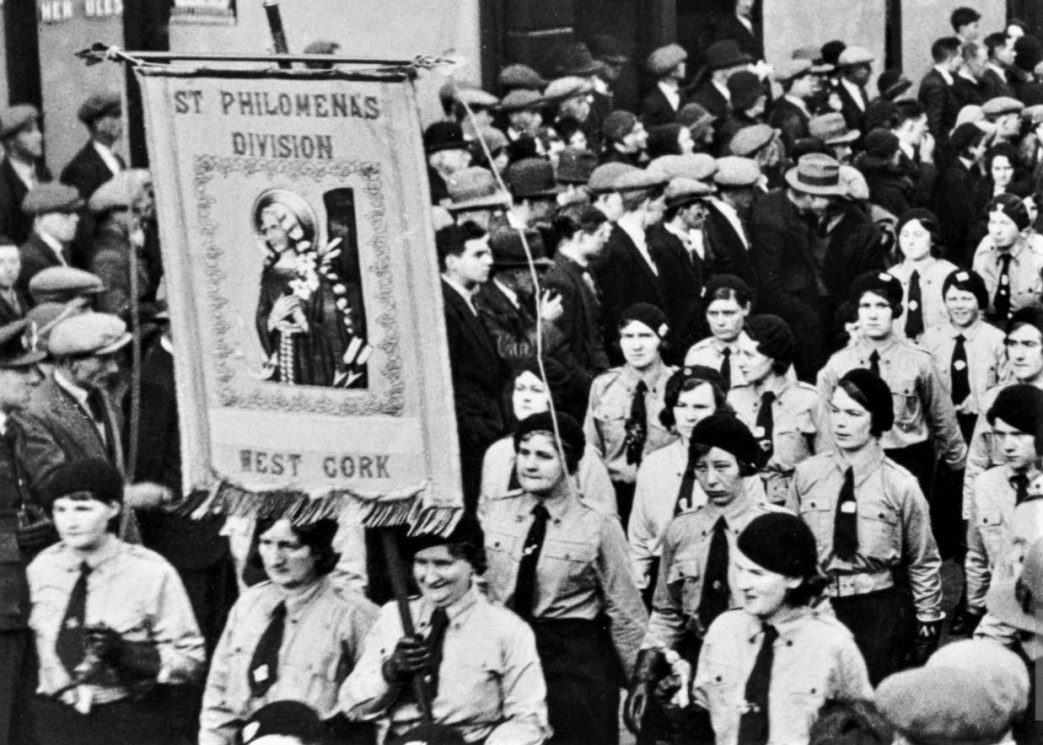
As fascism again takes to the streets of Ireland, Sean Murray looks at the, albeit in very different circumstances, dynamic of Irish fascism of the 1930s.
‘De Valera Helps Irish Fascism’ by Sean Murray from International Press Correspondence. Vol. 14 No. 8. February 9, 1934.
The difficulties of the de Valera government are steadily accumulating both in the economic and political spheres. The government is now two years in office. In this period there has been fall of £32 million out of a total foreign trade of over 287 million. Exports have dropped by over 50 per cent. on the figures for 1931 The British government is pressing home the economic blockade by the imposition of quota restrictions on fat cattle, on top of the already existing tariffs. The latest statement of J.H. Thomas was to the effect that his government was recovering the equivalent of the money withheld by the de Valera government, through the medium of tariffs. The British imperialists are confident that by means of these penalising measures against the Free State’s trade they will secure a satisfactory political deal with the Irish bourgeoisie.
The grazier and other exporting interests in Ireland have taken to organising a fascist movement whose first plank is to come to terms with the British. The de Valera government has taken to jailing its own Republican supporters for opposing the fascists and urging the operation of measures against the British imperialists and their Irish friends. Increasing numbers of opponents of fascism are being sentenced by the Military Tribunal, while the fascists are openly organising under the protection of the government’s police, army and courts of justice.
The labouring masses from the very outset gave unmistakable evidence that they understand the character of the O’Duffy Blueshirt menace. In August last year the fascist march on Dublin had to be abandoned owing to the massing of the workers on the streets. The Government had not banned this demonstration, but had prohibited the wearing of blue shirts. The value of the government’s “prohibitions” is illustrated by the marches of Blueshirted bodies, headed in nearly every case by mounted men, which is weekly taking place in the provincial towns, under the protection of police and troops. Tralee in the southwest is an example. Here the troops had to be called out to protect O’Duffy, while the police batoned down the demonstrating anti-fascists and arrested large numbers. The workers organised a general strike to secure the prisoners’ release, which drew de Valera personally to the area, with the result that the workers were manoeuvred into calling off the strike.
The pro-imperialist bourgeoisie, in addition to organising its fascist bands, conducting a powerful agitation from its press, the parliamentary tribune, the municipal and rural councils, the courts, social gatherings and by means of public parades and meetings, is also making widespread use of economic sabotage and intimidation. The big farmers are refusing to pay rates and annuities. The result is that municipal finances are in a perilous condition. In Tipperary, where the fascists are highly organised, the rate collection is 78 per cent. in arrears. In Waterford a large number of wealthy farmers were arrested for the organisation of terrorist conspiracy to prevent rate collection. The Military Tribunal found them “not guilty.” Out of a total of £3,148,955 rates to be collected, £1,900,000 was outstanding at the end of 1933, or over 60 per cent. This is J.H. Thomas speaking from behind the Irish hedges.
The de Valera government steadily pursues the aim of keeping the masses out of the fight against fascism. Its every act, both in relation to the fascists and to the anti-fascists, has been directed to this end. It secured à measure of popular approval for its introduction of the Coercion Act and the supersession of the ordinary courts, under the pretence that these were designed against the fascists. Now the anti-imperialists are crowding the jails. The political correspondent of de Valera’s own newspaper got a month’s imprisonment by the Tribunal for refusing to disclose the source of confidential information, and the government would not hearken to the demands of its own supporters for his release.
The government arrested O’Duffy, against whom a number of charges were preferred, including one of incitement to assassinate the President (de Valera). In less than twenty-four hours he was released by order of the Civil High Court on a writ of Habeas Corpus. This took place at the end of the year. O’Duffy is touring the country, organising his Blueshirts, while the lawyers are wearying the public over the respective rights and powers of the pro-imperialist Tribunal and the pro-imperialist civil Courts. In the hands of de Valera the fight against British imperialism is reduced to a series of judicial and parliamentary squabbles with O’Duffy and the Blueshirts.
As a result of all this there is a widespread dissatisfaction with the de Valera Government amounting in ever-growing instances to angry revolt. The changing situation is making itself felt in the relations between the government and the Irish Republican Army leadership. The I.R.A. chiefs and de Valera are no longer on speaking terms and the former are once more on the search “for a policy.” The problem of pleasing the workers and avoiding antagonising the capitalists is proving difficult in the midst of such growing class antagonisms. The I.R.A. leaders are resorting to the time-honoured remedy of all “Left”-wingers: the use of radical phrases. Socialistic propaganda, left for two years in abeyance, is again pouring forth from the columns of the Republican weekly “An Phoblacht.” So far has the “radicalising process” affected the Republican leaders that for the first time since Hitler came to power in Germany, their paper in a recent issue actually mentions the event and denounces the Hitler fascists. At the same time the I.R.A. leaders take the greatest pains through organisational measures to hold in check their supporters from organising the United Front against fascism, which the Communist Party and the militant workers are now creating. “Left” Republicanism is proving itself a by no means negligible factor in hindering the rise of a consciously-led United Front mass struggle against the fascist menace.
The struggle of the Communist Party to organise the united opposition to the fascist menace is meeting with increasing support among the trade unionists and Republican workers. Events are making clear that on this path lies the only way to victory over the fascist allies of J.H. Thomas and British imperialism.
International Press Correspondence, widely known as”Inprecorr” was published by the Executive Committee of the Communist International (ECCI) regularly in German and English, occasionally in many other languages, beginning in 1921 and lasting in English until 1938. Inprecorr’s role was to supply translated articles to the English-speaking press of the International from the Comintern’s different sections, as well as news and statements from the ECCI. Many ‘Daily Worker’ and ‘Communist’ articles originated in Inprecorr, and it also published articles by American comrades for use in other countries. It was published at least weekly, and often thrice weekly.
PDF of full issue: https://www.marxists.org/history/international/comintern/inprecor/1934/v14n08-feb-09-1934-Inprecor-stan.pdf
 Revolution's Newsstand