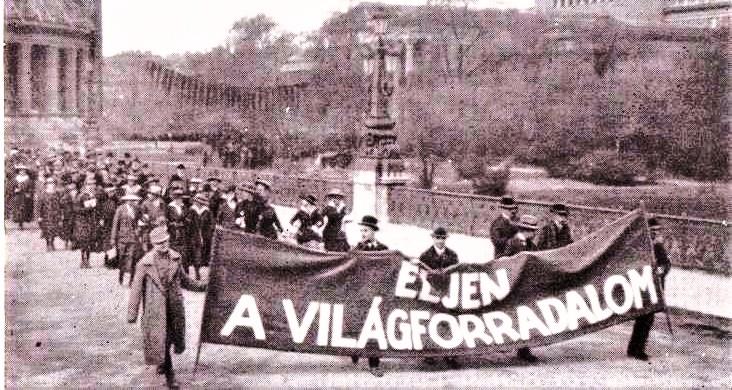
A concise history of Hungary’s brief Soviet Republic written shortly after its defeat and published in the new Communist Party of Yugoslavia’s newspaper, ‘Nova Istina.’
‘The Collapse of the Hungarian Soviet Republic’ from The Communist (Old C.P.A.). Vol. 1 No. 6. November 8, 1919.
AFTER the downfall of the Austro-Hungarian monarchy the Hungarian democrats, with Count Karolyi and Oscar Jaszy at their head, came into power in Hungary. The new government tried to consolidate the remnants of the rotten feudal state of Hungary. But it was too late. Hungary is a country where a handful of feudal landlords own three-fourths of the land. The different Tiszas undermined, the corrupt governmental machinery completely.
The bourgeoisie of Budapest, the most vicious in the world, was not able to consolidate anything. And as always when the structure of a state is crumbling, and as Karolyi realized, there was only one solution of the problem and that was to transfer the power of the state to the Social Democrats, who at that time were the only organized body in industrial Hungary.
With the aggressive onrush of the masses of workingmen for better working conditions, more pay and more bread, Karolyi slowly lost the power of government.
Meanwhile–right after the downfall of the dual Empire–Hungarian comrades returned from Russia, where, as prisoners of war, they participated in the revolutionary struggle of the Russian working class. Among them was Bela Kun, the president of the International Federation in Moscow.
The Communists at once began to clear the way among the workers of Hungary. The Social Democrats, who during the war discredited themselves, were unable to check the wave of Communism. In order to save themselves, they expelled the Communists from the party. And when the Communists established a party of their own and carried on an extensive propaganda of uncompromising Communism, the social-patriots started a merciless persecution of the Communists, who were arrested and prosecuted in masses.
But the results of that method brought entirely different results than was expected. In the economic breakdown, in the complete inability of the corrupt bourgeoisie and the oligarchy, as well as in the treachery of the social-patriots the workers in industry after industry abandoned the social-patriots and went over to the Communists. This movement was lead by the metal trade workers, the iron workers, the printing and publishing workers, and then the railroad and transportation workers followed. Soon all the groups of workers were on the side of the Communists, with whom already the majority of the army stood as the armed background of the revolution. Then instantly and unexpectedly came the “coup” of the “Nepszava” (the official social-patriotic paper in Budapest). Though innocent, Bela Kun and a number of other Communists were placed under arrest. This act of the social-patriots aroused the workers, who heard the rumor that Bela Kun was badly beaten by government agents in prison. Furthermore, there was a rumor, that the government planned to deport Bela Kun to some secret place.
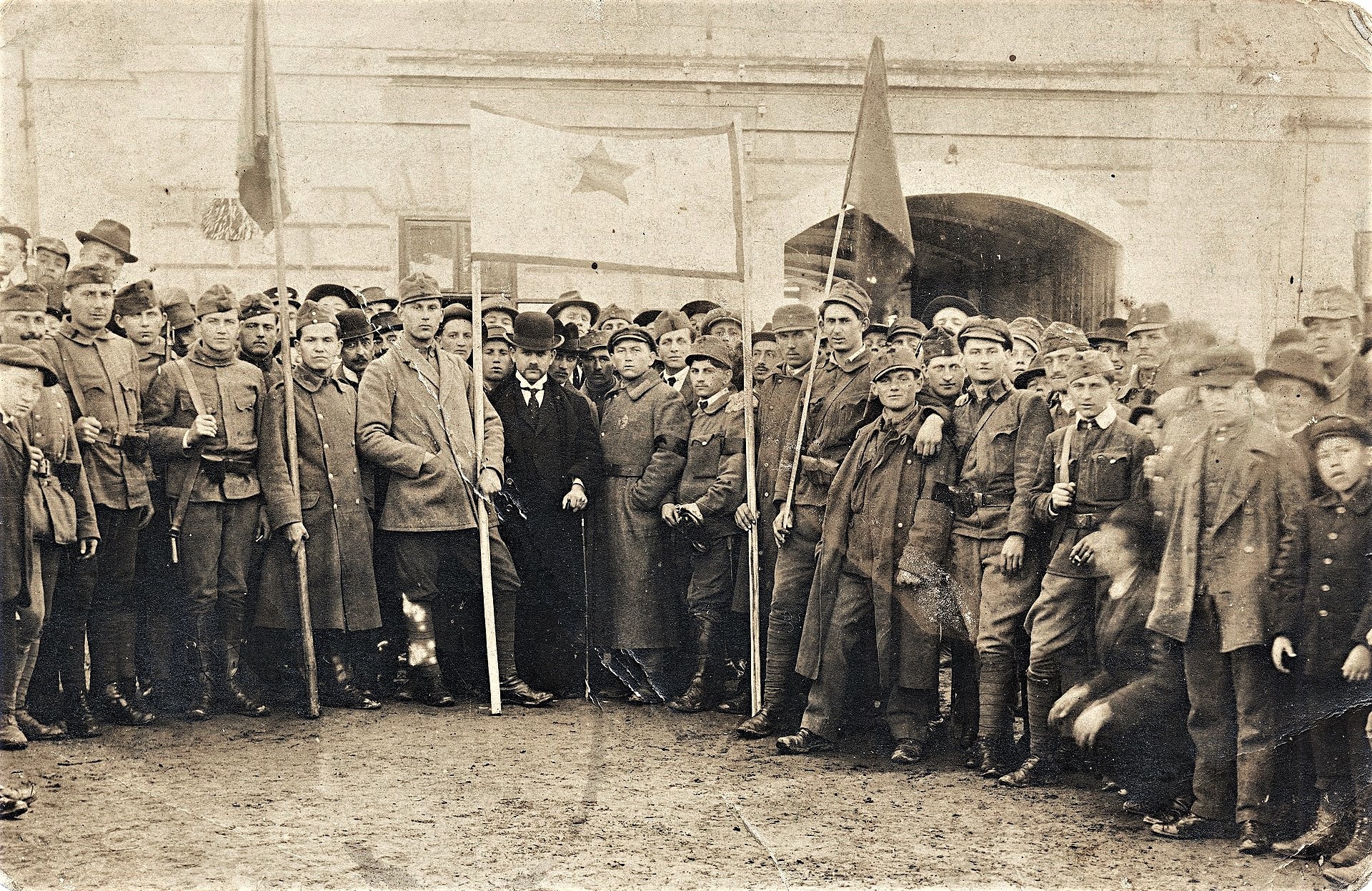
In the night of March 20-21 the Communist forces under the leadership of Tibor Samuelyi (who escaped from prison) equipped with two batteries of artillery made an attack on Budapest and demanded the immediate release of Bela Kun and all the other Communists.
Count Karolyi, confused by the imperialistic intentions of the Entente and the lust for conquest of the Czechs and the Roumanians, condemned and discredited personally, found it advisable to deliver the power of the state entirely into the hands of the Social Democrats.
THE “UNITY” OF THE SOCIAL DEMOCRATS WITH THE COMMUNISTS.
The Social Democrats now had to choose from three alternatives: 1) Resignation; 2) merciless war with the Communists; and 3) unity with the Communists.
Not willing to resign, and equally not very anxious to play the role of Ebert-Scheidemann-Noske, because they were the weaker and therefore unable to play that role, the Socialists chose the third alternative: Unity with the Communists. Kunfy, who was minister in the government of Karolyi, held conferences with Bela Kun, who was still in prison. On the basis of a platform Bela Kun had drawn in prison, unity of the two parties was realized. The platform called for the arming of the people, disarming of the bourgeoisie, expropriation and confiscation of large estates, and the socialisation of the banks, the wholesale houses, the stores and the industries. On March 27, the wire carried the famous message that the Soviet Republic of Hungary had been proclaimed. All power was taken over by the Workers’, Soldiers’ and Peasants’ Councils, Workers’, Soldiers’ and Peasants’ Councils, who at their first convention constituted themselves as the “Hungarian Party of Socialist-Communistic Workers”.
Thus the revolution was achieved without disorder and bloodshed.
The news of the revolution in Hungary was received with a certain reservation in revolutionary circles abroad, because of the experience that without a revolutionary tradition the social revolution cannot be accomplished. The bourgeoisie and the social-patriots saw in it only a game of the Hungarian imperialists to save their integrity. In the meantime Bela Kun issued a proclamation in which he renounced the territorial integrity of Hungary and affirmed the ethnographic principle of self-determination.
Such a transformation without bloodshed can only be explained by the weakness of the Hungarian bourgeoisie, which could not resist the aggression of the proletariat; and by the apathy and the nationalism of the petty bourgeoisie and the intellectuals. This example certainly will not repeat itself in the world evolution. The Hungarian intellectuals and petty bourgeoisie, who are entirely conservative and uncultured, during the first day looked with favor on the dictatorship of the proletariat, because they expected from it the salvation of their nationalism and the satisfaction of their own personal interests. Meanwhile, the Soviet Government carried on the socialisation of the banks, the industries and the commercial enterprises. All deposits in the banks over the amount of 20,000 crowns were expropriated and all large land holdings of over 100 acres were declared the property of the Commune. Because of the lack of progressive intelligence the reform of public education proceeded very slowly. With the caution proceeded very slowly. With the energetic measures of the revolutionary judiciary, crime decreased to a minimum. The manufacturing and selling of alcoholic beverages were prohibited, personal safety was assured much more than under the government of the bourgeoisie; but the bourgeoisie prepared the counter-revolution within the ranks of the slum-proletariat and the hoodlums.
After the first decrees of the Soviet Government were introduced the bourgeoisie and the conservative intellectuals felt themselves oppressed, and the petty bourgeoisie and the slum-proletariat became discouraged because the iron discipline prevented them from looting and exploiting the gains of the revolution for their own personal advantages. Their movement accordingly turned into counter-revolutionary channels.
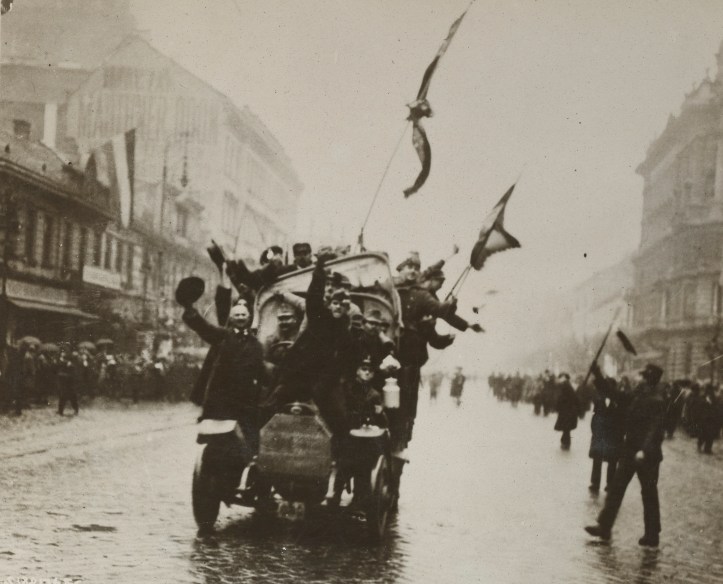
Society dames, discharged detectives, counter-revolutionary officers, and nuns driven, from the convents, mingled in disguise with the unconscious masses and plotted against the Soviet Republic. The Christian Socialists took advantage of the efforts of Bela Kun to accomplish the revolution in a humane way and preached sedition openly in processions, in the churches, etc.
This tactic of Bela Kun, of accomplishing the revolution a humane way, led to division on the left and on the right.
The left wing, under the leadership of Tibor Samuelyi, demanded radical measures and formed under the name “Lenin’s Boys” a terroristic group. When Bela Kun, under the pressure of the Entente, tried to disperse that group and send its members to the front they defended themselves with machine guns in the military camps and demanded the repeal of the order. Through the mediation of individuals serious conflicts were prevented.
The right wing, under Kunfi, the former right wing of the Socialists, sabotaged in the government and in all the Soviets as well. With the co-operation of the bourgeoisie they weakened the moral strength of the proletariat to a great extent. And so far as there was honest effort among them, they were already too corrupt through their social-chauvinism to be able to fill the important revolutionary positions that they were holding. So the unity of the Hungarian proletariat, that on March 21 was accomplished by the leaders of the Communists and the Socialists was only an illusion, because it contained the germ of disintegration.
The organization of the Red Army was at first a hard task, because of lack of real proletarian discipline. The Roumanians and the Czecho-Slovaks with the help of the French troops were advancing toward Budapest. At first the Red Army was defeated at every point. On May 2 not only the bourgeoisie but the Communists anticipated the collapse of the Soviet Republic. Nevertheless, the Government did not lose hope and courage. The Central Workers’ Council ordered the mobilization of half of the industrial proletariat. One half of the members of the government in a noble proclamation called upon the workers of Hungary to defend the Socialist Republic. In the short time of a few weeks the Red Army increased from 27,000 to 240,000 men. The Roumanians were thrown back behind the River Theiss; the Czechs suffered remarkable losses, being compelled to give up two-thirds of the Slovak territory, in which a Slovak Soviet Republic was immediately proclaimed. The formation of workers’ battalions raised the morale of the other formations; but when, under the pressure of the entente, the Red Army had to withdraw without a battle from the Czech front, the spirit waned. While counter-revolutionary, activity became more intense, proletarian class consciousness began to disappear; the working women publicly demanded that their husbands and sons be given back to them. A further factor was the fact that although the distinctions of the officers were abolished, the officers kept all the habits of capitalistic militarism and relations with the ranks were all but comradely.
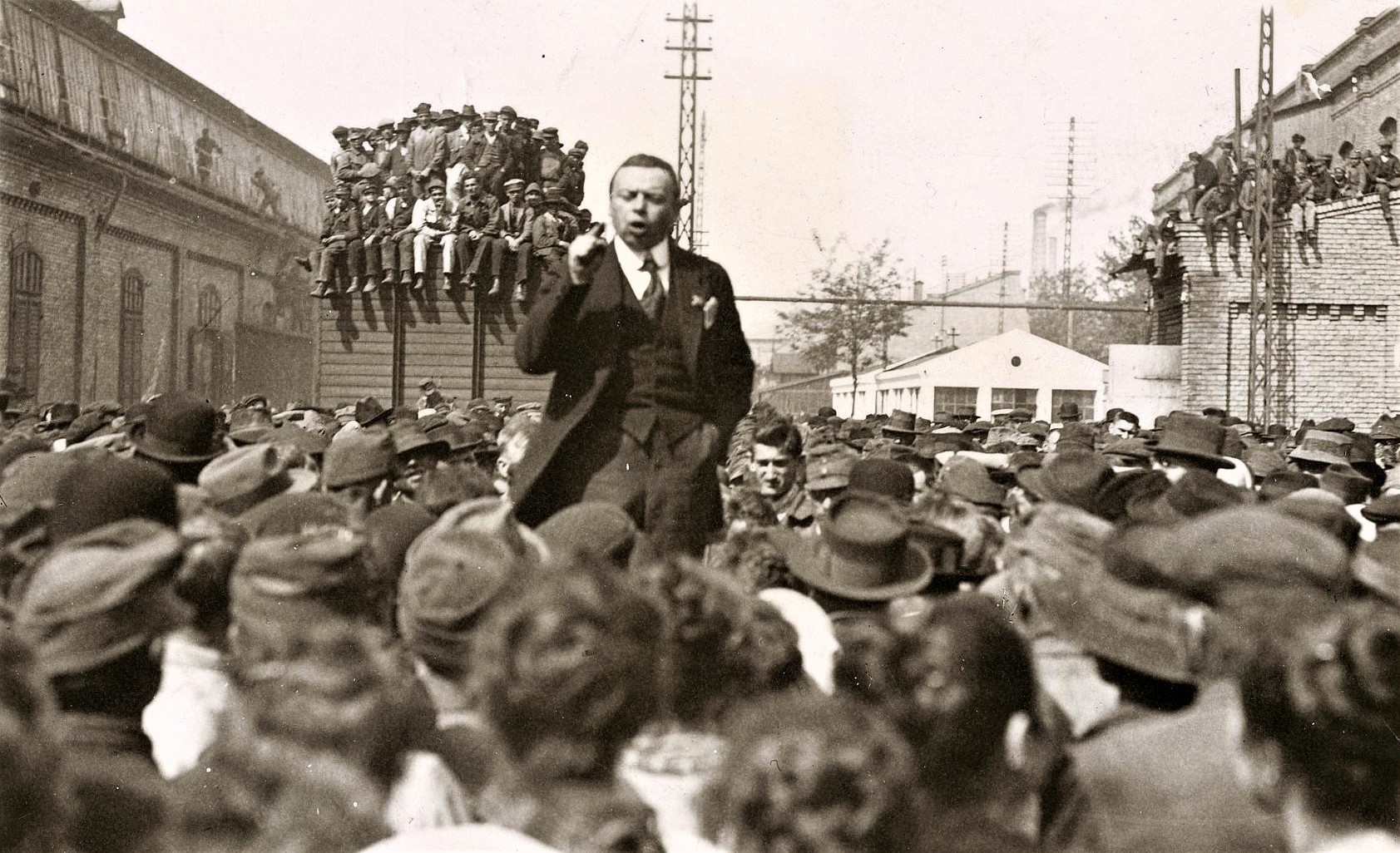
The peasantry of Hungary, entirely reactionary, could not possibly be satisfied in the short time, because the agrarian question could not be solved with the necessary speed.
Finally the main reason for the collapse of the Soviet Republic was the blockade of the new capitalistic Holy Alliance of the League of Nations.
The aristocratic oligarchy, the magnates of the Austro-Hungarian regime, who oppressed the Hungarian proletariat, who were for half a century the solid pillars of German and Central European Imperialism, the gang of the kind Tisza rallied around the Government of Szegedin, were the supporters of the Entente in the battle against the World Revolution, against Socialism. Together with the Entente they waged a dirty campaign against the Soviet Government. The chief of the Entente mission, Lieutenant General Romanelli, used his couriers, protected by immunity, to keep up connections between the counter-revolutionaries of Hungary with the counter-revolutionaries of the world.
BEFORE THE COLLAPSE.
At the moment when the Czechs were beaten, Clemenceau demanded from the Soviet Government the withdrawal of the Red Army from all occupied territory, at the same time notifying the Soviet Government, that its representatives would be summoned to Paris for the purpose of concluding peace and promising that the Roumanians would withdraw from all occupied territory. Bela Kun did not suspect this promise–and submitted. At the very moment when Czecho-Slovakia stood on the verge of the revolution, Kun ordered the Red Army to stop and to evacuate the occupied territory, consenting to an armistice. This was the most futile error. In Bohemia, where under the pressure of the “bolshevist danger” the government of Kramarz, the direct counter-revolutionary cabinet, had to resign, the reaction was strengthened. In Austria the very same thing happened. And the voluntary withdrawal, with the negative political results, necessarily had a demoralizing effect on Hungary itself.
The Entente used the armistice to deliver the Roumanians tanks, machine guns and other war material through Jugoslavia in order to strengthen the Roumanian army, and to start an instant unexpected offensive on the front of the River Theiss.
There was only one more hope left to the revolution in Hungary. An alliance with Russia could not be accomplished. The Russians concentrated all their strength to break the opposition of Kolchak in the Urals, and were not able to extend any help to Hungary. The hopes of Bela Kun in the movement toward the left in France and England were not in vain as to the fact, but they were in vain as to the tempo. The movement toward the left was alive but proceeded much more slowly than Bela Kun hoped. Only the international demonstration on July 21st could still assist the revolution in Hungary. Doubtless, the postponement of the demonstration by the French Confederation of Labor meant the final blow to the Hungarian proletarian republic. Hungary was isolated, without the hope of speedy and effective assistance by Russia, betrayed by the international and Hungarian social patriots.
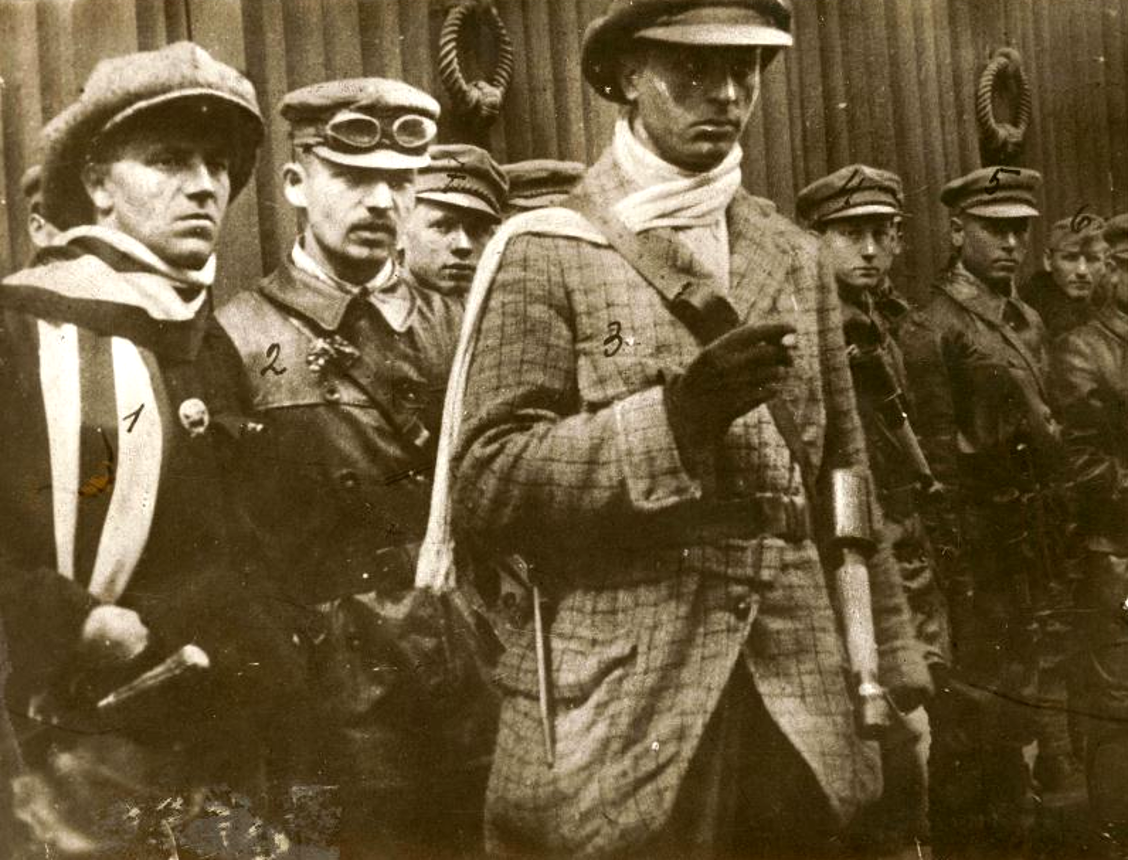
And thus Soviet Hungary’s offensive against the Roumanians on July 21st, at first successful, instantly came to a stand still.The Roumanian officers gave the order on July 28 to cross the Theiss and on August 1 the social-patriots reported to the People’s Commissaires the demand of the Entente, that Kun’s government must resign, in which case the blockade would be lifted and the Roumanian offensive discontinued. The Social Democrat Haubrich, the commander of Budapest, described in the blackest colors the dissolution of the Red Army. Bela Kun without opposition consented to the resignation, but Tibor Samuelyi, the Robespierre of the Hungarian revolution, energetically opposed resignation and demanded a fight to the end. “The duty of the Hungarian Communists”, he said, “is to fight on the barricades for the liberation of the proletariat of the whole world.” But his voice was not heard. It was decided to summon the general assembly of the 500 representatives of the proletariat of Budapest and vicinity, which should receive the resignation and name the new government.
LAST ADDRESS BY BELA KUN AND COLLAPSE.
With full consciousness of the gravity of the hour, the representatives of the Hungarian working class assembled in the afternoon. When Bela Kun appeared he was greeted by a frantic ovation. The courageous fighter, the soul and the brain of the Hungarian revolution, was very depressed. On his tired face, with eyes red from lack of sleep, one could feel the whole tragedy of this episode of the World Revolution.
The hearty ovation made Bela Kun only more nervous. While leaning on the back of a chair, he started to weep like a little child. Then he became more calin and began to speak. Among other things he said: “The dictatorship of the proletariat rested on three fundamental factors: on the spirit of the Hungarian proletariat; on the possibility of establishing contact with Communist Russia, and on the progress of the World Revolution. Those three factors partly or entirely failed to realize themselves and therefore the Hungarian Soviet Republic is given up to an early death.” He would like to fight on the barricades rather than resign without a struggle. But he knows that the majority is opposed to such a proposition. And then the Soviet Government resigned.
Then came the short-lived government of Peidl, composed entirely of social-patriots, who during the whole period of the war stirred the chauvinistic instincts of the proletariat and were supporting Austro-Hungarian Imperialism; and of the bureaucracy of the trade unions. Peidl’s government returned the means of production, which were expropriated by the Communists to the former owners and established again private ownership of the means of production; in short, the dictatorship of the bourgeoisie again come into existence. During that time the paid hordes of the Roumanian Boyars (feudal landlords) approached Budapest, looting and destroying everything they got hold of.
The Government of Peidl did not exist three days. In the shadows of the Roumanian bayonets and in the person of Grand Duke Joseph, the Hapsburg dynasty came like a vampire to life again. The monarchists carried out a Coup d’etat.
The very same rulers, the same oligarchy, speculators, officers, Christian Socialists and their appendages, and the whole corrupt official bureaucracy of which Budapest has more than enough who for four years poisoned the Hungarian proletariat and drove it with the proletariat of other countries into that terrible human butchery, the very same cruel element sat again on the back of the Hungarian proletariat. Immediately armed formations were established, composed of former officers, non-commissioned officers and non-conscious soldiers, who fought for the defense of the old monarchy. A terrible roundup of the Communists began in the streets and the houses. Whoever was caught, was shot on the spot and his body thrown in the muddy water of the Danube. On the first day hundreds of our comrades were killed. The prisons were transformed into human slaughterhouses.

The Hungarian proletariat now feels what it has lost. The Hungarian people never was subdued. Even the history of Hungarian Socialism does not show any serious persecution, because it always was social-patriotic. This is the great difference between the Hungarian revolution and the Russian revolution. In Russia since the uprising in 1830 the sparks of the revolution, always were glowing. In the cells of the prisons, in the icy fields of Siberia, in the blood of the crushed strikes, and in the numberless insurrections–the Russian workers developed class consciousness, revolutionary intelligence and a revolutionary tradition. All this Hungary lacked. For the first time the Hungarian proletariat has to go through all the terrible consequences of making an error in measuring the tempo of the World Revolution. The World Revolution is developing, but much slower than Bela Kun supposed. Still Hungary has not lost its revolution, but only postponed it. The struggle Hungary was engaged in and will have to go through again, will create the necessary class conscious, revolutionary intelligence and revolutionary tradition for final victory.
From “Nova Istina”, (The New Truth) Official Organ of the Communist Party of Jugoslavia, Aug. 29, 1919.
Emulating the Bolsheviks who changed the name of their party in 1918 to the Communist Party, there were up to a dozen papers in the US named ‘The Communist’ in the splintered landscape of the US Left as it responded to World War One and the Russian Revolution. This ‘The Communist’ began in September 1919 combining Louis Fraina’s New York-based ‘Revolutionary Age’ with the Detroit-Chicago based ‘The Communist’ edited by future Proletarian Party leader Dennis Batt. The new ‘The Communist’ became the official organ of the first Communist Party of America with Louis Fraina placed as editor. The publication was forced underground in the post-War reaction and its editorial offices moved from Chicago to New York City. In May, 1920 CE Ruthenberg became editor before splitting briefly to edit his own ‘The Communist’. This ‘The Communist’ ended in the spring of 1921 at the time of the formation of a new unified CPA and a new ‘The Communist’, again with Ruthenberg as editor.
PDF of full issue: https://www.marxists.org/history/usa/pubs/thecommunist/thecommunist3/v1n06-nov-08-1919.pdf#page=7
 Revolution's Newsstand