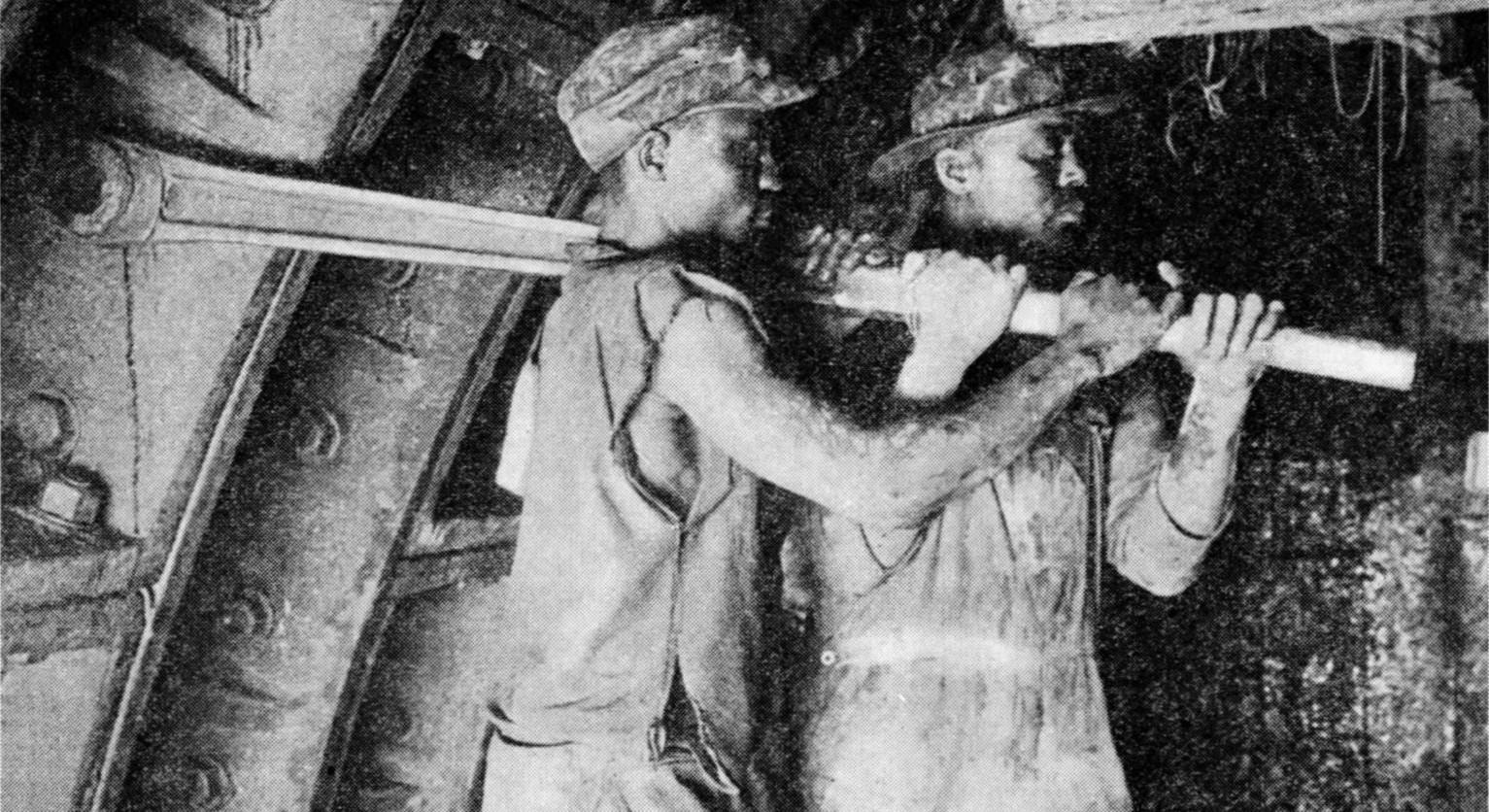
The most physically demanding job I have ever had was loading UPS trucks in Detroit going to Canada with industrial products. Even in the midst of a Detroit winter, the heat in the loading bay was so intense you gasped for breathe. After six hours, you had nothing left. Still a major workplace issue, below is a look at the myriad health effects of extreme temperatures on workers.
‘Air Condition the Factories!’ from Health and Hygiene. Vol. 5 No. 5. May 1937.
Extreme temperatures in poorly ventilated factories exact heavy penalties on workers’ health. Engineers have shown that air conditioned factories are possible.
ONE of the major health problems of our time is that of illness arising out of the kind of work a person is engaged in. More and more, people are becoming aware of the tremendous importance of industrial environment as a factor in the causation of illness in the working section of the population. They are learning, too, that occupational diseases could be almost entirely prevented through the application of existing knowledge of scientific chemistry, engineering, and medicine. Yet, new reports of mass poisoning of workers by silica, lead, radium, benzol, carbon monoxide and many other harmful substances. keep appearing in the daily press. The problem of industrial disease is growing rapidly, and little has been done to put into effect a thoroughgoing preventive program which, experts agree, could completely wipe out this type of illness.
Illness in industry can be divided roughly into three categories: first, accidents, second, specific poisoning by dust, fumes, and chemicals, and, lastly, general or non-specific illnesses which cannot be ascribed to any specific poison but rather to an unhealthful working environment. In this last category fall the ailments which result from poor ventilation, heating, lighting, and sanitary conditions of the plant.
Worker Had No Recourse
Industrial accidents increased enormously with the introduction of machinery. Only a few decades ago maimed workers were considered as much a part of the industrial set-up as the machinery itself. The worker was expected to risk the possibility of being crippled when he took the job. If he lost an arm or a leg the employer shook his head and chalked it up to carelessness. The worker had no recourse, even when it was obvious that the accident arose not out of carelessness but out of the lack of safeguards around dangerously exposed parts of the machine. In the attempt to achieve increased productivity the machines were often kept in poor repair, and this greatly contributed to the high accident rate.
These appalling conditions continued for years before the trade unions and progressive people fought for and won some protection for the worker. Workmen’s Compensation Acts were passed in most states, and though inadequate for the most part, they do help to maintain a measure of care against accidents as well as to provide partial compensation to the injured worker. An important factor in gaining recognition of the workmen’s compensation principle was the fact that accidents and the injuries resulting from them had a direct and obvious cause and effect relationship. A falling object strikes a worker who suffers a fractured skull. The relationship is a clear one and calls for immediate correction by obvious safety methods. This relationship is not so clear in the second category of industrial illness, namely, poisoning.
Slow Poisoning
Since in most instances the poisoning occurs very slowly and over a long period of time, the worker may have no other symptoms than a general feeling of being under par, and it is therefore difficult for the worker to relate his illness to his working environment. When one considers that in silicosis the worker may not feel any of the symptoms of the disease for fifteen or more years after his first exposure to the silica dust, despite the fact that an x-ray of the lungs shows them to be decidedly affected long before this period, one can understand the difficulty he experiences in linking his illness with the slow-poisoning dust he breathes at work. Patent medicine manufacturers have capitalized upon this “run-down feeling” and have sold at a neat profit multitudes of worthless nostrums which are magically supposed to clear the “system of accumulated poisons.” The fact that poor health is often based upon continuous exposure to industrial poisons is scrupulously avoided in the advertisements for such products.
Prevention of industrial poisoning has progressed at a much slower pace than accident prevention, but there is an increasing recognition by many trade unions of the insidious nature of industrial poisoning. Efforts are being made to force the employer to recognize his responsibility in the prevention of poisoning just as he has been made to accept responsibility for the prevention of accidents.
Some states have included certain types of industrial poisoning in the list of compensible diseases but, as yet these states are few and the lists are far from being all-inclusive.
Pneumonia and Chilling
The third category of industrial illness is associated with the physical conditions of the workroom. If a worker gets pneumonia his family and friends often attribute the onset of the illness to some single exposure to rainy or cold weather. The man spends eight or more hours a day at sweating labor in a damp and drafty workroom, leaves the shop without a change of clothes because there are no dressing rooms in the shop, and is chilled to the bone when he hits the cold air. Repeating this day in and day out slowly undermines his health, but this fact is almost always overlooked in the search for the cause of the pneumonia.
The human body is adaptable to a wide range of temperature and humidity, but continuous work under adverse conditions of cold and heat can bring about increased susceptibility to a number of diseases.
The few industries in which extreme cold is encountered on the job (artificial ice-making, work in refrigerating plants and packing houses, and so forth) are not dangerous to health so much because of the cold itself as because of the sudden changes in temperature which the worker experiences at various periods of the work day. In order to work comfortably in the cold, the worker has to dress warmly. Leaving the ice-box or refrigerated room, he enters a warmer room where he begins to perspire. Before his body can adjust itself to this change he is back in the ice-room again and the sudden cold produces a chilling effect on the sweating body. Constant repetition of this undermines the health of the worker and brings on frequent colds, nose and throat affections, all diseases to which workers in the cold industries have been shows to be especially susceptible.
Outdoor Workers Affected
Outdoor workers such as stevedores, laborers, steel workers, bargemen, street vendors, and roofers, are similarly affected by frequent changes in temperature. A wealth of statistical data has been compiled to show that the rate of pneumonia among these workers varies with the amount of cold weather they have to endure. An interesting survey was made of the health of the men on the Chicago police force. These men are picked men and have to undergo a stringent medical examination before they are accepted on the force. A pneumonia death rate among these policemen considerably higher than normal can be traced directly to exposure to the elements.
The United States Department of Labor has published statistics which show that steel workers employed outdoors have a death rate from pneumonia three times as high as steel workers employed indoors. These facts are reflected in the high pneumonia death rates of such steel cities as Pittsburgh, Braddock, and East Youngstown.
Heat Prostration
The harmful effects of hot weather are well known. Last summer the newspapers were full of reports of deaths from heat-exhaustion during the heat wave that gripped the Middle West. In that area alone 4,000 deaths directly attributed to heat were recorded. Most of these deaths were among old people and those working in the hot trades. Boiler stokers, foundry men, steel workers, miners, and others were carried out on stretchers either writhing with hot-mill cramps or prostrated with heat stroke, But more important than the acute effects of excessive heat are the consequences of working while exposed to high temperature for months or years on end.
Heat combined with moisture is especially trying to workers in laundries, cotton mills, canneries, and similar trades. Irritations of the nose, throat, and eyes, dizziness and headaches, as well as a very high tuberculosis rate are the common findings according to a New York State Department of Labor survey.
Tuberculosis and Textiles
In cotton spinning and weaving processes an atmosphere of moist heat is encountered. The poorly paid workers in the cotton textile industry suffer from a high pneumonia, influenza, and tuberculosis rate. When we compare these high rates with the rates of wool weavers who do similar work under normal temperatures and humidities, we find that lung affections are two to three times as prevalent among cotton as among wool weavers. The United States Department of Labor illustrates this susceptibility of cotton workers to tuberculosis with figures gathered in the textile city of Fall River, Massachusetts, where the death rate. from this disease among the women workers is 169 per cent above that of the general population.
Other workers showing similar susceptibility to lung affections include miners, brass foundry furnace men, glass workers, brick, tile and pottery kiln oven workers, brewers, workers in canneries and sugar refineries, and gas workers. All these are exposed to heat and abrupt temperature changes.
Excessive heat is definitely known to increase. the poisonous action of harmful dusts and fumes because the worker is forced to breathe more deeply when he exerts himself in a hot atmosphere. It is obvious that control of air temperature is of especially great importance in those industries where poisonous dusts and fumes are encountered.
Statistics show, too, that accidents increase directly as the air temperature rises. In the Morro Velho mine in Brazil twenty fatal accidents were reported in sixteen months prior to the installation of a cooling apparatus, and only six such accidents occurred in the sixteen months after the installation. Incidentally, the output of the workers increased 12 per cent after the installation of the apparatus.
How can these unhealthful conditions be eliminated from industry? Last year at the Harvard University Tercentenary Symposium, C.P. Yaglou of the Harvard School of Public Health offered a general program for control of excessive heat and cold in industry.
First, the manufacturing process should be altered or mechanized to correct unfavorable working conditions. An example of how this can be done is offered by the bottle manufacturing industry which used to be a very unhealthful one before the introduction of machine methods. The same holds true for the mechanization of malting and brewing processes in a few modern plants.
Secondly, the air conditions immediately around the process should be controlled. This can be effected by heat insulation screens, exhaust hoods, canopies, or enclosure of the entire hot process to isolate it from the general working-room atmosphere. This method of control is particularly needed in the hot and heavy industries such as iron and steel making and metal casting.
The temperature in the vicinity of the furnaces and red hot metals where the men work may be between 90 and 200 degrees Fahrenheit, while only a little distance away from the source of the heat, especially in open sheds, the temperature may be as low as 50 degrees.
Thus the front of the body may be covered with sweat, whereas the back may be subjected to cold drafts. The worker should be protected from this unhealthful situation by effective means of insulation from the main sources. of heat, such as stationary and movable screens, fire chains in front of open furnaces, and masks with suitable goggles. Most important is the introduction of mechanical appliances which help protect the workers from undue heat exposure. “Man-cooling” fans and other ventilation devices have been found to be of aid. Where men work out of doors and are exposed to the elements, warm shelters should be provided where they can keep dry during rain and snow.
In order to prevent chills after leaving the hot plant, suitable working clothes, facilities for bathing and changing to dry street clothes, are the most important aids in protecting the among health of the worker, and should be supplied by the management. Of course, short working hours are of the greatest importance in maintaining health in the hot industries.
The third general method in the control of abnormal air conditions is proper ventilation or air conditioning. The need for such air conditioning is illustrated by the American textile mills in the South. For efficient production of textiles it is necessary that the workroom temperature stay between 70 and 75 degrees, and that the humidity be maintained between 80 and 85 per cent. Observations in these cotton mills, however, show that the temperature varies between 80 and 100 degrees, and that in the summer months the latter figure is constant and that the workroom air is stifling. This is wholly unnecessary and could be prevented by proper air conditioning and refrigeration. A similar problem, with the same possible solution, exists in the deep mines.
Air Conditioning Is Feasible
How can these appalling conditions be remedied? Some well-meaning health authorities have attempted to correct conditions by appealing to the employers on the basis of the increased efficiency of workers under healthful conditions. It is obvious that the most efficient worker is one who is protected from all unhealthful industrial conditions. The tremendous extent of industrial disease that is still in evidence is a good indication of how successful this appeal to the employers has been.
As for the cry so often raised by employers, namely, that the idea of air-conditioned factories is utopian and that the expense of installation would be ruinous to business, we might point out that this same cry was raised when workmen’s compensation was first proposed. Engineering experts have gathered enough statistics to prove that this is no more true for air conditioning in industry than it was for the establishment of workmen’s compensation.
The trade union movement, which has finally won the right of collective bargaining according to law, can accomplish a great deal in regard to proper air conditioning if they include it in their demands when they negotiate their agreements with employers.
Health was the precursor to Health and Hygiene and the creation of Dr. Paul Luttinger. Only three issues were published before Health and Hygiene was published monthly under the direction of the Communist Party USA’s ‘Daily Worker Medical Advisory Board Panel’ in New York City between 1934 and 1939. An invaluable resource for those interested in the history history of medicine, occupational health and safety, advertising, socialized health, etc.
PDF of full issue: https://www.marxists.org/history/usa/pubs/health/v5n5-may-1937-health-hygiene-n.pdf
 Revolution's Newsstand