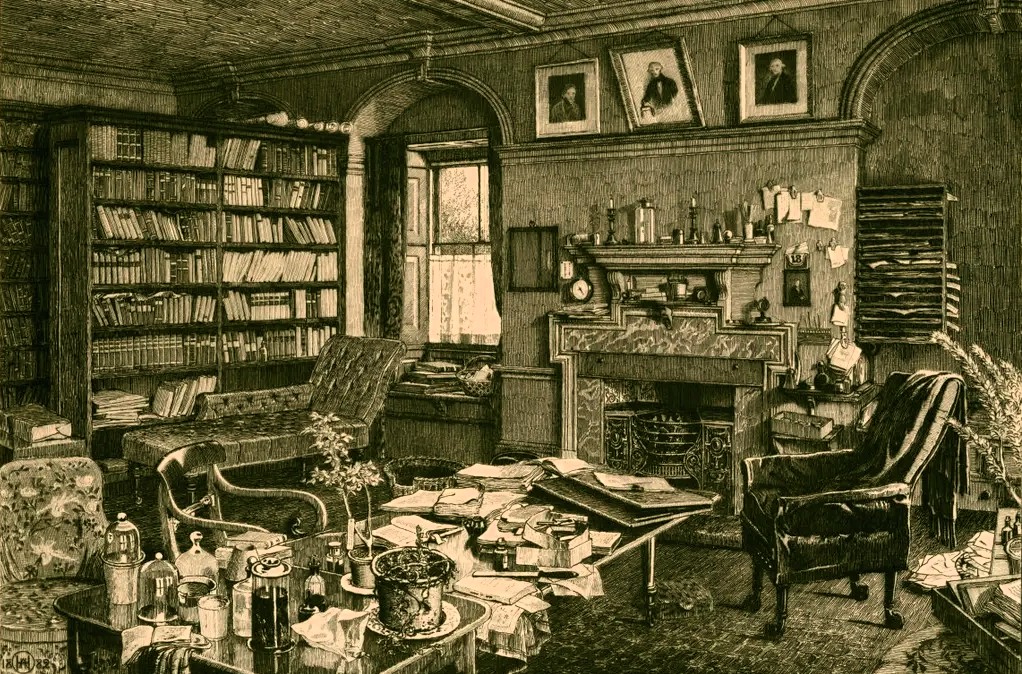
The first workers’ meetings were to study and to learn. Literacy of ideas and of history is an essential tool of a revolutionary, especially as our enemies do all they can to distort and deny them. Left wing Socialist, director of the Washington Socialist Parents’ and Teachers’ Bureau, and heroic Astoria teacher J.E. Sinclair on the books by Morgan, Marx, and Darwin that opened the world around him and made him a Socialist.
‘Among My Books’ by J.E. Sinclair from The Commonwealth (Everett). No. 117. March 28, 1913.
As a teacher it has been my lot to be surrounded by books, to pay freight on books, to pass examinations on books. As I look back over the years I can see hundreds of little hands, hundreds of little heads, but everywhere above and below and about them there float clouds of books and then more books. How civilized we are!
For years I lived in this fairyland of books breathing the breath of my young life into dead and rotten things, weaving fantastic spider webs of great intellectual beauty in the cob-web corners of castles. How thrilling it all was and how perfectly silly! Art for art’s sake, and all that sort of bourgeois dilelantism!
Then came the strong, sure tide of life with pain and poverty and stress—the class struggle, the hunt for jobs, the stern brutality of capitalism. The world of books faded away and I dreamed of a world of bread and shelter and clothing and elemental things. I yearned for them as I once yearned for the books and the cobwebs and the castles.
Slowly and painfully I came to see that something was wrong with the method of getting the elemental things. I found that between me and my desires, between me and the food and the other things, there stood a class that would not let me work until it could gain a profit from my toil. I found that every time that I tried to get things without giving a profit to this class that there were wild beasts that hunted me without mercy. I found thousands of others in the same fix and we used to compare notes in freight cars and old barns and places like that. These other fellows were as bright as I. Many of them had dreamed as I had dreamed. Many of them were still, even in their misery, book-blind. They could not see the world, the little hands poisoned with chemicals, the little faces stamped with death, the fix they themselves were in—they could not see, for everywhere they looked they saw the far-flung fairyland of books, books, written by the lackeys of those who never hunted for jobs nor walked ties until the knees grew weak and the brain reeled.
Not all of these books were bad. But my dreamy interpretation and my bourgeois mind had made of them an opaque wall that had shut me in from the ocean of life, from the mountain peaks of divine passion, from the | beauty and the horror of the world as it is. It was only through economic stress and social contact with the other fellows in the same fix that I was enabled to break down that wall and feel the pulse beats of the material world.
I am back again among my books. I use them in my business. I use them as a carpenter uses his tools. I am no longer their slave. My proletarian experience showed me that life and nature and the struggle were greater than the books. But after a long hunt I began finding books that were written by men that understand. Among these men there are three princes that live in the golden palace of the mind. They are Charles Darwin, Lewis H. Morgan, and Karl Marx.
Years ago we thought we could teach nature study to the children. Only a few can do it yet, and these have mastered the work of Darwin. I can never forget the first glad night that I sat up until the sun shone in through the window and saw me still reading Darwin’s Origin of Species. What a revelation and what a revolution it kicked up in my mind! How the plant and animal world reshaped itself around me after that! How the boys and girls around me thrilled when I touched natural things. How easy it was to teach!
Then Morgan lifted the curtain of ancient night and revealed to me my communistic ancestors, with their simple kindness, their crude strivings, and their long march upward from primitive savagery to the portals of today. He showed me how each successive stage of progress depended upon some new way of getting food, clothing, and shelter and how the mode of obtaining these things shaped the social arrangements just as definitely as the varying degrees of soil fertility, heat, and moisture shapes the destiny of plants. Morgan’s Ancient Society was an epoch in my life. No, gentle reader, neither Morgan nor Darwin were socialists. At least they were not conscious of it if they were.
Last and greatest of all the thought princes came Marx. Exiled Jew, newspaper hack, scientist, thinker of prohibited thoughts, this man combined the patient genius of the other two with the ardor and daring of the revolutionist. He was no Utopian; but he revealed to the working class the laws of capitalist production. He showed how ideas and institutions are made in the image of economic interests. He applied Darwin and Morgan to modern society and breathed into the dead clay of history the breath of life. He touched the literature of the ages with the fire of the class struggle and it became a theater wherein material interests told their tale of tragedy, Marx showed us so plainly why things happen to happen that those who understand his writing have become the greatest intellectual leaders of the time.
Grouped about these three books is an infinite variety of other books, I couldn’t mention a tenth of the books that can be interpreted by a first hand knowledge of the class struggle and a patient study of the first Volume of Capital by Marx, Ancient Society by Morgan, and the Origin of the Species by Darwin. Poetry, the drama great orations, fiction, history, and science become a living, pulsing things when the absolute and idealistic way of looking at things is abolished and the analytical materialist monist method of the scientist is used.
As a teacher let me mention a few of the books that have helped me in my work. First and foremost as a teacher of history I must place that little book, The Communist Manifesto, by Marx and Engels. Socialism Scientific and Utopia by Engels, The Materialistic Interpretation of History by Labriola, The Spirit of the American Government by Dr. Smith of our own university, The Workers In American History by Oneal, and Social Forces, In American History by Simons, are books that no history teacher can ignore, but must study or show pitiful ignorance.
And you who believe in the whipping post, read Harrow’s little booklet, Crime and Criminals, and Ferri’s scholarly little work, The Positive School or Criminology. Even Jane Adams’ book, The Spirit of Youth and the City Streets, may help you. Don’t strike another blow until you have read all three.
The Evolution of Man by Blosche, The Origin of the Family by Engels, and Salisbury and Chamberlain’s great volumes on Geology are needed by teachers far more than McMurray’s Special Method in Geography or Page’s Theory and Practice.
My dear fellow teacher, you can see by the above that I am a socialist and after you have read and thoroughly, digested the above books and have carefully compared their statements with the facts of life around you, you, too, will be a socialist and a member of the greatest army of emancipation that history ever knew.
J. E. SINCLAIR
The Washington Socialist was a weekly newspaper of the Socialist Party of Snohomish County published in Everett, Washington and edited by Maynard Shipley. Closely aligned with the Industrial Workers of the World, who were strong in the Pacific Northwest’s lumber industry, the paper ran for only 18 months when it was renamed The Northwest Worker with Henry Watts as editor in June, 1915, and again Co-Operative News with Perter Husby as editor in October, 1917. Like virtually all of the left press, the Co-Operative News was suppressed in June 1918 under the Federal Espionage Act.
PDF of full issue: https://chroniclingamerica.loc.gov/lccn/sn84025731/1913-03-28/ed-1/seq-1/
 Revolution's Newsstand