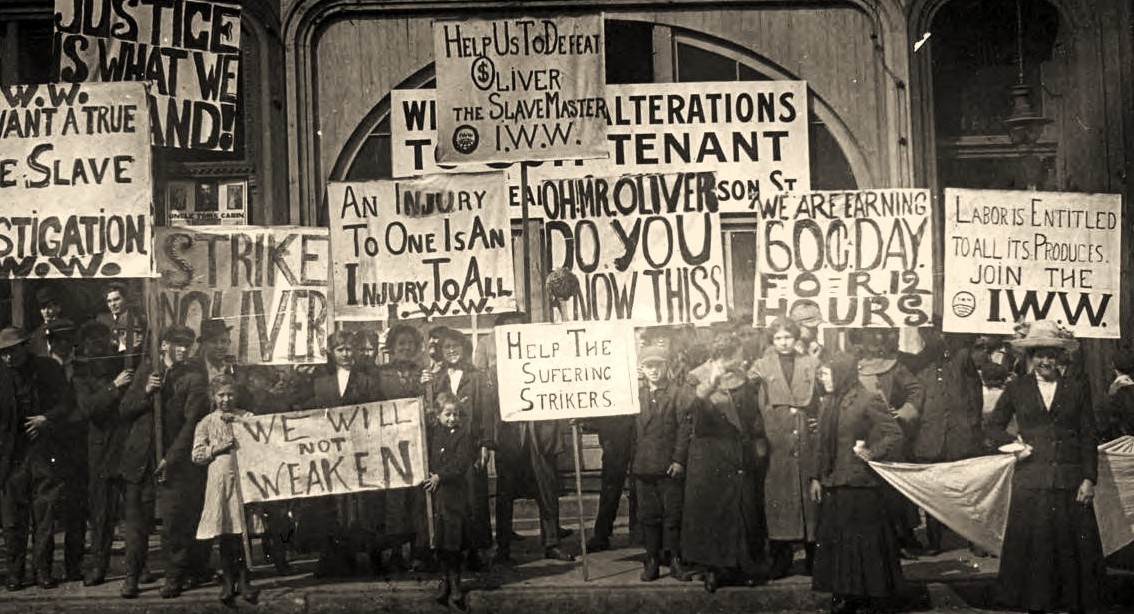
A major document from I.W.W. history, the General Executive Board (Thomas Halcro, Ewald Koettgen, George Speed, and Frank Little) to the Sixth National Convention held in Chicago during September, 1912. With around 25,000 members that year, the reports details internal organization, the Lawrence Strike, the trials of the McNamaras and Ettor and Giovannitti, newspapers, finances, strikes, police repression, the Mexican Revolution, violence, and much more.
‘Report of the General Executive Board’ from Industrial Worker. Vol. 4 No. 31. October 24, 1912.
To the Delegates, Seventh Annual Convention Industrial Workers of the World.
Fellow Workers: We herewith submit to you a record of our actions on the various matters that came before us since the adjournment of the Sixth Annual Convention.
We also submit, herewith, suggestions and recommendations which we believe will be of interest and benefit to the organization.
MOTION NO. 1-Young vs. Moore. Appeal of Young from the action of Local 84, St. Louis.
The G.E.B. voted to sustain the appeal.
MOTION NO. 2-Regarding calling convention of the Lumber Workers Locals in order to organize National Union in that industry.
The Board voted in favor.
MOTION NO. 3-Re. Constitution of the Central Committee German and Hungarian Branches of Chicago, Ill.
Motion carried.
MOTION NO. 4-Re. appeal from action of Local 84, Branch 1 in expelling Wm. Young.
Board voted in favor of appeal.
MOTION NO. 5-Re. request to reconsider expulsion of F.G. Moore from Local 84, I.W.W.
Board voted not to reinstate.
MOTION NO. 6-Re. increase in salary of Assistant Editor, “Industrial Worker.”
Board voted that increase be granted.
MOTION NO. 7-Re. Appeal of W.S. Short from action of Local 179, New York.
Appeal sustained.
MOTION NO. 8-Re. proceedings and constitutions of National Industrial Union of Forest and Lumber Workers. Motion carried.
MOTION NO. 9-Re. accepting application for affiliation from the Brotherhood of Timber Workers.
The Board voted to accept the application for affiliation.
STRIKE FINANCES.
An estimate of the amount of money expended for relief and other expenses incidental to handling strikes in the year past, shows that $101,504.05 were expended in handling strikes involving a total of 75,152 strikers and their families, lasting over a period of seventy-four weeks in the aggregate.
The problem of financing strikes is a question that should commend the earnest attention, not only of this convention, but of each and every local union after the close of the convention. It is a foregone conclusion that there is a limit to the ability of the workers to contribute to the support of strikes. With the ever growing tendency to involve larger and larger bodies of workers in the struggles for better conditions, it is but a question of a short time until this limit will be reached. The present and future conditions of modern industry do now and will continue to make it necessary that large numbers of the workers take an active part in every struggle for better conditions. There is but one way in which this situation can be met. That is, that the workers must be educated to carry on the struggle for better conditions without leaving the shops, except when it is absolutely necessary. In which event, they must be educated to adapt themselves to every requirement of each particular case and be prepared to return to work with their organization intact before they are starved into submission.
It is safe to assume that the employers will resort to the use of the lockout in order to meet these tactics and an effective answer to the lockout will have to be devised by the members of this organization. In our humble judgment the answer to the lockout is to extend the influence of the organization so that whenever necessary the workers can paralyze every industry in the country by a general strike of short duration repeated as often as is necessary to get results.
We think that it will be found that the employing class will not be willing to lose the profits accruing to them from the labor of 15,000,000 workers because some part of the employing class uses the lockout to subjugate a part of the workers. We recommend that blank forms for compiling information relative to strikes be designed and furnished all local unions by the general organization and that the local unions see to it that full information concerning strikes is furnished the general organization at all times.
THE MCNAMARA CASE.
Since the adjournment of the last Convention, the National Erectors Association and Manufacturers and Merchants Association of California, operating through the Burns Detective Agency, arrested J.B. McNamara, Ortie MacManigal and J.J. McNamara, charged with dynamiting the Los Angeles Times building at Los Angeles, California.
The two first named were arrested at Detroit, Mich., and J.J. McNamara at Indianapolis, Ind. The methods used in arresting these men and conveying them across the country to California, was in violation of all due process of law and furnishes another glaring example of what legal statutes do not mean when the liberty and lives of members of the working class are involved.
The arrest of these men was followed by a series of illegal and unlawful raids upon the records and property of the organization with which they are connected. Upon news of the arrest being made public, the General Executive Board of the I.W.W. issued a call for a general strike of all organized and unorganized workers in the country, as a protest against the high handed methods used by the States and private detective agencies in the case.
After many months in jail, the trial of J.B. McNamara was commenced, and while the jury was still being selected, a compromise was arranged between the State and Defense whereby J.B. and J.J. McNamara plead guilty and consented to take a sentence of life and fifteen years, respectively. With the guilt or innocence of these men, we are not concerned, nor are we in any position to find fault with the plea of guilt entered by them. Believing as we do, however, that the case in itself holds valuable lessons for the working class, we desire to call the attention of the membership to those phases of the case which, in our judgment, are worthy of careful consideration.
The case, in the first place, demonstrates beyond doubt, that no legal safeguard that can be invoked to protect any member of the working class who incurs the enmity of the employers by standing between them and unlimited exploitation of the workers. Second, in spite of the fact that the International Union to which these men belonged, was affiliated with the American Federation of Labor, that organization did not come to their assistance as it should have done. The position of the A.F. of L. in the case was one of half-hearted support and assurances that all they desired was a fair and impartial trial, when the history of the past proves that it is not possible for any member of the working class to get a fair and impartial trial in the courts of the employers. The only exceptions to this rule are cases wherein the workers of this country have been sufficiently aroused and sufficient money collected to enable the Defense to meet forces of the employers on equal terms. In the case of the McNamaras, the financial resources of the Defense were not sufficient to enable their attorneys to cope with the prosecution and the moral support guaranteed these members of the working class was practically nil, so far as the American Federation of Labor was concerned. The most striking object lesson of the case in our mind, however, is the fact that in spite of the handicap set forth above, the Defense were enabled to force the prosecution to agree to a compromise verdict and the National Erectors Association and Manufacturers and Merchants Association of California, were forced to content themselves with imprisoning these two men instead of having them executed according to their original plan. In our judgment, this compromise is but an indication of the progress that has been made in the past twenty-five years in this country. We do not believe that the interests concerned in the prosecution of the McNamaras are any less blood-thirsty than those who were instrumental in executing Spies, Parsons and their comrades in 1887. We do believe, however, that the working class of this country have progressed to the extent that the real rulers of the United States recognize the danger that existed for themselves and their class if the lives of these men were taken as a sacrifice to the greed of the National Erectors Association.
We believe that the progress made in the past 25 years should tend to encourage every fighter in the ranks of labor to redouble their efforts in the years that are to come and we feel sure that if they do so, it will not be many years until the struggle for economic freedom will have been won and jails and gallows will no more claim the victims of capitalist greed.
STRIKE AND LEGAL EXPENSE.
The cost of defending members of the working class that are selected as victims to appease the wrath of the employers, will also increase as time goes on. The membership of the I.W.W. must strive with all the energy that they have, to perfect the organization to such an extent that they will be able to cause the employers to lose profits whenever they attempt to victimize any member of the working class because of that worker’s activity and ability in the labor movement.
The only effective weapon that the workers have with which to meet this condition, is to render unproductive the machinery of production with which they labor, and have access to. Militant direct action in the industries of the world is the weapon upon which they must rely and which they must learn to use.
It is imperative that the attention of the membership be called to the obligation that follows the receipt of financial and other help from their fellow workers.
It is with a deep sense of gratitude that we acknowledge the solidarity so well expressed by the members of the working class who rallied to the support of the members in all sections of the country when they were engaged in the struggle for better conditions.
This sense of gratitude cannot be repaid by an expression of appreciation alone, and it should be the effort of every member of this organization to see that our sense of gratitude and solidarity finds expression in a substantial manner whenever any part of the workers are engaged in a struggle with the boss.
It is incumbent, however, that the organization at all times keep in mind that it is a fighting organization, and as such does not depend upon its financial resources in order to successfully fight the employing class. This point should be emphasized in the future as it has been in the past. The struggles just closed have furnished proof that the contentions of the I.W.W. in this regard have been based upon solid ground. They have stood the test and proved to be correct.
The attack made by the emissaries of the employing class through the medium of their courts upon the strike funds of the Lawrence strike, is but a warning as to what can be expected along that line in the future.
The delegates should give this development their careful attention and see if they cannot devise ways and means that will prove effective in meeting this latest tactic of the employing class.
It is to be expected that as the organization of the workers grows in power and influence, it will be met with every weapon at the command of the employing class. So long as the employing class relies upon open and hostile moves against the organization, we need have no fear as to the outcome of the contest. Such opposition, however bitter and brutal it may become, will but prove the fitness of the membership of this organization for the position that they have prompted for themselves as the vanguard of the army of labor in its march to economic freedom.
Open opposition will but serve to develop the necessary qualifications that fit the workers to undertake and accomplish the freedom of the human race from the bondage of wage slavery.
It is only when the employers recognize that the policy of open opposition will not get the desired result for them, and begin to cater to, and fraternize with, the I.W.W. that real danger will face the organization. It is then that the membership will have to double their vigilance and repel every overture of friendship that may be made to the organization or any part of it. Friendship of the employing class or any part of it will mean death to any organization of the workers so far as the interests of the workers as a class are concerned.
The only safeguard that the membership of the organization have against this danger is the proper education of the membership as to their real class interests; the steadfast adherence to the policy of at all times keeping the class lines distinctly drawn in the organization and the rejection of any and all alliances with any organization other than those composed wholly of members of the wage working class and standing upon the fundamental! basis of the class struggle for possession of the machinery of production for and by the workers as a class; no alliance open or otherwise with any organization not committed to the waging of that struggle at the point of production only in the work shops of the world. No entangling alliances with any part of the employing class should be tolerated, however alluring the prospect that is held out as an excuse for such alliance or the prospects for immediate gain may be.
With the gaining of a greater amount of economic control by the workers enrolled as members of the I.W.W. it is but natural to see the batteries of the employing class loosed upon the organization. A campaign of vituperation and slander has been inaugurated that should serve to firmly establish the conviction that the organization is on the right road to the goal of working class dominion over industry. It is to be expected that in proportion as the position of the I.W.W. is correct, it will be reflected in the bitterness of the opposition that it will encounter from the agents of the employing class in every walk of life and wherever found. It is likewise to be expected that this campaign of slander and abuse will serve to deceive some members of the working class who lack the experience and the knowledge flowing from experience to enable them to judge the reasons for this opposition.
Not the least effective weapon in this program of deceiving and misleading the workers as to their true economic interest is the aid and assistance rendered the employing class by the small coterie of mental bankrupts that have infested the socialist movement of America. One wing of this degenerate aggregation, composed of millionaire silk mill owners, petty business men of doubtful business ability and totally devoid of integrity, a small number of deluded workers with petrified tissues where their brains should be, and a number of barrel house bums whose sole claim to distinction is that they periodically appear upon a ballot appealing for the suffrage of the voters in order that they may avoid some useful service in return for their sustenance, devote most of their time repeating, with parrot-like brilliancy of intellect, every foul slander that has been coined by mouth pieces of the existing order of things since the world’s workers first began the struggle for supremacy. The other wing composed of a larger number of deluded wage workers, whose misery and desire for economic freedom is taken advantage of, by as unscrupulous a gang of parasites as ever traded upon the ignorance and misery of any people; business failures who, not successful in establishing themselves securely upon the backs of the workers, are devoting their petty talents to further misleading them in order to curry favor with the masters of the bread and thus enable them to win a place at the pie counter of politics; self-appointed saviors who failed to make a livelihood at the profession of saving souls who now mouth revolutionary phrases with all the unction that they once exhorted their superstitious dupes to place their hopes for relief in another and–for all they knew to the contrary–non-existent world; shyster lawyers whose mental equipment prevented them from success in competition with better equipped members of that profession, all join in the campaign of slander against a real expression of the workers and their efforts to perfect an organization on class lines that will be effective in the struggle for freedom. With few notable exceptions, the press of this institution is filled with parrot-like repetitions of the abuse always used against the workers by agents of the employing class. The agents of the employing class have at least the excuse that they are paid to do the dirty work of their masters. These others have no excuse except it be that they are desirous of scabbing the ones now holding the job out of their positions.
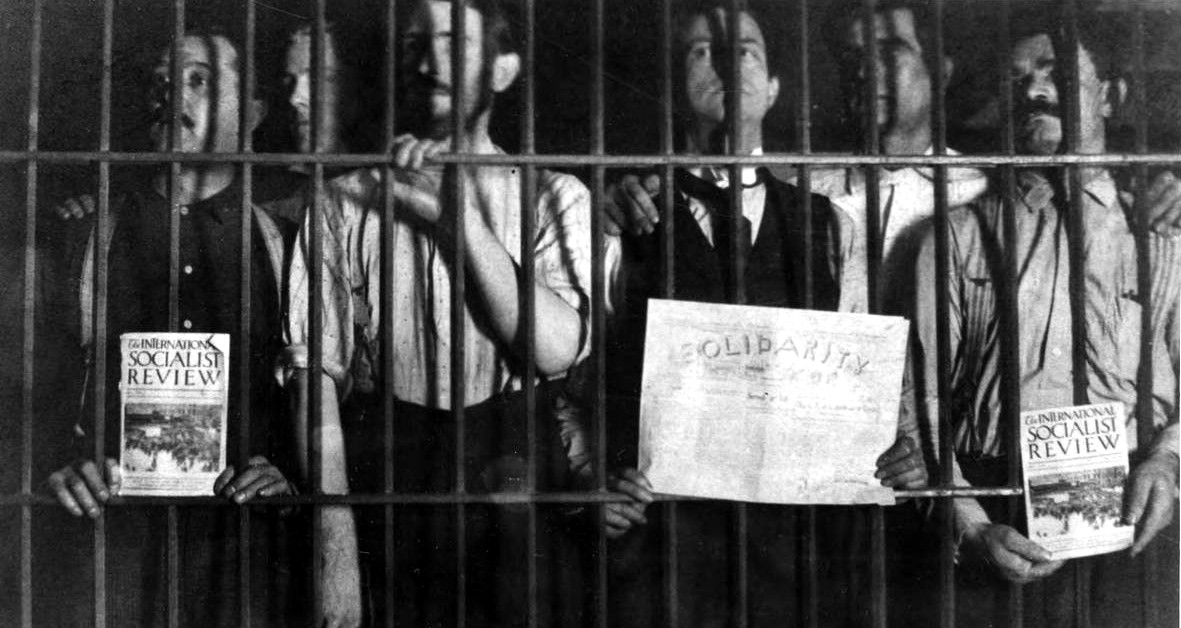
Professing to be neutral, they use up barrels of ink in parroting the false accusations hurled against the organization by the Kirbys, Posts, and Otis of the employing class. In times of struggle they are silent until forced to take some note of the fights made by the organization, or in hopes of making campaign material out of the success attending the efforts of the workers in the struggles. Then they will be found in the front making claims as to the value of their services that only serve to establish them as petty politicians attempting to take credit to themselves for success achieved by those whom they have reviled and ridiculed to the best of their mean ability.
Your organization has been accused of preaching violence in spite of the fact that in no word or line in the literature of the organization can be quoted to prove the accusation.
You are charged with being murderers in spite of the fact that in the many struggles taken part in by the organization no human life has been taken by any member of the organization regardless of the provocation offered.
You are charged with advocating a policy that will lead to bloodshed when the fact is that the program advocated by your organization offers the only possible method by which bloodshed can be avoided or reduced to a minimum.
Deprived of an opportunity to labor except at uncertain periods, forced by present circumstances to be content with a small portion of the wealth that your brain and muscle brings into being, you are characterized as bums, tramps and worthless loafers by the very individuals who spoil good paper coining excuses for the parasite classes, because, forsooth, they, the parasites, “are victims of the system.”
Professing to be for the overthrow of capitalist property, they are found endeavoring to instill into the minds of the now awakening proletariat a reverence for capitalist property that can serve no other purpose than to prolong the reign of capitalism.
We desire to emphasize in this report that we place no strictures upon any members of the working class who in all sincerity are connected with the same institution as those who are proving themselves only too willing to do the work of capitalist agents. To these, we have but one feeling–that of class solidarity and we earnestly request all members of the working class who today are being misled and duped by this element in the revolutionary movement to thoroughly investigate the conduct of those with whom they are associated, and we believe that if they will do so, their class interests will demonstrate to them that the role played by their officials and press, can but react against the interest of the working class.
It would be unwise in reviewing the past year of the organization’s progress if we omitted to call the attention of the members to the pretensions of friendship that are beginning to be manifested for the organization in many other quarters. Success breeds friends as well as enemies. When the organization struggled against tremendous odds for its very existence there were none so poor as to render it homage. When success seems to crown the struggle, all are more than willing to put forward their claim as being THE factor that is responsible for the victories won and the progress made. To all such, we have but one answer. That answer is, that the Industrial Workers of the World is an organization of workers who are conscious of their class interests, who know what they want and how to get what they want; who appeal only to members of the wage working class, and that we will resent with all our power any attempt on the part of individuals or organizations to interfere with the affairs of the organization or attempt to exercise a guardianship over it. As an organization of the useful members of society, the wealth producers, we propose to compel homage from all other elements in society and render reverence to none. As the fighting organization of the working class in the industries of the world, we will be guided only by our experience gained in the struggles of the past and future.
SIGNS OF THE APPROACHING CHANGE.
Everywhere in the modern world evidences of the coming revolution are apparent. In all lands the workers are beginning to assert themselves in an effort to wrest from the master class more of the good things of life. The awakening of the workers logically brings forth attempts on the part of the employing class and their agents to intimidate and cow the workers into abandoning the struggle for economic freedom.
South America in the year past has witnessed acts of official brutality that are past belief. In Russia the ruling class has in the year past given further proof of the lengths to which the rulers will go in order to maintain themselves upon the backs of the workers. In France, Germany, England and America the past year has witnessed many outrages inflicted upon the workers that the rights of private property and privilege of exploiting the workers be maintained.
All of these signs are but evidence that the workers in ever increasing numbers are awakening and that the near future will see the struggle for economic freedom actually on the world over.
Not the least evidence of the approaching struggle is to be seen in the cowardice and treachery displayed by the politicians who assume for themselves the right to represent the workers in the rotten political state of the employing class. At a time when courage and determination are demanded above every other qualification, when the times call for an aggressive policy, and correct education upon the fundamental principles upon which the revolution must be fought, these elements in the labor movement are found deserting every pretense of being revolutionary and seeking to avoid personal danger by proving to the employers that they are committed to nothing more revolutionary than a few phrases and high sounding. platitudes. They attempt to shield their professed revolutionary desires behind a declaration that they are committed to a “legal” revolution. A legal revolution means nothing less than to say that they do not propose to change the existing order of things except with the consent of that class who today are the beneficiaries of the present system of wage slavery.
This attitude of the politicians is not without its good effects. In every occasion in which they, the leaders of the political parties, have an opportunity to show themselves, they are furnishing indisputable evidence to the workers that they are but patch-work reformers whose only function is to feed at the pie counter of the master class for less than old party politicians exact in return for their ser vices.
THE LAWRENCE STRIKE.
On the 12th day of January, the workers in the textile mills of Lawrence, Mass walked out on a spontaneous strike against a reduction of wages instituted by the mill owners in reply to a law passed by the Massachusetts Legislature reducing the hours of work for women and children from fifty-six to fifty-four hours per week. Approximately 25,000 mill workers were actively involved in the strike. The strikers were of twenty-seven different nationalities, speaking forty-three different languages and dialects.
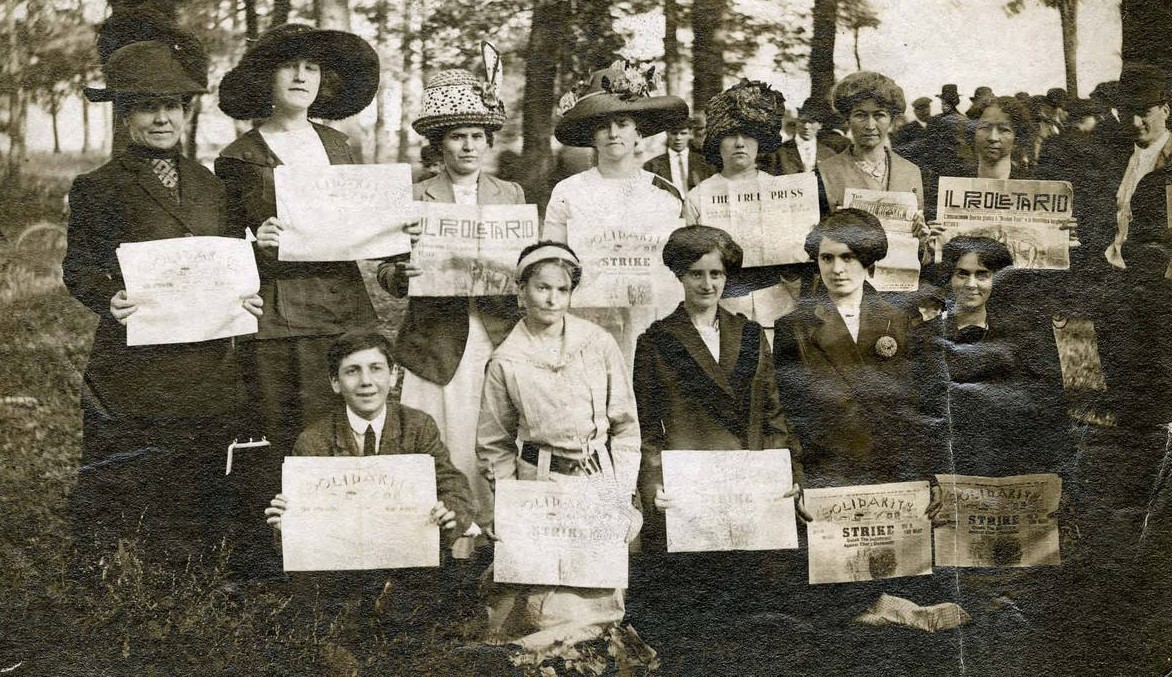
Indirectly there were some 60,000 people involved in the strike-families not actually at work in the mills but whose parents and relatives were so employed.
Of the total number of workers involve in the strike, not over 1,500 were enrolled as members of any labor organization. of this number 1,200 were members of Textile Workers Industrial Union No. 20, of Lawrence, Mass., affiliated with the National Industrial Union of Textile Workers of the I.W.W. The balance, 300. were connected with the United Textile Workers of America, holding a charter from the A.F. of L. or in independent craft unions.
When it is known that the average wages of the textile workers of Lawrence prior to the strike were $5.82 per week, and this average included the wages paid the superintendents as well as the higher paid workers, it can be readily seen that the strikers had very little in the way of financial resources with which to sustain themselves while on strike.
This one fact of itself furnishes convincing evidence that the conditions in the mills and rate of wages had reached the point where further submission was out of the question.
In the middle of winter, without fool or fuel at hand, these workers thought they could be no worse off starving and freezing in the streets of Lawrence thar they were slaving in the mills and starving at the same time.
At the beginning of the strike, the strikers wired to New York for General Executive Board Member Joseph J. Ettor who prior to the strike had assisted in carrying the message of Industrial Solidarity to the wage slaves of Lawrence. Ettor immediately left for the scene of the struggle and with him went Fellow Worker Arturo Giovannitti, the Editor of “IL PROLETARIO,” the official organ of the Italian Socialist Federation. With the arrival of these two men upon the scene, the work of organizing the strikers was pushed with all energy and ability at their command. Within the short space of a week, order was brought out of chaos, and the strikers were so effectively organized that all the power at the command of the mill owners failed to destroy the solidarity of the striker in the nine weeks of bitter and brutal struggle that followed.
In less than a week after the strike had started, the state militia were ordered into the strike district for the purpose of breaking the spirit of the workers and driving them back into the slave pens under the conditions against which they had rebelled.
The militia was reinforced by the state detective force and a horde of private detectives and thugs in the service of the mill owners and city of Lawrence virtually.
The city was placed under martial law and a reign of terror was inaugurated in the name of law and order.
As a result two of the strikers lost their lives. One a boy, 17 years of age who was stabbed through the back by member of the militia. The other, an Italian girl, a striker who was shot during an attack made upon the pickets by the police and detectives.
The testimony of eye witnesses tends to establish the fact that the shot which resulted in the death of this girl striker was fired by a policeman.
The record does not show that the killing of an unarmed boy by an armed militiaman was even investigated.
The killing of the girl striker was used as a pretext for arresting. Ettor and Giovannitti who were charged with being responsible for the death of the girl as accessories before the fact.
The city and state authorities hoped by arresting these men to deprive the strikers of their aid and counsel in conducting the strike and discourage the strikers, thinking that they would stampede back into the mills.
The arrest of Ettor and Giovannitti failed in its purpose. Instead of discouraging the strikers it made them all the more determined.
The general strike committee having the strike in charge established relief stations and issued an appeal for funds with which to provide relief for the strikers.
The response to the appeal for support was generous. The heroism of the men, women and children who were facing starvation and cold in the struggle for better conditions brought a ready and generous response from all quarters of the country. The relief stations were thus enabled to care for the most pressing needs of the strikers and the handicap of being without funds under which the strike started was overcome.
As a further measure of relief, the committees in charge decided to ask the workers of other localities to provide food, clothing and shelter for the children of the strikers. This request also met with a ready response and 120 of the children were sent to the workers of New York t be cared for until the strike was over. The arrival of the children in New York furnished the outside world with evidence that could not be contradicted as to the actual conditions existing in the textile industry of Lawrence.
This move of the strike committee was met by the mill owners and their agents. the police, deciding to prevent the children from being taken care of in that manner.
As a result, when the committee attempted to send a delegation of children to Philadelphia, the acting marshal of Lawrence, backed by the military forces of the state, forcibly prevented the children from leaving the city. The horrors of the scene at the depot that morning need not be repeated in this report. Suffice it to say that the official brutality displayed entitles the marshal of Lawrence to a place in infamy as the most degenerate thug that ever disgraced the earth with his presence in this or any other age of the world’s history.
Finding that every effort to break the strike was of no avail, the mill owner finally surrendered to the strikers and granted an increase of wages ranging from 5 per cent for the higher paid workers to 25 per cent for the lowest paid workers. The working conditions in the mills were improved and the bonus or premium system modified so that its most harmful features were abolished. Thus ended the Lawrence strike. The first and only victory achieved by the textile workers since modern industrial conditions were established in that industry.
In closing we desire to record our deep sense of gratitude to any and all who assisted in making a victory for the strikers possible. We are firmly convinced that all aid and assistance rendered was in the spirit of class solidarity so far as the workers are concerned and from a spirit of sympathy where relief was given by those who are not of the working class.
Credit for the Lawrence victory cannot be claimed by any one individual or set of individuals. Nor can the result be laid to any single circumstance that contributed to the successful ending of the fight. If credit is due to any, more than others, it is due to the strikers themselves, because they had the courage to dare to rebel against unbearable conditions and had the good judgment to refuse to allow themselves to be tricked by the employing class or any of their agencies. If credit is due to any one circumstance more than others, it is due to the heroism and fortitude of the strikers who refused to be cowed by the show of force and actual brutality of the mill owners’ hirelings. An exhibition of splendid solidarity that won for them the support of the workers everywhere and finally forced the surrender of the mill owners.
We are not unaware that individuals and institutions are today making claims that they and they alone are responsible for the success of the Lawrence strike. To all such we say “To the extent that you aided in making victory possible, full credit is coming to you, but when you for the purpose of self aggrandizement attempt to use the victory of the Lawrence strike to further mislead and delude the workers of this country, then we point out to you the many strikes that have been lost in the last few years, and ask you to explain to the workers of America, if you can, why it is that you did not also win those strikes for the workers involved? Why if your power is so great did you not use it before the workers were forced to face starvation and the militia in an effort to change their conditions?”
THE ETTOR AND GIOVANITTI CASE.
One of the developments in the successful revolt by the textile slaves of the Lawrence Textile Mills, was the arrest on the 26th day of January of one member of the organization, Joseph J. Ettor, G.E.B. Member, and Arturo Giovanitti, Editor of IL PROLETARIO organ of the Italian Socialist Federation. These fellow workers have been confined in the Essex County Jail up to date, on the charge of being accessories before the fact to the murder of an Italian girl striker, Anna Lo Pizza.
The evidence at hand all goes to prove that the shot which resulted in the death of Fellow Worker Anna Lo Pizza, was fired either by a police officer of the city of Lawrence, or by some thug acting with and under the protection of the police department of that city.
The arrest of these two fellow workers was a desperate effort on the part of the mill owners to break the spirit of the men, women and children involved in the strike. It was hoped that the arrest of Ettor and Giovanitti would create confusion that would result in a stampede back to the mills upon the mill owners terms. Failing to secure this result, the authorities of Essex County have been forced to make an attempt to secure a conviction in order that they may justify the arrest and continued imprisonment of Fellow Workers Ettor and Giovanitti.
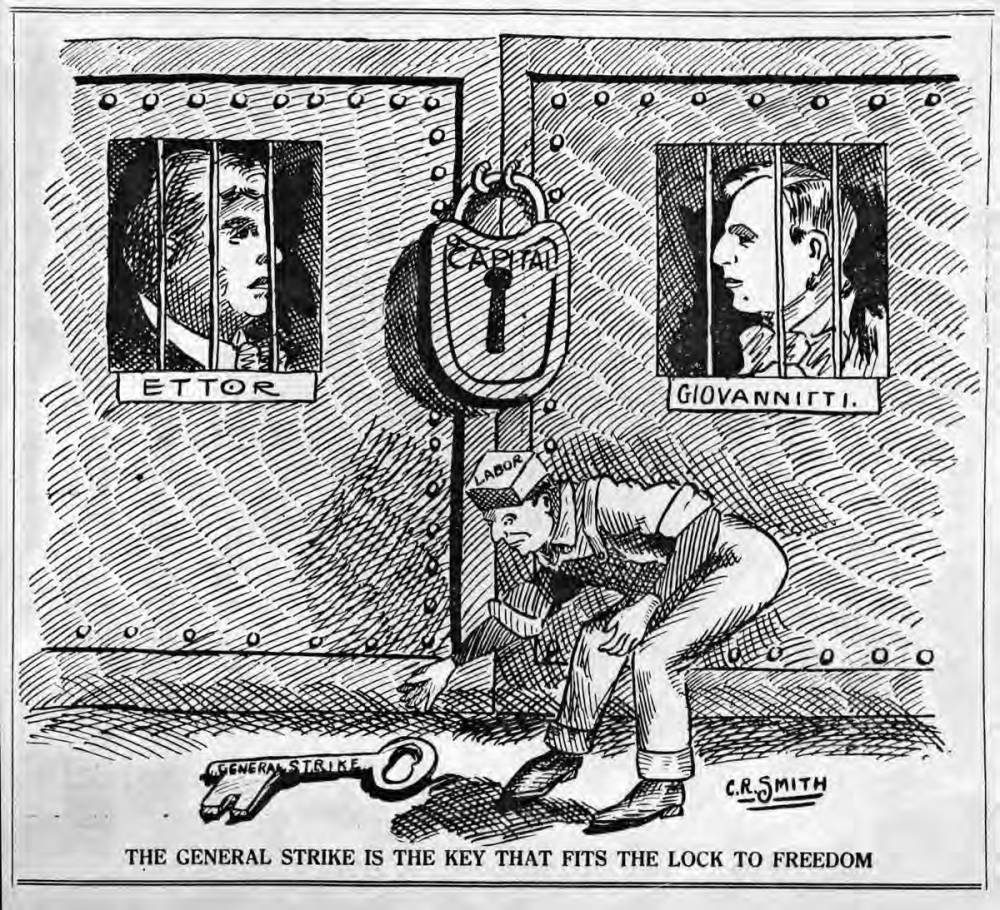
The date of the trial is set for September 30th. During the past eight months, the committee in charge of the defense of the fellow workers has been carrying on a campaign of publicity and appealing for aid and financial assistance to all the workers of this country. Defense conferences have been organized in many of the large industrial centers and the present outlook is that the workers are being aroused to a proper understanding of what this case means from a working class standpoint. And unless the fellow workers are acquitted, the industries of this country will feel the power of the workers expressed in a general tie-up in all industries, and further, the workers of other lands, as an expression of international solidarity, are willing and will be found inflicting financial damage upon the American employers to the full extent of their power and ability.
QUESTION OF VIOLENCE.
The enemies of the I.W.W., the employing class and their paid hirelings—are devoting a great deal of their time and energy charging that the organization, is committed to a program of violence in order to accomplish the overthrow of the wage system. This charge is made with all the variations that can be thought of by the upholders of the present rulers of society. Craft Union leaders, politicians of alleged revolutionary tendencies and labor misleaders of every stripe, are to be found echoing the charges formulated by the employing class and their agencies. On the question of violence, we desire to call the attention of the delegates and through them, the membership of this organization, to the lessons that history contains. This lesson in brief is that it is not the subject class of any society that dictates whether or not its progress shall be accompanied by violence. At all times, it is the rulers, who being in power, are in position to determine in a great measure, just how and when the struggle will be fought. The history of the past has been that the privileged class respect no law and will stop at nothing to maintain their position in society. It is they, who in the past have resorted to violence in order to perpetuate their reign and in the struggle of today and those that are to come, it is the employing class and their agencies who provoke violence and then cry out the loudest against its use.
The program of the I.W.W. offers the only possible solution of the wage question whereby violence can be avoided, or at the very worst, reduced to a minimum. To all opponents of the organization wherever found, we desire to state that this organization will to the best of its power and ability, bend every effort towards making that program effective. We also desire to serve notice upon the ruling class and all its defenders, that whatever form, the struggle may take, we are determined to continue in spite of all odds until victory has been achieved by the working class. If the ruling class of today decide as its prototypes of the past have decided, that violence will be the arbiter of the question, then we will cheerfully accept their decision and meet them to the best of our ability and we do not fear the result.
Certain elements in the revolutionary movement with profuse sophistry, put forth the claim of having a shield behind which they can fight the capitalist class in security and escape the consequences of attempting to revolutionize society. To all such we say, that the I.W.W. has nothing to shield and having nothing to shield, we have no use for a shield even though one existed. Those whose purpose needs a shield, let them use it. For us, our object is declared open and above board and that object will be pursued with all the ability and power at our command.
INTERNATIONAL ORGANIZATION.
The necessity for an integral organization, international in scope, will become more and more apparent as time goes on. It is to be hoped that the membership of the I.W.W. will provide ways and means whereby this organization can fulfill their part in the formation of a revolutionary international in the near future.
THE EIGHT HOUR DAY.
The present need for a shorter work day in the industries of the country is bound to make itself felt. To the end that the agitation for the shorter work day may get results, the membership should provide ways and means for the necessary literature in all foreign languages.
POLICE AGENTS.
In almost every publication catering to the good will of the workers and working class organizations, the hue and cry against police agents is raised today.
In this connection, we desire to point out to the membership of the I.W W. and to the working class in general, that those individuals holding positions as labor editors and editors of political publications claiming to represent the interest of the working class and who use such positions. to repeat the slanders and false accusations hurled against the workers in times of struggle for better conditions, are in our humble judgment proving themselves to be the most efficient police agents at the command of the capitalist interests in this country today. Not only are they most efficient, but they are likewise the cheapest servants of the capitalist class, because through their pretensions of fealty to the working class, they are enabled to work without pay from the capitalist class.
THE MEXICAN REVOLUTION.
Not the least significant struggle of the workers for economic freedom, is the efforts being made by the Mexicans peons to wrest economic freedom for themselves in the confines of their own country. Regardless of the many complications that exist in this struggle, we recognize that it is at the base an effort of the disinherited native workers of Old Mexico to gain for themselves their economic independence.
We are glad to be able to report that in this struggle, members of the I.W.W. have been able to lend some assistance and we sincerely hope the near future will see the efforts of the Mexican wage workers crowned with success and the fruits of victory, for which they have struggled against great odds and with great suffering, in their possession.
FAKE INDUSTRIAL UNIONISM AND BORING FROM WITHIN.
During the fiscal year past, different advocates offering to the working class something “just as good” as Industrial Unionism, have attempted to secure a recognition of their theories in the different local unions of the I.W.W., claiming to advocate the policy of boring from within the A.F. of L. With few exceptions, these individuals have confined their activities solely to an attempt to disrupt the I.W.W.
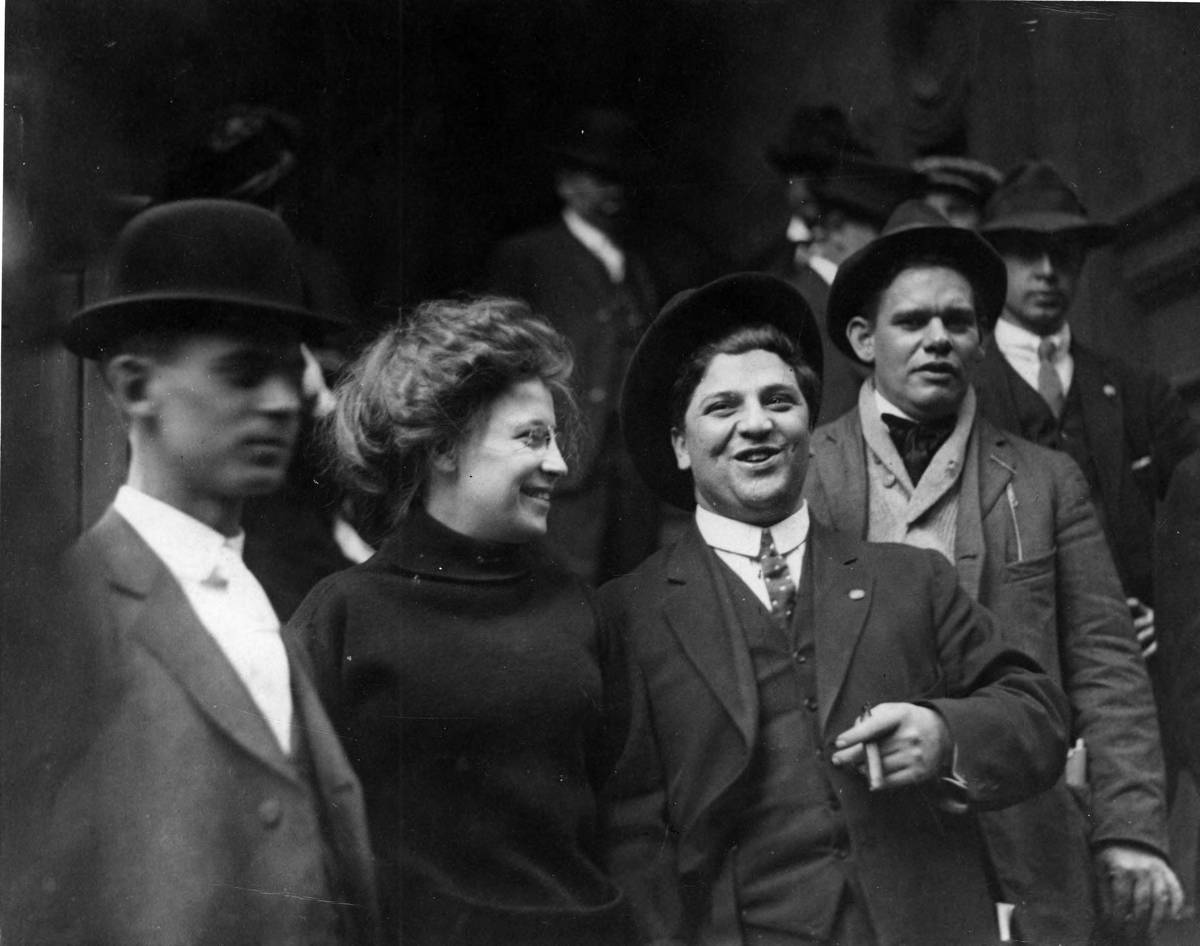
The year past furnishes some valuable illustrations as to the lack of merit in the policy of attempting to change the structure and principles of the American Federation of Labor.
Most glaring of these examples is the strike of the Shop Men on the S.P. and Illinois Central Railroads. This strike is now in its 11th month and so far as indicated on the surface, the operation of these roads has not been seriously crippled by the strike. In fact, the history of this strike is the same old story of a part of the workers in an industry fighting the boss, while the rest of their fellow workers stay at work and help to operate the railroads involved.
The newspaper strike in Chicago, wherein members of the Pressmen’s Union were locked out by the newspaper association of that city, to the credit of the newspaper drivers, newsboys and stereotypers, members of these organizations responded by refusing to assist the newspaper publishers in their efforts to crush the Pressmen’s Union.
This evidence of solidarity on the part of the stereotypers has brought about their expulsion from the International Union of which they were members, and the scabs who took their places were granted a charter.
This particular case proves that even if the workers were paying tax to the A.F. of L. or any part of it, they are not furnished any protection from being scabbed upon by other craft unions working under contract with the same employers.
The strike of the water front federation employes in New York city recently closed, also resulted in a defeat of the workers, due to the treachery of parts of the International Unions involved at the beginning of the struggle. The struggle, in common with the others mentioned, proves that the federation plan of organization with local and international autonomy, furnishes a weapon that is as ineffective as the independent craft union. It is not with any sense of satisfaction that we record defeats of the workers in struggles for better conditions. Our only object in mentioning these cases is that the workers in general and the membership of the I.W.W. in particular may profit by the lessons which they contain, using their best efforts to develop and establish the form of organization that will permit the necessary solidarity and encourage the fighting spirit required to gain victory in the struggles for better conditions.
SAFETY OF THE ORGANIZATION’S EFFECTS.
Late occurrences in the labor movement serve to emphasize the need of proper precaution being taken to safeguard the property and effects of the organization from the high handed methods of the agents of the employing class. As the organization from now on will exert more and more influence on the industries of country, it is safe to assume that the employing class will not hesitate to employ any means that give promise of retarding its growth and efficiency.
So called legal safeguards will be disregarded to the full extent that the agents of the employing class can do so in safety
to themselves. Verbal protests will be of no avail if that be the only method which the organization relies on for its protection.
NUMBER 1.-The only protection that the organization can have against this danger is to be in a position to foresee any possible attack and to forestall the same by maintaining an efficient guard over the effects and papers of the organization.
NUMBER 2.-To be able to do this will require that the General Office be maintained in some convenient place that is not a large industrial center. To build up around the locality of the General Office a force that can be relied upon to call any bluff made by the agents of the employing class.
NUMBER 3.-A duplicate set of records should be kept as an extra precaution.
NUMBER 4.-Locals will have to plan to take the same precaution in safeguard the effects of the locals. All locals are urged to equip themselves with typewriters and mimeographs to use for publicity purposes in time of struggles.
ORGANIZATION.
Chartering of Locals.
Experience of the past year has demonstrated that the system of chartering branches of locals calls for a thorough understanding of the plan of organization and the methods of procedure in conducting the affairs of the industrial union.
One of two steps will have to be taken–branches will have to be chartered as locals, or the General Organization will have to make provisions to have qualified organizers work with locals that have branch organizations and instruct them in their proper relation to each other and in the method of procedure in conducting the affairs of the industrial union.
Under the industrial plan of organization, branches of an industrial union are supposed to deal with the general or national organization only through the local industrial union of which they are a part. At the present time, due to a lack of understanding of this plan of organization on the part of branches, they deal with the general organization direct. As no branch accounts are kept, this is bound to result in confusion. If branch accounts are kept, it can only mean that each branch should be chartered as a local. This will tend to destroy the solidarity aimed to be brought about by the industrial plan of organization.
Therefore, it behooves the organization and all of its parts to thoroughly understand the industrial plan of organization and to organize in strict accord with the same. Too much stress cannot be laid upon this point while the organization is yet in its infancy. The time and energy expended now in getting things in proper shape will more than pay for itself in the future. It will mean stability and system where both are needed.
PAPERS.
The editors of the two English organs will have a full report of the papers in their charge.
On this matter we desire to call your attention to the grave danger which will at all times confront the organization unless the proper steps are taken to safeguard the official organs.
In our judgment all of the publications of the I.W.W. should be under the immediate control and supervision of the General Executive Board. We realize that under present conditions this may not be possible, but as the organization grows in size and strength, all publications should be issued from a central point and the General Office should be located at that point. Thus the executive officers of the several Industrial Departments who will constitute the G.E.B. will at all times have control and supervision over the official organs. The danger of sectionalism will be avoided, as well as the danger of as many different brands of Industrial Unionism as there might be editors of different papers–all being promulgated as the official declaration of the I.W.W., resulting in nothing but confusion and dissension.
We are not unmindful of the danger that will ever live in centralized power, but it does not follow that to centralize the administrative machinery of your organization necessarily means a centralized power.
The only means by which centralization of power can be avoided is by correct education and a thoroughly intelligent membership, each fully realizing the duties and obligations incumbent upon them as members and each discharging those duties and obligations to the fullest extent of their ability.
With an intelligent membership it will be impossible for any official to usurp or attempt to usurp power. Without an intelligent membership it will be an easy matter for designing individuals to usurp power, and no provisions, constitutional or otherwise, can be made that will prove a safeguard to the organization.
The greater efficiency that is obtained by having the machinery of the organization as compact as possible will offset the danger of power being usurped by any officials.
The seventh year of the I.W.W. finds the English papers under the management and control of the General Organization in more sound financial condition than heretofore. The membership should redouble their efforts to extend the circulation of these papers and make the press of the I.W.W. a power in the country. All of the foreign speaking publications, formerly published by locals, have suspended publication on account of lack of finances.
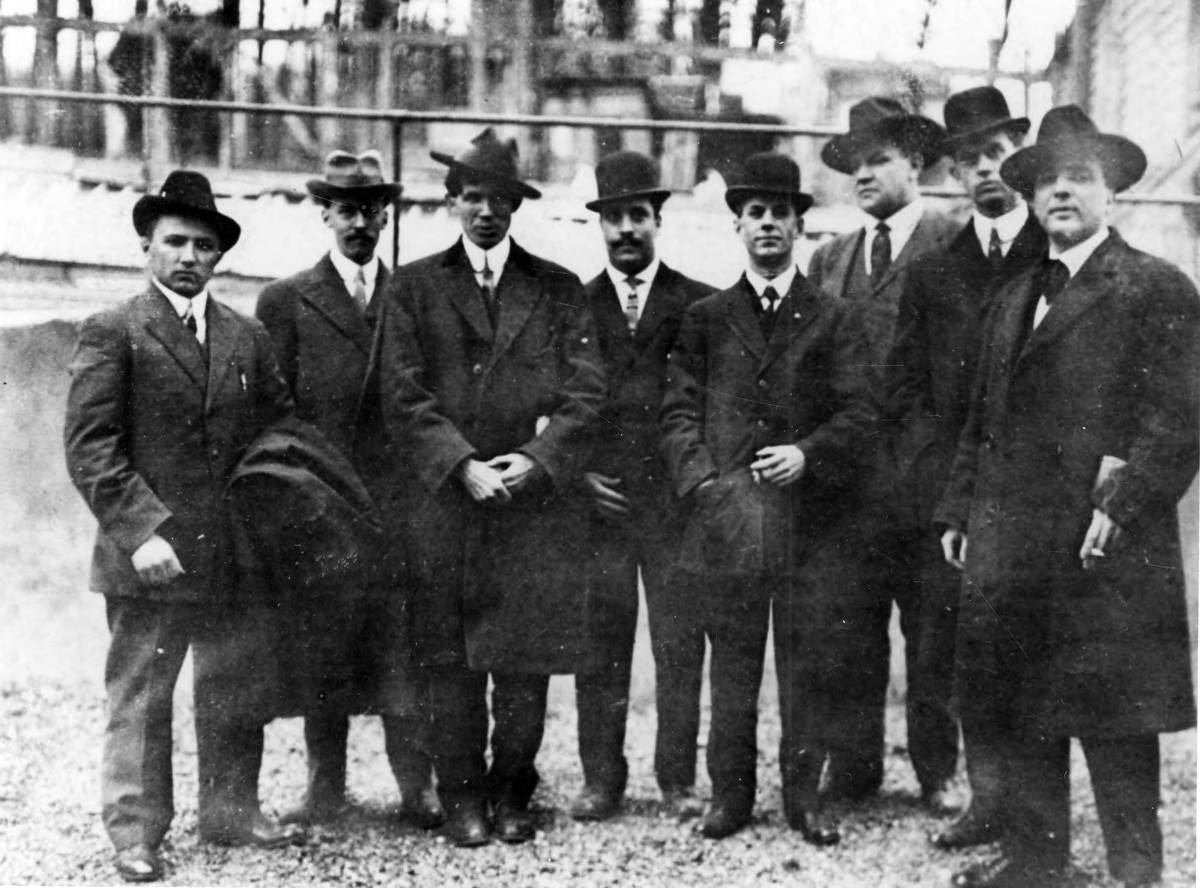
It is well to call the attention of the membership to the vital importance that the papers are to the organization and that every effort be made to re-establish the foreign publications as soon as possible.
Under the present circumstances of the organization, the papers must of necessity be devoted wholly to propaganda. The need of an official bulletin for the exchange of opinion between the membership is beginning to be felt and with the growth of the organization its need will be more urgent.
DEFAULTING SECRETARIES.
Several of the Locals have suffered in the past year from defaulting secretaries. It is needless to state that as the organization begins to make headway in the work of organizing the industries, it will attract to the organization individuals whose only object will be to despoil the organization of everything possible.
In this connection we desire to remind the membership that whenever a secretary or other financial officer makes away with the organization’s funds, the fault lies as much with the membership as it does with the defaulter. The only safeguard that an organization can have for its finances is the constant vigilance of its membership in all of its financial affairs. The membership of local unions cannot take any better steps to protect the local funds than to see to it that their financial officers make out the monthly financial report to the local unions and the quarterly financial report to the general office. As soon as the financial condition of the general organization will permit, a sufficient office force will be employed in the general office to enable all financial reports to be checked up promptly and compared with previous reports.
CONSTITUTION.
The present constitution has no provision governing the filing and trial of charges against members of a local union. We, therefore, recommend the adoption of the following to be known as Art. Sec.
Whenever any member of the Industrial Workers of the World violates any of the principles or rules of the organization, he shall be proceeded against in the following manner:
Charges shall be filed against the member in writing setting forth the facts in the offence with which the member is charged. The charges shall be read before the local union at the next regular meeting after the same have been filed. Upon the reading of the charges the local shall appoint or select a trial committee of five members from the floor of the meeting. The trial committee shall furnish the accused with a copy of the charges and a notice of the date set for the hearing of the same. Copy of charges and notice of trial shall be sent by registered mail if mailed or if delivered in person a receipt must be secured from the accused admitting that they have been notified and furnished with a copy of the charges.
The trial committee shall keep a complete record of the evidence pro and con of the trial. The trial committee shall report their findings to the first regular meeting after the conclusion of the trial, together with the record of the trial and the local union shall affirm or reject the findings of the committee.
Either party involved may take an appeal from the decision of the local union within sixty days from the date of the meeting passing on the report of the trial committee by filing a notice of appeal with the secretary of the local union in writing.
The secretary of the local union shall immediately forward the appeal together with all the evidence of the case to the general secretary-treasurer, who shall submit the same to the general executive board.
BRANCH ORGANIZATION.
Whenever charters are issued for branches of a local industrial union, the I branches must upon being chartered, form the central committee of the Industrial Union. This Central Committee of the Industrial Union shall maintain connection between the local industrial union and all its branches and the General Headquarters National Industrial Union or the department headquarters to which they belong.
All due stamps, literature and supplies purchased by the branches must be purchased from the secretary of the Central Committee of the local Industrial Union.
All moneys collected by the branches for dues and supplies must be paid into the secretary of the Industrial Union and all bills for expenses of carrying on the work of the local Industrial Union must be paid from the treasury of the Industrial Union. Funds raised by the branches in any manner outside of the regular in come of the organization for dues, assessments and supplies can remain in the treasury of the branch which handles the raising of such funds.
The central committee of the local Industrial Union shall be composed as follows: Each Branch of a local Industrial Union shall be entitled to two delegates for each hundred additional members or majority fraction thereof. Each delegate shall have one vote in the central committee.
The officers of the central committee of a local industrial union shall be as follows: Chairman, financial secretary and treasurer and three trustees who shall hold office for a term of six months or until their successors are elected and installed into office.
The chairman, financial secretary-treasurer and trustees of the central committee shall be elected by the Central Committee of the Industrial Union from the delegates to the central committee.
The central committee of the local Industrial Union shall meet at least once every month, and shall hold at least one general membership meeting every three months on demand of any of the branches or when called for by a majority of the delegates.
Also recommend that the following be adopted as procedure in filing charges against General Officers:
CHARGES AGAINST GENERAL OFFICERS.
Charges against any of the General Officers shall be filed in writing with the G.E.B. or the General Convention at the option of the person filing the charges. If the charges are filed before the G.E.B. they shall at once have a copy of the charges sent to the accused together with a notice of the date of the hearing of the charges. Charges filed before the General Convention must be sent to the General Secretary at least 60 days prior to the date of the convening of the convention.
On receipt of the charges the General Secretary will forward a copy of the same to the accused and notice to appear at the convention for trial.
Any decision of the G.E.B. on charges tried by them shall be subject to appeal to the next general convention and from the general convention to the general membership. The decision of the general convention on charges can be appealed from to the general membership.
The cost of appealing to the general membership shall be borne by the party taking the appeal until such time as the membership is in favor of the person taking the appeal, then the general organization will refund the cost of the appeal. Change second paragraph Art. VII, Sec. 5, to read:
Referendum initiated to change date for any action or to defer action or postpone dates already set, must have sufficient endorsements to be operative and to allow the vote to be sent out at least 60 days prior to date which referendum seeks to change.
Referendum returns from local unions, national unions or departments cannot exceed the paid up membership of the local union, national union or department for the three months previous to the vote on the referendum in question. New Section (Out of Work Stamps.) Members out of work and on strike shall be entitled to out of work stamps. Out of work stamps shall be a receipt for dues and assessments for the month in which they are used. The General Secretary-Treasurer shall furnish out of work. stamps to local unions, national unions and departments on request free of charge. Out of work stamps shall not be computed in standing of locals.
In conclusion, we desire to impress upon the membership of the organization the utmost necessity for vigilance and unceasing energy in the work or organization and education.
We sincerely trust that the record made by the organization will never be sullied by an act of treachery to any part of the working class; that the progress of the past year will be multiplied in the year to come, and the near future will see the workers in possession of the machinery of production.
With best wishes, we remain Yours for Industrial Freedom, THOMAS HALCRO. F. H. LITTLE. EWALD KOETTGEN. GEORGE SPEED. General Executive Board.
The Industrial Union Bulletin, and the Industrial Worker were newspapers published by the Industrial Workers of the World (IWW) from 1907 until 1913. First printed in Joliet, Illinois, IUB incorporated The Voice of Labor, the newspaper of the American Labor Union which had joined the IWW, and another IWW affiliate, International Metal Worker.The Trautmann-DeLeon faction issued its weekly from March 1907. Soon after, De Leon would be expelled and Trautmann would continue IUB until March 1909. It was edited by A. S. Edwards. 1909, production moved to Spokane, Washington and became The Industrial Worker, “the voice of revolutionary industrial unionism.”
PDF of full issue: https://www.marxists.org/history/usa/pubs/industrialworker/iw/v4n31-w187-oct-24-1912-IW.pdf
 Revolution's Newsstand