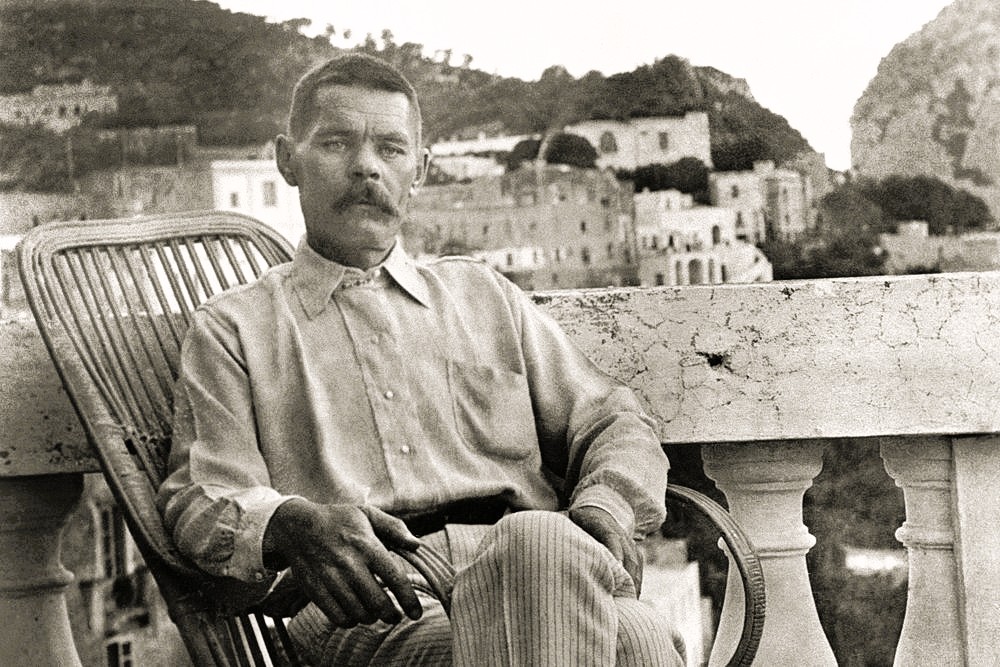
Gorki’s early concerns and vast hopes towards Bolshevik power are on display in these extraordinary paragraphs greeting a New World as it is born in blood.
‘The Torrent of Revolution’ by Maxim Gorki from Class Struggle. Vol. 2 No. 5. November-December, 1918.
December, 1917.
Christmas! We are living in a storm of the darkest passions. The past has opened wide its gaping jaws and reveals mankind in all its horrible disfigurement. Greed, hatred and revenge reign everywhere, the beast in the human breast, goaded to madness by years of imprisonment, martyred by centuries of untold suffering has torn wide its vengeful jaws, is roaring triumphantly, viciously, seeking whom it may devour. But all that is sordid and hideous on earth is the work of man. Beauty and reason toward which we are striving live within us.
Even the slave will learn to know the joy of life. Life is not worth living to him who has no faith in the brotherhood of mankind; there is no meaning in life to him who is not convinced of the victory of love.
Though we be buried in blood and filth up to our necks, though thick clouds of vile and disgusting vapors envelope our heads and blind our eyes, though it seems, at times, as if vulgarity had killed the beautiful dream we bore in agony and suffering, though all the torches that we once lit on the path that was to lead us to a new and better world seems to have been extinguished, humanity will win. For that is the great meaning of life in this world. Life has no other meaning.
But perhaps, after all, we are doomed to destruction! Were it not better then to be burned up in the fierce fire of the revolution than to rot slowly on the dungheap of monarchy, as we have been rotting till the revolution came?
Clearly, the time has come when we Russians must shake the thralldom of the past from our souls, when we must cleanse the filth of centuries from our lives, must kill our slavish laziness, must review our habits and opinions, our lives and our ideals. Let us gird our loins and go forth, like self-confident and capable workmen, to meet the great human task of reconstructing our planet.
Our lot today is tragic. Aye but in tragedy man is at his best and highest!
It is not easy to live. So much mean hatred has come to the surface of life, that the holy wrath that could kill all these small meannesses was drowned beneath them.
Sinesius, the Bishop of Ptolemy once said:
The philosopher must have peace and quiet, but the clever helmsman is trained in storms.
Let us believe that those who do not go down in the storm and chaos of our times will become strong and sure, that they will be hardened to an invincible resistance against the ancient bestial principles of life.
Today is the day when Christ was born. His birth has been to suffering humanity one of the two great symbols that man has created in his age-long striving for right and beauty.
Christ is the eternal ideal of mercy and humanity; Prometheus is the enemy of the Gods, the first rebel against fate. Humanity has nowhere created anything more sublime than these two embodiments of its own desires.
The day will come when these two symbols of mercy and goodness, of high faith and mad courage will merge in the soul of man into one great wonderful sentiment, when mankind will recognize its own worth, the beauty of its aspirations and the bonds of blood that bind men to each other.
In these days that are filled with horror for so many of us, in these days that are so terribly filled with rebellion and blood and hatred we must never forget that we are striking upon a journey of great travail and well-nigh unbearable trials to achieve the liberation of life from the heavy, rusty chains of the past.
Let us believe in ourselves, let us be stubborn and unyielding in our battles. Everything is in our power, and in all creation there is no law but our reason and our will.
You who feel in the storm of events; you whose hearts are torn by evil doubts, whose minds are oppressed by black sorrow—my greetings.
My greetings to you, too, who are innocently languishing in prison.
Not We Have Desecrated the World!
Three years of cruel senseless butchery; three years the blood of the best peoples of the world has been spilled, the best brains of the cultured races of Europe has been destroyed. France, “the leader of mankind,” is bleeding to death, Italy the most beautiful gift the Gods have given to this mournful’ earth, is facing annihilation; England who “with calm pride shows to the world the wonders of labor,” is putting forth its last desperate effort, the “busy folk of Germania” are being throttled in the iron clutches of war.
Belgium, Rumania, Servia and Poland are ruined, dreamy spineless Russia, the land that has never lived, that has never had a chance to show the world its hidden strength, is economically and spiritually rent asunder.
For nineteen centuries Europe has preached humanity, in the churches it is now destroying with bombs, in books that its soldiers are using for fire wood. And in the twentieth century humanism is forgotten and scorned. What the unselfish work of science created, has been confiscated by shameless murderers and utilized for the destruction of mankind.
What are all the Thirty Years Wars and the Hundred Years Wars of the past compared with these fantastic three years of butchery? Where can we find a justification for this unexampled crime against the culture of our planet?
There can be no justification for this horrible self-destruction. Whatever hypocrites may say of the “great” aims of the war, their lies cannot cover up the shameful truth: that this war was born of greed, the only goddess that is recognized and worshipped by these murderers who trade in the lives of humanity.
In every nation these scoundrels are branding those who believe in the ultimate victory of the ideal of world brotherhood as insane, as dangerous and heartless, as phantasts who know no love of fatherland.
They have forgotten that Christ, John of Damascus, Francis of Assisi, Leo Tolstoi, and all the other demigods and supermen that are the pride and worship of mankind were also such phantasts. They who are ready to destroy millions of lives for a few kilometers of foreign soil, have neither God nor Devil. To them the lives of their fellowmen are worth less than a stone, their love of fatherland is nothing more than an acquired mental habit. They demand to live as they have been accustomed to live, though the whole world be torn into fragments.
For three years they have been living up to their necks in the blood of millions of men that is being shed because they will it.
But when once the strength of the masses is spent, when once there flares up within them the determination to live, a purer, a more human life, and puts an end to this bloody delirium—then they who have destroyed will cry out:
We are not to blame! Not we have devastated the world, not we have destroyed and plundered Europe.
But when that time comes, we hope that the “voice of the people” will be “the voice of God,” sounding more loudly than the most blatant lie. Let all those who believe in victory over shamelessness and madness unite their forces.
For after all, in the end reason must always conquer.
New Conditions—New People
What will the New Year bring. All that we are able to command from it.
To become capable men and women we must believe that these mad blood and filth stained days are the great birthdays of a new Russia.
It is a painful birth, amid the crashing overthrow of old forms of life, under the rotting ruins of the dirty caverns in which the people have been struggling for breath for three hundred years, in which they became hateful, and unhappy, in the midst of this outburst of all the degradation and vileness that were stored up within us under the leaden weight of monarchism in this eruption of a whole volcano of defilement the old Russian people, the self-satisfied idler and dreamer is dying. And in his place the bold, healthy workman, the creator of a new life has come.
The new Russian is not attractive, less attractive than ever before. Still fearful for the permanence of his victory, still unable to fully enjoy the fruits of his liberation, he sheathes himself with an armor of petty hatreds to assure himself, over and over again of the incredible truth, that he is really free. How dearly he himself, and the objects of his experiments are paying for this assurance!
But life, that severe and merciless teacher, will soon bind him once more with necessity’s chain, will force him to work, and in united labor, he will forget all the small, slavish and shameful instincts that still hold him in their power.
New men and women will be created by new conditions—new conditions create new men and women.
And out of the sorrow of today will come new men and women, who know not the misery of slavery, no longer disfigured by oppression, men and women whose own freedom makes them incapable of oppressing their fellow men.
Let us meet the new year with the confidence that man will learn to love work and to understand its meaning. Work that is done with love, is not slavery, but creation.
When man has once learned to love work for its own sake, the world and all its glories will be his.
Letters from Women
The most interesting letters that I receive come from women. These letters, concerned with the impressions of the stormy present, are filled with anguish, resentment and wrath, but they are not apathetic like those of men, in every woman’s letter is the cry of a living soul, tortured by the countless woes of the horrible times in which we live.
They produce the impression of having been written by one woman, by the Mother of Life, by her, who has given the world all races and peoples, by her, who has borne and who will bear in her womb all genius, by her who has helped man to convert coarse animal instinct into the tender ecstasy of love.
These letters are the cry of a being which has called poetry into life, which has inspired art, and which is continually tortured by the unquenchable desire for beauty, life and joy.
The letters to which I refer are full of the wails of mothers over the corruption of mankind, over the fact that it is becoming cruel, savage, vulgar and dishonorable, and that morality is being coarsened. These letters are full of curses against the Bolsheviki, the peasants and the workers, invoking all punishment, all horrors, all tortures upon them.
“Hang them all, shoot them all, annihilate them all,” demand the women, mothers and nurses of all heroes and saints, all geniuses, all criminals, all rogues and all honorable men, the mother of a Christ as well as of a Judas, of Ivan the Terrible as well as of the shameless Machiavelli, of the gentle, affectionate Francis of Assisi, of the gloomy enemy of every joy, Savanarola, the mother of Philip II., who laughed but once in his life when he heard the news of the Bartholomew massacre, the greatest crime of Catharine de Medici, who also was a woman and a mother and in her way was concerned with the welfare of many men.
Hating death, annihilation and atrocities, the mother, the object of man’s greatest reverence, she who leads him to high and beautiful things, she, the source of Life and Poetry, cries, “Kill! Hang! Shoot!”
We are here face to face with a fearful and gloomy contradiction, that may well destroy the aureole with which History has surrounded woman. Can it be that women do not fully understand their great cultural function, do not feel their creative power, that they abandon themselves too much to the despair that is awakened in their maternal souls by the chaos of revolutionary days?
I will not go into this question any further, I will just make the following remarks.
You women know that birth is always accompanied by labor pains, that the new being is born in blood—the malicious irony of blind Nature wills it so. In the moment of delivery you cry out like animals, and smile the blissful smile of the Madonna when you press the new born child to your breast.
I will not reproach you for your animal cries, I understand the unendurable torture which causes them, for I myself nearly faint at the sight of such tortures, although I am not a woman. And I hope with my whole soul that soon, smiling the smile of the Madonna, you will press to your hearts the new born child of Russia.
One must remember that revolution brings out not only many cruelties and crimes, but also many heroic deeds of bravery, of honor, of unselfishness, and of disinterestedness. Do you not see that? Is it perhaps because you are blinded by hatred and hostility?
The forty years of civil war of the eighteenth century caused a disgusting brutality in France, an arrogant cruelty, but think what a benign influence a Julie Recamier exercised! There are many such examples of the influence of women on the development of human feelings and ideas in history. It is fitting that you mothers be excessive in your love of humanity, but cautious in your hatred.
The Bolsheviki? Yes, just think they are human beings like the rest of us, born of mothers, and there is no more of the animal in them than in us. The best of them are remarkable persons of whom the future history of Russia will be proud, while our children and grandchildren will admire their energy. Their deeds are subject to violent criticism, even to malicious scorn—this has fallen to the lot of the Bolsheviki in perhaps greater measure than they have deserved. They are surrounded by their enemies with a stifling atmosphere of hatred and, what is perhaps more dangerous for them, by the hypocritical, servile friendship of those who, like foxes, prowl about those in power, in order to use them like wolves, and who, we hope, will die like dogs.
Am I defending the Bolsheviki? No, I am working against them—but I defend the men whose honest convictions I know, whose personal honor is known to me, just as I know the honesty of their devotion to the well-being of the people. I know that they are conducting a most cruel scientific experiment on the living body of Russia. I understand how to hate, but I prefer to be just. Oh, yes, they have made many very grave, serious mistakes—God also made a mistake when he made us more stupid than we should be—Nature has made mistakes in many things—shall we judge them from the standpoint of our wishes, which may contradict their objects, or their imperfections? Without knowing to what political results their activities will finally lead, I assert, that from a psychological standpoint, the Bolsheviki have already done the Russian people a great service in that they have called forth in the masses an interest in present events, without which interest our country would have been destroyed.
Now it will not be destroyed, for the people have awakened out of their apathy to a new life, and new forces are ripening in them, which fear neither the madness of political innovators nor the greed of foreign robbers who are altogether too certain of their invincibility. Russia struggles convulsively with the dreadful labor pains of delivery—do you wish, that as soon as possible a new, beautiful, good, human Russia shall be born?
Let me tell you, Oh mothers, that rage and hatred are bad midwives.
The Class Struggle and The Socialist Publication Society produced some of the earliest US versions of the revolutionary texts of First World War and the upheavals that followed. A project of Louis Fraina’s, the Society also published The Class Struggle. The Class Struggle is considered the first pro-Bolshevik journal in the United States and began in the aftermath of Russia’s February Revolution. A bi-monthly published between May 1917 and November 1919 in New York City by the Socialist Publication Society, its original editors were Ludwig Lore, Louis B. Boudin, and Louis C. Fraina. The Class Struggle became the primary English-language paper of the Socialist Party’s left wing and emerging Communist movement. Its last issue was published by the Communist Labor Party of America. ‘In the two years of its existence thus far, this magazine has presented the best interpretations of world events from the pens of American and Foreign Socialists. Among those who have contributed articles to its pages are: Nikolai Lenin, Leon Trotzky, Franz Mehring, Karl Liebknecht, Rosa Luxemburg, Lunacharsky, Bukharin, Hoglund, Karl Island, Friedrich Adler, and many others. The pages of this magazine will continue to print only the best and most class-conscious socialist material, and should be read by all who wish to be in contact with the living thought of the most uncompromising section of the Socialist Party.’
PDF of full issue: https://www.marxists.org/history/usa/pubs/class-struggle/v2n5nov-dec1918.pdf
 Revolution's Newsstand