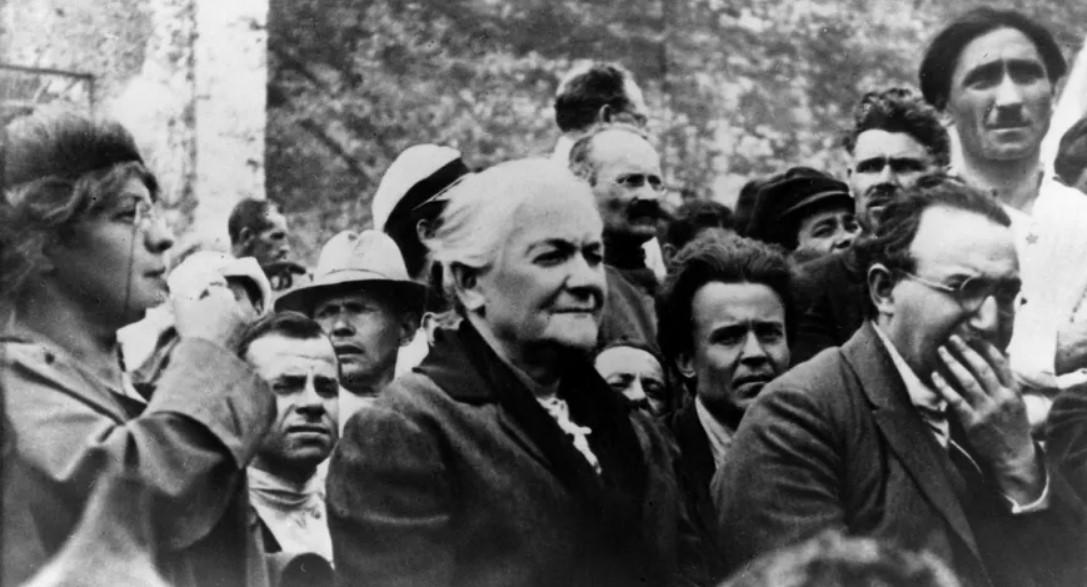
Clara Zetkin describes secreting across the border to visit France for the first time since the war, and her surprise arrival at the Communist Party’s convention in Tours.
‘Clara Zetkin Outwits French Authorities’ from Truth (Duluth). Vol. 5 No. 5. February 4, 1921.
Veteran German Communist Visits Convention In Tours and Slips Away.
Berlin, Feb. 3. The resumption of the sessions of the Reichstag has brought back to Berlin Frau Clara Zetkin, whose trip to Tours created such a sensation in France. She has received many congratulations on her pluck, not only from her partisans, the communists, but also from the reactionary Nationalists; for any trick played upon the French authorities will always be applauded by Junkerdom.
It was with difficulty that we persuaded the lively little gray-haired woman to give an account of her recent visit, which she thought much less interesting than her trip last year to Russia, where her friend Lenin convinced her “by facts of the supremacy of Bolshevism.”
“You just telegraph what Americans are missing,” she urged, “by not having elected a man like the President (Lenin), who still wore the same old hat he had six years ago and who never eats anything but the soup distributed to all by the Moscow Government.”
“You must not think we played any tricks on the French Government,” she said, “I am like most Communists, I hate lies, I had no other papers than my German passport, which described me as Clara Zetkin, a member of the Reichstag, adding a few complimentary remarks regarding my personal appearance. Where I crossed the border I must not reveal, nor how it happened that the frontier guard never noticed that my passport was not properly vised, because our Communist comrade may have to rely upon the same methods to cross France, and I must not spoil their game.
“When I passed through the devastated district, and I must say I was shocked. I never expected to see such business, which makes me wonder no longer at French hatred against the Germans. Beyond the devastated districts the train became extremely crowded, and the passengers often addressed me, but they never suspected by nationality, because I speak French very well, having lived in Paris for more than eight years.
“My heart beat quickly whenever we stopped at any station, for I feared the control officers might ask unpleasant questions. The danger became pressing when we reached the Gare du Nord in Paris, where policemen in plain clothes stop any suspicious looking arrival.”
But Frau Zelkin passed this ordeal successfully. Continuing her story, she said:
“I took a seat in front of the Cafe de la Paix and ordered coffee. Then I looked about. So this was Paris after the war! Well, I could not see any difference, except that the women wore extremely short skirts and very low necks. Otherwise Paris is the same city I left some time before the war—even more Parisian, if possible; livelier, more elegant, and with streets full of Yankees, and English.
“I hastened to my old friends, who could not believe their eyes when they saw their unexpected visitor, I stayed thirty-six hours with my friends in Paris, who would not let me continue my journey to Tours by railway, but rented an automobile at an enormous price. Before nightfall myself and a Parisian friend were en route for Tours, traveling in the dark, because the nearer we got to Tours the more vigilant became the police, and my Parisian friend said I should never have been able to reach the Tours railway station undetected. Nevertheless, we took three meals in Hotels on the way, and, as my Parisian friend never failed to speak in a very nasty way about Germany, and even more nastily about Lenin, nothing happened.
“We reached Tours before noon and lunched at my (word missing) house. My visit was a great surprise to the delegates of the Third Internationale assembled there, who had merely heard that Clara Zetkin had been prevented from crossing into France.
“It was 7 o’clock in the evening when I and my Parisian companion entered the congress, and the members were speechless when my name was announced. After a short consultation with the Chairman all the doors were locked and guards were placed before them, whereupon trusted delegates rushed to the three telephone booths in the hall and began conversations with any Tom, Dick or Harry in Paris; for these telephones connected the congress directly with the French capital, and if any secret agent present had notified Millerand he would never have permitted me to leave France again.
“Thundering applause greeted me when I began my address, which it was arranged should last only half an hour. Meanwhile our car took in fuel and provisions for several days.
“When I finished the audience fairly stormed the * stage, wishing to congratulate me and shake hands with me. The committee formed a circle around me, conducting me through a back door, where tine car was waiting. Away we speed through the old-fashioned streets of Tours into the unlighted country, and never stopped till we reached Rheims.
“That city is one tremendous heap of ruins, with here and there some mean, low, narrow shanty rebuilt on the site of former palaces once surrounding the fine Cathedral, which, despite all assertions to the contrary, is rather well preserved. The country around Rheims has recovered quickly from the wounds of the war and is again the land where the champagne flows, which nobody discovered the German communist, although she stayed fully twenty-four hours.
“In reaching home by way of Luxemburg I used the same methods, which I must not reveal for the reasons I told.
“And now,’’ continued Frau Zetkin, “will you tell the Americans that France, even should she regain much of her old beauty, is not half so fine a country as Bolshevist Young Russia, where nobody cares what one wears and children are no trouble because the State is playing nurse?”
Truth emerged from the The Duluth Labor Leader, a weekly English language publication of the Scandinavian local of the Socialist Party in Duluth, Minnesota and began on May Day, 1917 as a Left Wing alternative to the Duluth Labor World. The paper was aligned to both the SP and the IWW leading to the paper being closed down in the first big anti-IWW raids in September, 1917. The paper was reborn as Truth, with the Duluth Scandinavian Socialists joining the Communist Labor Party of America in 1919. Shortly after the editor, Jack Carney, was arrested and convicted of espionage in 1920. Truth continued to publish with a new editor JO Bentall until 1923 as an unofficial paper of the CP.
Access to full issue: https://www.mnhs.org/newspapers/lccn/sn89081142/1921-02-04/ed-1/seq-1
 Revolution's Newsstand