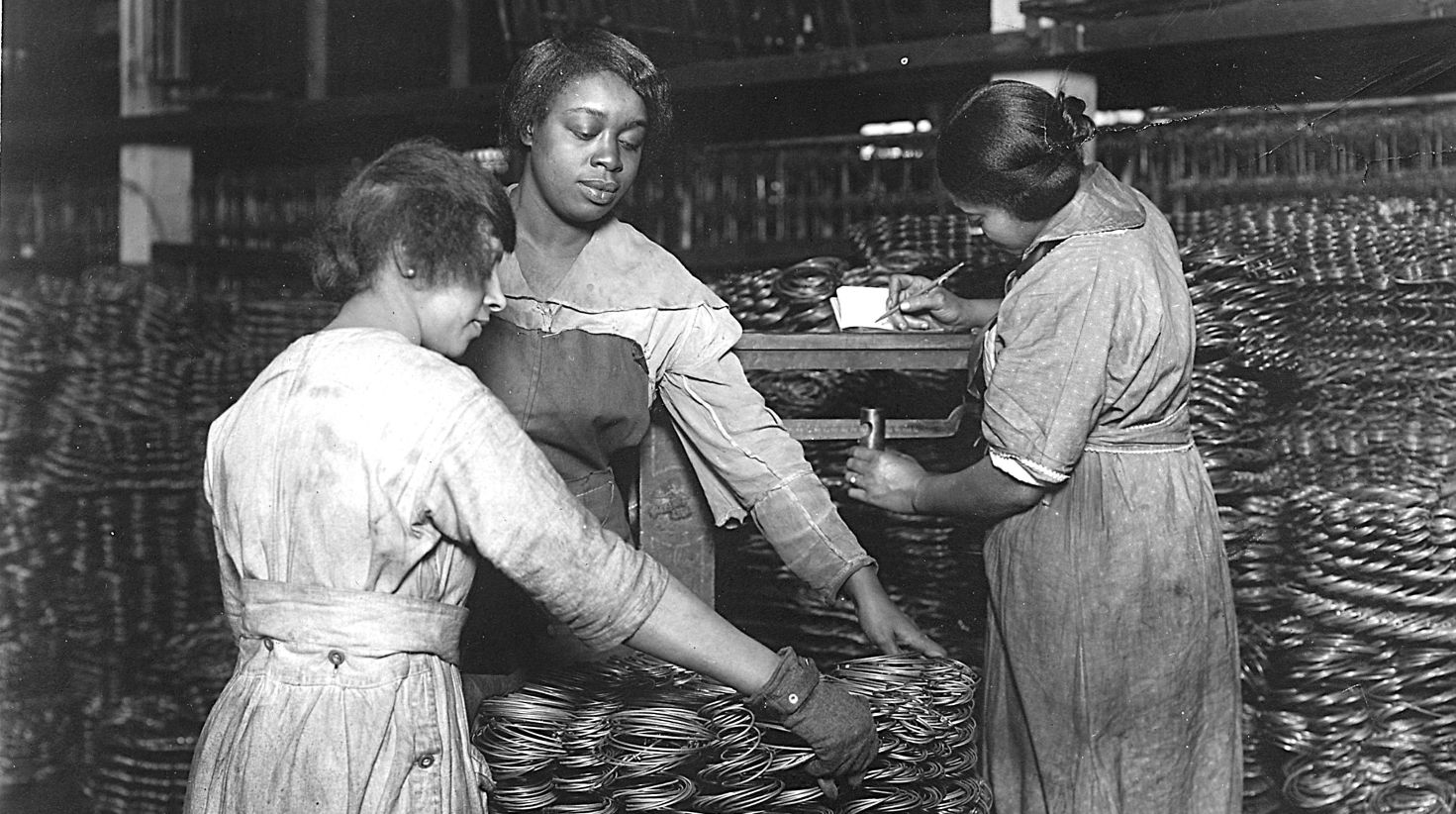
Before the C.I.O. the bulk of the labor movement was a cold house for Black workers, with nearly every A.F.L. union barring or restricting membership. Even those like the U.M.W.A. that organized Black workers did so in separate locals in many, though not all, areas. Below, Esther Lowell with a synopsis of Black workers in unions for 1926.
‘Only 100,000 Negro Workers in American Labor Unions Out of Many Millions in Industry’ by Esther Lowell from The Daily Worker. Vol. 3 No. 26. February 11, 1926.
NEW YORK, Feb. 9. Probably 100.000 Negro workers are in trade unions, estimates the National Urban League research director, reporting on his survey at the National Urban League conference. He finds 65,492 Negro members in about half the locals of 48 American Federation of Labor national and international unions. In all local unions of Chicago, New York City, Detroit and Washington, D.C., in New Jersey, Delaware, Idaho, Connecticut, Maryland, Pennsylvania and Ohio, In the United Mine Workers in West Virginia and Pennsylvania, and in the three large independent Negro unions: Railway Men’s Independent Benevolent Association, Dining Car Men’s Association, and Brotherhood of Sleeping Car Porters. New York city has 14,500 Negro unionists; Chicago, 13.000 and Detroit 2,000.
The following eleven American Federation of Labor unions exclude Negro workers: Boilermakers, switchmen, railway telegraphers, railway carmen, railway mall association, railway clerks, commercial telegraphers, machinists. wire weavers, glint glass workers, and masters, mates and pilots. Blacksmiths permit Negro helpers’ auxiliaries, but prevent promotion and do not admit Negro helpers in shops where white are now employed.
Unions without constitutional bars to Negroes but discouraging their membership are: Electrical workers, altho there are 1,343 Negro electricians: sheet metal workers; plasterers, with less than 100 from 6.000 Negro plasterers; plumbers and steamfitters, altho 3,500 Negroes are in this trade, Chicago Negro plumbers have tried for six years to enter the union.
Flint glass workers object to Negro members on the grounds that the glass-blowing pipe is passed from mouth to mouth and no one would use it after a Negro. Journeymen tailors have less than 100 Negro members, claiming few Negro tailors are sufficiently skilled. Unions admitting but not encouraging Negro members are listed as: Carpenters, 592 of 34,217 Negro carpenters in the union; painters, 279 of 10,600 Negroes organized. Negro workers in these skilled crafts complain that when they join unions white workers are continually given preference in job assignments.
Unions admitting Negroes freely but in separate locals only: Musicians with 3,000 Negroes; hotel and restaurant workers with 1000 Negroes; journeymen barbers, laundry workers, tobacco workers, United Textile Workers, cooks and waiters, and American Federation of Teachers. Division in the latter is partly due to separate schools; in the barbers because of clientele; in the textile union because Negroes are in southern mills where mixed unions are difficult.
Most Negro unionists are in unions admitting Negroes freely to mixed or separate unions: Longshoremen, hod carriers and building laborers, tunnel workers. Geographical location largely determines whether locals are separate or mixed. Boot and shoe workers, federal employes, mail carriers, post office employes’ unions follow the same policy.
United Mine Workers and the garment unions admit Negroes only in mixed locals. Independent Negro unions are the Railroad Men’s Association, a union of railway workers barred from regular craft unions but willing to affiliate with American Federation of Labor when restrictions are removed, admitting them to full membership. Dining car men are not favorably disposed to join the American Federation of Labor and Pullman porters have not expressed their policy.
The Daily Worker began in 1924 and was published in New York City by the Communist Party US and its predecessor organizations. Among the most long-lasting and important left publications in US history, it had a circulation of 35,000 at its peak. The Daily Worker came from The Ohio Socialist, published by the Left Wing-dominated Socialist Party of Ohio in Cleveland from 1917 to November 1919, when it became became The Toiler, paper of the Communist Labor Party. In December 1921 the above-ground Workers Party of America merged the Toiler with the paper Workers Council to found The Worker, which became The Daily Worker beginning January 13, 1924.
PDF of full issue: https://www.marxists.org/history/usa/pubs/dailyworker/1926/1926-ny/v03-n027-NY-feb-12-1926-DW-LOC.pdf
 Revolution's Newsstand