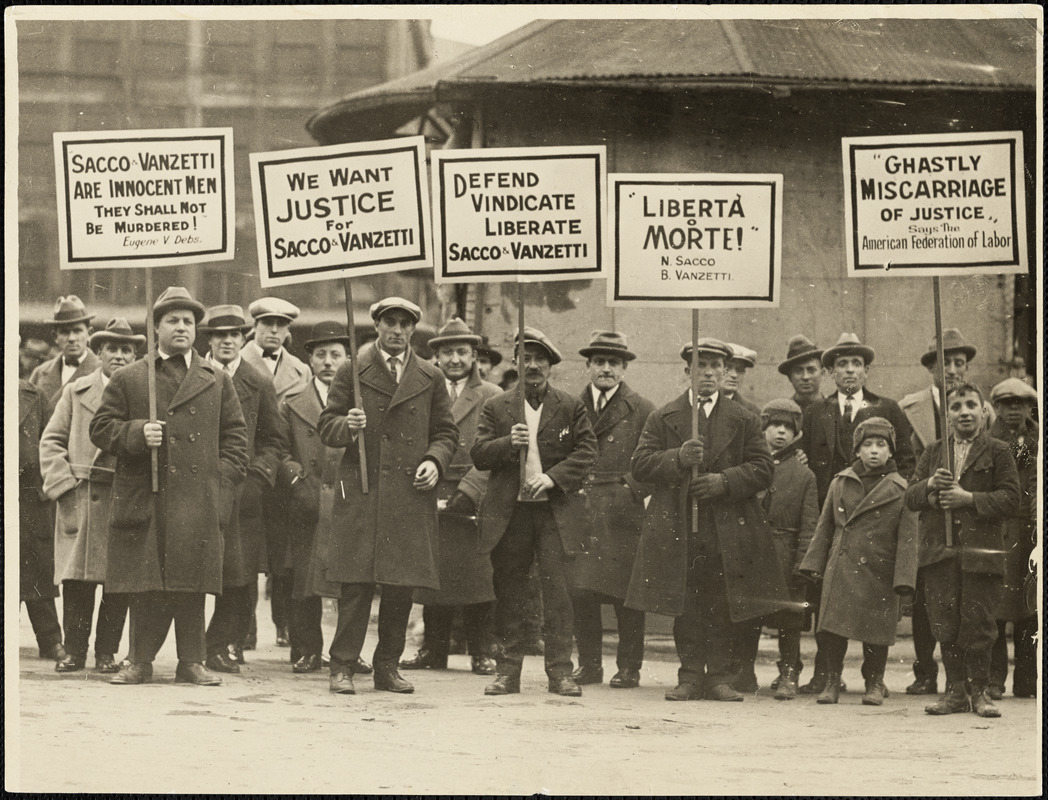
‘Red Scares’ are always accompanied by anti-immigrant violence. Sacco and Vanzetti were victims of virulent anti-Italian racism as much as anti-radicalism. In one of the essential pieces of writings of the time on the legal persecution and judicial murder of Nicola Sacco and Bartolomeo Vanzetti, John Dos Passos gives us the social context the case and personal backgrounds of the defendants as he travels to meet them in prison a year before their execution.
‘The Pit and the Pendulum’ by John Dos Passos from New Masses. Vol. 1 No. 4. August, 1926.
ABOUT dawn on Monday, May 3rd, 1920, the body of Andrea Salsedo, an anarchist printer, was found smashed on the pavement of Park Row. He had been arrested for deportation eight weeks before in the tail end of the anti-Red raids of the Department of Justice then running amok under A. Mitchell Palmer. The man had jumped or been thrown from a window of the offices of the Department of Justice on the fourteenth floor of the Park Row building. What happened during those eight weeks of imprisonment and third degree will never be known. At that time Bartolomeo Vanzetti was peddling fish in the pleasant little Italian and Portuguese town of North Plymouth. He was planning to go into fishing himself in partnership with a man who owned some dories. Early mornings, pushing his cart up and down the long main street, ringing his bell, chatting with housewives in Piedmontese, Tuscan, pidgin English, he worried about the raids, the imprisonment of comrades, the lethargy of the working people. He was an anarchist, after the school of Galeani. Between the houses he could see the gleaming stretch of Plymouth Bay, the sandy islands beyond, the white dories at anchor. About three hundred years before, men from the west of England had first sailed into the grey shimmering bay that smelt of woods and wild grape, looking for something; liberty…freedom to worship God in their own manner…space to breathe. Thinking of these things, worrying as he pushed the little cart loaded with eels, haddock, cod, halibut, swordfish, Vanzetti spent his mornings making change, weighing out fish, joking with the housewives. It was better than working at the great cordage works that own North Plymouth. Some years before he had tried to organize a strike there and been blacklisted. The officials and detectives at the Plymouth Cordage Works, the largest cordage works in the world, thought of him as a Red, a slacker and troublemaker.
At the same time Nicola Sacco was living in Stoughton, working an edging machine at the Three K’s shoe factory, where star workmen sometimes make as high as eighty or ninety dollars a week. He had a pretty wife and a little son named Dante. There was another baby coming. He lived in a bungalow belonging to his employer, Michael Kelly. The house adjoined Kelly’s own house and the men were friends. Often Kelly advised him to lay off this anarchist stuff. There was no money in it. It was dangerous the way people felt nowadays. Sacco was a clever young fellow and could soon get to be a prosperous citizen, maybe own a factory of his own some day, live by other men’s work. But Sacco working in his garden in the early morning before the whistles blew, hilling beans, picking off potatobugs, letting grains of corn slip by threes or fours through his fingers into the finely worked earth, worried about things. He was an anarchist. He loved the earth and people, he wanted them to walk straight over the free hills, not to stagger bowed under the ordained machinery of industry; he worried mornings working in his garden at the lethargy of the working people. It was not enough that he was happy and had fifteen hundred or more dollars in the bank for a trip home to Italy.
Three years before Sacco and Vanzetti had both of them had their convictions put to the test. In 1917, against the expressed votes of the majority, Woodrow Wilson had allowed the United States to become involved in the war with Germany. When the law was passed for compulsory military service a registration day for citizens and aliens was announced. Most young men submitted whatever their convictions were. A few of those who were morally opposed to any war or to capitalist war had the nerve to protest. Sacco and Vanzetti and some friends ran away to Mexico. There, some thirty of them lived in a set of adobe houses. Those who could get jobs worked. It was share and share alike. Everything was held in common. There were in the community men of all trades and conditions; bakers, butchers, tailors, shoemakers, cooks, carpenters, waiters. It was a momentary realization of the hope of anarchism. But living was difficult in Mexico and they began to get letters from the States telling that it was possible to avoid the draft, telling of high wages. Little by little they filtered back across the border. Sacco and Vanzetti went back to Massachusetts.
There was an Italian club that met Sunday evenings in a hall in Maverick Square, East Boston, under the name of the Italian Naturalization Society. Workmen from the surrounding industrial towns met to play bowls and discuss social problems. There were anarchists, syndicalists, socialists of various colors. The Russian revolution had fired them with new hopes. The persecution of their comrades in various parts of America had made them feel the need for mutual help. While far away across the world new eras seemed to be flaring up into the sky, at home the great machine they slaved for seemed more adamant, more unshakable than ever. Everywhere aliens were being arrested, tortured, deported. To the war heroes who had remained at home any foreigner seemed a potential Bolshevik, a menace to the security of Old Glory and liberty bonds and the bonus. When Elia and Salsedo were arrested in New York there was great alarm among the Italian radicals around Boston. Vanzetti went down to New Y ork to try to hire a lawyer for the two men. There he heard many uneasy rumors. The possession of any literature that might be interpreted as subversive by ignorant and brutal agents of the departments of Justice and Labor was dangerous. It was not that deportation was so much to be feared, but the beating up and third degree that preceded it.
On May 3rd Salsedo was found dead on Park Row. The impression was that he had been murdered by the agents of the department of Justice. There was a rumor too that a new raid was going to be made in the suburbs of Boston. There was a scurry to hide pamphlets and newspapers. Nobody must forget that people had even been arrested for distributing the Declaration of Independence. At the same time they couldn’t let this horrible affair go by without a meeting of protest. Handbills announcing a meeting in Brockton were printed. Vanzetti was to be one of the speakers.
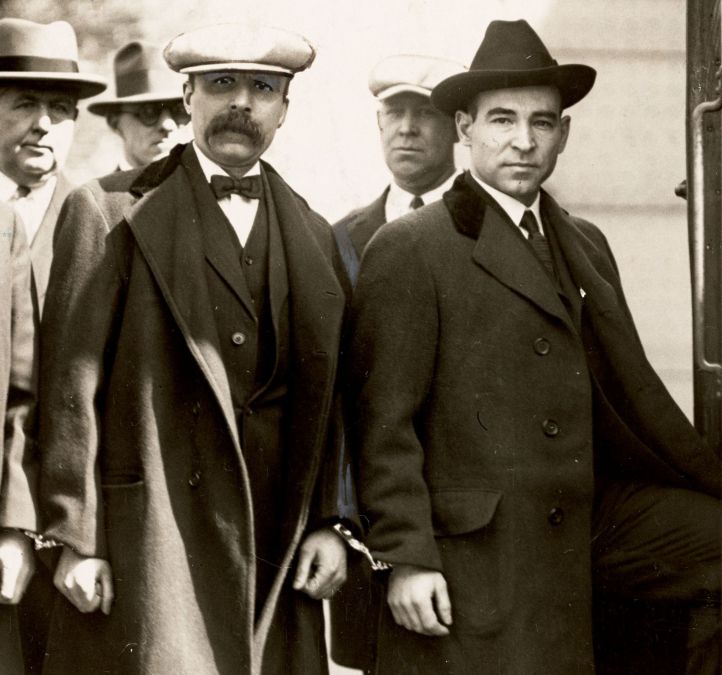
On the evening of May 5th, Sacco and Vanzetti with the handbills on them went by trolley from Stoughton to West Bridgewater to meet a man named Boda who they thought could lend them a car. Very likely they thought they were being trailed and had put revolvers in their pockets out of some confused feeling of bravado. If the police pounced on them at least they would not let themselves be tortured to death like Salsedo. The idea was to hide the handbills somewhere until after the expected raid. But they were afraid to use Boda’s car because it lacked a 1920 license plate and started back to Stoughton on the trolley, probably very uneasy. When they were arrested as the trolley entered Brockton they forgot all about their guns. They thought they were being arrested as Reds in connection with the projected meeting. When they were questioned at the police station their main care was not to implicate any of their friends. They kept remembering the dead body of Salsedo, smashed on the pavement of Park Row.
About this time a young fellow of Portuguese extraction named Madeiros was living in Providence. From confidence games and the collecting of money under false pretenses he had slipped into the society of a famous gang of professional criminals known as the Morelli gang. They lived mostly by robbing freightcars but occasionally cleaned up more dangerous jobs. Gerald Chapman is supposed to have worked with them once or twice. In the early morning of April 15, Madeiros and four other members of the Morelli gang went over to Boston in a stolen touring car and at a speakeasy on Andrews Square were told about the movements of the payroll of the Slater-Merrill factory in South Braintree which was to be shipped out from Boston that day by express. They then went back to Providence and later in the morning back again towards South Braintree. In the outskirts of Randolph they changed to another car that had been hidden in the woods. Then they went to a speakeasy to wait for the time they had chosen. Madeiros’ job was to sit in the back seat and hold back the crowd with a revolver while the other two got the payroll. Everything came out as planned, and in broad daylight in the most crowded part of South Braintree they shot down two men and carried off the satchel containing some $5,000. The next day when Madeiros went to a saloon on North Main Street, Providence, to get his share of the swag, he found no one. In his confession made at Dedham jail he says he never did get paid.
When Sacco and Vanzetti were first grilled by the chief of police of Brockton they were questioned as Reds and lied all they could to save their friends. Particularly they would not tell where they had got their pistols. Out of this Judge Thayer and the prosecution evolved the theory of “the consciousness of guilt” that weighed so heavily with the jury. After they had been held two days they were identified by the police, Sacco as the driver of the car in the South Braintree holdup and Vanzetti as the “foreign looking man” who had taken a potshot at a paytruck of the L.Q. White company at Bridgewater early on the morning of Christmas eve, 1919.
In spite of the fact that twenty people swore that they had seen Vanzetti in North Plymouth selling eels at that very time in the morning, he was promptly convicted and sentenced to fifteen years in the Charlestown penitentiary. The fact that so many people testified to having bought eels was considered very suspicious by the court that did not know that the eating of eels on the fast day before Christmas is an Italian custom of long standing. Later Vanzetti was associated with Sacco in the murder charge. On July 14, 1923, both men were found guilty of murder in the first degree on two counts by the Norfolk County jury, a hundred per cent American jury, consisting of two real estate men, two storekeepers, a mason, two machinists, a clothing salesman, a farmer, a millworker, a shoemaker and a lastmaker.
Dedham is the perfect New England town, white shingleroofed houses, polished brass knockers, elmshaded streets. Dedham has money, supports a polo team. Many of the wealthiest and oldest families in Massachusetts have houses there. As the seat of Norfolk County it is the center of politics for the region. Dedham has always stood for the traditions of the Bay State. Dedham was pro-British during the war; even before the Lusitania the people of Eastern Massachusetts were calling the Germans Huns. Dedham has always stood for Anglo-Saxon supremacy, and the white man’s burden. Of all white men the whitest are those descendants of Puritan shipowners and brokers and ministers who own the white houses with graceful colonial doorways and the trim lawns and the lilac hedges and the elms and the beeches and the barberry bushes and the broad A and the cultivated gesturelessness of the New English. When the Congregational God made Dedham he looked upon it and saw that it was good.
But with the decline of shipping and farming a threefold population has grown up in the ring of factory towns round Boston, among which Dedham itself sits primly disdainful like an old maid sitting between two laborers in a trolley car. There is the diminished simonpure New England population, protestant in faith, Republican in politics and mostly “professional” in occupation. Alongside of that is the almost equally wealthy Irish Catholic element, Democratic, tending to make a business of politics and of the less severely respectable trades and industries. Under both of these is the population of wops, bohunks, polacks, hunkies, dagoes, some naturalized and speaking English with an accent, others unnaturalized and still speaking their native peasant dialects; they do the work. These three populations hate each other with a bitter hatred, but the upper two manage to patch up their rancor when it becomes a question of “furriners.” In industrial disputes they find that they are all hundred per cent Americans. Meanwhile the latest-come immigrants are gradually gaining foothold. The Poles buy up rundown farms and get the tired and stony land back to the point of bearing crops. The Italians start truck gardens in back lots, and by skillful gardening and drudgery bring forth fiftyfold where the American-born couldn’t get back the seed they sowed. The Portuguese work the cranberry bogs and are reviving the shore fisheries. The American-born are seeing their own state eaten up from under their feet. Naturally they hate the newcomers.
The war exalted hatred to a virtue. The anti-Red agitation, the Ku Klux Klan, the activities of the American Security League and the American Legion have been a sort of backwash of hate dammed up by the signing of the peace. It was when that pent-up hatred and suspicion was tumultuously seeking an outlet that Sacco and Vanzetti, wops, aliens, men who spoke broken English, anarchists, believing neither in the Congregationalist or the Catholic God, slackers who had escaped the draft, were arrested, charged with a particularly brutal and impudent murder. Since that moment the right-thinking Puritan-born Americans of Massachusetts have had an object, a focus for the bitterness of their hatred of the new young vigorous unfamiliar forces that are relentlessly sweeping them onto the shelf. The people of Norfolk County, and of all Massachusetts, have decided that they want these men to die.
The faces of men who have been a long time in jail have a peculiar frozen look under the eyes. The face of a man who has been a long time in jail never loses that tightness under the eyes. Sacco has been six years in the county jail, always waiting, waiting for trial, waiting for new evidence, waiting for motions to be argued, waiting for sentence, waiting, waiting, waiting. The Dedham jail is a handsome structure, set among lawns, screened by trees that wave new green leaves against the robinsegg sky of June. In the warden’s office you can see your face in the light brown varnish, you could eat eggs off the floor it is so clean. Inside the main reception hall is airy, full of sunlight. The bars are cheerfully painted green, a fresh peagreen. Through the bars you can see the waving trees and the June clouds roaming the sky like cattle in an unfenced pasture. It’s a preposterous complicated canary cage. Why aren’t the birds singing in this green aviary? The warden politely shows you to a seat and as you wait you notice a smell, not green and airy this smell, a jaded heavy greasy smell of slum, like the smell of army slum, but heavier, more hopeless.
Across the hall an old man is sitting in a chair, a heavy pear-shaped man, his hands hang limp at his sides, his eyes are closed, his sagged face is like a bundle of wet newspapers. The warden and two men in black stand over him, looking down at him helplessly.
At last Sacco has come out of his cell and sits beside me. Two men sitting side by side on a bench in a green bird cage. When he feels like it one of them will get up and walk out, walk out into the sunny June day. The other will go back to his cell to wait. He looks younger than I had expected. His face has a waxy transparency like the face of a man who’s been sick in bed for a long time; when he laughs his cheeks flush a little. At length we manage both of us to laugh. It’s such a preposterous position for a man to be in, like a man who doesn’t know the game trying to play chess blindfolded. The real world has gone. We have no more grasp of our world of rain and streets and trolleycars and cucumbervines and girls and gardenplots. This is a world of phrases, prosecution, defence, evidence, motion, irrelevant, incompetent and immaterial. For six years this man has lived in the law, tied tighter and tighter in the sticky filaments of law-words like a fly in a spiderweb. And the wrong set of words means the Chair. All the moves in the game are made for him, all he can do is sit helpless and wait, fastening his hopes on one set of phrases after another. In all these lawbooks, in all this terminology of clerks of the court and counsel for the defence there is one move that will save him, out of a million that will mean death. If only they make the right move, use the right words. But by this time the nagging torment of hope has almost stopped, not even the thought of his wife and children out there in the world, unreachable, can torture him now. He is numb now, can laugh and look quizzically at the ponderous machine that has caught and mangled him. Now it hardly matters to him if they do manage to pull him out from between the cogs, and the wrong set of words means the chair.
Nicola Sacco came to this country when he was eighteen years old. He was born in Puglia in the mountains in the heel of Italy. Since then up to the time of his arrest he has had pretty good luck. He made good money, he was happily married, he had many friends, latterly he had a garden to hoe and rake mornings and evenings and Sundays. He was unusually powerfully built, able to do two men’s work. In prison he was able to stand thirty-one days of hunger strike before he broke down and had to be taken to the hospital. In jail he has learned to speak and write English, has read many books, for the first time in his life has been thrown with native-born Americans. They worry him, these native-born Americans. They are so hard and brittle. They don’t fit into the bright clear heartfelt philosophy of Latin anarchism. These are the people who cooly want him to die in the electric chair. He can’t understand them.
When his head was cool he’s never wanted anyone to die. Judge Thayer and the prosecution he thinks of as instruments of a machine.
The warden comes up to take down my name. “I hope your wife’s better,” says Sacco. “Pretty poorly,” says the warden. Sacco shakes his head. “Maybe she’ll get better soon, nice weather.” I have shaken his hand, my feet have carried me to the door, past the baggy pearshaped man who is still collapsed half deflated in the chair, closed crinkled eyelids twitching. The warden looks into my face with a curious smile, “Leaving us?” he asks. Outside in the neat streets the new green leaves are swaying in the sunlight, birds sing, klaxons grunt, a trolleycar screeches round a corner. Overhead the white June clouds wander in the unfenced sky.
Going to the Charlestown Penitentiary is more like going to Barnum and Baileys. There’s a great scurry of guards, groups of people waiting outside; inside a brass band is playing “Home Sweet Home.” When at length you get let into the Big Show, you find a great many things happening at once. There are rows of benches where pairs of people sit talking. Each pair is made up of a free man and a convict. In three directions there are grey bars and tiers of cells. The band inside plays bangingly “If Auld Acquaintance Be Forgot.” A short broadshouldered man is sitting quiet through all the uproar, smiling a little under his big drooping mustache. He has a domed, pale forehead and black eyes surrounded by many little wrinkles. The serene modeling of his cheek-bones and hollow cheeks makes you forget the prison look under his eyes. This is Vanzetti.
Bartolomeo Vanzetti was born in Villafalletto, in a remote mountain valley in Piedmont. At the age of thirteen his father apprenticed him to a pastrycook who worked him fifteen hours a day. After six years of grueling work in bakeries and restaurant kitchens he went back home to be nursed through pleurisy by his mother. Soon afterwards his mother died and in despair he set out for America. When after the usual kicking around by the Ellis Island officials he was dumped on the pavement of Battery Park, he had very little money, knew not a word of the language and found that he had arrived in a time of general unemployment. He washed dishes at Mouquins for five dollars a week and at last left for the country for fear he was getting consumption. At length he got work in a brick kiln near Springfield. After that he worked for two years in the stone pits at Meriden, Connecticut. Then he went back to New York and worked for a while as a pastrycook again, and at last settled in Plymouth where he worked in various factories and at odd jobs, ditchdigging, clamdigging, icecutting, snowshovelling and a few months before his arrest, for the sake of being his own boss, bought a pushcart and peddled fish.
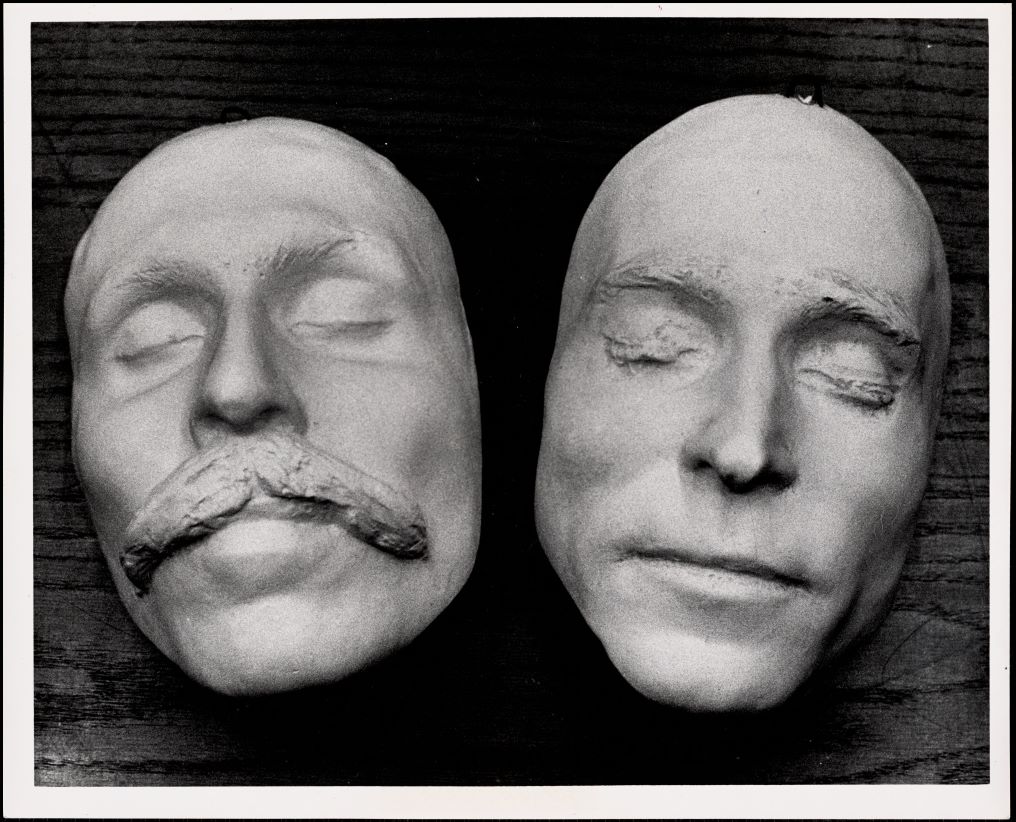
All this time he read a great deal nights sitting under the gasjet when every one else was in bed, thought a great deal as he swung a pick or made caramels or stoked brick kilns, of the workmen he rubbed shoulders with, of their position in their world and his, of their hopes of happiness and of a less struggling animallike existence. As a boy he had been an ardent Catholic. In Turin he fell in with a bunch of socialists under the influence of De Amicis. Once in America he read St. Augustine, Kropotkin, Gorki, Malatesta, Renan and began to go under the label of anarchist-communist. His anarchism, though, is less a matter of labels than of feeling, of gentle philosophic brooding. He shares the hope that has grown up in Latin countries of the Mediterranean basin that somehow men’s predatory instincts, incarnate in the capitalist system, can be canalized into other channels, leaving free communities of artisans and farmers and fishermen and cattlebreeders who would work for their livelihood with pleasure, because the work was itself enjoyable in the serene white light of a reasonable world.
Vanzetti has served six years of the fifteen year term. How many more of them will he live to serve? And the wrong set of words means the chair!
William G. Thompson, the Boston lawyer who is conducting the defence, who is making the moves in the law game that mean life or the Chair to these two men, is a very puzzled man. As a man rather than as a lawyer he knows that they did not commit the crimes of which they are accused. The refusal of the Supreme Court of Massachusetts to entertain his motion for a new trial, the attitude of his friends, of the press, of Governor Fuller try him sorely. He wishes he were well out of it. He wants to go on believing in the honesty of Massachusetts justice, in the humanity and fair mindedness of the average educated Harvard-bred Bostonian. The facts he handles daily compel him to think otherwise. He wishes he were well out of it. And the wrong set of words means the chair!
And for the last six years, three hundred and sixty-five days a year, yesterday, today, tomorrow, Sacco and Vanzetti wake up on their prison pallets, eat prison food, have an hour of exercise and conversation a day, sit in their cells puzzling about this technicality and that technicality, pinning their hopes to their alibis, to the expert testimony about the character of the barrel of Sacco’s gun, to Madeiros’ confession and Weeks* corroboration, to action before the Supreme Court of the United States, and day by day the props are dashed from under their feet and they feel themselves being inexorably pushed towards the Chair by the blind hatred of thousands of well-meaning citizens, by the superhuman involved stealthy soulless mechanism of the law.
The New Masses was the continuation of Workers Monthly which began publishing in 1924 as a merger of the ‘Liberator’, the Trade Union Educational League magazine ‘Labor Herald’, and Friends of Soviet Russia’s monthly ‘Soviet Russia Pictorial’ as an explicitly Communist Party publication, but drawing in a wide range of contributors and sympathizers. In 1927 Workers Monthly ceased and The New Masses began. A major left cultural magazine of the late 1920s to early 1940s, the early editors of The New Masses included Hugo Gellert, John F. Sloan, Max Eastman, Mike Gold, and Joseph Freeman. Writers included William Carlos Williams, Theodore Dreiser, John Dos Passos, Upton Sinclair, Richard Wright, Ralph Ellison, Dorothy Parker, Dorothy Day, John Breecher, Langston Hughes, Eugene O’Neill, Rex Stout and Ernest Hemingway, Artists included Hugo Gellert, Stuart Davis, Boardman Robinson, Wanda Gag, William Gropper and Otto Soglow. Over time, the New Masses became narrower politically and more journalistic in its tone.
PDF of full issue: https://www.marxists.org/history/usa/pubs/new-masses/1926/v01n04-aug-1926-New-Masses-2nd-rev.pdf
 Revolution's Newsstand