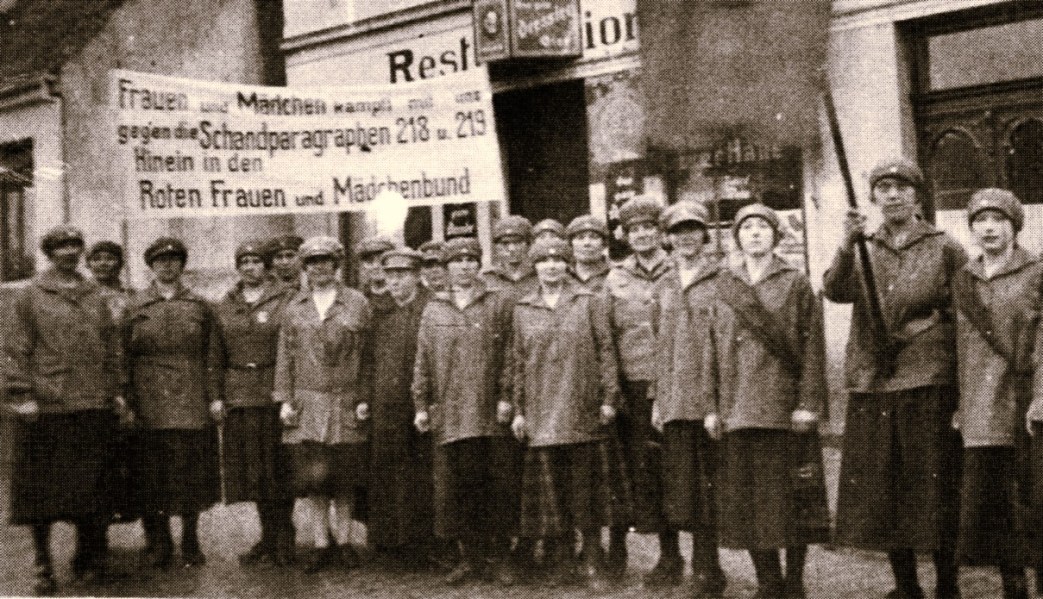
Lene Overlach, leader of the Roter Frauen und Mädchenbund, the women’s Red Front Fighters of German Communism, on their actions during the bloody events of May Day, 1929.
‘The Role of the Proletarian Women in the May Fights in Germany’ by Lene Overlach from International Press Correspondence. Vol. 9 No. 26. May 31, 1929.
Already before the 1st of May the working women in the factories this year displayed a keen interest in the decisive question: “Shall we let the machines remain idle on the 1st of May?” “Will the 1st of May be observed?” The majority of women employed at the factories decided to abstain from work. In one of the largest metal factories in Berlin, although the whole staff did not cease work, the women’s department was at a complete standstill on the 1st of May.
One of the most striking features of the demonstration processions was the great number of women participating in them. It is reported from Langenbielau, a place in Silesia, for example, that more women than men appeared at the demonstration.
The Berlin working women and housewives played a leading role in the demonstrations and the fights with the police. We give a few examples reported by the functionaries.
In Schöneberg, a district of Berlin, the workers had gathered in the neighbourhood of the market square. Suddenly, four young working women appeared in the middle of the street and started singing the “Internationale”. A procession was immediately formed. When the police drove up in motor lorries, the first ranks did not waver. Two working women were arrested; the procession was dispersed by means of baton charges. Now the indifferent women in the market place joined in the fray. They bombarded the police with everything they could lay their hands on: oranges, apples, cabbages etc. The stall-holders permitted this in spite of the loss it meant to them.
In Mariendorf the women were also at the head of the procession. The police were at first at a loss what to do. They retreated in order to get reinforcements and to occupy the bridges. Here a procession was broken up. It was the women marching at the head of the procession who received the first blows from the truncheons. The demonstrators made their way singly over the bridges and then gathered together again in Tempelhof, another district of Berlin. Here a young working women jumped up in the street and called out: “Come out in the streets! Demonstrate!” Arrests were again carried out. But the young working woman, standing beside the police lieutenant, again called out: “Long live the 1st of May!” “Long live the Communist Party!” This group of demonstrators forced its way to Potsdamer Platz.
In the centre of the town the women formed a firm phalanx in the demonstration procession. Suddenly there was unfurled a big banner, bearing the slogan: “We women demand equal pay for equal work!” When the police came up there was a fierce struggle for this banner, but it was rapidly rolled up and hidden under the cloak of a working women.
In Wedding and Neukölln, where the fiercest fighting took place, the proletarian women played the most important role.
The women took active part in building barricades.
In Köpenick the demonstrating women called to the police: “Shoot if you have the courage to!” Here the police did not venture to shoot.
At the Alexander Platz a young working woman was beaten insensible by blows from the police batons and then dragged to a patrol wagon. Here she was again beaten. In spite of this the working woman held up her clenched fist. Blows from the police batons were again rained down upon her; blood ran from mouth and nose and she again lost consciousness.
In the police hospital she made propaganda among the old police officials and told them they were only misguided proletarians. She was then threatened by a police officer who said: “We ought to have killed you, you whore! Shut your mouth at once, or I will kill you!”
Forty women were locked up in a stable. The indifferent women wept, but the class-conscious women made propaganda. They called out: “Down with the security police! Long live the Communist Party of Germany!” and sang the Internationale. From all the police barracks there was heard the revolutionary songs of the arrested.
Many women who were not taking part in the demonstrations were wounded, seven women were killed by bullets.
The women of the C.P. of German and of the Red Women and Girls League visited the wounded in the hospitals. A revolutionary mood prevailed in all the hospitals where the wounded lay.
In these days of fight the Red Women and Girls League of course entirely fulfilled its revolutionary duty.
On the 2nd of May it was the working women in three tobacco factories in Berlin who first entered spontaneously on a protest strike. They were followed by the shoe factories, where also about 90 per cent. of the employees are women. The women throughout the country took part in the protest movement. Thus a well-attended shop meeting of the women of the safety razor department of the firm of Henckels in Solingen unanimously adopted a resolution protesting most energetically “against the bloody and brutal action of the social fascist Zörgiebel and his lackeys against the revolutionary Berlin proletariat”.
In Chemnitz, the women delegates in the firm of Marshel, which employs 200 working women, succeeded in bringing the staff out on strike.
The revolutionary behaviour of the working women in the May days has furnished the proletariat with practical proof of the important role of the women in all revolutionary struggles. The exemplary courage, the revolutionary elan of the proletarian women has served to shake that petty-bourgeois, backward view, still prevailing in the proletariat, that the women have a minor role to play in the revolution.
The strong participation of the women in the May demonstrations and struggles is a new and striking proof of the rapid radicalisation of the masses of working women. It is evidence of the profound revolutionising process taking place in the working class, which is now seizing hold of the politically most backward strata, the masses of women.
The 1st of May is a glorious page in the history of the fights of the female-proletariat.
International Press Correspondence, widely known as”Inprecorr” was published by the Executive Committee of the Communist International (ECCI) regularly in German and English, occasionally in many other languages, beginning in 1921 and lasting in English until 1938. Inprecorr’s role was to supply translated articles to the English-speaking press of the International from the Comintern’s different sections, as well as news and statements from the ECCI. Many ‘Daily Worker’ and ‘Communist’ articles originated in Inprecorr, and it also published articles by American comrades for use in other countries. It was published at least weekly, and often thrice weekly.
PDF of full issue: https://www.marxists.org/history/international/comintern/inprecor/1929/v09n26-may-31-1929-inprecor.pdf
 Revolution's Newsstand