
Coming from a country whose only public ‘art’ is an advertising billboard, John Dos Passos is almost overwhelmed by the, many state-subsidized, works of Diego Rivera, José Clemente Orozco, and Roberto Montenegro in Mexico.
‘Paint the Revolution’ by John Dos Passos from New Masses. Vol. 2 No. 5. March, 1927.
Even Cortez clanking across the dykes on his warhorse is said to have been struck by the beauty of the markets of Tenochtitlan. Your first morning in the City of Mexico. The sunlight and the bright thin air, the Indian women sitting like stone idols behind their piles of fruit or their bunches of flowers, the sculpture on old red colonial buildings and the painting on the pulque shops, all tie you up into such a knot of vivid sights that you start sprouting eyes in the nape of your neck.
Going to see the paintings of Diego Rivera in the courts of the Secretaria of public education straightens you out a little bit. They give a dramatic sequence to all this brightness and white glitter, to the terribly silent welling up of life everywhere. In tense earth colors that have a dull burnish to them he has drawn the bending of bodies at work, the hunch of the shoulders under picks and shovels of men going down into a mine, the strain and heave of a black body bent under a block of marble, men working at looms, in dye-vats, spooning out molten metal. Then there are the plodding dust-colored soldiers of the revolution, red flags and black flags of the Zapatistas, crowds in marketplaces, women hanging out washing, politicians making speeches, Indians dancing. Everywhere the symbol of the hammer and sickle. Some of it’s pretty hasty, some of it’s garlanded tropical bombast, but by God, it’s painting.
Go round to the art galleries in New York. Look at all the little pictures, little landscapes after Cezanne, Renoir, Courbet, Picasso, Corot, Titian, little fruity still lifes, little modern designs of a stovepipe and a bisected violin…stuff a man’s afraid to be seen looking at…a horrible picking up of crumbs from rich men’s tables. Occasionally a work of real talent, but what’s the good of it? Who sees it? A lot of male and female old women chattering round an exhibition; and then, if the snobmarket has been properly manipulated, some damn fool buys it and puts it away in the attic, and it makes a brief reappearance when he dies at a sale at the Anderson Galleries.
“A lotta bunk this revolution stuff in Mexico,” said the salesman of brewing machinery coming down on the train from Laredo. “Peons don’t know nothin’…It’s only a lot of politicians fighting for the swag, when they’re not hired by the oil companies. Why people down here don’t know what the word means.” He got off at Saltillo before I could find out from him what the word did mean.
And there’s not only the Secretaria of education. When you’re through looking at the three stories of frescoed walls, probably a good half mile of them, setting down in passionate hieroglyphics every phase of the revolution, you can go to the superb baroque building of the Preparatory where Clemente Orozco is working. Orozco was a cartoonist and started with a bitter set of lampoons on the bourgeoisie; but as he worked he became a painter. His panels express each one an idea with a fierce concentration and economy of planes and forms I’ve never seen anywhere except in the work of the old Italian Cimabue. Again the revolution, soldiers and peasants and workingmen and the sibylline faces of old countrywomen. Over the doors the sickle and hammer. Imagine a sickle and hammer painted (in three dimensions, no Willy Pogany pastels of Progressive Evolution as in the Rand School), over the door of the Columbia University library.
And that’s not all. Roberto Montenegro is filling the walls of another school with a sober and lilting decoration. There’s a library dedicated to Ibero-American Unity decorated by him with a huge map of South America and Mexico where the U.S. is left in anomalous darkness. And everybody complains that the good old days are over, that nobody is painting any more.
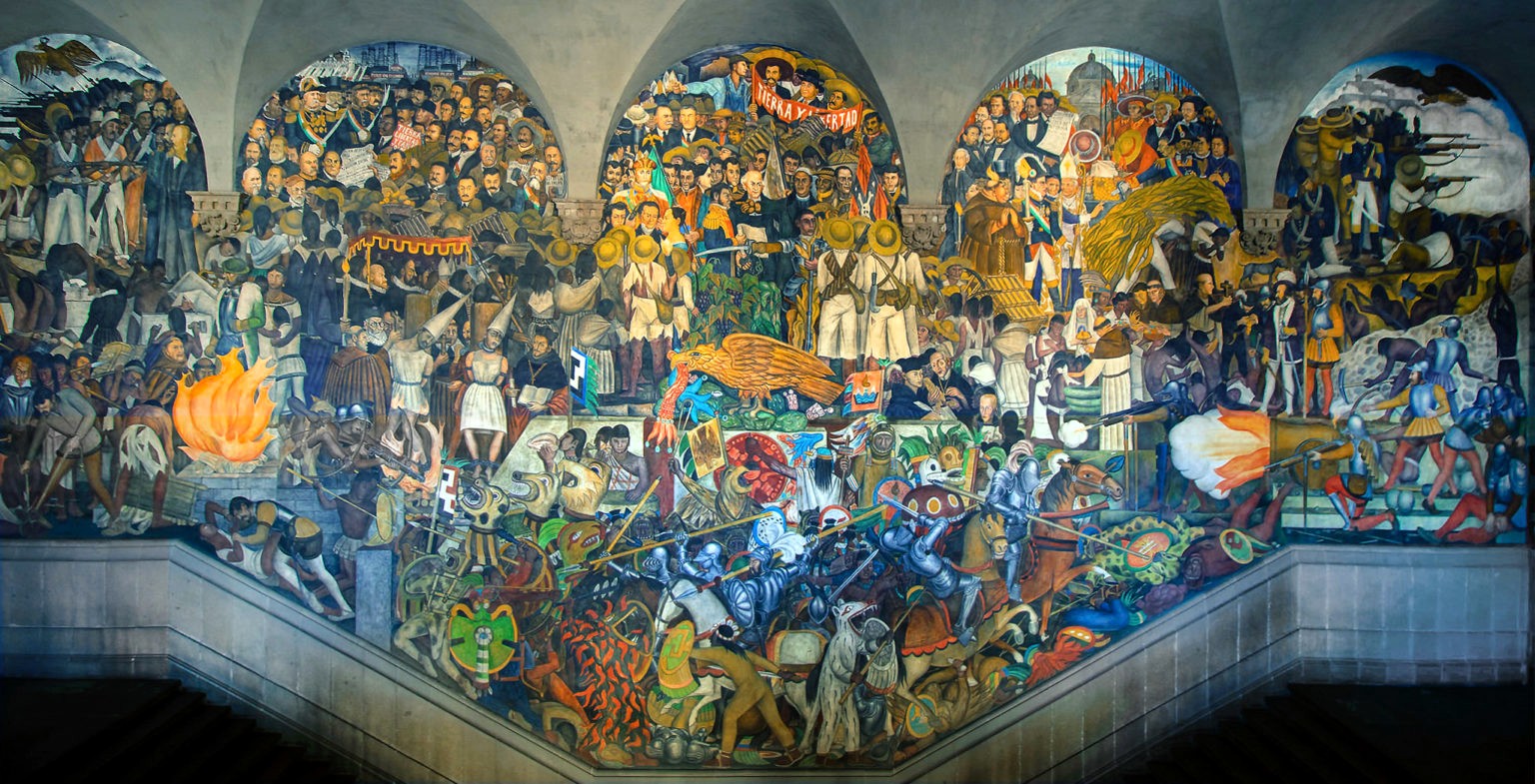
As a matter of fact the Sindicato de Obreros Tecnicos, the painters’ and sculptors’ union, that was the center of this huge explosion of creative work, has broken up. Everything that happened, happened in two years. In 1923 Diego Rivera came back from Europe, full of Picasso and Derain and the plaint of artists pampered and scantily fed by the after-the-war bourgeoisie. (In New York at that time we were trying to be modern and see the beauty of the Woolworth Building and sighing for the first Independents and the days of the, oh, so lovely Sienese tablas of Spumone degli Spaghetti.) He found an enormously rich and uncorrupted popular art in textiles and pottery and toys and in the decoration of ginmills, a lot of young painters fresh from the heartbreaking campaigns of civil war and eager to justify the ways of Marx to man, and Jose Vasconcelos as head of the department of education.
After Felipe Carillo, the great leader of Yucatan, had made a speech to the liberated Mayas, outlining a Socialist commonwealth, someone went up to him and said the speech was worthy of Lenin. “Fine,” he answered, “who’s he?”
It wasn’t a case of ideas, of a lot of propaganda-fed people deciding that a little revolutionary art would be a good thing, it was a case of organic necessity. The revolution, no more imported from Russia than the petate hats the soldiers wore, had to be explained to the people. The people couldn’t read. So the only thing to do was to paint it up on the wall.
So some thirty painters started a union, affiliated themselves with the Third International, and set to work. Everyone was to get the same wage for painting, a cooperative studio was to be started; “its fundamental aesthetic aim was rooted in the socialization of art, tending towards the absolute disappearance of individualism, characteristic of bourgeois epochs, thus approaching the great collective art of antiquity.” As a basis of study they took the remains of ancient Mexican painting and sculpture. Easel painting they rejected as intellectual, aristocratic and onanistic. But this isn’t the first time that painters have issued a manifesto. The extraordinary thing about this group is that they set to work and delivered the goods.
Xavier Guerrero went down to Teotihuacan and studied the methods of the ancient Indian painters there. They made chemical analyses of the pigments and varnishes used and after much experimentation, began to paint. Diego Rivera’s first big decorative work had been in encaustica, in which he had been experimenting in Paris. Vasconcelos, whose boast was that he would spend as much on education as the war department spent on the army, was ready to give any competent painter wall space, a small wage, and materials. And so in an incredibly short time an enormous amount of work, not only in the capital, but in Jalapa and Guadalajara as well, was under way.

All this time there had been growing opposition. The students of the Preparatoria, sons of liaciendados and oilsplattered politicians, objected to this new style of painting, and set about destroying the frescoes. The hammers and sickles over the doors made them uneasy. Intellectuals and newspaper writers, whose idea of painting was a chic girl drawn a la Vie Parisienne with sensually dark smudges under the eyes, kept up a continual hammering under which the Government began to weaken. Vasconcelos left the ministry of education. The Union broke up in personal squabbles, largely owing to the fact that to continue working under the Laborista government it became necessary to give up the Third International. Now Rivera, Orozco and Montenegro are the only three painters subsidized by the Federal government. The rest of them pick up a living as best they can in the provinces. Several of them are carrying on lively communist propaganda, through El Machete which started as the Union’s mouthpiece.
But, even if nothing more is done, an enormous amount of real work has been accomplished. Even if their paintings were rotten it would have been worth while to prove that in our day a popular graphic art was possible. Maybe it’s not possible anywhere but in Mexico. As it is, Rivera’s paintings in the Secretaria, Orozco’s paintings in the Preparatoria, Montenegro’s decorations are a challenge shouted in the face of the rest of the world. You’re a painter? All right, let’s see what you can do with a wall a hundred by sixteen with a lot of homely doors and windows in it.
All we have in New York to answer with are a few private sensations and experiments framed and exhibited here and there, a few watercolors like Marin’s, and a lot of warmed-over truck, leavings of European fads.
If it isn’t a revolution in Mexico, I’d like to know what it is.
The New Masses was the continuation of Workers Monthly which began publishing in 1924 as a merger of the ‘Liberator’, the Trade Union Educational League magazine ‘Labor Herald’, and Friends of Soviet Russia’s monthly ‘Soviet Russia Pictorial’ as an explicitly Communist Party publication, but drawing in a wide range of contributors and sympathizers. In 1927 Workers Monthly ceased and The New Masses began. A major left cultural magazine of the late 1920s to early 1940s, the early editors of The New Masses included Hugo Gellert, John F. Sloan, Max Eastman, Mike Gold, and Joseph Freeman. Writers included William Carlos Williams, Theodore Dreiser, John Dos Passos, Upton Sinclair, Richard Wright, Ralph Ellison, Dorothy Parker, Dorothy Day, John Breecher, Langston Hughes, Eugene O’Neill, Rex Stout and Ernest Hemingway, Artists included Hugo Gellert, Stuart Davis, Boardman Robinson, Wanda Gag, William Gropper and Otto Soglow. Over time, the New Masses became narrower politically and more journalistic in its tone.
PDF of full issue: https://www.marxists.org/history/usa/pubs/new-masses/1927/v02n05-mar-1927-New-Masses.pdf
 Revolution's Newsstand