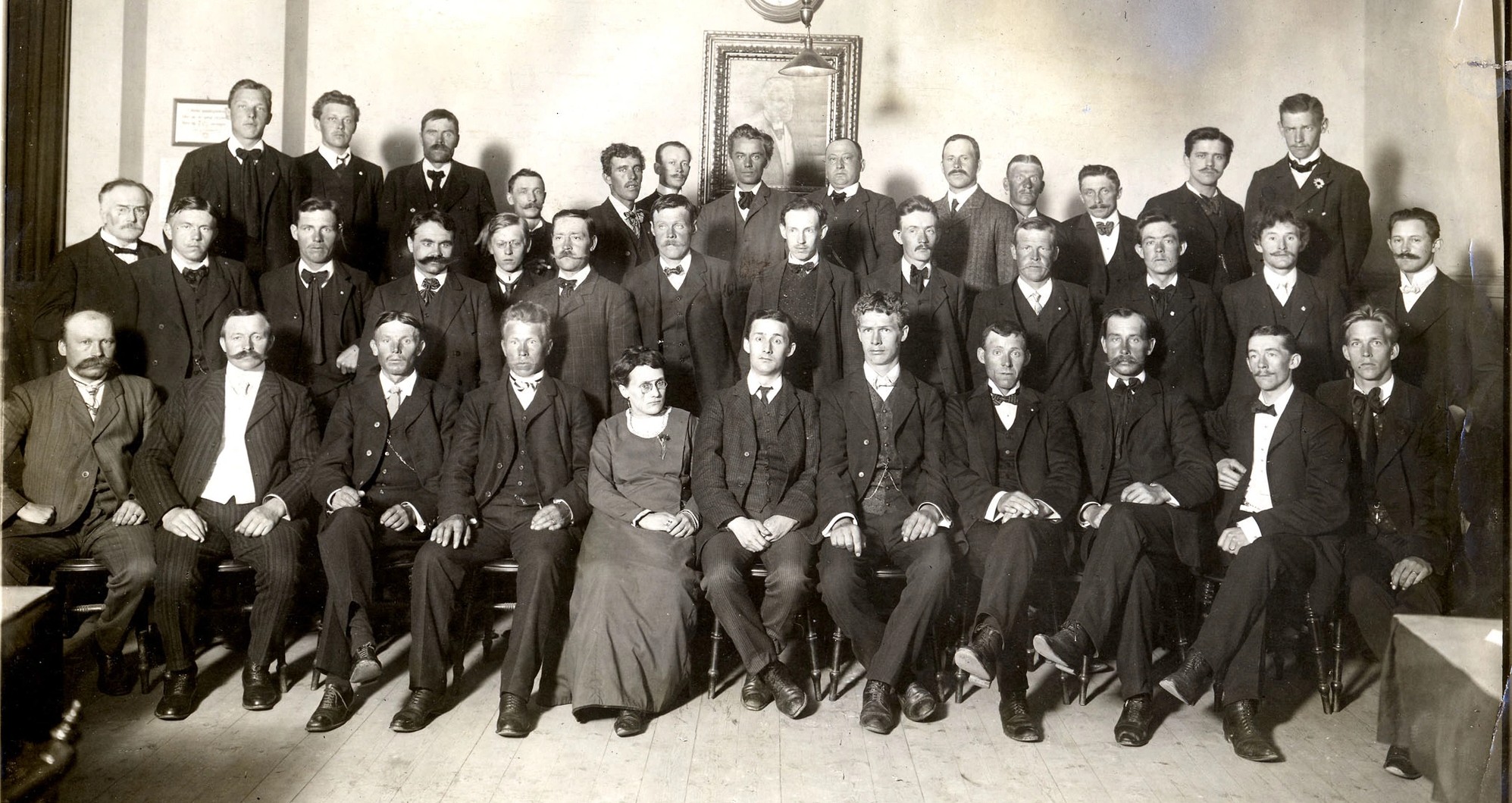
John Sandgren on the formation and growth of the Sveriges Arbetares Centralorganisation.
‘The Syndicalist Movement in Sweden’ by John Sandgren from Solidarity. Vol. 5 No. 212. January 31, 1914.
According to the last number of “Syndicalisten,” the official organ of the Syndicalist movement of Sweden (Sveriges Arbetares Centralorganisation), our Swedish fellow workers can look back upon a year’s successful work.
The S.A.C. of Sweden was started in the summer of 1910 by about 500 men, who broke away from “Landsorganisationen,” the social-democratic trade union movement, which had made such a jungle of the general strike in 1909. In all over 80,000 or about one-half, left the old unions in dismay over the mismanagement of one of the greatest labor battles ever started.
The following figures show the growth of the new organization in the last three years.
No. of Locals–No. of Members
Dec. 31, 1910: 21—696
Dec. 31, 1911: 51—1176
Dec. 31, 1912: 64—2037
Dec. 31, 1913: 95–3300
Only a few of these locals are “mixed locals” for agitation purposes. Nearly all are bona fide industrial unions.
The Swedish syndicalists come as near to the I.W.W. in regard to final aim, form of organization and tactics as the economic development of the country warrants.
In two industries they have already a sufficient membership to make it necessary to take steps toward forming “National Industrial Unions.” They have two “district committees” of stone-cutters’ locals and an “Industrial Committee for education and propaganda” among the railroad and other construction workers.
Their “lokala samorganisationer” would most nearly correspond to the District Councils of the I.W.W.
Their tactics, as proven by numerous successful struggles, are the same as that advocated by the I.W.W.
Their final aim is to organize the workers of the whole country for the purpose of taking control of the industries and to form the structure of a new society.
Their paper has a regular edition of 7,500, while the “Brand,” the young Socialist organ which also stands for syndicalism has an edition of about 15,000, showing that the actual paid up membership is far below the number who endorse the new organization. In fact, the old unions are honey-combed with syndicalists.
Our Swedish fellow workers keep in close touch with their friends in Norway and Denmark, the agitators frequently touring all three countries. The Norwegian and the Danish Syndicalists have not as yet formed separate unions, but continue to work inside the old unions. But they have good propaganda leagues and issue their own weekly papers, “Direkte Aktion” in Christiania, and “Solidaritet,” in Copenhagen. Furthermore one of the foremost daily social-democratic papers (in Trondhjem) is vigorously advocating the new kind of unionism.
If the Norwegians and Danes thought they could do better by forming separate organizations, like the Swedes and like the I.W.W., they would no doubt do so, and it is not impossible that such a thing will be necessary. But those are local, or rather national questions, which the workers of each country are best able to settle themselves. No general rules can be laid down.
As far as the Swedish Syndicalists are concerned, they were confronted with a situation quite similar to the one we find in the United States. Like the American “borer from within,” they were bumping their heads sore against the Chinese wall of labor-fakirdom, until they saw the futility of such efforts and got tired.
It was for them a case of either submitting to the dictation of union officials who are first of all politicians and aspire to become congressmen or senators or to the manipulation of the tools these ambitious politicians. The union movement was being turned into an adjunct of the Social-Democratic party, in fact if not in form, and seemed to have for its principal aim the prosperity and personal “success” of the leaders, who dominated over, the brains of the unconscious mass through a machine as perfect as any machine built up by American politicians or the A.F. of L.
That the step they took when they formed a separate organization was correct is proven by the success they have met with. The S.A.C. is in splendid shape. It is a quick-action fighting machine, basing its movements on the will-power and the intelligence of the industrial members. There are no leaders, only agitators and executives, who are personally acquainted with nearly every member. As agitator and organizer for the S.A.C. the writer has had a chance to personally ascertain that there is a democracy and self-reliance among the membership which sharply contrasts against the submissive obedience to leadership in the old unions. The Syndicalists form LIVING organizations, while the old unions are contract-bound and dead dues-gathering agencies.
It is plain to a wide-awake observer that the new unions are the only ones with a future.
Had the radicals stayed in the old unions, they could have accomplished nothing against the machine and the educational work and the propaganda of the new ideas could not have been carried on with one-tenth the force. And it cannot be said that they split or weakened the Swedish labor movement, for the 3300 organized Syndicalists are as good as all the Social-Democrats put together.
Furthermore the organization of the Syndicalists has, been the stimulating force, which has caused the awakening in Denmark and Norway.
They are the terror of Scandinavian capitalist society, and cause the ruling class no end of worry. It is dawning on all layers of society that they from now on will have to deal with a new social force, which will ultimately take control.
The position taken by Tom Mann in regard to the I.W.W. is unquestionably largely based on information volunteered by the innumerable enemies of the I.W.W., and the pretended friends of “industrial unionism.” When Tom Mann thinks that it is unwise for the I.W.W. to maintain a separate organization he is under a misconception as to the possibilities of working within the old unions. Those that he met probably all showed him the sunny side of their face, in order to break the point off his endorsement of I.W.W. principles. We who have bored from within the Militia-of-Christ and Civic-Federation controlled A.F. of L. and who have had to deal with socialistic would-be politicians, we have seen the other side of the face.
We know that we are right, and we know that the I.W.W. is the union of the future. And that settles it. New York, Jan. 9, 1914. JOHN SANDGREN.
The most widely read of I.W.W. newspapers, Solidarity was published by the Industrial Workers of the World from 1909 until 1917. First produced in New Castle, Pennsylvania, and born during the McKees Rocks strike, Solidarity later moved to Cleveland, Ohio until 1917 then spent its last months in Chicago. With a circulation of around 12,000 and a readership many times that, Solidarity was instrumental in defining the Wobbly world-view at the height of their influence in the working class. It was edited over its life by A.M. Stirton, H.A. Goff, Ben H. Williams, Ralph Chaplin who also provided much of the paper’s color, and others. Like nearly all the left press it fell victim to federal repression in 1917.
PDF of full issue: https://www.marxists.org/history/usa/pubs/solidarity-iww/1914/v05-w212-jan-31-1914-solidarity.pdf
 Revolution's Newsstand