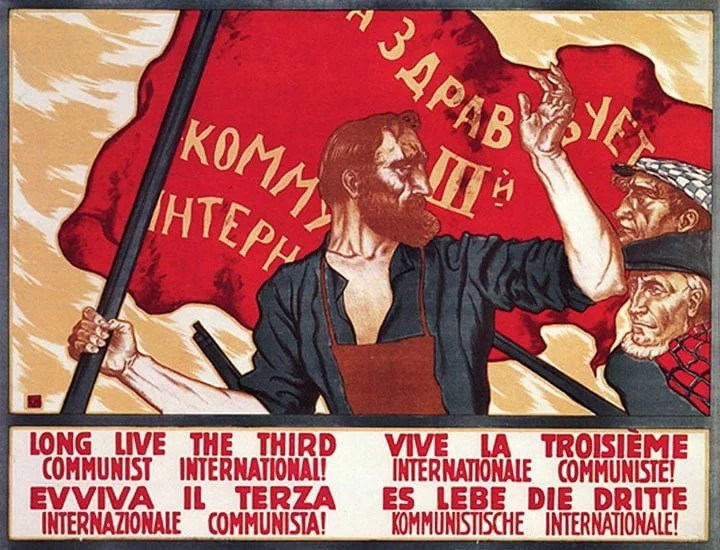
Karl Radek with a synopsis of the work of the Third Comintern Congress.
‘The Third Congress of the Communist International’ by Karl Radek from The Communist (Unified C.P.A.). Vol. 1 No. 2. August, 1921.
The first Congress of the Communist International was a call to arms issued by the Russian working class, that besieged, first section of the world revolution which for a year and a half had held power and defended it with arms against a world of enemies. In the moment of its greatest danger the besieged Russian working class called out “Workers of all countries unite! Follow our example! Arise to the struggle! Only the hammer of the dictatorship can break the chains of capitalist slavery. Only a Soviet Republic can express the power of the working class.” Small groups of representatives of the proletariat of Germany, Austria, Poland, Lettland and Finland rallied round the banner of the Communist International which was then formed. Its opponents laughed when they received the news of its formation. They were convinced that the armies of the Entente will succeed in overthrowing the Soviet Government and that the call of the Communist International was its last testament.
When the Second Congress of the Communist International met in the summer of last year, the main armies of the counter-revolution in Russian territory were defeated. The last detachments to be sent into battle, the legions of White Poland and the bands of Wrangel, were being steadily pressed back by the Red Army. While the Congress was proceeding the Red Army was approaching Warsaw. At the Congress there were not only representatives of the Communist vanguard of all countries of the world, the West and the East, the North and the South, but also the representatives of great mass parties like the Independents of Germany, and the French Socialist Party, who, having come as a result of the pressure of the members, were compelled to negotiate on the questions of the affiliations to and the conditions of the Communist International. The Communist International grew into a mass power and its influence spread far over its organized ranks. It sought to organize and to strengthen its ranks in order to point out concretely to the proletariat the road to power. In the resolutions passed at the Congress on the Trade Union, on parliamentarism, and on the role of the Party, it showed, on the basis of the experience of the Russian Revolution and the Proletarian Revolution of Central Europe, and on the basis of Marxian teaching, the path along which it could rally the masses of the proletariat for the struggle. While it rejected all sectarian tendencies which posing as preachers of the pure milk of the words, isolated themselves from the masses, it at the same time, laid down the dividing line between itself and the opportunist mass parties. It frankly and clearly stated in what the revolutionary work of the Party consists and said it would form revolutionary mass parties which would conduct a popular agitation to convert the masses to Communism, which would unite the struggle of these masses and extend the struggle for power. It appealed to the revolutionary elements of the proletariat to rally round its banner. In order to ease the path of these revolutionary proletarian elements who were not yet communists, the Congress of the Communist International resolved to form a Red Trade Union International which should rally around the nucleus of the class conscious Communists, those sections which are not completely communist.
The Third Congress of the Communist International is gathering at a moment when the world economic crisis and the incapability of capitalism to reconstruct the world is strikingly apparent. It is gathering at a moment when millions and millions of workmen in the richest countries in the world are unemployed. It is gathering at a moment when not one of the great political crises has been solved, when all the crises have merely been postponed. Thus, the task for which the Communist International was built lies untouched before us, the task of leading the advance of the onward marching World Revolution. The Communist parties are the instrument of this leadership. In many countries the Communist parties are still in the process of formation. There the first task of the Communist International is to urge on these communists to increase their efforts ten-fold, to draw the masses to themselves and spread Communist influence among them.
This is the position in England and in the United States of America. In other countries like Italy, Sweden, Tchechko-Slovakia and France, the Communist International has more or less the mass parties on its side, but either owing to the predominance of centrist tendencies in this leadership or to its passivity, are not yet in a position to reach the broad masses or to lead them to their struggle. In Italy the opportunist policy of the Serrati group led to a split in the Party, and to break with the Communist International. In the other countries mentioned opportunism is not so prominent, but the weakness lies in the incapacity to adopt a popular method of Communist agitation and action. The Communist International must openly combat these centrist tendencies and clearly point out to the workers in their respective countries how they can be overcome.
In Germany these tendencies exist in a certain section of the leadership and are clearly similar to that of the policy of Serrati. The exclusion of the representatives of these tendencies from the leadership of the party has given it an impetus to the left. But owing to the fact that the party had to enter the battle before it was prepared for this new policy of revolutionary action, its connection with the masses became weakened as the result of its isolated action. Making a virtue of necessity, it constructed the theory of the “offensive of the isolated Communist Party” which if consistently developed and carried out in practice must endanger the development of the Communist Mass Party. The leading comrades of the Left Wing of the Germany Party will themselves realize this danger. The Communist International will have the task of showing to all the Communist parties on the basis of the March rising in which way they can insure to the Party the leading role in the mass party. They must take part in the everyday struggle of the masses and take over the leadership in these spontaneous battles of the proletariat. They must enter the battle alone, and isolated only under pressure of necessity when the honor and the future of the Party demands it.
In the discussions concerning partial demands and partial actions, the Communist International will prove to its affiliated parties, beyond the shadow of a doubt and on the basis of their own experiences, why no party may content itself with mere communist agitation and propaganda, but must inevitably participate in every struggle of the proletariat, and how each party, while continuing its organizational activities, should take the lead in such proletarian struggles, forcing these conflicts to develop from ordinary strikes into rebellions. The problem of the Red Trade Union International and its battle against the Amsterdam lackeys of world capitalism, is the organization complement to the problem of partial struggles and of the progress of the Communist parties towards the conquest of power. The Third Congress of the Communist International will have much preparatory work to accomplish for the congress of the Trade Union International which will follow directly in its wake.
There are, further, two “foreign” questions on the agenda of the Congress, i.e., the Russian question and the problem of the Orient. The leading party in the Communist International will report to the Congress regarding its efforts to safeguard and reinforce the power of the working class in a country for the far greater part agrarian, and in a most difficult period of transition from war to peace. The Congress will have to express its opinion on the policies of the first isolated proletarian state. At the same time it will have to decide how the struggle for power of the world proletariat can be promoted by the increase and reinforcement of the revolutionary movements in the Orient. Hundreds upon hundreds of delegates, hundreds upon hundreds of guests have hastened from all corners of the earth to attend this congress of the Communist International. Already it represents a colossal power. The work of the congress will increase and purify it. And if all the omens are not deceptive, the C.I. will in the near future become involved in such struggles, that it will be compelled to give evidence of its power in great revolutionary conflicts.
Revolutionary passion is requisite for these battles; but it must be accompanied by clear insight, and proper estimation of all situations. The Russian Communist Party, under whose aegis this congress is being held, has proved, throughout its history, that such a combination is very well possible. It welcomes the delegates to this Third International Congress and calls to them: Forge your weapons for the victory, which shall be gained not in the heroic exertion of a single moment, but in the ever-fiercer daily struggle.
Emulating the Bolsheviks who changed the name of their party in 1918 to the Communist Party, there were up to a dozen papers in the US named ‘The Communist’ in the splintered landscape of the US Left as it responded to World War One and the Russian Revolution. This ‘The Communist’ began in July 1921 after the “Unity Convention” in Woodstock, New York which created the Communist Party of America, Section of the Communist International uniting the old CPA with the CLP-CPA party. With Ruthenberg mostly as editor the paper acted as the Party’s underground voice, reporting official party business and discussion. The Toiler served as the mass English-language paper. This ‘The Communist’ was laid to rest in December, 1922 with the creation of the above-ground Workers Party. An invaluable resource for students of the formation of the Communist Party in the US.
PDF of full issue: https://www.marxists.org/history/usa/pubs/thecommunist/thecommunist6/v1n02-aug-1921-com-CPA.pdf
 Revolution's Newsstand