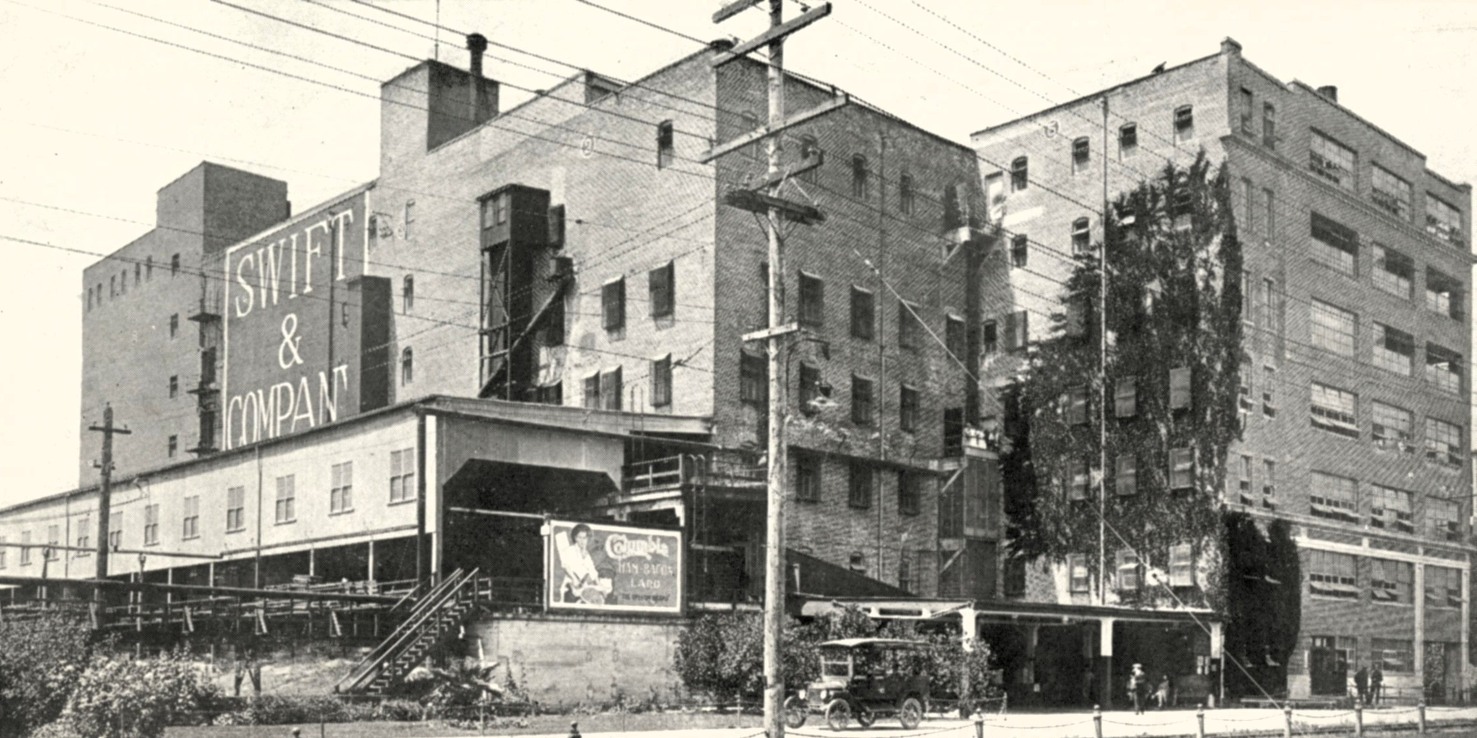
An attempt to form a union at Portland, Oregon’s Swift meatpacking plant is undermined at every step by…the union. The too-familiar story of a unionism that doesn’t organize from the head of Portland’s Labor College.
‘A Strike That Failed’ by H. Aaron Director from Labor Age. Vol. 16 No. 8. August, 1927.
Battling Against the Speed-Up
In many American cities the strength of trade unionism is to be found in the printing and building trades and among a miscellaneous group of workers like barbers, meatcutters, restaurant workers, and retail clerks. These have developed a certain method of doing business which may roughly be called label unionism. It is characterized by great dependence on the label, close contact with the employer, a local product or service, and a small unit of business organization. Hence unionism is sold not to the workers but to the employers. It may be characterized further as organization of jobs and not of men. Most often shops are organized not because the men working in them were convinced of the superior position of a union, but because the employers were promised a certain amount of trade in return for the union card.
These methods when applied to other industries, which produce goods on a national and not a local scale, where employers are strongly intrenched and far removed from the workers, often prove disastrous to the cause of unionism.
Swift and the Speed-Up
The Swift Packing Plant of Portland, Oregon, like the national organization of which it is a subsidiary, is committed to the Open Shop—in which union workers are not wanted. A small group of meatpackers working in small “independent” plants has stuck to the union for many years. These members were imbued with the philosophy and tactics described above as label unionism. They made some effort to carry on organization work among the Swift employees, but with meager results. However, what arguments failed to accomplish, brutal economic events succeeded in doing.
The local Swift plant, not content with its contribution to a large American fortune, introduced the Bedeaux speed-up system—kindly calling it a bonus system. Work was minutely subdivided. The men did not understand the basis of pay, calculated according to the number of “b’s” performed every hour. The rate of the fast worker became the standard of pay. Any output larger than this standard was rewarded with a bonus—until a new standard was set based upon this new speed. Men were thus compelled to compete with time and with each other.
Some two weeks after this was introduced the men walked out and came to the union. Here was a good opportunity to take advantage of a new situation and add several hundred union members to the ranks of organized labor. Now from the beginning a defeatist atmosphere was prevalent in trade union circles. “Swift and Company cannot be beaten.” It is of course doubtful, but if true, the defeat could have been a glorious one, and the occasion utilized to expose the methods and practices of big business, and to preach the advantages of organization to men who were ready to listen.
The “Fight”
What was done? The meat packers’ local union went to the section of which it is a part and asked that Swift and Company be placed on the unfair list. It in turn made the same request of the Central Labor Council and both counted on the boycott to win the fight. They were responding with the same pattern reaction to a new situation and it did not work.
The union made no serious effort to picket the plant and thus prevent other workers from taking the places of the strikers. A half-hearted appeal for relief funds was made—because the men might just as well look for other jobs, while Swift and Company was brought to terms by the all-powerful weapon of the label.
The retail meatcutters could not see their way clear to refuse to handle Swift’s products, because they would jeopardize their jobs and their union, and because they were informed of the recent and famous court decision in the stonecutters’ case which makes such practice illegal. The rest of the trade union movement did what is expected of it on such occasions, and advised its members to boycott Swift’s products.
The end was even more ludicrous than the process. Swift and Company proceeded to cut its prices and thus compel every small competitor to close shop. These went to the union and pleaded for the removal of the boycott. The original members of the union working in these small shops lost their jobs and added their voices to this plea. The executive board (probably because the strikers constituted a majority of the union) declared Swift fair again, and asked the Central Council to remove it from its unfair list.
Twenty-five members again attend union meetings and the high position of the label has been restored.
Labor Age was a left-labor monthly magazine with origins in Socialist Review, journal of the Intercollegiate Socialist Society. Published by the Labor Publication Society from 1921-1933 aligned with the League for Industrial Democracy of left-wing trade unionists across industries. During 1929-33 the magazine was affiliated with the Conference for Progressive Labor Action (CPLA) led by A. J. Muste. James Maurer, Harry W. Laidler, and Louis Budenz were also writers. The orientation of the magazine was industrial unionism, planning, nationalization, and was illustrated with photos and cartoons. With its stress on worker education, social unionism and rank and file activism, it is one of the essential journals of the radical US labor socialist movement of its time.
PDF of full issue: https://www.marxists.org/history/usa/pubs/laborage/v16n08-aug-1927-LA.pdf
 Revolution's Newsstand