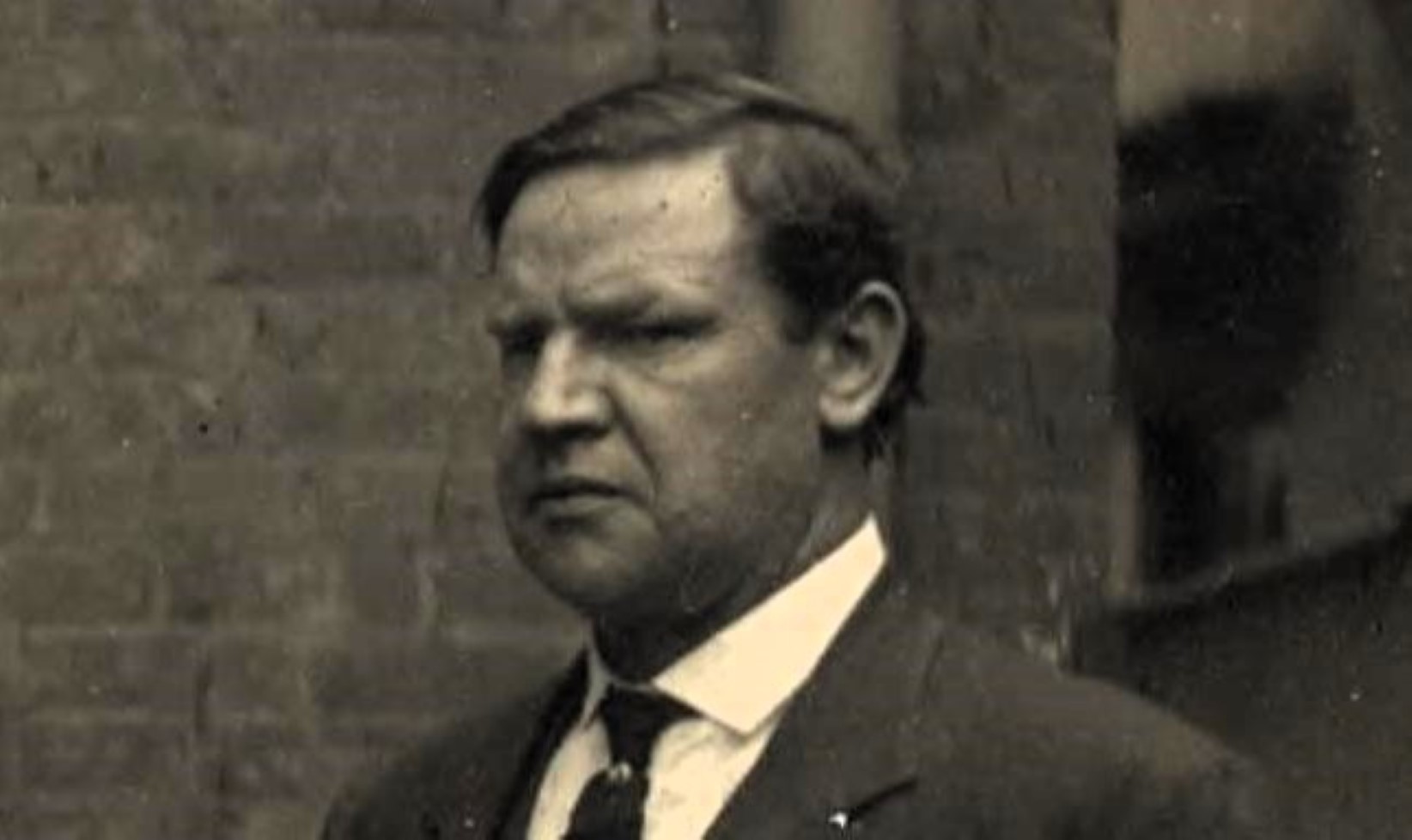
With total defiance Haywood, then on its national leadership, responds to the Socialist Party’s Article 2, Section 6 forbidding members from advocating ‘sabotage’ and law-breaking in this magnificent, internationalist speech transcribed by Georgia Kotsch. The month following, Haywood would be ‘recalled’, losing his seat in the National Executive. Many thousands of activists would leave the Socialist Party after.
‘Haywood’s Los Angeles Speech’ from Solidarity. Vol. 4 No. 5. January 25, 1913.
(Reported for Solidarity by Georgia Kotsch.)
From the heart of the class-struggle they spoke to us. From the jail and the shadow of the gallows rope. Jack Whyte, of to-hell-with-your-courts-I-know-what-justice-is” fame, fresh from his long martyrdom in San Diego’s jail, smiling and debonair and making no bid for a martyr’s crown, introduced Haywood, the Misrepresented.
The Undesirables were out in force and fairly raised the great roof of the Shrine Auditorium when Haywood walked down the aisle Friday night. The crowd was augmented by many who were curious to hear Haywood after reading so many things that he did and didn’t say. So there were a lot of nice folks there, too–voting revolutionists who wouldn’t be so impolite as to do anything to a capitalist, without first asking his advise about it.
In spite of his strenuous activities and of the fact that be essays the stormy role of a I.W.W. and a Socialist Party man, Haywood looked considerably younger than when he was here some years ago. He wasted no time in putting the audience in a good humor–an I.W.W. audience always being in that cheerful state–but went directly to bis subject.
“Fellow Workers: I feel that I need no introduction. We are one family. This reception is not for me personally, but for the principles I represent. We meet under the auspices of the I.W.W. an organization of the working class with the avowed purpose of fighting the everyday battles of the working class on the industrial field, where we meet the capitalists at their own game; an organization which will make the campaigns of the pure and simple trade unions look like an invalids’ picnic. The capitalist has every reason to fear the I.W.W. We workers are not going to destroy the factories we have built, but strip the capitalist class of their ownership, compel them to roll up their sleeves, put on their overalls and go into the mines and mills with us. The I.W.W. is organized upon the lines of the class struggle. Not one of its members imagine for a moment that his interest is identical with that of the capitalist. This struggle is irresistible and will continue as long one man eats bread in the sweat of another man’s face. The class struggle has been accentuated here in Otis-town, but you have no monopoly on it; it is world-wide.
“We will go back in history a little ways–only so far as runs the memory of a working-man, and that is the shortest thing I know of. There are working men in Los Angeles that would sign up an agreement with the Merchants & Manufacturers and call off all the terrible things that have occurred to them and forget them if they could get a small increase in wages for themselves. Other working men view the world-wide struggle as a part of themselves.”
World-Wide Class Struggle.
Concluding a dramatic recital of the events of Bloody Sunday, the speaker said, “And when you heard the volley you beard the echo of the world-wide class struggle as you hear it in the shrieks and groans of the exiled Russian girls now on strike and of those burned to death in the Triangle fire. The Russian government was brought to its knees and forced to grant constitutional government. That was one thing in one nation accomplished by the general strike. It was a small thing to win political bauble, but there will be another soon to abolish the constitution and establish industrialism. Every young Finn is compelled to serve as a soldier or pay a great tribute in gold. They will be part of the general strike. A few years ago we were sending funds to Sweden which was engaged in a great general strike. It was led by socialists in the government who decided not to call out the railroad workers for fear of interfering with the government. They told me in Stockholm of living on black bread and water, and they said, ‘Tell the workers in your country we will be with them until the working class of the world triumphs.’
“I visited the Latin countries. Certain French bankers had an interest in the gold mines of the Riffe. The Moors objected to their mines being invaded from the outside. The King of Spain was called upon to protect the financial institutions and be called upon the youth to go to war. The Building Trades of Barcelona went on a general strike to prevent war. How long would it take for the Building Trades of Los Angeles to strike to prevent war or the American Federation to declare a general strike for any purpose? (Laughter.) The working class of this country is not organized for the general strike. It is organized for co-partnership with the employing class rather than for putting it out of business.”
A glowing tribute was paid to Francisco Ferrer and his work. “When they sounded his death-knell capitalism in Spain aroused the workers everywhere till even in Egypt is carried on a campaign for industrial unionism. Roosevelt in London Guild Hall, with bloodshot eyes and clenched teeth, gave vent to the same spirit that shot the fleeing Spaniard at San Juan Hill and that attacked us when we were lying in our cells, but young Egypt is carrying on its campaign still and industrial unionism is growing more rapidly there than anywhere in the world.
“In Italy they know how to strike–at the point of production. In the lap of the new-born political liberty of Portugal they are asking for industrial liberty–asking to work when they want to work and to receive the full social value of their work.
“I went to Wales during the great mining strike. They have been striking for hundreds of years, but this was the first strike of its kind. I told them of a strike in a mining camp in California where the pampers and engineers were called out first and the spirits of the bosses ran down as the waters rose in the mine. So the Welshmen tried the experiment and every man quit. The bosses took the bookkeeping force to try to run the pumps. They plead for the 300 ponies–surely they would not let them drown. No, they would hoist them up and let the owners feed them during the lay off. The police were called. It must be said for the police of Great Britain that they are not the murderous outfit we have in this country. They are not allowed to carry firearms. It seems to be understood that man who will work as a policeman is unsafe to trust with weapons They carried batons this long–but the miners carried pick-handles that long. Then at the behest of the mine owners the King of England, like his half-witted relative in Spain, sent soldiers to drive the miners back to work. But many of the soldiers had listened to the words which spell solidarity and class-consciousness and they took the locks off of their guns and threw them away and rendered the guns useless. This was sabotage on the government. I know there are patriots here who say that those men did wrong, were not loyal to the government and did not live up to the obligation taken when they became soldiers. It is better to be a traitor to your country than to your class. They were loyal to their brothers in the coal mine. There were some who were loyal to the government and sped the bullet into their brothers breasts. Many were killed, but the strike was not broken.
“Just previous to this the workers of England had spent fifteen million pounds to pau a gold crown upon an empty pate–what you do every four years. But you are not satisfied with one king. You must have nine, to sit on their thrones in the supreme court room and usurp the right to declare unconstitutional any and all laws your representatives make. These are the bulwark of capitalism and are duplicated in every state in the union and you expect to go before these and have laws enacted in your behalf. There never was a time in the history of the workers when a subject class could enforce legislation in its own interest. You are not subject unless you allow the capitalist class to select the ground upon which you fight. Select your own ground. Remember you hold the power in the shop even if the employer does bold the title.
“For the first time in mining history all the miners in Wales saw the sunshine at the same time. Other industries quickly followed them in Great Britain and if the rest of the workers had been prepared to have kept those miners for awhile the government of England would have turned over the mines to them. And that is the great power of the general strike–the key to unlock the shackles which bind the wage-slave’s world.
“The International Socialist Congress at Copenhagen resolved as a means to prevent war to declare a world-wide general strike if necessary. If we can make peace with the general strike we can do more. We can lock the capitalists out and continue to run the machinery.
“I was in France during the railroad strike. It was not like any in this country. Every Jerry on the brake and every stenographer in the office carries the same kind of a card. They are all in one big union. The strike lasted three days and secured an increase of two francs a day in wages and reduced the hours from ten to eight. In this country, in a cab not large enough for two large men to turn around there is room for two labor organizations, both working for the same company. On the train are represented the union of mail clerks, baggage-men, brakemen (noted for their record as scabs), conductors, and on the track the flag men. They don’t take in the porters because they are a little off-color–but the company takes anyone broad enough across the back and narrow enough between the eyes to make a good wage slave. There are 40 railroad organizations, more or less, in this country, and they maintain expensive lobbies at the state legislatures and congress, and, as a result, they have been successful in reducing the hours of labor, so that now no railroader works more than 16 hours at one time. They used to work 36 hours in one day.
“The French government discharged 5,500 of the strikers, and the rest refused to return to work without them. Then Premier Briand called out the reserves, and, as soldiers, the men were forced to return to work. White bands upon their arms marked the members of the C.G.T. Then I learned it was possible for a well-disciplined army of workers to put in full time and over-time and be on strike at the same time. I’ll tell you how it operated, even at the risk of violating article 2, section 6.
“Fifty thousand tons of freight was piled up. The workers were busily engaged in loading it. Somehow freight for Paris got to Marseilles, where it was just as busily unloaded, and someday the mistake was discovered and it was reloaded for Paris and landed in Lyons. Some packages were marked: “Saboteurs, notice address,” These were for their own prisoners in the jails, and these went through properly. A train load of fresh meats, butter, fruits, destined for the idlers on the boulevards, would break down, and it always happened to break down in a working class district, where the stuff would have to be distributed to keep it from spoiling. Some think the workers are not entitled to the best. They are. In the packing houses there are three grades of goods put up–first class, second class and working class, the latter being the scrapings, the long tails and short tails. I think it is a good scheme to organize the work in the packing houses to put the first label on the third class cans and vice versa. Give the third class to the fellow who does nothing. That is sabotage. Some socialists say sabotage means dynamite. It wouldn’t hurt them to study a little bit. Others say direct action means physical violence. I am not an advocate of violence, but I am an advocate of direct action. It’s the shortest way home. I do not advise any group of workers to elect representatives to do what they can do for themselves.
“At the American Federation’s convention a vote was taken which many say indicates that the Federation is moving on to industrial unionism. It is not so much the form as the idea of the organization. The United Mine Workers is industrial in form, but is poisoned by all the virus of trade unionism. With all the workers in the country organized and divided into districts one is played against another and they scab on their own members. This magnificent organization, nearly 400,000 strong, is in entire agreement with the boss that contracts shall expire on different dates and there is never united action. The initiation fee is $50. All these are reactionary tactics.
Direct Action!
“I will show the value of direct action by raising a union which you may not consider revolutionary. A number of years ago the Typographical Union wanted an 8-hour day If it had followed the tactics advocated by politicians it would have tried to pass an eight-hour law in forty-eight states, one after another, and all the laws would have gone to the supreme court and would have got what the ten-hour law of the bakers got from a judge who never worked ten hours in his life. The Typographical Union decided on direct action. In its convention in 1906 it passed one law and that law went from the Convention hall to the organized shop and on the first of January that law went into effect in the 48 states, in Canada, in Mexico, Porto Rico, the Philippines and Hawaii. Do you see any physical force or dynamite about that?
“The industrial power of the people is not at Sacramento or Washington. It is in the industries. The I.W.W. is not interested in the machinery of government, but in the government of machinery. We are not here to patch a system too rotten to hold another patch. Change it from a political junk shop to an industrial workshop with jobs enough for everybody and everybody on the job. We know we can accomplish the result we have set out to attain because we have the labor power upon which civilization rests, the brain and brawn of the working class. Capital can take all it has and yet we could build the old world over again.
Protected Capitalist Violence.
“The Erectors’ Association, auxiliary to the Steel Trust, came to your city not to punish but to persecute. When it announced that every labor organization would be wiped out it had an easy task, for they were divided among themselves. But one remained–the Bridge and Structural Iron Workers–men who are not afraid in this most hazardous occupation–men who never die–they get killed. In some places they got $5 a day for scaling skyscrapers. The Erectors’ Association cared not for widows and orphans. This organization stood between them and more profits. It started out to put it out of business. The fight was merciless. It used that most inhuman weapon, the blacklist. This government is largely responsible for the results which followed. When its rights are violated in foreign parts it immediately sends fleets to blow them off of the map. Citizens are taught murder, violence, destruction, by the example of the nation. Patriotism and the soldier are held up before our youth. Here 21 lives were lost in an explosion and the government put a federal grand jury to run the criminal to ground. Remember that in Briceville, Tenn., 207 lives were lost and the charred bodies are down in the depths now. It was a direct result of the avarice and greed of the mine owners. They knew that an explosion might occur, but it took money to remove the fumes and dust. They took the chance on the cheapest commodity in the world–human life. No federal grand jury was appointed to investigate. In the Grand Central depot tons of dynamite exploded and lives were lost; in Wyoming herds of sheep were dynamited; at Cripple Creek the Independence depot and 13 men killed; in California dynamite is piled in mines against the laws of the state, but there was no federal grand jury.
“There is a man in the city of Los Angeles charged with bribing a juror. You and I know him well. He has struggled for the poor and lifted his voice for the oppressed. They are trying to break the spirit of this great man and send him to the penitentiary. What is your answer? Will you let Clarence Darrow go to the dungeon? Let your answer ring out till those who hate the working class will hear it from the lapping waves of the Pacific to the roar of the Atlantic. By God, you will not pat Clarence Darrow in a dungeon cell. He is our friend, He has fought for us, and we will fight for him.” (Tremendous applause.)
In closing, the speaker referred to the strikes at Little Falls, Merryville and Lawrence. “If the rest of you will furnish us with a seven-cent meal twice a day,” he said, “we can whip any capitalist in the country. The only violence we will commit is to put our hands in our pockets; the most violent thing we could do. When the soldiers came the strikers sang the Red Flag. The preachers and priests thundered, and they picketed the churches and wouldn’t let a scab go in. The court issued an injunction, and they sang the Internationale, and the bosses went crazy and planted dynamite. Breen was convicted and fined $500. Ryan was convicted and sentenced seven years. With the strike we got $15,000,000 in wages in ten weeks and organized 27 different nationalities into One Big Union.” Mr. Haywood paid his respects to Mr. Otis, but said he regretted that his education had been neglected that he only knew two languages, English and profane, and the presence of ladies barred him from expressing his opinion of the old gray wolf.
The most widely read of I.W.W. newspapers, Solidarity was published by the Industrial Workers of the World from 1909 until 1917. First produced in New Castle, Pennsylvania, and born during the McKees Rocks strike, Solidarity later moved to Cleveland, Ohio until 1917 then spent its last months in Chicago. With a circulation of around 12,000 and a readership many times that, Solidarity was instrumental in defining the Wobbly world-view at the height of their influence in the working class. It was edited over its life by A.M. Stirton, H.A. Goff, Ben H. Williams, Ralph Chaplin who also provided much of the paper’s color, and others. Like nearly all the left press it fell victim to federal repression in 1917.
PDF of full issue: https://www.marxists.org/history/usa/pubs/solidarity-iww/1913/v04n05-w161-jan-25-1913-solidarity.pdf
 Revolution's Newsstand