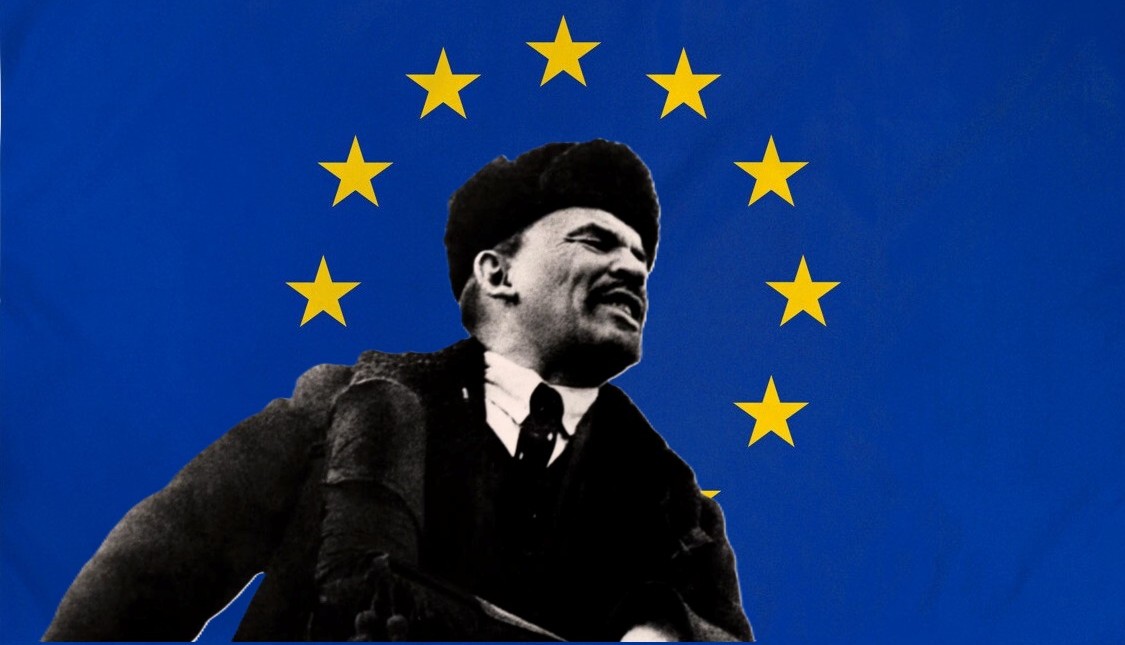
A debate within the Bolsheviks on the ‘United States of Europe’ as a slogan to raise against the war in 1915, with states meaning ‘republican’ states at a time when empires and monarchies, constitutional or otherwise, were largely ruling the continent.
‘On the ‘United States of Europe’ Slogan’ (1915) by V.I. Lenin from Selected Works, Vol. 5. International Publishers, New York. 1936.
In No. 40 of Sotsial-Demokrat we reported that the conference of the sections of our party abroad had decided to postpone the question of the “United States of Europe” slogan pending a discussion in the press on the economic side of the question.
At our conference the debate on the question assumed a onesidedly political character. Perhaps this was partly due to the fact that the Manifesto of the Central Committee directly formulated this slogan as a political one (“the immediate political slogan,” it says), and not only did it advance the slogan for a republican United States of Europe, but it especially emphasised that this slogan is false and senseless “without the revolutionary overthrow of the German, Austrian and Russian monarchies.”
To argue against such an approach to the question within the limits of a political estimation of the given slogan, for instance, to argue that this slogan obscures or weakens, etc., the slogan of the socialist revolution, is absolutely wrong. Political changes of a truly democratic nature, and especially political revolutions, can never, under any circumstances, obscure or weaken the slogan of the socialist revolution. On the contrary, they always bring it nearer, widen the basis for it, draw ever new strata of the petty bourgeoisie and the semi-proletarian masses into the socialist struggle. On the other hand, political revolutions are inevitable in the course of the socialist revolution, which must not be regarded as being a single act, but must be regarded as an epoch of turbulent political and economic upheavals, of the most acute class struggle, civil war, revolutions and counter-revolutions.
But while the United States of Europe slogan, raised in connection with the revolutionary overthrow of the three most reactionary monarchies of Europe, headed by Russia, is quite invulnerable as a political slogan, the important question of its economic content and meaning still remains. From the point of view of the economic conditions of imperialism, i.e., capital exports and the partition of the world among the “progressive” and “civilised” colonial powers, the United States of Europe is either impossible or reactionary under capitalism.
Capital has become international and monopolistic. The world has been divided among a handful of great powers, i.e., powers successful in the great plunder and oppression of nations. The four Great Powers of Europe, England, France, Russia and Germany, with a population ranging from 250,000,000 to 300,000,000, with an area of about 7,000,000 square kilometres, possess colonies with a population of almost half a billion (494,500,000), with an area of 64,600,000 square kilometres, i.e., almost half the surface of the globe (133,000,000 square kilometres, not including the Polar region). Add to this the three Asiatic states, China, Turkey and Persia, which are now being torn to pieces by the plunderers who are waging a “war of liberation,” namely, Japan, Russia, England and France. In those three Asiatic states, which may be called semi-colonies (in reality they are now nine-tenths colonies), there are 360,000,000 inhabitants and their area is 14,500,000 square kilometres (almost one and one-half times the area of the whole of Europe).
Further, England, France and Germany have invested capital abroad to the amount of no less than 70,000,000,000 rubles. The function of securing a “legitimate” profit from this tidy sum, a profit exceeding 3,000,000,000 rubles annually, is performed by the national committees of millionaires called governments, which are equipped with armies and navies and which “place” the sons and brothers of “Mr. Billion” in the colonies and semi-colonies in the capacity of viceroys, consuls, ambassadors, officials of all kinds, priests and other leeches.
This is how, in the epoch of the highest development of capitalism, the plunder of about a billion of the earth’s population by a handful of great powers is organised. No other organisation is possible under capitalism. Give up colonies, “spheres of influence,” export of capital? To think this is possible means sinking to the level of a little minister who preaches to the rich every Sunday about the greatness of Christianity and advises them to give to the poor, if not several billions, at least several hundred rubles yearly.
A United States of Europe under capitalism is equivalent to an agreement to divide up the colonies. Under capitalism, however, no other basis, no other principle of division is possible except force. A billionaire cannot share the “national income” of a capitalist country with anyone except in proportion to the capital invested (with an extra bonus thrown in, so that the largest capital may receive more than its due). Capitalism is private property in the means of production, and anarchy of production. To preach a “just” division of income on such a basis is Proudhonism, is stupid philistinism. Division cannot take place except in “proportion to strength.” And strength changes in the course of economic development. After 1871 Germany grew strong three or four times faster than England and France; Japan, about ten times faster than Russia. There is and there can be no other way of testing the real strength of a capitalist state than that of war. War does not contradict the principles of private property—on the contrary, it is a direct and inevitable development of those principles. Under capitalism the even economic growth of individual enterprises, or individual states, is impossible. Under capitalism, there is nothing else that periodically restores the disturbed equilibrium than crises in industry and wars in politics.
Of course, temporary agreements between capitalists and between the powers are possible. In this sense the United States of Europe is possible as an agreement between the European capitalists…but what for? Only for the purpose of jointly suppressing socialism in Europe, of jointly protecting colonial booty against Japan and America, which feel badly treated by the present division of colonies, and which, for the last half century, have grown infinitely faster than backward, monarchist Europe, which is beginning to decay with age. In comparison with the United States of America, Europe as a whole implies economic stagnation. On the present economic basis, i.e., under capitalism, the United States of Europe would mean the organisation of reaction to retard the more rapid development of America. The times when the cause of democracy and socialism was associated with Europe alone have gone forever.
The United States of the World (not of Europe alone) is a state form of national federation and national freedom which we connect with socialism—until the complete victory of communism brings about the total disappearance of the stale, including the democratic state. As a separate slogan, however, the slogan of a United States of the World would hardly be a correct one, first, because it merges with socialism, second, because it may be wrongly interpreted to mean that the victory of socialism in a single country is impossible; it may also create misconceptions as to the relations of such a country to the others.
Uneven economic and political development is an absolute law of capitalism. Hence, the victory of socialism is possible, first in a few or even in one single capitalist country. The victorious proletariat of that country, having expropriated the capitalists and organised its own socialist production, would confront the rest of the capitalist world, attract to itself the oppressed classes of other countries, raise revolts among them against the capitalists, and, in the event of necessity, come out even with armed force against the exploiting classes and their states. The political form of society in which the proletariat is victorious, in which it has overthrown the bourgeoisie, will be a democratic republic, which will more and more centralise the forces of the proletariat of the given nation, or nations, in the struggle against the states that have not yet gone over to socialism. The abolition of classes is impossible without the dictatorship of the oppressed class, the proletariat. The free federation of nations in socialism is impossible without a more or less prolonged and stubborn struggle of the socialist republics against the backward states.
It is for these reasons and after repeated debates at the conference of the sections of the R.S.D.L.P. abroad, and after the conference, that the editors of the central organ have come to the conclusion that the United States of Europe slogan is incorrect.
August 23, 1915.
International Publishers was formed in 1923 for the purpose of translating and disseminating international Marxist texts and headed by Alexander Trachtenberg. It quickly outgrew that mission to be the main book publisher, while Workers Library continued to be the pamphlet publisher of the Communist Party.
PDF of full book: https://archive.org/download/selected-works-vol.-5/Selected%20Works%20-%20Vol.%205.pdf
 Revolution's Newsstand