
Carl Reeve provides a valuable background to one of the largest and most important class battles ever fought in the U.S. The Uprising of ’34 which a million textile workers walked out, many in the South and many striking for the first time, in a struggle that was ultimately betrayed by union mis-leadership. A defeat that the working class South has yet to overcome.
‘A Million Workers Say Strike!’ by Carl Reeve from New Masses. Vol. 12 No. 9. August 28, 1934.
THE unanimous decision of the 500 delegates to the Thirty-third National Convention of the United Textile Workers Union of America, with 300,000 members, to declare a general strike in the textile industry, was not an empty threat.
For a whole week these 500 delegates met in stormy session at the Town Hall, New York City. There are one million textile workers in the United States, and in this strike convention every branch of the industry was represented. There were delegates from the silk, woolen, worsted, cotton and rayon mills of New England. The Southern textile states–Georgia, Alabama, North and South Carolina, Virginia and Tennessee–sent scores of delegates. The hosiery, silk and thread mills, the dye houses of Eastern Pennsylvania, New Jersey and New York were represented. Textile workers in twenty states and 217 cities, including the Pacific Coast, met and elected delegates representing 300,000 workers.
The gathering in Town Hall was something new in the history of the textile industry of the United States. Never before has there been such a representative gathering of textile workers. Two years ago the United Textile Workers union was no more than a dormant skeleton, with only scattered locals. Since then 230,000 workers, in 537 new local unions, have joined the U.T.W.
It was this mass influx into the United Textile Union which caused the seeming contradictions in the debates. dictions in the debates. On the one hand there were the delegates of the new local unions raw, inexperienced in parliamentary maneuvering illusions clinging to them, but militant and fighting mad. On the other hand there was the leadership of President Thomas MacMahon, mossbacked and musty, in the saddle for a score of years.
When a telegram was read from William Green expressing regrets that he could not come, there was not a ripple of applause. When George Googe, personal representative of Green, worked himself into a lather exhorting the delegates to turn to “the greatest humanitarian who ever sat in the White House–Franklin D. Roosevelt”—there was stony silence.
But when delegate Horace Reviere of Manchester, N.H., declared, “The textile workers have looked to the N.R.A. and been disappointed. We must strike every textile mill from Alabama to Maine”–the keynote of the convention had been sounded. For five minutes the thunder of applause mingled with the “rebel yells” of the southern delegates. It was a strike convention.
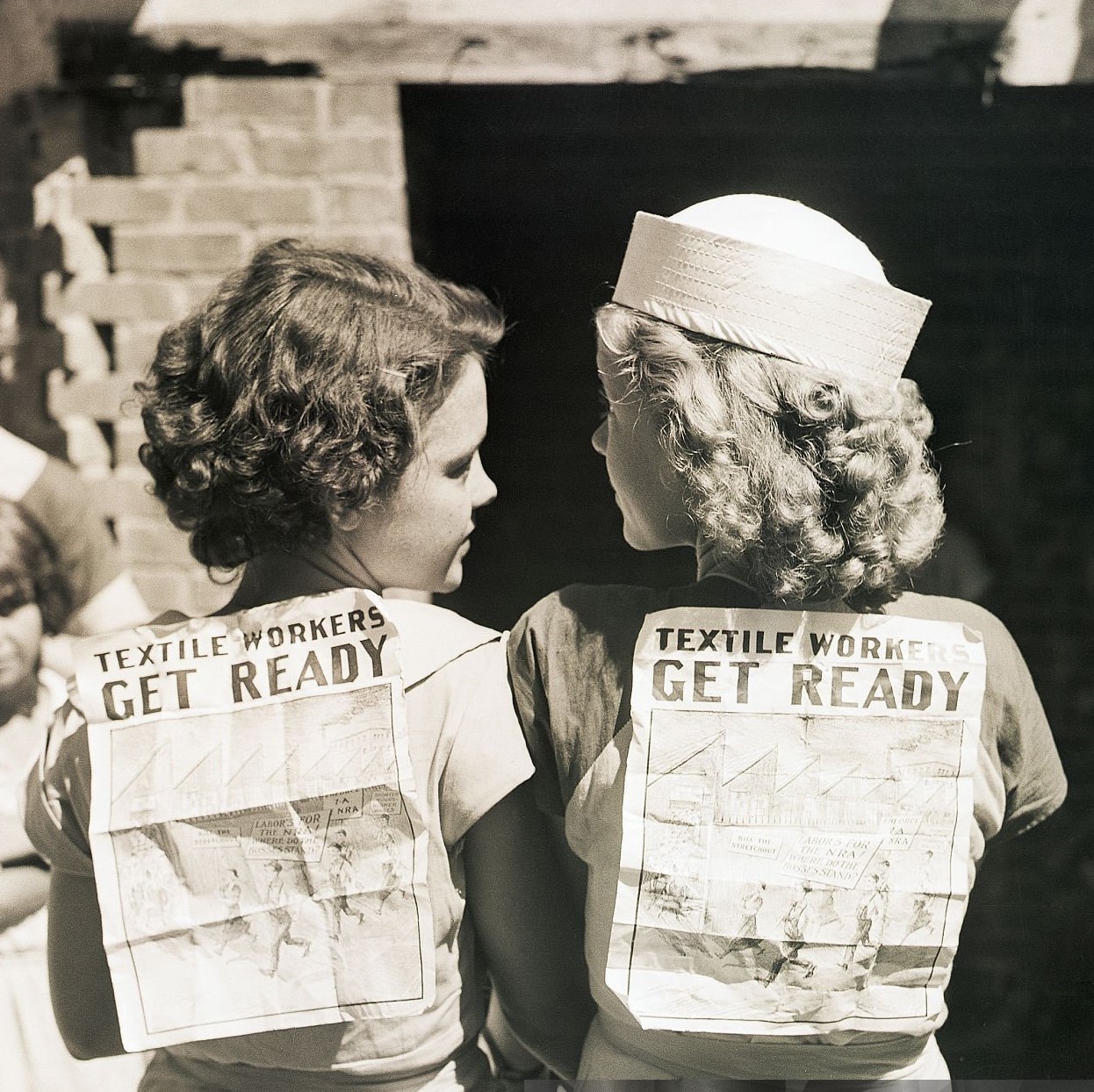
Why did the textile workers come to this convention disillusioned with the N.R.A. and determined to strike? The deal given the textile workers in the past year is the reason for the unprecedented urge for struggle. When the N.R.A. set the minimum wage in the industry at $13.00 ($12.00 for the South), this figure tended to become the maximum wage. In the skilled trades, of which there are many in the industry, actual wage reductions went into force with the N.R.A.
The stretchout (speedup) became an unbearable burden to the textile workers. Curtailments, a polite name for layoffs, were ordered by the textile code authorities of the N.R.A., which further reduced wages far below the code minimum. Reports to the union office show that in Alabama the average wage of the textile workers is $7.30 a week, for a thirty-hour week. According to government estimates, the average wage for all cotton workers (including the skilled categories) was $13.31 per week, in April, 1934. Even at that time, many thousands of textile workers were receiving wages considerably below the code minimums.
Speaking of the stretch-out, which has been responsible for a number of the strikes in the industry, J.A. Frier, of Columbia, S.C., told the delegates that the number of picks per minute have been increased in his mill from 160 to 176 in the last couple of years.
The company store still holds sway in many Southern mill villages. Delegate Charles McAbee, of Inman, S.C., brought with him the Inman company store coupons, which he said the workers are forced to sell at a 25 percent discount in order to get ready cash.
R.G. Strickland, of Selma, N.C., said: “Six workers in my mill now do the work formerly done by 23. There are now four loom-fixers doing the work that was done by ten loom-fixers. We have to make 144 picks a minute, whereas formerly 136 picks were turned out. The weavers in my mill now make $21 for forty hours of work that they got $27.95 for two years ago. Outside of the few loom-fixers and weavers, all the workers in the mill get only thirty cents an hour.”
When Frier clenched his fist and said: “We are determined to have a reduction in the machine load,” he voiced the burning grievance of the cotton textile workers, who are being continuously speeded up, their productivity increased, while their wages at best remain stationary.
The textile workers have more than once taken their demands before the N.R.A. The demands in the present strike situation are: abolition of the stretch-out (reduction in the machine load); the thirty-hour week, with two shifts; wage differentials (minimum wages for the skilled and semi-skilled as well as for the unskilled); recognition of the union. These are the demands which the textile workers have been laying unsuccessfully before the N.R.A. for a year. The answer received by the textile workers was a whole series of “curtailments” which further drastically reduced their wages. Accompanying this lowering of the living standards, carried through directly by the code authorities, was a sweeping drive to destroy their union by the firing of thousands of union men.
This spring the cotton textile code authority decreed a “curtailment” in production of 25 percent. This reduced the wages of the half-million cotton-textile workers far below the minimum code. The cotton textile workers decided to strike. The strike date was set for the first week in June. On the eve of the strike, on June 2, the reactionary union leadership of President MacMahon and Vice-President Francis Gorman signed an agreement jointly with General Johnson.
This agreement threw away every one of the above demands of the cotton textile workers. The strike was called off without consultation with the workers. The first point of the agreement was: “Strike order to be countermanded without prejudice to the right of labor to strike.” On the question of demands the N.R.A. Division of Planning and Research was to investigate and report on hours (the thirty-hour week demand) on wages (the demand for an increase in wages) and other demands.
The N.R.A. report on hours made a few weeks later is almost unbelievable. On the heels of the 25 percent shutdown, carried through by the N.R.A., the N.R.A. ruled, after solemn “investigation” that “it will require ninety hours per week of productive machine operation [or ten hours more than the eighty hour maximum in two forty-hour shifts permitted under the Cotton Textile Industry Code] when normal annual consumption of cotton in the U.S. is obtained.”
Thus the demand of the union for the thirty-hour week (two shifts making sixty hours), or ten hours reduction per week, without any decrease in pay, was denied by these learned men. As the N.R.A. itself declared, “The report was prepared…as a result of the contention of textile labor leaders that the maximum hours in the industry should be reduced to two thirty-hour shifts a week.” With this report declaring for increased hours out of the way, the 25 percent curtailment, with a corresponding 25 percent reduction in pay, was carried through.
The N.R.A. report on wages in answer to the union’s demand for pay increases, is just as satisfactory to the cotton textile workers. It concluded with these words, “Under existing conditions, there is no factual or statistical basis for any general increase in Cotton Textile Code wage rates.” An analysis of the report shows that it was based on the percentage of increase in hourly rates, not accounting for the decrease in hours worked effected when the N.R.A. began.
The same National Run Around was given to the other branches of the textile industry. A “survey” conducted under Frances Perkins’ direction netted the Paterson silk workers a three percent reduction in wages. The woolen and worsted workers set a strike date and again their leaders postponed the strike and signed an “agreement” with the N.R.A. with none of the demands granted.
This is the background of the meeting which called for a general textile strike. Before the national convention met, the Paterson silk workers, in referendum, voted for a strike. Several thousand walked out in Alabama, and thousands more in Georgia, New England, and other states.
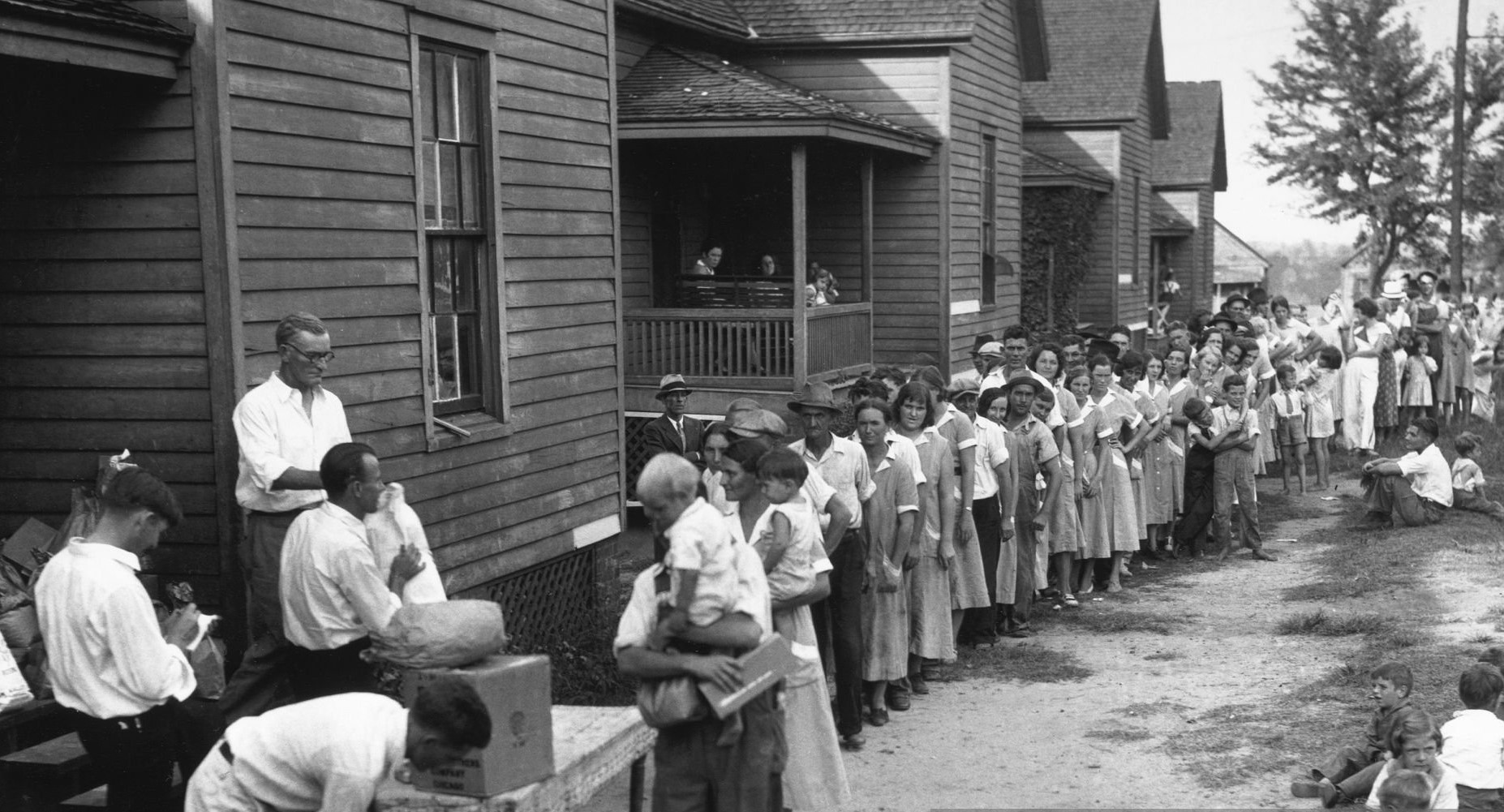
Terror against the textile workers increased. Before the walkout centering around Huntsville, Ala., 1,500 cases of discrimination against union members were reported to the union offices from Alabama alone.
The conditions of terror under which the textile workers are striking can be judged from the letter of Mollie Dowd, union organizer in Huntsville, to the convention:
“I have never seen a group of businessmen acting just like them (the C. of C. of Huntsville). They are still boldly threatening our lives and send me word every day that they are coming after me that night to take me for a ride just like they did Dean and you need not discount that they will do it. They have sent us word that the American Legion has promised to lend them the machine guns they have in the Armory and that they intend to get us no matter how we shield or protect ourselves. The pity of this is that we have no protection except of course that loyal guarding of our strikers, but I hate to see them shot down. And I fear that will happen if Huntsville is not curbed in some way. They say as soon as they get rid of us that they will put these workers back in the mill at the point of a gun if necessary…It is a thoroughly Democratic town…I cannot understand such Democrats…Please help us with relief. They have hopes of starving us to death and how they will rejoice.”
W.M. Adcock, of Huntsville, Ala., appeared on the convention platform with terrible scars seaming his head. He told in simple language, with deep feeling, how he was sent over to Decatur, Ala., famous for the Scottsboro trials, to organize the workers there. He was shot several times through the legs, and beaten with lead pipes and blackjacks by the Chamber of Commerce thugs. He was left for dead. “I would be glad to give my life to get better conditions for the Southern textile workers,” he told the convention, which responded with thunderous applause.
From all sections the upsurge of the textile workers against the stretch-out, against discrimination, against low wages, rang through the hall. “Whether we get a strike vote or not, silk workers will strike,” said Russell Wood, president of the Easton, Pa., Silk Workers Federation. “The silk workers of Paterson district have already voted in referendum to go on strike for their demands. If you do not call the silk strike, our union will be destroyed,” said Frank Schweitzer, secretary-treasurer of the Silk Workers Association of Paterson. A delegate from South Carolina declared, “A large majority of the textile workers of my state favor action.” “New England workers have been ready for months to go on strike,” Horace Reviere told the convention. Conservative leaders like Reviere and Schweitzer thought it best to swim with the tide.
The militancy of the delegates was shown in the 103 votes given to the resolution of Local Union 1791, Reading, Pa., condemning William Green for his desertion of the San Francisco general strike. This resolution characterized Green’s anti-general strike statement as
“not only an open disavowal of action undertaken by and carried on by recognized A.F. of L unions, in said strike, but was in hardly disguised language a direct attack upon the general strike then in progress. Instead of remaining with his army as a good general would have done, he deserted them and as a result events have shown that this statement of President Green’s played a big part in breaking down the morale of the strikers and opening the way for the disintegration of the strike. We condemn the action of Green…in deserting the interests and welfare of the courageous San Francisco strikers.”
It took the utmost efforts of MacMahon’s entire machine, and a hysterical red scare, to secure 192 votes to defeat this resolution.
The pressure of the radicalized masses of the textile workers was also felt in the 177 votes for the resolution to declare a general strike the moment war is declared. This motion was defeated by only about forty votes. The convention went on record for a labor party, for industrial unionism, for a campaign against the company unions, and against injunctions in labor disputes.
In spite of this fine militancy, expressing the will of hundreds of thousands of radicalized workers, the end of the convention saw the old line, conservative, MacMahon leadership elected to office almost without opposition. This contradiction came about because the militancy of the workers was not organized into a solid, well knit rank and file opposition. The rank and file was duped and a leadership was elected which is notoriously opposed to strike action–to lead a general strike.
The attitude of MacMahon toward the question of organizing the Negroes reveals his reactionary line. The U.T.W. maintains Jim Crow locals. There was not a single Negro delegate at the convention. MacMahon, after his election, stood in the wings of the stage, beaming, and surrounded by reporters. He told them of his intention of going at once to Roosevelt. “Are there any Negroes in the industry?” the writer asked MacMahon.
“A good many,” MacMahon answered. “They are in separate locals. I believe in separate locals myself. The Negroes would rather have it that way too. I wouldn’t want my daughter to sleep with a n***r.” When MacMahon was asked why none of the Southern Jim Crow locals sent delegates he said, “They didn’t have the money.”
MacMahon thus encourages the most chauvinistic prejudices, instead of attempting to achieve the solidarity of the textile workers, regardless of race. “When in Rome do as the Romans do,” MacMahon said. He added that “some elements try to embarrass the union by placing us in a difficult position.”
Then, as to women. The latest figures available show that there are 452,000 women in the industry–more than in any other industry in the country. In fact in the silk and knitting branches the women outnumber the men. Yet not one woman was even nominated for office. Seventeen officers were elected.
Two maneuvers in convention served to bring about the re-election of MacMahon, a result at which the Journal of Commerce on August 18 editorially rejoiced. One was the demagogy of the MacMahon machine. MacMahon knew from the outset that if he opposed strike action he would be swept off the platform. At no point in the convention did the officials of the union oppose the strike resolutions. They proposed that the strike date be set by the Executive Board. In this they were defeated, and an amendment to set the cotton textile strike (of half a million workers) on or before September I was overwhelmingly carried.
But MacMahon, using the argument (in the caucuses) that it was bad to put in “inexperienced” leadership while going into battle, was able to win over some of the Southern delegates for his re-election. He was also able to have the strike date for silk, woolen and worsted referred to the Executive Board. The MacMahon leadership killed a resolution calling for withdrawal of the officials from all N.R.A. Boards by pushing through an amendment, “unless the U.T.W. gets fairer and greater representation,” on the N.R.A. boards.
MacMahon’s demagogy was directed towards binding the union to Roosevelt and the N.R.A. His line was to criticize the N.R.A.–to declare “fight,” but “fight in the N.R.A.” He directed attention to negotiating inside these boards instead of toward actual preparation and organization of the strike.
This tactic is most clearly demonstrated in the printed report of Francis Gorman, vice-president, who is now head of the strike committee. Gorman “criticizes” the N.R.A. for thwarting the textile workers in all their demands. Then at the very end of his report he declares:
“I desire to express our sincere appreciation to the research department of the American Federation of Labor and the Labor Advisory Board of the N.R.A. for the splendid assistance they have rendered to the United Textile Workers of America, and their willingness at all times to cooperate in our endeavors.”
Roosevelt further strengthened MacMahon’s hand by his appointment as member of the N.R.A. Labor Advisory Board only a few hours before the elections.
But this tactic alone would not have saved the tottering MacMahon machine. To Emil Rieve, a Socialist party leader, head of the Hosiery Worker’s Federation, went the honors for re-electing MacMahon. Rieve, until the last day of the convention, was feverishly electioneering for the presidency in the place of MacMahon, as a “progressive.” The militant element at the convention was supporting Rieve and expected his election. At the last moment, Rieve withdrew his candidacy, leaving his followers dumbfounded. MacMahon was elected unopposed, after calling Rieve to the chair to preside during the elections.
After MacMahon was elected he said, “I ask the delegates to rise to their feet in honor of Emil Rieve for the manner in which he has conducted the elections.” The photographers took pictures of MacMahon and Rieve side by side on the platform, and Rieve was elected to the Executive Board of the union with the votes of the MacMahon machine. A few hours later Rieve was arguing against the calling of a strike in the silk, woolen or worsted industry, on the ground that there should be “one strike at a time.” Rieve’s rapid transition from progressive, pro-strike leader to floor leader for MacMahon cleared the way for the latter’s election and prevented the militants from organizing their forces to nominate a real militant against MacMahon.
The delegates belonging to the Lovestone group (Keller, Rubinstein and Herman) while they made “left” speeches of a general nature, did not concretely expose the treacherous role of the MacMahon leadership and did not direct sharp criticism toward this leadership. Finally, they did not put up one of their leading delegates as a candidate to run against MacMahon. Thus their “radical” speeches were nullified.
The Worcester, Mass., Labor News, A.F. of L. paper, in commenting on these events, stated: “Mr. Gorman is quoted as saying that ‘Mr. MacMahon’s re-election will have a strong influence in avoiding the calling of a general strike.”
The Journal of Commerce says that because of MacMahon’s election, “it is reasonably safe to count upon the continuation of old policies of union administration.”
But anyone who heard the militant voice of the masses of textile workers at the convention must be convinced that it will be impossible for MacMahon to prevent the cotton textile strike, and strikes in the silk, woolen, rayon and worsted industry, from taking place. The danger lies in the beheading of the strike by MacMahon before the demands are won.
If the strike is to be properly organized, the local unions will have to do it by setting up their mill strike committees to lead the struggle. These committees are a safeguard against the splitting up of the strikers’ ranks into localized strikes which could be broken a section at a time.
The New Masses was the continuation of Workers Monthly which began publishing in 1924 as a merger of the ‘Liberator’, the Trade Union Educational League magazine ‘Labor Herald’, and Friends of Soviet Russia’s monthly ‘Soviet Russia Pictorial’ as an explicitly Communist Party publication, but drawing in a wide range of contributors and sympathizers. In 1927 Workers Monthly ceased and The New Masses began. A major left cultural magazine of the late 1920s to early 1940s, the early editors of The New Masses included Hugo Gellert, John F. Sloan, Max Eastman, Mike Gold, and Joseph Freeman. Writers included William Carlos Williams, Theodore Dreiser, John Dos Passos, Upton Sinclair, Richard Wright, Ralph Ellison, Dorothy Parker, Dorothy Day, John Breecher, Langston Hughes, Eugene O’Neill, Rex Stout and Ernest Hemingway, Artists included Hugo Gellert, Stuart Davis, Boardman Robinson, Wanda Gag, William Gropper and Otto Soglow. Over time, the New Masses became narrower politically and more journalistic in its tone.
PDF of full issue: https://www.marxists.org/history/usa/pubs/new-masses/1934/v12n09-aug-28-1934-NM.pdf
 Revolution's Newsstand