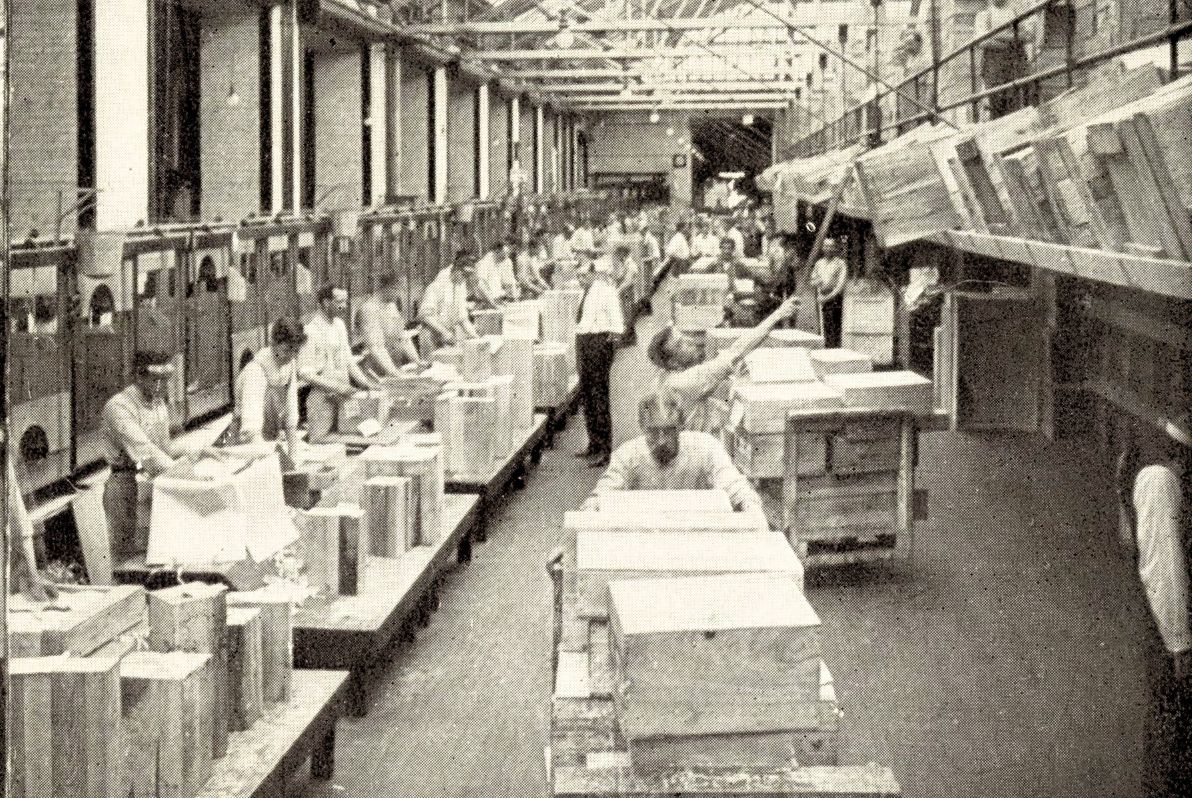
The Young Workers League sells 15,000 copies of special edition of their paper in a campaign to organize Chicago’s massive mail order industry. The ‘Amazon’ of their day, companies like Sears and Montgomery Ward employed tens of thousands of mostly young, underpaid and super-exploited workers in their shipping warehouses.
‘Drive on Mail Order Houses’ from Young Worker. Vol. 3 Nos. 22 & 23. November 15 & December 1, 1924.
CHICAGO TAKES SPECIAL 15,000 ISSUE OF Y.W. December 1, 1924.
Campaign Against Mail Order Houses On
The Young Workers League of Chicago is taking 15,000 copies of a special edition of The Young Worker to be sold in front of numerous mail order houses in the city.
The special edition, which is being run off the press simultaneously with the current number, is the beginning of a huge campaign to rally the exploited young workers in the mail order houses to the economic demands of the league.
Mere to Follow.
All preparations have been made for the sale of the paper. This is the first special edition that has been issued and it is expected that not only Chicago, but other units of the national organization will follow suit in other campaigns that will be carried on hereafter.
The special edition contains stories on the conditions in such mail order houses as Sears, Roebuck & Co., Philadelphia’s Montgomery Ward & Co., the Chicago Mail Order House and other slave plants. The young workers are appealed to join the Young Workers’ Loague on the basis of the economic demands that are put out based on the general demands of the Young Workers’ League applied specifically to the special conditions of the young workers in the industry. Units of the league all over the country are urged to communicate with the manager of The Young Worker for rates on special editions to be printed for special campaigns that are being carried on numerous cities.
Another Factory Drive
THE first test of strength for the Chicago league since its reorganization into working area branches will be the biggest campaign yet undertaken by any unit of the Young Workers League. Chicago is the center of the mail order business, there being 93 mail order houses in Chicago where thousands of young workers slave for the lowest imaginable wages and under the worst conditions. The Chicago League is going to launch a mail order house campaign, the first task of which will be to sell 15,000 copies of a special edition of The Young Worker to the young workers in the bigger mail order houses, the campaign to end with the establishment of functioning nuclei in the five most important mail order houses in the city.
Now that the members of the Chicago league are mobilized around the shops they will demonstrate how much harder they can hammer on the shops, and what organizational result these more concentrated drives can produce.
Every working area branch is responsible for a mail order house, and each branch will supplement the work of those comrades who work inside by organized activities outside the mail order houses.
Like the campaigns that the Chicago league has held at Bunte’s and the National Biscuit Company, this campaign will make the Young Workers League known to thousands of young workers throughout the city. But as a result of the experience gained in its first two campaigns, the Chicago comrades are in a position to launch a campaign which will not only be bigger, but one which will be so much better organized as a result of their experiences that it is bound to have far reaching effects, and to be crystallized in the four shop nuclei that it will build for the Young Workers League.
More than 15,000 leaflets will be distributed at the mail order houses the day before the campaign starts. The following day squads will be at the mail order houses with The Young Worker, which they will sell there for more than a week. At the end of this week all the working area branches will hold special shop meetings for the mail order house in its district which will further help the work of the comrades within the mail order houses in recruiting members for their shop nuclei. At the end of the campaign 5,000 copies of a 5 cent pamphlet on the mail order houses will be sold at the factories.
With so few members working in the same shops, it is with the help of such a campaign that the Chicago league will give the impetus necessary to help the comrades, from the outside, in the organization of strong units of the Young Workers League in the shops.
As in all factory campaigns, The Young Worker will prove itself to be a militant weapon in the hands of the Chicago league in their fight against the mail order house bosses.
CALL OUT COPS IN ATTEMPT TO HALT Y.W. SALE. December 1, 1924.
Ask Youth to Join Young Workers League
The campaign of the Young Workers League in the Chicago mail order houses has reached it organizational stages, and the slogan “Read The Young Worker” has given way to the slogan: “Join the Young Workers League.”
The young mail order house workers know what attempts their bosses made to prevent them from reading the facts about the mail order industry printed in the special mail order house edition of The Young Worker; now that they have defied their bosses and read the articles on conditions and wages in the mail order houses, they must take some organized action to improve these conditions.
How much the bosses are afraid of the facts printed in The Young Worker and the definite program offered, is shown by the extremes to which they went to stop the young mail order house workers from buying the paper.
Fire a Reader.
At Sears Roobuck’s one young worker was laid off because he bought a copy of The Young Worker against the orders of his foreman. The result was many Sears Roebuck employes were afraid to buy the paper, though thousands weren’t frightened by these threats.
At Philipsborn’s all the bosses were at the doors the morning after the paper was first sold there, talking to the young workers, telling them not to buy the paper, and telling them that the paper was “against them” (the young workers) because it was against the boss.
Orders were also given out in each department that the young workers should not buy the paper and some of the girls were so frightened that when approached by a member of the Young Workers’ League and asked what they thought of The Young Worker they were afraid to talk about it. The morning after the first sale of the paper at Philipsborn’s a meeting of all the officers of the company was held and plans gone into for concerted action with Sears Roebuck and “Monkey” Ward bosses to stop the sale of The Young Worker on a city scale. But his plan was turned down since the league was so well organised at the plants that they were afraid such an action would raise too much of a rumpus, and only increase instead of decrease the sales.
Police Called.
It was noticed that at all the mail order bouses the second day, that the workers bought more papers than the first day, they had their nickel ready, got the paper and moved on as quick as possible for fear the boss would see them buying it. At Montgomery Ward’s the police were called upon to stop the sales, but when they found that they couldn’t scare the newsies away, knowing that they could not arrest anybody for selling papers they had to give up the bluff and let the league members continue selling there.
The next morning when the young workers at Montgomery Ward’s came to work, they found signs painted on the sidewalks advertising The Young Worker and a big sign in black paint on the marble front of the building: “Read The Young Worker.”
The mail order bosses are afraid to have the young mail order house workers read the facts about wages and conditions in the mail order houses. But most of all they are afraid of the consequences if the young workers in Montgomery Ward’s, Sear Roebuck’s, Philipsborn’s and other mail order houses should organise into units of the Young Workers’ League and work to improve these conditions.
One reason the mail order house campaign of the Young Workers’ League is so displeasing to the mail order house kings right now, is the fact that at this very time they are preparing to force even lower wages on the young mail order workers. They are not satisfied with the gradual reduction in wages that has been going on for some months in the mail order industry despite the slight rise in the cost of living, but are planning more drastic wage cuts as soon as the Christmas rush is over.
The fact that the special mail order house edition of the Young Worker pointed out that the mail order house bosses are planning these wage cut and calls upon the young mail order house workers to organise Into the Young Workers’ League to fight these organized attacks of the bosses, is what really worries the mail order house workers.
They know that if the young mail order house workers should organise to resist these attacks, not only would they be unable to force lower wages on them, but the mail order house workers would be able to force wages in the other direction.
If the young mail order house workers don’t want lower wages and a continuation of the present rotten conditions, they must join the Young Workers’ League in the fight for the following demands:
1. No layoffs during slack seasons–Instead the 6-hour day, 5-day week.
8. A minimum wage of $35 for all young workers in the mail order houses.
3. Call upon Retail Clerks’ International to immediately launch organizational campaign in mail order houses.
4. Equal pay for equal work for young and old.
5. Removal of dust and general betterment of sanitary conditions.
6. For the abolition of all overtime and night work for youth labor up to 20 years of age.
7. A four weeks vacation each year for all young workers with full pay.
8. We demand doing away with the “credit system” and all other “speed up” and efficiency” systems.
The Young Worker was produced by the Young Workers League of America beginning in 1922. The name of the Workers Party youth league followed the name of the adult party, changing to the Young Workers (Communist) League when the Workers Party became the Workers (Communist) Party in 1926. The journal was published monthly in Chicago and continued until 1927 when it moved to New York City and remained in print until 1937. Editors included Oliver Carlson, Martin Abern, Max Schachtman, Nat Kaplan, and Harry Gannes.
For PDF of full issue: https://www.marxists.org/history/usa/pubs/youngworker/v03n22-nov-15-1924-yw.pdf
PDF of full issue 2: https://www.marxists.org/history/usa/pubs/youngworker/v03n23-dec-01-1924-yw.pdf
 Revolution's Newsstand