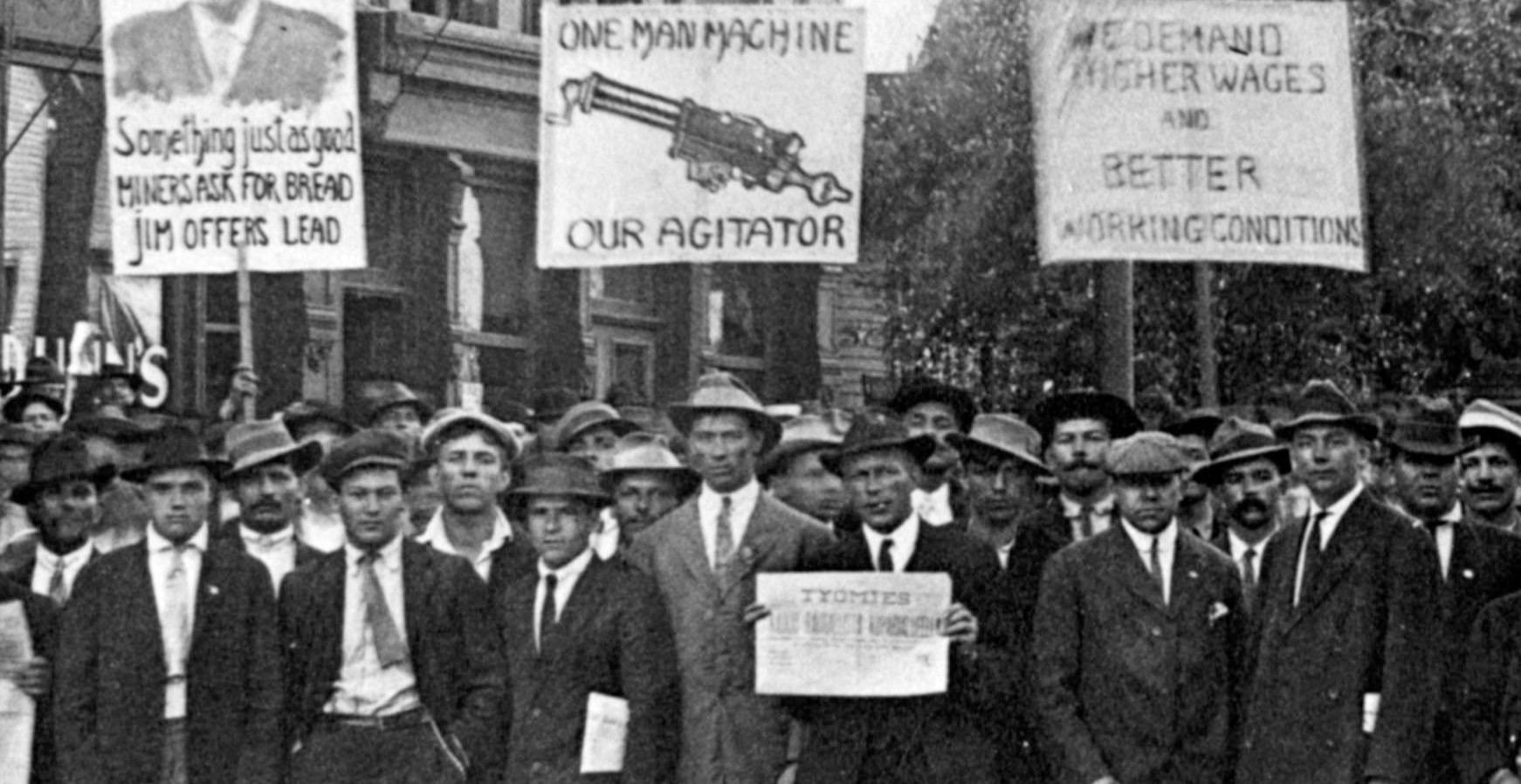
Organizers from the Western Federation of Miners reports on the copper strike in Michigan’s Upper Peninsula and the need for the basics, food and clothing, to keep the struggle going.
‘Conditions in the Michigan Copper Strike’ by from The Commonwealth (Everett). No. 160. January 27, 1914.
Governor Ferris left the copper country Jan. 10th, after giving an exceedingly weak statement relative to the ending of the strike, notwithstanding the fact that he very emphatically stated to Moyer and other representatives of organized labor before coming here, that he was going to try to get the two warring elements together, or at least would let the public know the TRUTH, and place the responsibility where it properly belonged.
The statement Gov. Ferris is credited with issuing is to the effect that he “challenges anyone to say that he ever said that he could end the strike, that he is not a God, and that the thing could probably be settled if left to the miners and operators directly affected.”
As soon as President Moyer was made acquainted with this, he immediately wired the governor while en route for Lansing, asking him to recommend that a conference be held between the men actually on strike and the mine owners here, and the governor wired back “that he believed that if all outsiders were eliminated the controversy could be settled.” (This telegram was sent to President Moyer 49 cents collect.)
In short, the little bit of bravado displayed by Governor Ferris at Lansing while interviewing the representatives of “Horny Handed Toil,” was effectually extinguished before he had been long in the presence of those who own the Upper Peninsula, top, bottom and side, and who by “divine right” of private ownership own so much of Michigan are enabled to throw considerable weight on the political atmosphere.
It looks like another case of “invisible government” being both seen and caught.
The local miners here established beyond the shadow of a doubt that the strike was called at the unanimous behest of the miners actually working in the copper country; that they are trying to increase their earnings so as to be able to cope with the high cost of living, and most of all to establish the right to belong to an organization that will protect their rights as American citizens so that they may enjoy the right of free speech and free assembly, the right to deal where they please and see that state laws are lived up to and enforced so that working conditions in the mines may be such as to promote health and safety for life and limb.
18,000 Men Involved.
There are 18,000 men involved, a majority of them with large families. The mines have been closed all over the copper range since the 23rd day of July with the exception of one of the large Calumet mines which was in such a condition that it could not possibly stand an extended period of idleness; here they gathered all their “pets,” bosses, captains, etc., at the beginning of the strike, from the surrounding mines controlled by this company.
In addition to this they have imported strikebreakers so as to swell the total number of men working to the number of about 3,000. These imported men are not good “dividend” payers on account of lack of experience and physical inability.
Big Meetings Held.
We are addressing all the meetings we can, and everywhere find overflow meetings and the greatest enthusiasm. The strikers and their wives and children are as determined to win as they were the first day of the strike, nearly six months ago. This is a community with one industry, the copper industry; a community with two distinct classes: those who work in the mine and those who live off those who work in the mines; and when the copper miners struck, those who live off the earnings of the copper miners felt aggrieved; their incomes were seriously interfered with; hence “THE CITIZENS ALLIANCE.”
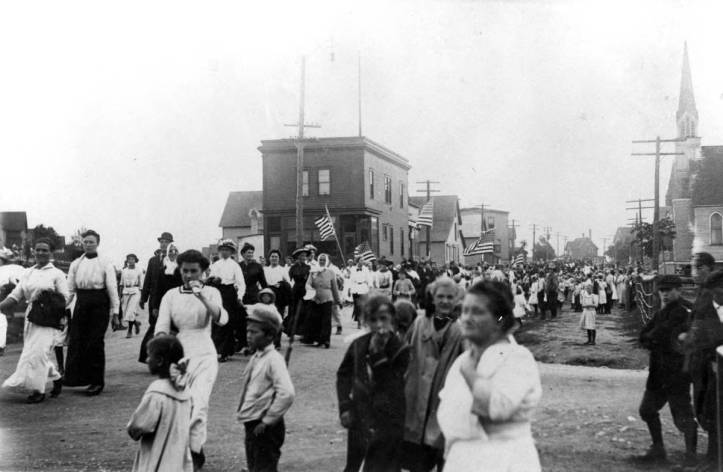
These exhibitions from the butcher, the baker, etc., of “biting the hand that feeds you,” just added one more link to the chain of compulsory education the copper miners are undergoing, and they quietly, intelligently, started stores of their own in the localities where they are most needed, and they are doing great work with them, while the long established enterprises of their “fair weather” friends are at this present time caught in the throes of an “automatic lockout,” a lock-out that will continue long after this strike is over, just as the remembrance of those who wore the Citizens’ Alliance button will continue. Co-Operative Stores Established. These stores are established at Houghton, Hancock, Calumet and South Range; strike benefits are issued in the form of coupon books and are good only at these stores. There are no middlemen’s profits. The goods are bought in Chicago in carload lots by a man who is absolutely reliable and thoroughly understands this business, so the cost of feeding the strikers is reduced to a minimum.
It takes approximately $80,000 per month to carry this on; this does not include the cost of clothing which is just beginning to be a serious prolem, especially as applied to the smaller children. Children cannot be sent to school in this climate without being properly clothed.
The W.F. of M. is unable to carry this burden alone, and this battle is the battle of the organized workers of America. The situation looks exceedingly hopeful; in fact, nothing in the world can beat this strike but actual starvation or freezing. There never was a fight waged for a worthier cause nor there never was more determination, solidarity or unassuming bravery shown anywhere on this earth, than is daily being shown by our comrades here, in the copper district; and the mothers whose babies died on Christmas eve–babies who died with their Christmas stockings in their little hands–these mothers are just as determined today on “no surrender” as ever was Lincoln or Washington.
New Phase of Fight.
Today another phase of the fight manifested itself. The children at Ahmeek, a neighboring camp, are unable to go to school because of lack of heavy underwear. That is absolutely necessary in this climate. The law provides a $10 fine against parents who do not send their children to school. A special attempt must be made at once to secure suitable underclothing for these children, as a succession of these law suits would be disastrous at this time.
After visiting the adjoining camps, President Moyer will be compelled to get out of this climate at once. He is taking long chances on his health by coming back here, considering the weakened condition in which he is in, yet did the right thing, in our opinion, in coming back as soon as he was able to get on his feet, in view of the threats that the murderous “Citizens’ Alliance” have made.
This is a brief review of conditions as they actually exist here now. This strike can be won; if it should be lost it will be to the everlasting shame of organized labor. No man or woman who really understands the situation can have an easy conscience if they have not done what they could to alleviate the privation and suffering of their fellow creatures here in the Peninsula, who are simply asking the right to live as God intended men and women should live.
Send all contributions to the secretary-treasurer of the W.F. of M., Ernest Mills, 605 R. R. Bldg., Denver, Colo.
(Signed)
PAUL J. PAULSEN. JAMES LORD.
The Washington Socialist was a weekly newspaper of the Socialist Party of Snohomish County published in Everett, Washington and edited by Maynard Shipley. Closely aligned with the Industrial Workers of the World, who were strong in the Pacific Northwest’s lumber industry, the paper ran for only 18 months when it was renamed The Northwest Worker with Henry Watts as editor in June, 1915, and again Co-Operative News with Perter Husby as editor in October, 1917. Like virtually all of the left press, the Co-Operative News was suppressed in June 1918 under the Federal Espionage Act.
PDF of full issue: https://chroniclingamerica.loc.gov/lccn/sn84025731/1914-01-29/ed-1/seq-1/
 Revolution's Newsstand