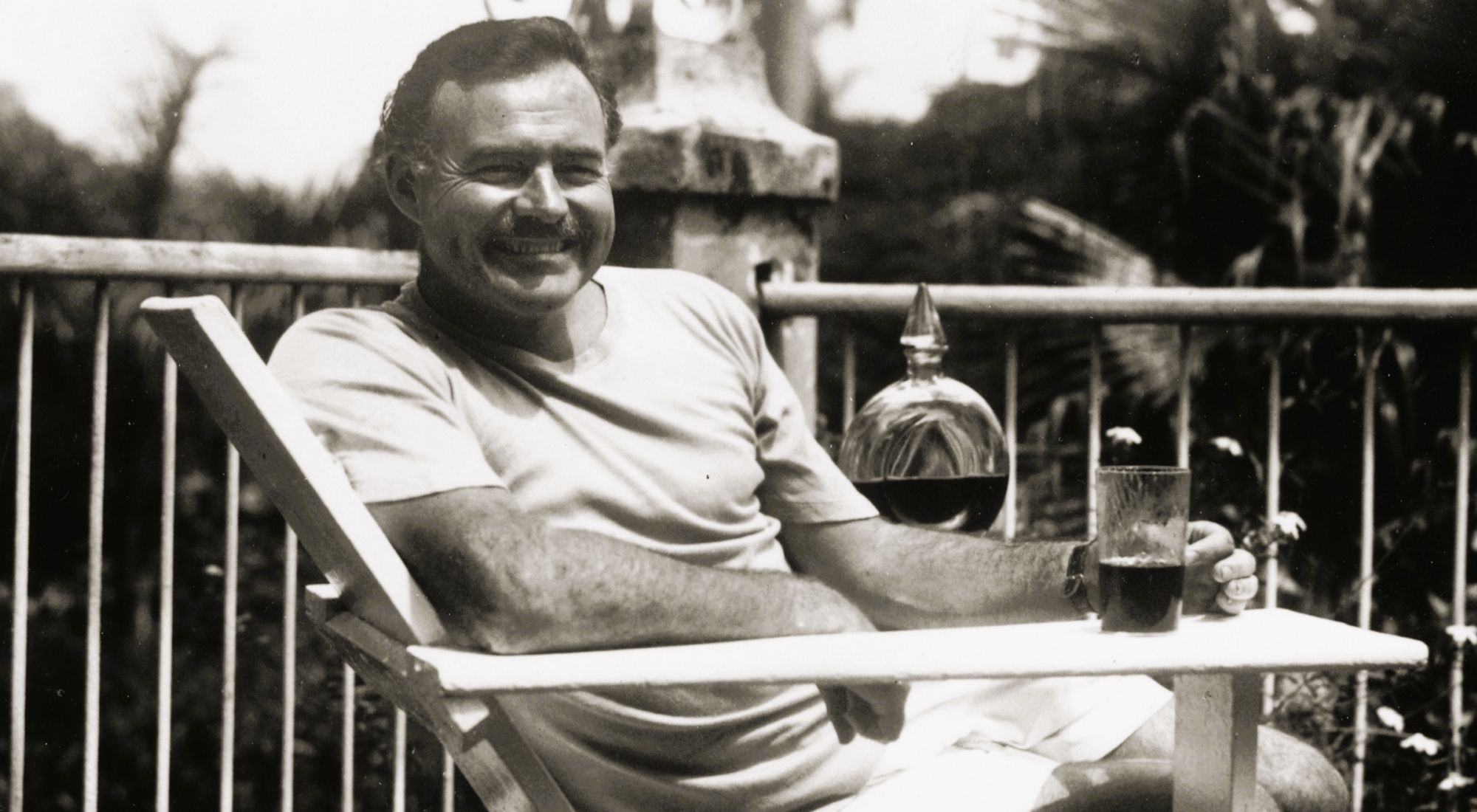
Ernest Hemingway became a major literary figure in the U.S. on the publication of his first novel, The Sun Also Rises, in 1926. Michael Gold looks at the context from which he emerged.
‘Hemingway—White Collar Poet’ by Michael Gold from New Masses. Vol. 3 No. 11. March, 1928.
Only Marxians have the slightest clue to the social basis of fashion. Fashion is as whimsical as a butterfly, neurotic as a racehorse with hives, crazy as the New York weather.
What causes the cycles of fashion? The average “literary critic” can’t tell you; the world is all accident to him. He is as incompetent as the average university “economist” who describes perfectly the cycles of economic expansion and depression, but knows as little of their basic laws as an Eskimo of television.
Ernest Hemingway is the newest young writer to leap into fashion among American intellectuals. He deserves recognition; he is powerful, original, would be noticed anywhere, and at any time. He has a technical control of his material as sure as a locomotive engineer’s. He sees and feels certain things for himself, for 1928.
Hemingway became a best seller with his novel The Sun Also Rises. He had already published a volume of short stories, and a satirical novel. Neither was very popular. Hemingway was considered member of a cult. The advance guard of American writing, most of whom live in Paris, looked upon Hemingway as one of their bannermen. He expressed their mood of irony, lazy despair, and old-world sophistication.
Suddenly this esoteric mood became popular. Thousands of simpler male and female Americans, not privileged to indulge in cafe irony and pity in Paris, but rising to alarm clocks in New York and Chicago, discovered and liked Hemingway. Why? His novel was an upper-class affair, concerned with the amours and drinking bouts of Americans with incomes who rot in European cafes; self-pitying exiles and talkers. Michael Arlen had already specialized in them, and fattened his bank account; why did the hardworking Babbitt Americans accept more of the same gilded sorrows in Hemingway?
It was no accident.
The middle-class youth of America is without a goal. It is shot to pieces morally and intellectually. America is the land where the business-man is the national hero. A big section of the middleclass youth, however, hates in its heart the rapacities, the meanness, the dollarmanias of business.
Part of the propaganda of the bourgeois philosopher Mencken has been to reconcile the American youth to business. In all of his writings he preaches American common sense to the young; but his common sense is that of a prosperous grocer.
American business simply cannot satisfy the mind and the heart. A thousand voices rise every day to testify against it. Mencken is losing his followers; they are discovering he is shallow. It is not his materialism one objects to; materialism offers greatness Mencken never dreamed of. Materialism is the basis of a heaven on earth, a social heaven. Mencken offers us only a fat little wholesale grocer’s suburb.
The war was a profound shock to all the youth. It was an earthquake in which their world of solid Y.M.C.A. values disappeared. And they studied Versailles, and now they can sense the next war, and they have no illusions about the past or present, and they have no hopes for the imperialist future.
Mencken, Hemingway, Sherwood Anderson, all the bourgeois modern American writers, whom do they write for? Not for workingmen, and not for the bankers of Wall Street. They write for, and they express the soul of the harried white-collar class.
I know a hundred gay, haggard, witty, hard-drinking, womanchasing advertising men, press agents, dentists, doctors, engineers, technical men, lawyers, office executives. They go to work every morning, and plough their weary brains eight hours a day in the fiercest scramble for a living the world has ever known.
Men who cheerfully fought through the war become nervous wrecks under the strain of American business competition. You must never let down; you must never stop to feel or think. There is no relief except violent nights of bootlegging and Bohemian love.
Sherwood Anderson expressed the soft day-dreams of this class, an epicene’s dream of escape, without will, without vigor.
Hemingway offers the daydreams of a man. Liquor, sex and sport are his three chief themes, as they are in the consciousness of the American white-collar slave today.
The intelligent young American liberal who was shocked and disgusted by his helplessness in the Sacco-Vanzetti case, forgets his impotence in getting drunk and imagining himself a strong, brutal killer with Ernest Hemingway. This is literature of escape, it is a new form of the ivory tower in America.
The young American “liberal” writes advertising copy meekly all day, then at night dreams of Hemingway’s irresponsible Europe, where everyone talks literature, drinks fine liqueurs, swaggers with a cane, sleeps with beautiful and witty British aristocrats, is well informed in the mysteries of bullfighting, has a mysterious income from home.
That is why Hemingway is suddenly popular. He has become the sentimental story-teller to a whole group of tired, sad, impotent young Americans, most of whom must work in offices every day—“white collar slaves.”
After the first Revolution failed in Russia, in 1905, a similar situation arose. The young people lost all hope for a modern world. Artzibashev came and expressed their mood in Sanin. Suicide clubs and clubs for sex orgies flourished among the youth.
When the French Revolution seemed to have failed, the poets it had created, like Wordsworth, grew timid and sad.
The literary historian of America will recognize that a great wave of social revolt came to its climax in the election of Woodrow Wilson to the Presidency. It was diverted by him, as Napoleon diverted the French revolution, to a means of vast personal power. It then collapsed in the Versailles treaty, and in the following years of this false, stinking, imperialist peace of ours.
This is the social background of the depression among the young American intellectuals; the background and reason for the new Hemingway fashion. We are living in a decade of betrayals; our time is dominated by Ramsay Macdonald, Mussolini and other Judases.
Ten years ago Hemingway could not have written in this mood; he would not have felt the mood, and no one else would have understood him, in this mood. His mood is that of the betrayed young idealist.
There is no humanity in Hemingway, as there is in Dreiser, Stephen Crane, Upton Sinclair, Carl Sandburg, all the men of the earlier decade. He is heartless as a tabloid. He describes the same material as do tabloids, and his sole boast is his aloofness, last refuge of a scoundrel. What one discerns in him, as in those younger writers close to his mood, is an enormous self-pity. He romanticizes his bewilderment in a world where social problems have become the only real problems of the so-called individual. The Hemingways are always running away from something—not going to something.
Hemingway, curiously enough, is an imitator of Tolstoy. I have seen no critic who has yet pointed this out. Hemingway has the same bare, hard style of a god-like reporter; his narrative is precise and perfect as science; he is the poet of facts.
Tolstoy, the disillusioned intellectual, strove like a weary exile to return to the golden childhood of the senses; he dreamed he could be a peasant. Hemingway, weary of the Judas decade and incapable of social thought, surrenders his intellect too, and dreams that he can be an American lowbrow; a prizefighter, a fisherman, a village drunkard.
Tolstoy had a big brain, and in his Russia for an intellectual to turn peasant meant that the Revolution had gained another recruit. This was far from a tragedy for Tolstoy and the world.
Hemingway will soon exhaust the illusion that he is a brainless prize-fighter, and since he is too bourgeois to accept the labor world, I predict he will imitate next, not Tolstoy, but those young French writers near to his mood, who have sought nirvana in the Catholic Church.
It will be a pity. Hemingway is a power; he has led American writing back to the divine simplicities of the prosaic; he has made a great technical contributions.
The revolutionary writers of the future will be grateful to him; they will imitate his style. But they will have different things to say. A new wave of social struggle is moving on the ocean of American life. Unemployment is here; hints of a financial depression; the big conservative unions are breaking up; another world war is being announced by Admirals and Generals.
Babbitt was one of the evidences of the desperation and pessimism of the middle-class idealists
during the Judas decade, Hemingway was another sign. In the decade to come we may develop Gorkies and Tolstoys to follow these Artzibashevs. The Sacco-Vanzetti case woke the conscience of the intellectuals. They brushed Mencken aside and walked on the picket lines in Boston. Upton Sinclair is coming back in popularity in his own land. There is surely something brewing^ Hemingway is not the herald of a new way of feeling, but the last voice of a decade of despair.
The New Masses was the continuation of Workers Monthly which began publishing in 1924 as a merger of the ‘Liberator’, the Trade Union Educational League magazine ‘Labor Herald’, and Friends of Soviet Russia’s monthly ‘Soviet Russia Pictorial’ as an explicitly Communist Party publication, but drawing in a wide range of contributors and sympathizers. In 1927 Workers Monthly ceased and The New Masses began. A major left cultural magazine of the late 1920s and early 1940s, the early editors of The New Masses included Hugo Gellert, John F. Sloan, Max Eastman, Mike Gold, and Joseph Freeman. Writers included William Carlos Williams, Theodore Dreiser, John Dos Passos, Upton Sinclair, Richard Wright, Ralph Ellison, Dorothy Parker, Dorothy Day, John Breecher, Langston Hughes, Eugene O’Neill, Rex Stout and Ernest Hemingway. Artists included Hugo Gellert, Stuart Davis, Boardman Robinson, Wanda Gag, William Gropper and Otto Soglow. Over time, the New Masses became narrower politically and the articles more commentary than comment. However, particularly in it first years, New Masses was the epitome of the era’s finest revolutionary cultural and artistic traditions.
PDF of full issue: https://www.marxists.org/history/usa/pubs/new-masses/1928/v03n11-mar-1928-New-Masses.pdf
 Revolution's Newsstand