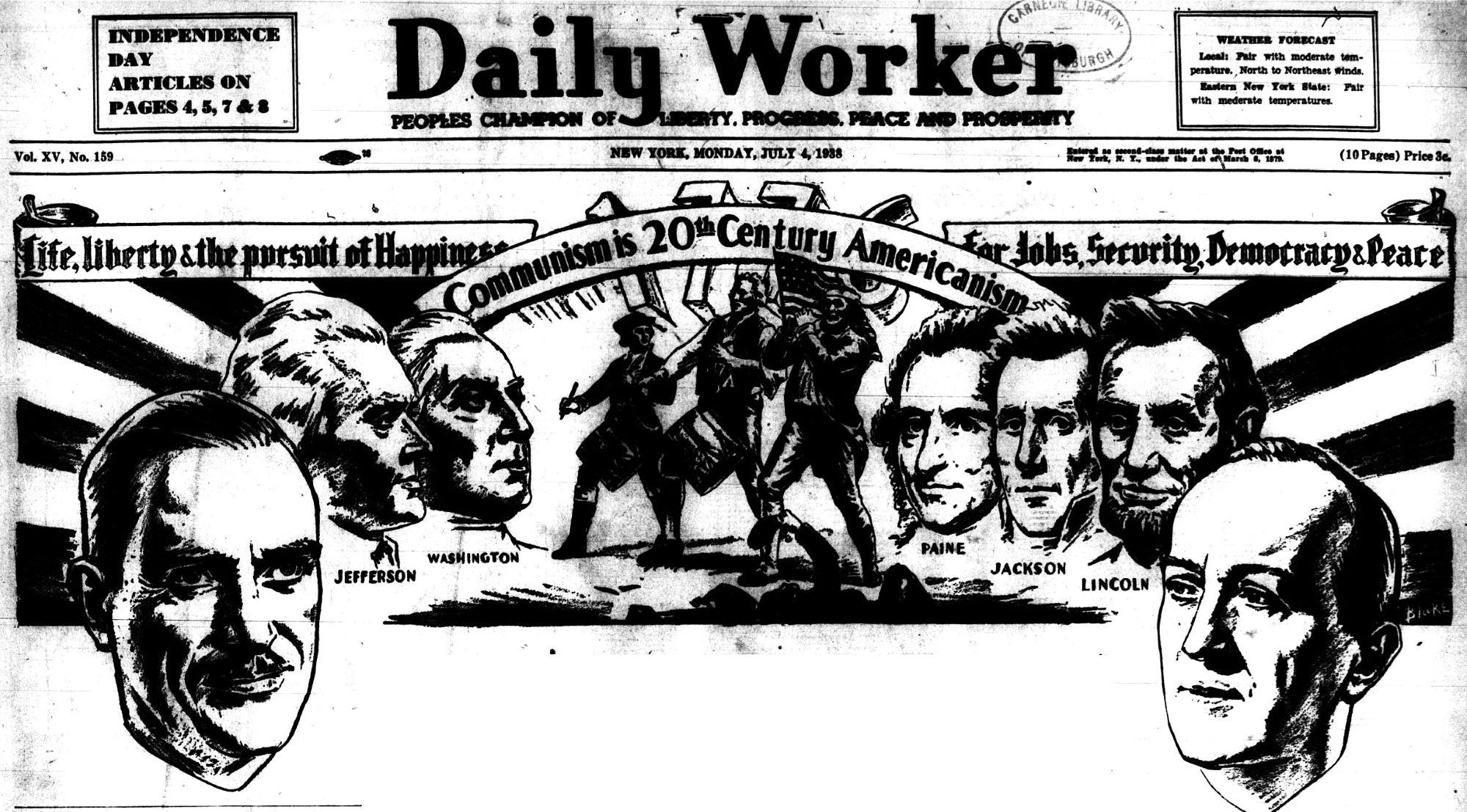
The 1930s Popular Front-era Communist interpretation of the Fourth of July and War of Independence would baffle even most conservative Socialists of a generation ago. Many Socialists at that time largely viewed the Constitution as a mostly passe document of the 18th century robber class, with yeoman-based ‘Jeffersonian Democracy’ always a myth, and one also entirely incompatible with industrial life. Here, Communist leader Earl Browder not only embraces Thomas Jefferson of 1776, but the later Jefferson. Jefferson the founder of the Democratic Party, the architect of the ‘Factory System’ of systematic indigenous dispossession and empire-making Western expansion which bloodily converted a continent that had never seen private property into a land of fences. Jefferson, that rich eccentric whose wealth was based on the ownership and labor of other human beings and of massive land speculation; Jefferson; that Enlightenment intellectual who more than any English writer of his era, through ‘Notes from Virginia,’ theorized and popularized the most vulgar, enduring fables of ‘scientific racism.’ Jefferson, that serial rapist of those he enslaved, his own offspring born as a result, he recorded in his slave register; Jefferson who built, and would rarely leave his peculiar, Greek-obsessed pleasure palace so as to indulge his particular peccadilloes in privacy and in luxury. That Thomas Jefferson. Browder boldly asserts that the “full and complete application of Jefferson’s principles, the consistent application of democratic ideas to the conditions of today, will lead naturally and inevitably to the full program of the Communist Party.” Not once in Browder’s article does the world ‘slavery’ appear, nor is ‘democracy,’ mentioned dozens of times, ever given a class character, but ‘agrarian’ and ‘industrial.’
‘July Fourth, The American Tradition and Socialism’ by Earl Browder from the Daily Worker. Vol. 15 No. 159. July 4, 1938.
The Communist Party of the U.S.A. is based upon the fundamental program of the revolutionary socialist reorganization of our country, that is, the assumption of ownership and operation of the national economy by all the people, acting through their state organization, for the benefit of all the people.
Because the majority of the American people are not convinced of the necessity of this socialist reorganization, this program being accepted as yet only by a relatively small minority, and because today the main enemy is fascism, the Communist Party finds it necessary to dedicate all its forces to realizing the program of the democratic front, and building the organizations of the democratic front, as the only guarantee against the victory of reaction and fascism, which threatens to destroy democracy and all its past achievements, to destroy civilization itself.
The program of the democratic front is not a socialist program. It is the minimum of those measures necessary, under capitalism, to preserve and extend democracy, all those things which have been the heart of the American tradition in the past, ever since the revolutionary foundation of the United States. The program of the democratic front is squarely based upon traditional Americanism.
Of course, the reactionary camp denies this. Everything which in the slightest comes into collision with the profits of monopoly capital they give the all-embracing label of “Communism.” Even the middle-of-the-road New Deal of Roosevelt, which insists upon some concessions from monopoly capital to the demands of the people precisely for the purpose of saving the present system from shipwreck and collapse, these blind reactionaries denounce as “Red” and “revolutionary” with a bitterness even surpassing for the moment that which they heap upon the real revolutionaries, the Communist Party. But we do not need to waste much time in this Convention in polemic with these “Red-baiters,” who proved in the elections of 1936 and 1937 that they are largely out of touch with the American masses. By their wild denunciations they have succeeded only in immunizing the great public against the most obvious forms of “Redbaiting.” In this way Senator Copeland and State Senator McNaboe, for example, by a process of reductio ad absurdum, have even unwittingly performed a public service–for which, however, there is no need to thank them, for they know not what they did. All the best minds of the democratic camp are now awake to the strategy of the Hitler-Mussolini-Mikado “Anti-Communist Alliance,” they recognize the application of that strategy in America’s domestic life by the camp of reaction, and they are already armed against it. We must extend this understanding to the broadest masses of the democratic movement, and to all its sincere leading people.
We must address ourselves, however, to those friends and potential allies within the democratic camp, who in a different form entirely see a contradiction between the Communist support of the democratic program today and our aspirations for socialism tomorrow; who see in socialism itself–actual socialism, not the reactionary bogey-man–something alien to the democratic tradition of Americanism. We need to make clear to them, and to ourselves, the true relation between the preservation of democracy today and the achievement of socialism tomorrow.
For the avoidance of all misunderstanding, now and in the future, let us make clear beyond the slightest doubt that the Communist Party is in no way weakening or abandoning its goal of the complete realization of socialism for America at the earliest possible moment, which means as soon as socialism gains the support of the majority. Because of this fact, and not, as some seem to think, despite it or refuting it, we are the most consistent and loyal sector in the democratic front. In our loyalty to socialism lies the key to our loyalty to the democratic front.
Our slogan, which we take directly from Lenin, is this: “Through democracy to socialism; through socialism to the highest and complete realization of democracy.”
Our program for socialism is organically linked up with, is a necessary outgrowth from, the traditional American democracy as founded by Thomas Jefferson, whose political descendants we are. Let those who try to set off Jefferson against Marx, Engels, Lenin and Stalin, who see in socialism something “imported from abroad,” as “alien,” be reminded that, in the same sense, Jefferson was also “importing” the theories of democracy from Europe to America, where they found their first and best realization of that period. Jefferson’s greatness arose directly from his all-embracing search through the entire world of thought for the best from everywhere, from all lands. Just as America’s people became strong and great because it was compounded of the most vigorous and dynamic vanguard drawn from all countries of the Old World, so American democratic philosophy and program were fed by the best thinkers of all the world, and were able to give leadership to the whole world because of that fact. We are following closely in Jefferson’s footsteps, therefore, when we reject all narrow nationalism of thought and program, when we range the whole world to find the best from everywhere. Like Jefferson, we believe that America is entitled to the best of everything, whatever its point of origin.
What was the essence of Jefferson’s democratic ideas, which formed the fundamental American tradition? It can be summed up in a few propositions:
1. There can be no social health and progress in a society where the selfish private interests of a minority are imposed upon the masses of the people through governmental coercion; government must, therefore, be based upon the will of the majority, democratically expressed.
2. Governmental power, political power, can be built only upon a foundation of economic power, that is, ownership, control, and operation of the basic economy of the country, which is the foundation of social life; the America of the late 18th and early 19th centuries was able to achieve such a foundation by breaking up the great colonial land monopolies and opening up the great territories to the West, and by the widespread distribution of free or cheap lands. Democracy was, therefore, primarily agrarian, supplemented by the city democracy of the handicraftsmen who owned and worked with their own tools.
3. The supreme power, the state, must be endowed with sufficient powers to perform its function to guarantee the social order which erects it from attacks by selfish minority interests within and from aggression from without, and no more. Therefore, in the democracy based upon widespread distribution of the national economy in the hands of individual producers, there must be a maximum of local self-government, and all government a necessary evil at best–must be confined to those fields where its operations are indispensable to the solution of the problems of the people.
We Communists unconditionally approve of the Jeffersonian principles thus expressed, and we consider that Jefferson’s concrete application of them produced the highest, most progressive society that history had ever seen up to that time. We consider Jefferson’s principles equally valid today, when they are adjusted to the tremendous changes that have taken place in the last hundred and fifty years.
What are these changes? They are the changes of the economic revolution, the rise of large-scale power and machine production in industry, the disappearance of individual production, the emergence of giant trusts and monopolies, the subordination of the farm to the city, and the domination of monopoly capital over even the remnants of individual agrarian production. In Jefferson’s day, the national economy was overwhelmingly in the hands of the masses of the people. Jefferson’s main preoccupation was with the problem of how to keep it there. He succeeded in raising a superstructure of democratic government, and in establishing a powerful democratic tradition–but his aspiration for a self-perpetuating agrarian democracy was wrecked on the rise of machinery and mechanical power, on the industrial revolution, which he could not foresee. Today, in 1938, the national economy has passed out of the hands of the people; more than 90 per cent of it is directly owned by the great corporations representing a minute fraction of the population; the whole national economic life is dominated by this minority–the economic royalists–subject to the limitation only of the degree of governmental intervention under the influence of the democratic masses. The economic foundations of Jefferson’s democracy have disappeared; the superstructure of democratic government and the self-organization of the people this makes possible remain as the sole instruments whereby the masses can influence and control their economy. That is why democracy is threatened today by the economic royalists, by monopoly capital.
The whole democratic mass movement arising today in America is directed toward finding some means to restore the lost economic foundations of Jeffersonian democracy. If it is to remain true to Jefferson’s principles, it must find a new and quite different practical program. The old Individualistic economy is gone beyond recall; whereas Jefferson could bolster up democracy by the protection of individual private property in production, today all measures to strengthen private property only strengthen the hold of monopoly capital, the rich minority, over the masses of the people. The very existence of democratic self-government is threatened. There is no road leading back to the past. We are forced to abandon Jefferson’s dream of an agrarian democracy, if we are to preserve Jefferson’s democratic principles.
All the progressive measures of Roosevelt’s New Deal are incomplete and fragmentary efforts to apply Jefferson’s democratic principles to the new conditions of the twentieth century. They are incomplete and fragmentary because they avoid their logical consequences of a fundamental collision with monopoly capital.
The program for the democratic front which we have elaborated here is a further, and more systematic effort to apply Jefferson’s principles within the limits of the capitalist system of production and distribution.
But a full and complete application of Jefferson’s principles, the consistent application of democratic ideas to the conditions of today, will lead naturally and inevitably to the full program of the Communist Party, to the socialist reorganization of the United States, to the common ownership and operation of our economy for the benefit of all. To illustrate this, allow me to restate Jefferson’s three central ideas in terms of the conditions of today. We then have the following:
1. The first, most basic, Jeffersonian proposition remains unchanged. We can repeat today: There can be no social health and progress in a society where the selfish private interests of a minority are imposed upon the masses of the people through governmental coercion: government must, therefore, be based upon the will of the majority, democratically expressed.
2. Political power can be built only upon a foundation of economic power, the ownership, control, and operation of the basic economy of the country, which is the foundation of social life; America of the twentieth century is a new world, in a deeper sense than the original America was a New World for Europe; it finds its basic and controlling economy in the form of giant enterprises, socially operated, interconnected and interdependent, which cannot be broken up without destruction of the power to produce, which can become the foundation for democratic self-government only if taken over entire through the organs of that democratic self-government. Democracy must become, therefore, an industrial democracy primarily, a democracy of socially owned and operated industry, supplemented by the agrarian-democratic forces as allies; that is, it must be a socialist democracy.
3. The supreme power, the state, must be endowed with sufficient powers to perform its function to guarantee the social order which erects it from attack by selfish minority interests within and from aggression from without, and no more. So far we repeat the original Jeffersonian principle unchanged. But in the conditions of twentieth century economy, which cannot be distributed among individual producers, which must be democratically owned, controlled, and operated, local self-government must be fitted into a national state with all the powers necessary to effectively operate the national economy and protect it from attack: all government–a necessary evil at best–must be directed toward creating a classless society, where exploitation of man by man has been entirely abolished, and where therefore government, the state power, will ultimately become unnecessary and will wither away and disappear.
In this restatement of Jefferson’s fundamental democratic principles, we have the only possible solution for the final preservation of these principles. But at the same time we have thereby a complete amalgamation of Jefferson’s teachings with those of Marx, Engels, Lenin and Stalin. We have the complete program of the Communist Party.
That is why, in the work of the Communist Party we realize the program of the democratic front, as well as our fight for the full Communist program, for socialism, we declare that we are continuing the great American tradition, we are carrying on the work of Jefferson, Paine, Jackson, and Lincoln. We express this fusion of the American tradition with socialism when we sing “The Star Spangled Banner” and “The International” together, when we decorate our platform today with the flag of our democratic revolution of the eighteenth century and the red flag of the socialist revolution of the twentieth century. This is the meaning of our slogan: “Communism Is Twentieth Century Americanism.”
The Daily Worker began in 1924 and was published in New York City by the Communist Party US and its predecessor organizations. Among the most long-lasting and important left publications in US history, it had a circulation of 35,000 at its peak. The Daily Worker came from The Ohio Socialist, published by the Left Wing-dominated Socialist Party of Ohio in Cleveland from 1917 to November 1919, when it became became The Toiler, paper of the Communist Labor Party. In December 1921 the above-ground Workers Party of America merged the Toiler with the paper Workers Council to found The Worker, which became The Daily Worker beginning January 13, 1924.
PDF of full issue: https://archive.org/download/per_daily-worker_daily-worker_1938-07-04_15_159/per_daily-worker_daily-worker_1938-07-04_15_159.pdf
 Revolution's Newsstand