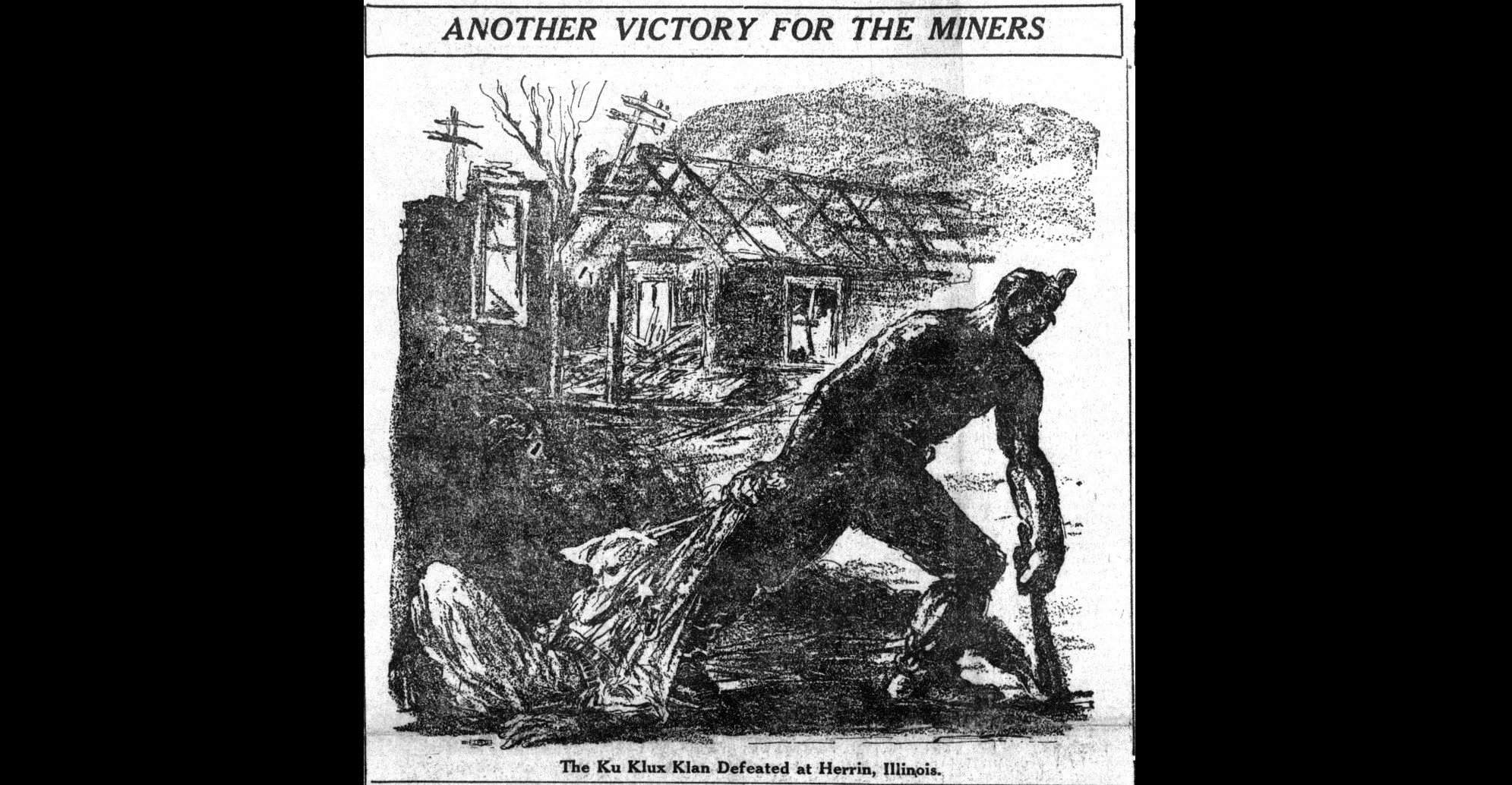
Nowhere has the Klan’s role as an anti-union terrorist organization been more obvious and pronounced than in Southern Illinois. On January 24, 1925 two mortal class enemies representing the warring sides in Southern Illinois’ coal region met on the street in a gun battle that took both their lives. Murderous anti-union Klan leader Glenn Young was felled by heroic miner and union-baked sheriff, Ora Thomas. It was not the first time the two had battled, and was part of a long, roiling civil war in the area as the coal operators and their Klan thugs waged a campaign of terror against largely foreign-born miners in revenge for the devastating defeat they inflicted on imported scabs and their armed escort during a 1922 strike. Since then the Klan sought to beat the union miners into submission, including infiltrating the U.M.W.A. itself. A long war waged for almost two decades resulting in incalculable death and injury, with the miners finally getting the best of the Klan. Thurber Lewis with an extremely informative lay of the land in the immediate aftermath of Young and Thomas’s deaths.
‘Illinois Klan War Heritage of Miners’ Strike’ by Thurber Lewis from The Daily Worker. Vol. 2 No. 37 &2 9. February 7 & 10, 1925.
‘Miners’ Union Foes at Trial all Klansman’ February 7, 1925.
Ora Thomas Led Attack on Strikebreakers
HERRIN, III, Feb. 6. There is more to the fight in Williamson County than mere Klan and anti-Klan. Superficially observed, the fight takes on the aspect of a feud between two rival groups of people. Of course, there are rival groups. There wouldn’t be fight here if there were not. But these groups represent forces. The dry raids, burning of gambling housed and the numerous shootings constitute only half of the story. The Ku Klux Klan and the frequent gun play here in Williamson County are but the outer expression of the real forces at work. The Ku Klux Klan is organised to “enforce the law” in Williamson County. But why must it be Williamson County? It is no more “wide open in the matter of booze and vice than any other county in “Egypt” (the same applied to southern Illinois in these parts). All the counties round about Williamson are “wide open” coal districts with mixed American, southern and European stock similar to that in Williamson. And of all the in Williamson County why must the fight center around Herrin?
Glenn Had Plenty of Money.
Williamson county is 100 per cent organized so far as labor is concerned. Outside Herrin on June 21, 1923, there were over a score of scabs and gunmen killed when they attempted to open and run the Lester strip min during the strike of 1922, and murdered two strikers.
A number of union miners were arrested and charged with the killings. Thousands of dollars were spent by the chamber of commerce and other anti-labor forces in an attempt to railroad these miners to execution. It failed. No one was convicted. The matter was dropped so far as the county concerned. Most of the county officials, notably the state’s attorney, were sympathetic to the miners. Apparently the affair was, so far as the most of the population is Williamson County were concerned, a closed matter.
S. Glenn Young came to town. He was well supplied with money. He said he had “cleaned up” Breathitt County. Kentucky, also known as “Bloody Breathitt, and that he intended to clean up Williamson. He found supporters. Bankrupt business men, adventurous minded lads of nineteen or twenty years, farmers, most of whom around here are enemies of the miners and even a number of deluded miners rallied to the Klan banner that Young raised. In addition, he had about twenty shady characters, mostly outsiders, acting as his constant bodyguard and apparently paid by Young since they did nothing else.
Raiding Miners Homes.
Home after home was raided. Miners were dragged out of their beds and taken to jail on charges of moon shining. No one was safe. No one know who the next victim would be.
Most of the homes raided were those of foreign-born miners who are to the habit of making up a few gallons of wise a year for home consumption. Opposition to the Klan grew. The opposition found leaders. Ore Thomas deputy sheriff was one. There were shooting frays. Seven Klansmen and six anti-Klansman were killed. The county was terror-stricken.
Glenn Young and Ora Thomas were killed on January 24, in a gun battle to Herrin. Sheriff Galligan asked for state troops. He was denied them. With the exception of the sheriffs office, most of the rest of the officials in Williamson County are Klansmen. The board of supervisors are trying to force Gallagan out. He is an old time enemy of the Klan. He has a good record and is still a member of the U.M.W. of A. That is the story the world knows. But that is only half the story. That story does not answer the question: “Why should the scene of the Herrin mine riots also be the scene of Glens Young’s Klan activities
Young A Mine Scab
John Frothingham and Harry Storer, both gunmen, are in Chester, Illinois penitentiary for robbing a bank in Brownsville, Pope County. At the time of the robbery they were living Herrin and acting as part of Glens Young’s bodyguard. Before reliable persons they stated that on many occasions Glenn Young told an anecdote of the Lester mine trouble. Young, the two said, claimed to have been one of the gunmen in the Lester mine and boasted that be crawled out and escaped the night before the battle.
Delos Duty, state’s attorney for Williams County, in the trials following the Lester mise affair, told the DAILY WORKER yesterday, “I have it on good authority that Young was one of the mined guards brought down to run the Lester mine by the Hargrave Detective Agency of Chicago” Officials of sub-district of the United Mine Workers told the reporter in Herrin that they have substantial reason to state that Glen Young was a strikebreaker during the railroad’s shopmen’s of 1922.
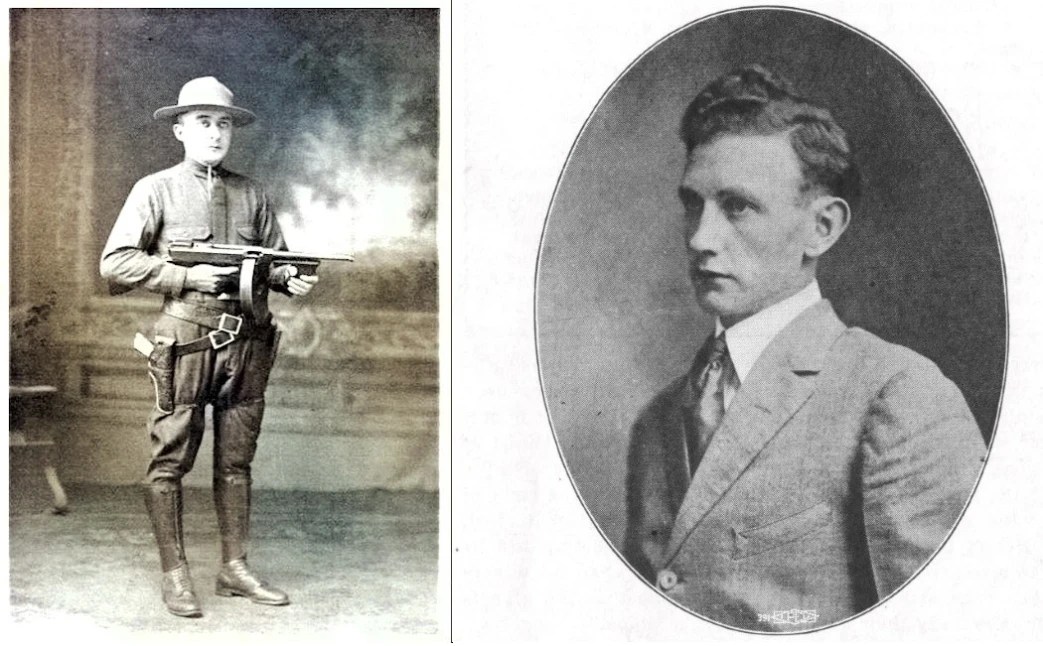
Several miners who were interviewed, expressed the opinion that Young’s aids on miners’ homes were evidence to reopen the episode of Lester mine in the courts. The searchers, the miners said were intended to reveal plants of machine guns, rifles, etc.
To Avenge McDowell.
An avowed Klansman told the reporter in loud voice. “There are a lot of machine guns in Williamson County and some of them aren’t found yet.” A former employe at the Herrin City hall, a girl, said she overheard Young say on one occasion, “I don’t give a damn about the bootleggers: I am here to make someone pay for McDowell’s death.” “Peggy” McDowell was the superintendent of the Lester mine who was killed in the attack of June, 1922.
Otis Clark, a miner, one of the defendants in the mine riot trial, was taken by Young in a raid last year. Young told him to pray, that his days were numbered and made reference to the Lester mine shooting.
Bob Greer’s testimony in the mine riot trials was the most prejudiced and damaging of all witnesses for the prosecution. He is known to be a Klan leader and was very active as one of Young’s Lieutenants in his raids.
Banker Supported Klan.
Earl Jackson of the State Bank in Marion, loaned Lester, owner of the Lester mine, ten thousand dollars for promotion purposes, prior to the Lester mine affair. He is a vigorous supporter of the Klan. A.B. McClaren, a prominent businessman, who was active in the prosecution of the miners during the trial, contributes ten times as much as any many in the county to the Klan, according to Klan members. All the men who were actively engaged in trying to get convictions during the riot trials, many of them former Lester mine promoters are loyal supporters of the Klan.
Ora Thomas, who was killed by Young supporters on January 24, had been a notable and influential member of the Miners’ Union in Williamson County for many years. He had lived in Williamson County all his life and joined the union when he was sixteen years of age. He was one of the leaders of the attack on the mine and is said to have been the one who rode the observation plane over Lester mine to direct the attack. He was an investigator for the defense during the trials. Mrs. Thomas, his widow, told the DAILY WORKER that on Dec. 33, of last year, her husband received an unsigned Christmas card on which was drawn a Ku Klux Klan emblem. The card said, “Remember June 21, 1922” That was the day of the Lester mine shooting. Mrs. Thomas said the attack of January 24, of last year was but one of many attempts on the part of Young and his followers to “gang” her husband.
A former Klan member, a miner who left the Klan when he found out Young’s real business, told Mrs. Thomas that Glenn Young was sent to Herrin and paid by the chamber of commerce and the manufacturers’ association.
E.L. Stanford, editor of the Herrin News, told the DAILY WORKER he had followed Young’s raids closely and that he found most of them were directed against the houses of foreign-born miners. When the reporter called today on John L. Whiteside, garage owner, on whose shoulders Young’s Klan mantle has fallen, he refused to say anything for publication. He did, however, agree to give me an application card for the Klan. One of the many tenets printed on the card reads: “Preventing unwarranted strikes by foreign labor agitators.”
II. Herrin War Heritage of Mine Fight. February 10.
Young Led Kluxers for Coal Bosses
It is very hard to get people to talk in Williamson County. Very few people care to express an opinion. But a very reliable person unlikely to be prejudiced, said there was a good ground for the DAILY WORKER’S belief there is a very concise connection between the recent Klan trouble and the Lester mine affray of 1922.
A prominent lawyer in Marion who did not wish to be quoted told the DAILY WORKER “Glenn Young certainly must have had powerful forces behind him. He always had plenty of money. He drove around in the best car in the county. He had a paid bodyguard of some twenty men with him all the time. He made trips to all parts of the country. It is my belief this whole movement is an attempt to break up the labor unions in Williamson County.”
Says Union Leaders Scared.
Another prominent person in Williamson who did not want his name used for obvious reasons, said in answer to a question by the reporter regarding the attitude of the officials of the Miners’ Union, “The reason they don’t do anything about this obvious attack on organized labor in Illinois is because they are either jelly-fish or pussy-footers. Some of the officials are just plain scared and others of them are in politics and looking for jobs.”
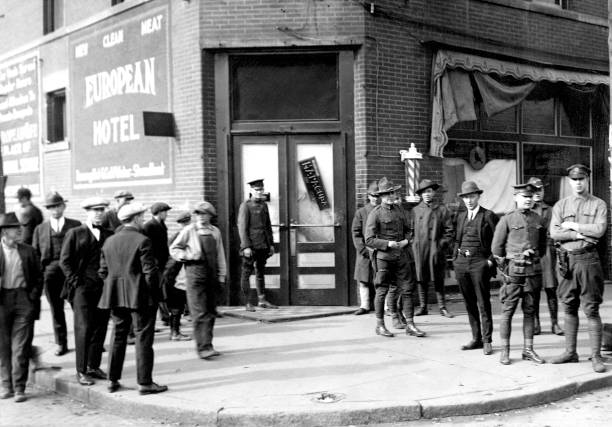
Phase of Class Struggle.
Taken by and large, the Klan and counter-Klan fight in Williamson County can be said to be merely a phase of the class struggle. Without question, Glenn Young represented interests who were chaffing under the strain caused by the solid organization of the southern Illinois miners.
Even the mine union officials, referred to above, who talked with the utmost caution, said there was ground to believe an under current of wage cut propaganda is at work here. They wouldn’t talk about the Klan. They merely said that miners who are members of the Klan are expelled as soon as their membership comes to light.
They make no effort to find out who are members and who are not and they haven’t, they said, taken any official position regarding the Klan. Different sources that the DAILY WORKER came in contact with alleged that even some of the officials were members of the Klan.
Precisely what particular interests sent Young to Herrin cannot be proven. But Young was obviously posing when he said he came to clean up the county. The mere fact that his immediate following was composed for the most part, of thugs and old-time boozers makes his expressed intentions ridiculous. And more than one miner’s wife was known to have complained about the “good stuff” her husband got in Glenn Young’s “soft drink” parlor on W. Madison Street, Herrin.
God’s Army With Young.
Whoever sent him to Herrin sent him to make trouble. He made plenty. He got the whole riff-raff of the county behind him. And in addition he got the preachers. With the exception of one or two and the catholic priest, every man of god in town was preaching Klanisn from his pulpit and making a hero of Glenn Young. Under Young’s leadership the Klan maneuvered into every office in the county except the sheriff’s. They are trying to get that now. If they do, there is no telling what will happen to the United Mine Workers.
While the most of the miners and especially the foreign-born miner are belligerent enough against the Klan in Williamson County, they have no leadership. Their own officials ore either Klansmen or spineless. With Ora Thomas gone and the sheriff going, the miners are on the way to being made the victims of whole sale campaigns by Klansmen in complete control of the county.
In a conversation with some minors in West Frankfort, in Franklin County next to Williamson, the DAILY WORKER was told; “Anytime the men in Herrin need any help, we’re all ready.” One prominent miner in West Frankfort said, “If Sheriff Gallagan would send out a call tomorrow he could got six thousand men from this county to go in there and help him.”
Young’s Successor.
The killing of Glenn Young and Ora Thomas by no means Bottles the issue in Williamson County. Things are likely, If anything, to be far worse than before. John L. Whiteside, the new Klan leader, told the reporter as he sat at his desk in his garage office, “Just because Glenn’s gone, don’t matter.” He was playing with a big colt automatic and was surrounded by a half dozen not so nice looking characters who smirked when he said it.
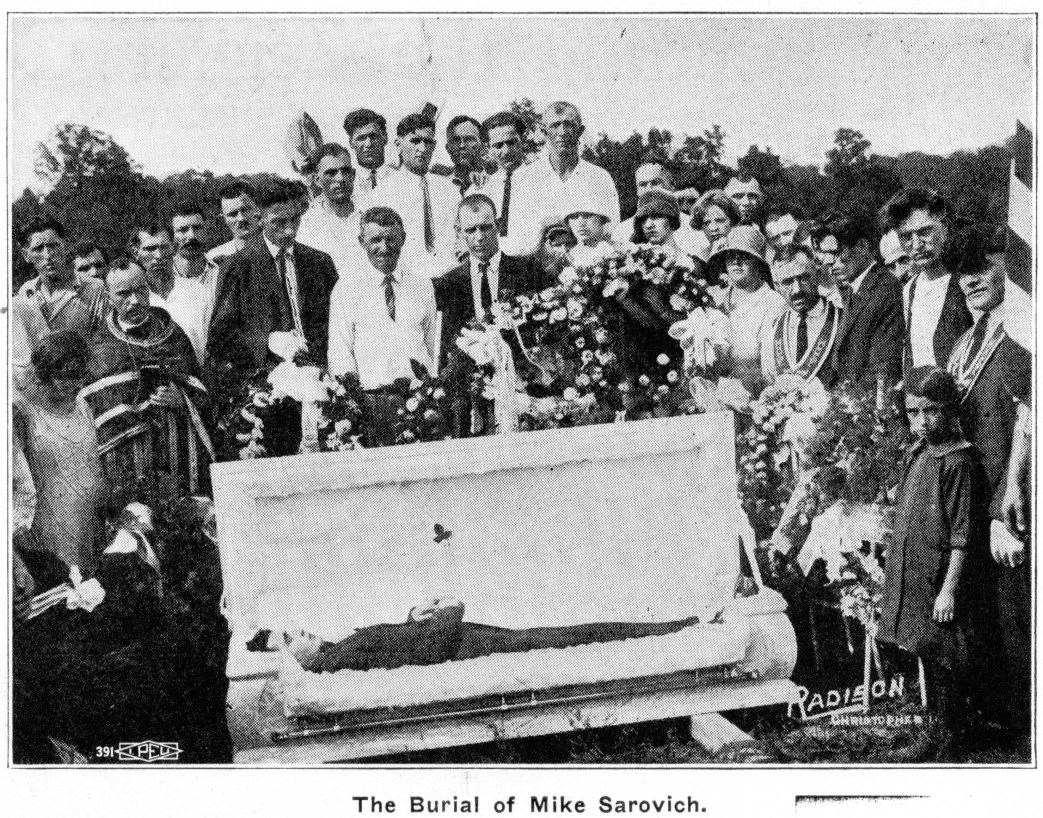
The fact that Governor Small was supported by the Klan in Williamson County and that many reputable people here say with assurance that Adjutant General Black is a Klansman, would indicate the reason why troops have not been sent here. It appearsthe state administration is perfectly willing to let the Klan run the county. The last reports from Springfield state that Sheriff Gallagan has agreed to leave the state. Gallagan is in conference with the governor and a committee of Klansmen sent by the county board of supervisors, all of whom but one, is a Klansman. Gallagan has agreed to let Deputy Sheriff Parks take over his office. But when I saw Parks this afternoon, he said he would not under any circumstances take the post of acting sheriff.
Miners Quitting Klan.
Many miners haye recently quit, the Klan. They are beginning to get their eyes open. There are very few miners in the Klan now, although at first a great many flocked in. If any leaders spring up there are some terrible battles in store for Williamson. The miners are being hard hit in more ways than one. Most of the mines are not working in southern Illinois. The reason is that coal orders are being concentrated in the non-union fields of Kentucky and elsewhere. Three more mines have shut down in the past few days. If this condition keeps up and it is further aggravated by outside support to the anti-labor Klan forces, as will probably be the case, the Lester mine massacre will be a skirmish compared to the battles that will follow on such conditions.
PDF of full issue: The Daily Worker began in 1924 and was published in New York City by the Communist Party US and its predecessor organizations. Among the most long-lasting and important left publications in US history, it had a circulation of 35,000 at its peak. The Daily Worker came from The Ohio Socialist, published by the Left Wing-dominated Socialist Party of Ohio in Cleveland from 1917 to November 1919, when it became became The Toiler, paper of the Communist Labor Party. In December 1921 the above-ground Workers Party of America merged the Toiler with the paper Workers Council to found The Worker, which became The Daily Worker beginning January 13, 1924.
PDF of full issue: https://www.marxists.org/history/usa/pubs/dailyworker/1925/1925-ny/v02b-n023-NYE-feb-07-1925-DW-LOC.pdf
 Revolution's Newsstand