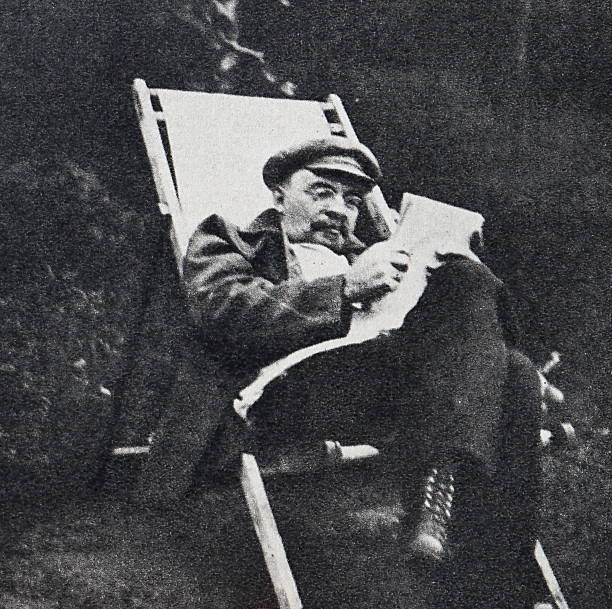
Lenin’s last fight. After his second major stroke in December, 1922, Lenin went to Gorky to convalesce. Realizing his precarious health and confronting his morality, while increasingly concerned about the vast challenges faced by the Party and Revolution. The resolution, or lack of, for those problems would have deep, long, and potentially destructive consequence for the future of the Soviet experiment. In the last weeks of December, 1922 and the first weeks of January, 1923 Lenin, a transcriber required due to his stroke, wrote several memos of opinion and advice, rather than direction address to the Party leadership. By March, 1923 Lenin was almost completely incapacitated, and unable to verbally communicate. That is the context in which these articles are referred to as his ‘Testament.’ The four main topics covered were State Panning, The Question of Nationalities or “Autonomisation,” a ‘Better Fewer, But Better’ attack the growing bureaucracy. The most important and controversial was his warning over the divisions among the Bolsheviks central leadership, particularly between Stalin and Trotsky, along with the strengths and weakness of other C.C. members. Far too democratic to even contemplate naming or promoting a successor to his positions, Lenin limited himself to a direct and honest estimation of leading figures. A famous postscript forcefully demanded Stalin’s removal from his General Secretary position, creating a crisis within the leadership. Krupskaya insisted the letter be presented to the Party Conference, with a compromise that the ‘Testament’ would be read aloud, with no notes allowed, and only to a select body of Bolshevik ‘elders,’ which included Stalin. It was not until the 20th Congress in the 1950s that the letter was made fully public. The full ‘Testament’ below, with the other memos to follow.
‘Lenin’s Testament’ from The Suppressed Testament of Lenin. Pioneer Publishers, New York. 1934.
By the stability of the Central Committee, of which I spoke before, I mean measures to prevent a split, so far as such measures can be taken. For, of course, the White Guard in Russkaya Mysl (I think it was S.E. Oldenburg) was right when, in the first place, in his play against Soviet Russia he banked on the hope of a split in our party, and when, in the second place, he banked for that split on serious disagreements in our party. Our party rests upon two classes, and for that reason its instability is possible, and if there cannot exist an agreement between such classes its fall is inevitable. In such an event it would be useless to take any measures or in general to discuss the stability of our Central Committee. In such an event no measures would prove capable of preventing a split. But I trust that is too remote a future, and too improbable an event, to talk about. I have in mind stability as a guarantee against a split in the near future, and I intend to examine here a series of considerations of a purely personal character. I think that the fundamental factor in the matter of stability–from this point of view–as such members of the Central Committee as Stalin and Trotsky. The relation be- tween them constitutes, in my opinion, a big half of the danger of that split, which might be avoided, and the avoidance of which might be promoted in my opinion by raising the number of members of the Central Committee to fifty or one hundred. Comrade Stalin, having become General Secretary, has concentrated an enormous power in his hands; and I am not sure that he always knows how to use that power with sufficient caution. On the other hand, comrade Trotsky, as was proved by his struggle against the Central Committee in connection with the question of the People’s Commissariat of Ways and Communications, is distinguished not only by his exceptional ability—personally, he is, to be sure, the most able man in the present Central Committee–but also by his too far-reaching self-confidence and a disposition to be far too much attracted by the purely administrative side of affairs. These two qualities of the two most able leaders of the present Central Committee might, quite innocently, lead to a split, and if our party does not take measures to prevent it, a split might arise unexpectedly. I will not further characterize the other members of the Central Committee as to their personal qualities. I will only remind you that the October episode of Zinoviev and Kamenev was not, of course, accidental, but that it ought as little to be used against them as the non-Bolshevism of Trotsky. Of the younger members of the Central Committee, I want to say a few words about Piatakov and Bukharin. They are, in my opinion, the most able forces (among the youngest) and in regard to them it is necessary to bear in mind the following: Bukharin is not only the most valuable and biggest theoretician of the party, but also may legitimately be considered the favorite of the whole party; but his theoretical views can only with the very greatest doubt be regarded as fully Marxian, for there is something scholastic in him (he never has learned, and I think never fully understood the dialectic). And then Piatakov a man undoubtedly distinguished in will and ability, but too much given over to the administrative side of things to be relied on in a serious political question. Of course, both these remarks are made by me merely with a view of the present time, or supposing that these two able and loyal workers may not find an occasion to supplement their onesidedness.
December 25, 1922 Postscript:
Stalin is too rude, and this fault, entirely supportable in relations among us communists, becomes unsupportable in the office of General Secretary. Therefore, I propose to the comrades to find a way to remove Stalin from that position and appoint another man who in all respects differs from Stalin only in superiority—namely, more patient, more loyal, more polite and more attentive to comrades, less capricious, etc. This circumstances may seem an insignificant trifle, but I think that from the point of view of preventing a split and from the point of view of the relation between Stalin and Trotsky which I discussed above, it is not a trifle, or it is such a trifle as may acquire a decisive significance.
January 4, 1923. LENIN
Pioneer Publishers was the publishing house established by the Communist League of America (Opposition) in 1930. It later served the Socialist Workers Party and was superseded by Merit Publishers in 1965, and later by Pathfinder Press in 1969.
The Suppressed Testament of Lenin with Leon Trotsky. Pioneer Publishers, New York.
PDF of original pamphlet: https://digitalcollections.lib.uh.edu/downloads/dr26xz63p?locale=en
 Revolution's Newsstand