
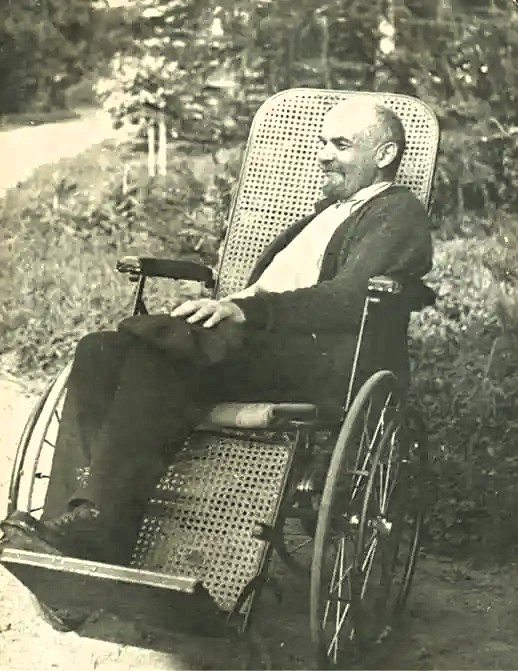
Lenin’s final article, and often grouped with his so-called ‘Testament.’ The contents, and not that anecdote, make it among Lenin’s most important post-Revolution writings. Following his December, 1922 stroke, the reality of incapacity and possibility of death, Lenin, through a transcriber wrote several memos of opinion and advice addressed to Party and the broader Soviet public. There is an urgency in the articles, and one not just based on Lenin’s declining health, but on his increasing concerns of the institutions, and by extension, the direction of the Revolution. With four key issues focusing his attention in those final essay; the toxic divisions within the Party’s leadership; efficiency and cohesion in State Panning; the question of relations among Soviet nations where Lenin continued to oppose Stalin’s position and defend a greater federalism, and finally ‘Better Fewer, But Better,’ by far the longest, below. In Lenin’s last article he addresses the need for raising cultural and educational levels, abandon routinism and foster initiatives to facilitate Socialist transformation; after the failure of the European revolutions an essential shift to the East to challenge imperialism and create a revolutionary respite for isolated Russia; most of article is an appeal for the smallest possible Soviet state apparatus and fight against bureaucracy, castigating the Workers’ and Peasants’ Inspection, an agency headed by Stalin, for failure to stop, and even action facilitation of a growing bureaucracy. Though not named, there was no doubt as to whom Lenin was referring, which may account for the article, written on February 10, 1923, not published in Pravda for another month. An essential work by Lenin in tracing his changing positions in response to a changing reality.
‘Better Fewer, But Better’ (1923) by Vladimir Ilyich Lenin from Selected Works, Vol. 9. International Publishers, new York, 1937.
On the question of improving our state apparatus the Workers’ and Peasants’ Inspection should not, in my opinion, strive after quantity, and should not hurry. Up to now we have been able to devote so little attention to the quality of our state apparatus that it would be quite legitimate to display special concern for its organisaton and to concentrate in the Workers’ and Peasants’ Inspection human material of real modern quality, i.e., quality not inferior to the best West European models. For a Socialist republic this condition is too modest, of course; but the first five years have fairly crammed our heads with disbelief and scepticism. Involuntarily, we are inclined to display these latter qualities towards those who talk very fine and large about “proletarian” culture, for example. For a start we would be satisfied with real bourgeois culture, for a start we would be satisfied to be able to dispense with the particularly crude types of pre-bourgeois culture, i.e., bureaucratic or serf culture, etc. In matters of culture haste and bustle are the worst possible things. Many of our young writers and Communists should get this well into their heads.
Thus, on the question of the state apparatus we should now draw the conclusion from our past experience that it would be better to go more slowly.
The situation in regard to our state apparatus is so deplorable, not to say outrageous, that we must first of all think very carefully how to eliminate its defects, bearing in mind that the roots of these defects lie in the past, which, although it has been overturned, has not yet been overcome, has not yet passed into a culture of the remote past. I raise the question of culture because in these matters we can regard as achievements only what has been assimilated in culture, in social life, in custom. We can say that what is good in the social system in our country is not thought out, not grasped, not appreciated, hastily clutched at, untested, not tried by experience, not fixed, etc. Of course, it could not be otherwise in a revolutionary epoch, when development proceeded at such breakneck speed that we passed from tsarism to the Soviet system in five years.
We must come to our senses in time. We must become highly sceptical of too rapid progress, of boastfulness, etc. We must think of testing the steps forward which we proclaim to the world every hour, which we take every minute, and which later prove to be flimsy, superficial and not understood every second. The worst thing of all would be haste. The worst thing of all would be to rely on the assumption that we know anything, or on the assumption that we possess any considerable quantity of the elements necessary for building a really new apparatus that would really deserve the name of Socialist, Soviet, etc.
No, we have no such apparatus, and even the quantity of elements of it that we have is ridiculously small; and we must remember that we must not stint time on building this apparatus, that many, many years will be required for it.
What elements have we for building this apparatus? Only two. First, the workers who are absorbed in the struggle for Socialism. These elements are not sufficiently educated. They would like to build a better apparatus for us, but they do not know how to do it. They cannot do it. They have not yet developed the culture that is required for this; and it is precisely culture that is required for this. Here nothing will be achieved by doing things in a tush, by assault, by smartness, or energy, or by any other of the best human qualities in general. Secondly, we have the clement of knowledge, education and training, but to a degree that is ridiculously small compared with all other countries.
Here, too, we must not forget that we are too prone to compensate (or imagine that we can compensate) our lack of knowledge by zeal, doing things in a rush, etc.
In order to rebuild our state apparatus we must at all cost set ourselves the task, first, of learning, second, of learning, and third, of learning, and then of testing what we have learnt so that it shall not remain a dead letter, or a fashionable phrase (and, it is no use concealing it, this often happens among us), so that what we have learnt may become part of our very beings, so that it may actually and fully become a constituent element of our social life. In short, we must not put the demands that are put by the bourgeoisie of Western Europe, but such as are worthy and proper to put to a country which has set itself the task of developing into a Socialist country.
The conclusions to be drawn from the above are the following: we must make the Workers’ and Peasants’ Inspection, which is the instrument for improving our apparatus, a really exemplary institution.
In order that it may achieve the necessary level we must follow the rule: “Measure your cloth seven times before you cut.”
For this purpose, the very best of what there is in our social system must be utilised with the greatest caution, thoughtfulness and knowledge in building up the new Commissariat.
For this purpose, the best elements in our social system, such as firstly the advanced workers, and secondly the really enlightened elements, for whom we can vouch that they will not take the word for the deed, and will not utter a single word that goes against their conscience, must not shrink before any difficulties, must not shrink from any struggle, in order to achieve the object they have seriously set themselves.
We have been bustling for five years trying to improve our state apparatus, but it was mere bustle, which during the five years only proved that it was useless, or even futile, or even harmful. This bustle created the impression that we were working; as a matter of fact, it only clogged up our institutions and our brains.
It is time things were changed.
We must follow the rule: “A smaller number, but better quality.” We must follow the rule: “It is better to get good human material in two years, or even in three years, than to work in haste without hope of getting any at all.”
I know that it will be hard to follow this rule and apply it to our conditions, I know that the opposite rule will force its way through a thousand loopholes. I know that enormous resistance will have to be offered, that devilish persistence will have to be displayed, that in the first year, at least, the work in this connection will be hellishly hard. Nevertheless, I am convinced that only by such work shall we be able to achieve our aim, and that only by achieving this aim shall we create a republic that is really worthy of the name of Soviet, Socialist, etc.
Probably many readers have thought the figures I gave as an example in my first article! to be too small. I am sure that many calculations may be made to prove that they are too small. But I think that we must put one thing above all such and other calculations, viz., the interests of real exemplary quality.
I think that for our state apparatus the time has at last come when we must work on it properly, with all seriousness, and when one of the worst features of this work will be haste. That is why I would utter a strong warning against increasing these figures. On the contrary, in my opinion we must be parsimonious with figures. Let us say frankly that the People’s Commissariat for Workers’ and Peasants’ Inspection does not enjoy a shadow of authority. Everybody knows that a more badly organised institution than our Workers’ and Peasants’ Inspection does not exist, and that under present conditions nothing can be expected from this Commissariat. We must have this firmly fixed in our minds if we really want to take up the task of creating within a few years an institution that will, firstly, be an exemplary institution, and, secondly, win everybody’s absolute confidence, and, thirdly, prove to all and sundry that we have really justified the work of such a high institution as the Central Control Commission. In my opinion, we must utterly and irrevocably reject all general standards for size of staffs. We must make a particularly careful selection of the employees of the Workers’ and Peasants’ Inspection and put them to the strictest test. Indeed, what is the use of establishing a People’s Commissariat in which the work is carried on anyhow, which does not enjoy the slightest confidence, and whose word enjoys infinitely small authority? I think that our principal task is to avoid this in the work of reconstruction that we now have in mind.
The workers whom we are enlisting as members of the Central Control Commission must be irreproachable Communists, and I think that a great deal has yet to be done to teach them the methods and objects of their work. Furthermore, to assist in this work there must be a definite number of secretaries, who must be put to a treble test before they are allowed to assume their functions. Finally, the officials whom in exceptional cases we shall accept as employees of the Workers’ and Peasants’ Inspection must conform to the following requirements.
First, they must be recommended by several Communists.
Second, they must pass an examination in knowledge of our state apparatus.
Third, they must pass an examination in knowledge of the principles of the theory of our state apparatus, of the principles of the science of administration, of office routine, etc.
Fourth, they must work in such close harmony with the members of the Central Control Commission and their own Secretariat that we can vouch for the work of the whole of this apparatus.
I know that these requirements will call for extraordinarily great efforts, and I am afraid that the majority of the “practical” workers in the Workers’ and Peasants’ Inspection will say that they are impossible, or will treat them with contempt. But I ask any one of the present leaders of the Workers’ and Peasants’ Inspection, or anyone who has any connection with it: Can he conscientiously tell me what are the requirements for a People’s Commissariat like the Workers’ and Peasants’ Inspection? I think the question will help him to acquire a sense of proportion. Either it is not worthwhile undertaking another of the numerous reorganizations that we have had, and therefore we must give up the Workers’ and Peasants’ Inspection as hopeless, or we really set to work, by slow, difficult and unusual methods, and testing these methods over and over again, to create something really exemplary, which will win the respect of all and sundry for its merits, and not only because rank and calling demand it.
If we cannot arm ourselves with patience, if we are not prepared to spend several years on this task, we had better not start on it.
In my opinion we ought to select the smallest possible number of the higher institutes of labour, etc,. which we have baked so hastily, see whether they are organised properly, and allow them to continue to function only if they maintain the high level of modern science and give us all its guarantees. If we do that it will not be utopian to hope that within a few years we shall have an institution that will be able to do its work, viz., work systematically and steadily to improve our state apparatus, enjoying the confidence of the working class, of the Russian Communist Party, and of the whole mass of the population of our republic.
The preparatory work for this can be started at once. If the People’s Commissariat for Workers’ and Peasants’ Inspection accepted the present plan of reorganisation it could take the preparatory steps at once and then work systematically until the task is completed, without haste, and not hesitating to alter what has been done if that is necessary.
Any half-hearted solution would be extremely harmful in this case. In essence, any standard of size of staff for the Workers’ and Peasants’ Inspection that is based on any other consideration would in fact be based on the old bureaucratic considerations, on old prejudices, on what is already condemned, what is universally ridiculed, etc.
In essence, the question stands as follows.
Either we prove now that we have learnt something about state construction (we ought to have learnt something in five years), or we prove that we have not matured for that sufficiently. If the latter is the case, it is not worth while starting on the task.
I think that with the human material we have at our disposal it will not be immodest to assume that we have learnt enough to be able systematically to rebuild at least one People’s Commissariat. True, this People’s Commissariat will have to be the model for our state apparatus as a whole.
Announce at once a competition for compiling two or more textbooks on the organisation of labour in general, and of the work of administration in particular. We can take as a basis the book already published by Yermansky, although it should be said in parenthesis that he obviously sympathises with Menshevism and is unfitted to compile suitable textbooks for the Soviet government. We can also take as a basis the book by Kerzhentsev; and some of the other textbooks available may be useful.
Send several trained and conscientious persons to Germany, or to England, to collect literature and to study this question. I mention England in case it is found impossible to send people to America or Canada.
Appoint a commission to draw up the preliminary programme of examinations for candidates for employment in the Workers’ and Peasant’s Inspection; ditto for candidates for the Central Control Commission.
These and similar measures will not cause any difficulty for the People’s Commissar for Workers’ and Peasants’ Inspection, or his Collegium, or the presidium of the Central Control Commission.
Simultaneously, a preparatory commission should be appointed to select candidates for the Central Control Commission. I hope that we shall now be able to find more than enough candidates for this post among the experienced workers in all departments, as well as among the students of our Soviet universities. It would hardly be right to exclude either of these categories beforehand. Probably preference will have to be given to a mixed composition of this institution, which shall combine many qualities, shall combine various merits. Consequently, the task of drawing up the list of candidates will entail a considerable amount of work. For example, it would be least of all desirable for the new People’s Commissariat to be made up of people of one type, say, of people of the type of officials, or if it did not include people of the type of agitators, or people whose principal trait is sociability, or the ability to penetrate into circles into which this type of worker is usually unable to penetrate, etc.
I think I shall be able to express my idea best if I compare my plan with an academic type of institution. Under the guidance of their presidium, the members of the Central Control Commission should systematically examine all the papers and documents of the Political Bureau, At the same time they must properly divide their time on various jobs of investigating the routine in our institutions, from the very small and private to the highest state institutions. And finally, their work will include the study of theory, i.e., the theory of organisation of the work they intend to devote themselves to, and practical work under the guidance either of older comrades or of teachers in the higher institutes for the organisation of labour.
I do not think, however, that it will be possible to confine oneself to this sort of academic work. In addition, it will be necessary to prepare for work which I would not hesitate to call training to catch—I will not say rogues, but something like that, and inventing special devices to deaden one’s footsteps, conceal one’s approach, etc.
If such proposals were made in West European institutions they would rouse frightful resentment, a sense of moral indignation, etc.; but I hope that we have not become so bureaucratised as to be capable of that. The N.E.P. has not yet succeeded in winning such respect as to cause one to be offended at the thought that someone may be caught. Our Soviet Republic is of such recent construction, and there are such heaps of lumber lying around, that it would hardly occur to anyone to be offended at the thought that these piles may be delved into by means of cunning devices, by means of investigation sometimes directed to rather remote sources, or by devious routes. And even if it did occur to anyone to be offended by this we may be sure that such a person would become a laughing-stock.
Let us hope that our Workers’ and Peasants’ Inspection will not suffer from what the French call pruderie, which we can call ridiculous primness, or ridiculous swank, and which plays entirely into the hands of our Soviet and Party bureaucracy. Let it be said in parenthesis that we have bureaucrats, not only in the Soviet institutions, but also in the Party institutions.
When I said above that we must study and study hard in the higher institutes for the organisation of labour, etc., I did not mean to imply “studying” in the schoolroom way, or that I confined myself to the idea of studying only in the schoolroom way. T hope that not a single genuine revolutionary will suspect me of refusing, in this case, to understand “studies” to mean resorting to some semi-humorous trick, some cunning device, some piece of trickery, or something of that sort. I know that in the staid and serious states of Western Europe such an idea would horrify people and that not a single decent official would even entertain it. I hope, however, that we have not yet become sufficiently bureaucratic to be affected in the same way, and that the discussion of this idea will only give rise to amusement among us.
Indeed, why not combine what is pleasant with what is useful? Why not resort to some humorous or semi-humorous trick to expose something ridiculous, something harmful, something semi ridiculous and semi-harmful, etc.?
I think our Workers’ and Peasants’ Inspection will gain a great deal if it takes these arguments into consideration, and that the list of devices by which our Central Control Commission and its Collegium in the Workers’ and Peasants’ Inspection achieved several of their most brilliant victories will be enriched by not a few exploits of our “W.P.I.-ists” and “C.C.C.-ists” in places unmentionable in prim and respectable textbooks.
* * *
How can a Party institution be amalgamated with a Soviet institution? Is there not something improper in this suggestion?
I do not ask these questions on my own behalf, but on behalf of those I hinted at above when I said that we have bureaucrats not only in the Soviet institutions, but also in our Party institutions.
But why, indeed, should we not amalgamate the two if it is in the interests of our work? Have we not all observed that amalgamation of this sort has been very useful in the Commissariat for Foreign Affairs, and that it has been practised there from the very beginning? Have we not on the Political Bureau discussed from the Party point of view many questions, both minor and important, concerning the “moves” we should make in reply to the “moves” of foreign powers in order to forestall their, say, cunning, if we are not to use a less respectable term? Is not this flexible amalgamation of a Soviet institution with a Party institution a source of great strength in our politics? I think that what has proved its usefulness, what has been definitely adopted in our foreign politics, and has become so customary that it no longer calls forth any doubt in this field, will be at least as appropriate (I think it will be much more appropriate) for the whole of our state apparatus. And the Workers’ and Peasants’ Inspection deals with the whole of our state apparatus, and its activities should affect all and every state institution without exception: local, central, commercial, purely official, educational, archive, theatrical, etc.—in short, all without the slightest exception.
Why then should not an institution whose activities are so wide, and moreover require such extraordinary flexibility of form, be permitted to adopt this peculiar amalgamation of a Party control institution with a Soviet control institution?
I see no obstacles to this. More than that, I think that such an amalgamation is the only guarantee of success in our work. T think that all doubts on this score arise only in the dustiest corners of our state apparatus, and that the only answer they deserve is ridicule.
* * *
Another doubt: is it expedient to combine educational activities with official activities? I think that it is not only expedient, but necessary, Generally speaking, in spite of our revolutionary attitude towards the West European form of state, we have allowed ourselves to become infected with a number of its most harmful and ridiculous prejudices; to some extent we have been deliberately infected with them by our dear bureaucrats, who deliberately calculated on being able to fish in the turbid waters of these prejudices. And they fished in these turbid waters so persistently that only the blind can fail to see how extensively this fishing has been carried on.
In all spheres of social, economic and political relationships we are “frightfully” revolutionary. But in the sphere of precedence, in the observation of the forms and rites of office routine, our “revolutionariness” very often yields to the mustiest routine. Here on more than one occasion we have witnessed the very interesting phenomenon of a great leap forward in social life being accompanied with monstrous hesitancy in the face of the smallest changes.
This is natural, for the boldest steps forward were taken in the sphere that has for long been the field of theory, which has been cultivated mainly, and even almost exclusively, theoretically. The Russian found consolation for the bleak bureaucratic realities at home in unusually bold theoretical constructions, and that is why these unusually bold theoretical constructions assumed an unusually one-sided character among us. Among us, theoretical audacity in general constructions lived side by side with astonishing timidity in regard to some very minor reform in office routine. A great universal agrarian revolution was worked out with an audacity unprecedented in any other country, and at the same time, the imagination was lacking to work out a tenth-rate reform in office routine; the imagination, or patience, was lacking to apply to this reform the general propositions that produced such “brilliant” results when applied to general problems.
That is why our social life combines within itself an astonishing degree of fearless audacity and mental timidity in the face of very minor changes.
I think that things were no different in any really great revolution, for really great revolutions grow out of the contradictions between the old, between what is directed towards analysing the old, and the abstract striving for the new, which must be so new that not a particle of the old remains.
And the more abrupt the revolution is, the longer will a number of such contradictions last.
* * *
The general feature of our present social life is the following: we have destroyed capitalist industry and have tried to raze to the ground the institution of mediaeval landlordism; in its place we have created a small and very small peasantry, which is following the lead of the proletariat because it believes in the results of its revolutionary work. It is not easy, however, merely with the aid of this confidence, to hold on until the Socialist revolution is victorious in the more developed countries, because, especially under the N.E.P., the small and very small peasantry is compelled by economic necessity to remain on an extremely low level of productivity of labour. Yes, and even the international situation threw Russia back and, taken as a whole, forced the productivity of the labour of the people considerably below the pre-war level.
The West European capitalist states, partly consciously and partly spontaneously, did all that was possible to throw us back, to utilise the elements of civil war in Russia in order to cause as much ruin in the country as possible. It was precisely such a way out of the imperialist war that seemed to hold out many advantages. They argued as follows: “If we fail to overthrow the revolutionary system in Russia, we shall, at all events, hinder her development towards Socialism.” And from their point of view they could not argue in any other way. In the end, their problem was half solved. They failed to overthrow the new system that was created by the revolution, but they prevented it from at once taking the step forward that would have justified the forecasts of the Socialists, that would have enabled it to develop the productive forces with enormous speed, to develop all the possibilities that would have merged together and become Socialism, would have proved strikingly and vividly to all and sundry that Socialism contains within itself gigantic forces and that mankind had now entered into a new stage of development which offers extraordinarily brilliant possibilities.
The system of international relationships has now taken the shape in which one of the states of Europe, viz., Germany, has been enslaved by the victor countries. Furthermore, a number of the oldest states in the West are in a position to utilise their victory for the purpose of making a number of insignificant concessions to their oppressed classes, concessions which, insignificant as they are, nevertheless retard the revolutionary movement in those countries and create something which has the appearance of “class peace.”
At the same time, precisely as a result of the last imperialist war, a number of countries—the East, India, China, etc.—have been completely dislodged from their groove. Their development has been completely shifted to the general European capitalist lines. The general European ferment has begun to affect them, and it is now clear to the whole world that they have been drawn into a process of development that cannot but lead to a crisis in the whole of world capitalism.
Thus, at the present time we are confronted with the question: shall we be able to hold on with our small and very small peas-ant production, and in our present state of ruin, until the West European capitalist countries accomplish their development to Socialism? They, however, are not accomplishing it in the way we formerly expected. They are not accomplishing it by the even “ripening” of Socialism, but by the exploitation of some countries by others, by the exploitation of the first of the countries to be vanquished in the imperialist war combined with the exploitation of the whole of the East. On the other hand, precisely as a result of the first imperialist war, the East has been completely drawn into the revolutionary movement, has been completely drawn into the general maelstrom of the world revolutionary movement.
What tactics does this situation prescribe for our country? Obviously the following: We must display extreme caution in order to preserve our workers’ government, and to retain our small and very small peasantry under its authority and leadership. We have the advantage in that the whole world is now passing into a movement that must give rise to world Socialist revolution. Bul we are labouring under the disadvantage that the imperialists have succeeded in splitting the world into two camps; and this split is made more complicated by the fact that it is extremely difficult for Germany, which is really a land of advanced, cultured, capitalist development, to rise to her feet. All the capitalist powers of what is called the West are pecking at her and preventing her from rising to her feet. On the other hand, the whole East, with its hundreds of millions of exploited toilers who have been reduced to the last degree of human endurance, has been forced into such a position that its physical and material strength cannot possibly be compared with the physical, material and military strength of any of the much smaller West European countries.
Can we save ourselves from the impending conflict with these imperialist countries? May we hope that the internal antagonisms and conflicts between the thriving imperialist countries of the West and the thriving imperialist countries of the East will give us a second respite, as was the case when the campaign of the West European counter-revolution in support of the Russian counterrevolution broke down owing to the antagonisms in the camp of the counter-revolutionaries in the West and the East, in the camp of the Eastern and Western exploiters, in the camp of Japan and America?
I think the reply to this question should be that the answer depends upon too many circumstances, and that, taken as a whole, we can foretell the outcome of the struggle only in as much as, after all is said and done, capitalism itself is educating and training the enormous majority of the population of the globe for the struggle.
In the last analysis, the outcome of the struggle will be determined by the fact that Russia, India, China, etc., constitute the overwhelming majority of the population of the globe. And it is precisely this majority of the population that, during the past few years, has been drawn into the struggle for ils emancipation with extraordinary rapidity, so that in this respect there cannot be the slightest shadow of doubt what the final outcome of the world struggle will be. In this sense, the final victory of Socialism is fully and absolutely assured.
But what interests us is not this final victory of Socialism, but the tactics which we, the Russian Communist Party, we, the Russian Soviet government, should pursue in order to prevent the West European counter-revolutionary states from crushing us. In order to ensure our existence until the next military conflict between the counter-revolutionary imperialist West and the revolutionary and nationalist East, between the most civilised countries of the world and the Orientally backward countries, which, however, are the majority, this majority must become civilised. We, too, lack sufficient civilisation to enable us to pass directly to Socialism, although we have the political requisites for this. In order to save ourselves we must adopt the following tactics, or pursue the following policy.
We must strive to build up a state in which the workers retain their leadership of the peasants, retain the confidence of the peasants, and, exercising the greatest economy, remove every trace of superfluity from our social relations.
We must reduce our state apparatus to the utmost degree of economy. We must remove from it all traces of superfluity, of which so much has been left over from tsarist Russia, from its bureaucratic capitalist apparatus.
Will this not be the reign of peasant narrowness?
No, if the working class retains the leadership of the peasantry, we shall be able, by exercising the greatest possible economy in our state, to use every kopek we save to develop our largescale machine industry, to develop electrification, hydro-peat, to construct Volkhovstroy, etc.
In this and in this alone lies our hope. Only when we have done that, shall we, speaking figuratively, be able to change horses, from the peasant, muzhik, impoverished horse, from the horse of economy intended for a ruined peasant country, to the horse which the proletariat is seeking and cannot but seek—the horse of largescale machine industry, electrification, Volkhovstroy, etc.
That is how I link up in my mind the general plan of our work, of our policy, of our tactics, of our strategy, with the tasks of the reorganised Workers’ and Peasants’ Inspection. This is what, in my opinion, justifies the exceptional care, the exceptional attention which we must devote to the Workers’ and Peasants’ Inspection in order to raise it to an exceptionally high level, to give it a head with the rights of the Central Committee, etc., etc.
And this justification is that, only by purging our apparatus to the utmost, by cutting out everything that is not absolutely necessary, shall we be certain of holding on. If we do that we shall be able to hold on, not on the level of a small-peasant country, not on the level of this universal narrowness, but on the ever rising level of large-scale machine industry.
These are the lofty tasks that I dream of for our Workers’ and Peasants’ Inspection. That is why I am planning for it the amalgamation of the most authoritative Party body with an “ordinary” People’s Commissariat.
March 2, 1923.
International Publishers was formed in 1923 for the purpose of translating and disseminating international Marxist texts and headed by Alexander Trachtenberg. It quickly outgrew that mission to be the main book publisher, while Workers Library continued to be the pamphlet publisher of the Communist Party.
PDF of full book: https://archive.org/download/selected-works-vol.-9/Selected%20Works%20-%20Vol.%209.pdf
 Revolution's Newsstand