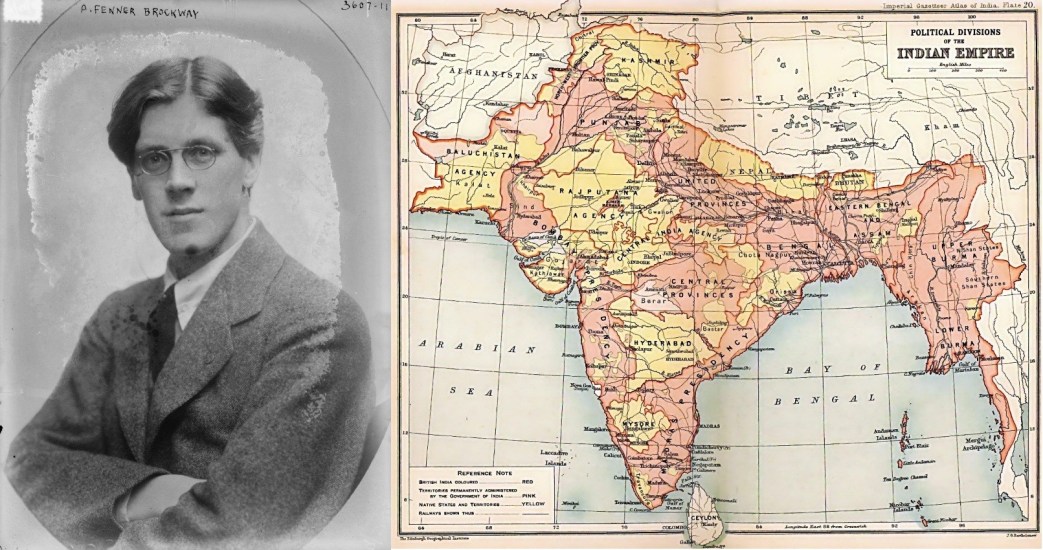
When Fenner Brockway’s ‘leftist’ Independent Labour Party, in reality a left-wing adjunct to the Labour Party, gave support for the Labour’s Ramsay MacDonald’s 1930 election bid, advancing joint candidacies with the promise of cabinet positions. Brockaway was known as a British politicians most critical of British rule in India and for his advocacy of independence. Reaching a position in which they could make demands and pressure colonial policy….these ‘stalwarts’ of anti-imperialism folded quicker than a busted flush.
‘The I.L.P. Hypocrites and India’ by Virendranath Chattopadhyaya from International Press Correspondence. Vol. 10. No. 37. August 14, 1930.
In the colonial countries it is still generally believed that the Independent Labour Party of Great Britain is a genuinely anti-imperialist organisation, that its principal leaders, Maxton, Fenner Brockway etc., are “rebels” who are in revolt against the imperialism of the Labour Government, and that these “rebels” may be relied upon to take up the fight on behalf of the independence of the colonial peoples. These illusions have been systematically created in the colonies by the radical phraseology adopted by the I.L.P., which has now assumed the role that the Labour Party used to play m the old days when Ramsey MacDonald denounced British imperialist exploitation in India in a book the entry of which into India he himself as Prime Minister forbade in 1924 There are some left wing Indian nationalists who are members of the I.L.P., all the Indian National Congress leaders trust the I.L.P., there is an important Iraqi statesman (now leading the resistance against the imperialist treaty imposed by MacDonald on Iraq), who is a member of the British I.L.P.. and the Wafd leaders of Egypt find in their I.L.P. friends trustworthy go-betweens between themselves and the imperialist Government.
It is hardly worthwhile to try and expose to these “left wing” colonial nationalists the real role of the I.L.P. in the maintenance of the British Empire. For imperialism and bourgeois nationalism have to come to a compromise after a few preliminary skirmishes, and it is these “left wing” parties on both sides that are working to bring about the agreement for the joint control and exploitation of the masses and the suppression of the revolutionary movement.
But to the workers both of Great Britain and of the colonial countries under British imperialist exploitation the treacherous tactics of the I.L.P. must be mercilessly exposed. There is not a single colonial question–whether China or India or Egypt or Palestine or Iraq–in which the I.L.P. has not given its support to the imperialism of the Labour Government, as can be proved by the speeches and writings of leading I.L.P. politicians.
To begin with, let us consider their attitude towards that lying imperialist document, the Simon Commission’s Report. On June 13th, Fenner Brockway wrote in the “New Leader” re. Vol. I. of the Simon Report: “Even those of us who from the first have opposed the Simon Commission must admit that it has done its work courageously and thoroughly…I doubt whether the most extreme Nationalist will be able to point to serious inaccuracies on major facts, though they will dispute, of course, the significance of the facts.” In other words, the deliberately false statistics of the Government of India as reproduced in the Simon Report are accepted as “facts”, which is exactly the object of the imperialist Government.
This imperialist propaganda is repeated with still greater vehemence by H.W. Nevinson in a review of Vo. II of the Simon Report. He quotes the Government figures intended to show the enormous diversity of races, religions, castes, languages etc., and adds: “Everyone who thinks of India ought to know those bare facts to start with. If he does not, he should read Vol. I of the Report. If he neither knows nor reads, let him hold his peace!” So the ultimate authority with regard to India is the Simon Report! So far, the I.L.P. leaders are in perfect agreement with the imperialist parties.
Where they apparently, but only apparently, differ is with regard to the immediate tactics to be followed. In concluding the article already quoted, Brockway writes: “I propose to conclude with a series of concrete proposals which I am confident would prevent the threatening disaster in India“, and among the seven proposals he makes the principal one is that the Round Table Conference “should be asked to prepare a Constitution automatically advancing to complete self-government, to define the transitional period from the present to the new regime” etc. He wishes to give India the right of secession after that period, but in making this generous offer his object is clearly to prevent India from going out of the Empire. This is shown by the address he delivered on India at the I.L.P. Summer School on August 5th (reported in the “New Leader” of August 8th) in which he said that, if the above-mentioned proposals were accepted, “not only would Gandhi join the Conference, but India would most likely remain within the Empire“.
These words indicate clearly how anxious Brockway & Co. are to maintain the Empire, and that they are speaking of the right of secession in order to prevent India from seceding! This is the typical hypocrisy of the I.L.P.
Another interesting piece of hypocrisy is revealed in the way in which the phrases “independence”, full self-government and “Dominion, Status” are used by the I.L.P. At the 6th Annual Conference of the I.LP. Guild of Youth held at Bradford during the Whit weekend, a resolution was passed calling for “the total independence of India and the immediate release of all political prisoners”, while Brockway proposes in the “New Leader” that “an amnesty should be granted to all political offenders, except those actually guilty of acts of violence”. The National Administrative Council of the I.L.P. at its meeting on July 13th passed a resolution “recognising the right of the Indian people to self-government and independence” and calling upon the Labour Government “to negotiate a settlement with Indian representatives on the basis of full responsible Government”. On other words, to negotiate to keep India in the Empire and to prevent a movement for independence.)
And Brailsford goes so far as to declare that mere “recognition of status”, i.e. “having an Indian Government at Delhi”, would suffice. “No one”, he writes (“New Leade'”, July 18th), “is quite sure what Indians mean by Dominion Status. I think they mean the sense of equality, the startling self-respect which would come to them with the restoration of an Indian Government. The English Viceroy, might remain, many officials, more soldiers!” “If we grant that”, says Brailsford, “we have a Joyal and tranquil India tomorrow.” Brailsford, Brockway &. Co. are clearly aiming at an India “loyal” to British imperialism. The possibilities of exploiting that loyalty for specific purposes are subtly insinuated by Brailsford in the following passage:–“Why not station the main part of the British force in the North West under its British command and subject only to the Viceroy? But in India proper, let us have an Indian army under the Indian Government.” The main British force in the North West–against whom?
The word independence, though used sometimes in resolutions, is suppressed in actual work. The I.L.P., for instance, has decided to organise an India weekend on August 23rd and 24th, in order to create a “strong public opinion” that “would force the Government to an agreement with India” (by India the I.L.P. means mainly Gandhi and the two Nehrus). The propagandists of the I.L.P. are “asked to make support of Indian self-government the theme of their speeches” during the India Weekend. The word independence is here carefully avoided, notwithstanding the resolutions of the Youth Conference and the National Administrative Council. At the same time, Brockway, Maxton and a number of other I.L.P. leaders have sent a letter to Gandhi and the other Indian National Congress leaders assuring them that the I.L.P. stood for Indian independence. For the mass meetings in Britain the word “self-government” is used, for cables to India, “independence”.
But while the I.L.P. outwardly condemns the repressive measures of the MacDonald Government and criticises its Indian policy in Parliament and the press, the real role of the I.L.P. is now clearly exposed by the agreement arrived at with the Labour Party at the joint conference between the Executives of the two Parties, held on July 27th. The “Forward” of Glasgow, an unofficial I.L.P. organ, states in its issue of August 2nd that two things were made clear at the Conference: “1) That the I.L.P. accepts the Labour Party Annual Conference as the supreme authority of the organised political movement of the workers, and 2) that the I.L.P. wishes to remain in affiliation with the Labour Party.” At the Conference, the I.L.P. National Council, headed by James Maxton, was present in full strength, and Maxton declared that “apart from the question of disarmament, there was no fundamental disagreement on basic policy and principles”
This statement by Maxton is sufficient to show that the I.L.P. accepts in fact the Indian policy of the Labour Government, and it is therefore dear that all the talk about “full self-government” and “independence” is merely a bait with which to draw the Indian leaders into the imperialist net. The I.L.P. method of work is a method that has the full sar1ction and approval of the Labour Government. In that Government the Secretary of State for India is Wegdwood Benn, who orders the bombing and shooting of the Indian masses but nevertheless retains his membership of the pacifist I.L.P., while his Party comrades Brockway and Co. keep declaring that they stand for Indian self-government even to the point of “secession”. The I.L.P. is in fact the left wing of British imperialism.
International Press Correspondence, widely known as”Inprecorr” was published by the Executive Committee of the Communist International (ECCI) regularly in German and English, occasionally in many other languages, beginning in 1921 and lasting in English until 1938. Inprecorr’s role was to supply translated articles to the English-speaking press of the International from the Comintern’s different sections, as well as news and statements from the ECCI. Many ‘Daily Worker’ and ‘Communist’ articles originated in Inprecorr, and it also published articles by American comrades for use in other countries. It was published at least weekly, and often thrice weekly.
PDF of full issue: https://www.marxists.org/history/international/comintern/inprecor/1930/v10n37-aug-14-1930-Inprecor-op.pdf
 Revolution's Newsstand