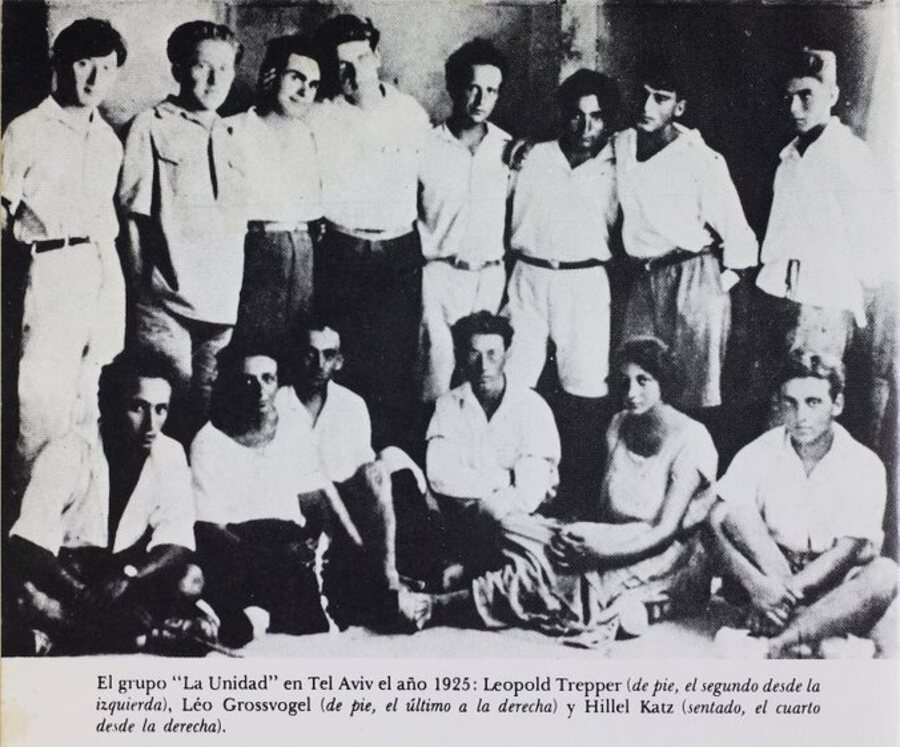
Palestine’s Communist Party in conference just before the ‘Arab Revolt’ would explode some months later. *I am unsure why this is called the ‘Third’ conference when the ‘Sixth’ was held in 1926.
‘The Third Conference of the Communist Party of Palestine’ by M.N. from International Press Correspondence. Vol. 9 No. 1. January 3, 1929.
On the 1st and 2nd of December there took place, under illegal conditions, the Third Conference of the C.P. of Palestine, 24 delegates from different parts of the country participated in it.
The Conference was able to record that the increased persecutions of the imperialist police, the wholesale arrests, the brutal sentences and deportations had been unable to achieve their object, the annihilation of the Communist movement in Palestine. As a result of the systematic terror, which is not only applied to organised Communists but also to members of the trade union organisation “Workers Fraction”, of the Red Aid, and even to the “unity movement”, the Party has to record a certain impeding of its activity and of its influence; but it defies reaction by means of a closer welding of its cadres and by systematic propaganda among the workers.
The question of the formation of a firm revolutionary cadre of Jewish and Arab workers and the organisational measures for the consolidation of the Party in the approaching struggles were the centre-point of attention at the Conference. The Conference severely condemned the defeatist moods penetrating the Party, obviously under the influence of the petty-bourgeois surroundings, and unanimously expressed full confidence in the Central Committee.
In the political resolution the Conference states that the most important political forecasts of the Party have been fully confirmed: growing impoverishment of the working class and of the peasantry, aggressive attitude of the Zionist bourgeoisie, accentuation of reaction in the country, growth of fascism, all this confronts the working class with serious tasks. The utopian and treacherous policy of the labour leaders resulted in the fact that the working class is facing the reactionary wave practically unarmed. They do not possess the international class organisations which could effectively offer resistance to the imperialist government and the bourgeoisie.
The Zionist trade union organisation “Histadruth”, whose leaders are still striving for class peace and are sacrificing the workers’ interests upon the Zionist altar, is losing a portion of its followers, but the workers who leave them are for the greater part passive and not inclined to join new organisations. The Arabian workers’ organisations are developing very slowly, although precisely among the Arab workers there is to be noticed a striving for organisation.
The organising of Arab workers is of special importance owing to the fact that the leaders of the Arabian national movement are getting more and more pro-imperialist since the Seventh Arabian Congress. The Arabian bourgeoisie and the “Notables” would like to conclude a compromise with the British government at the expense of the workers and peasants, in return for which they are even ready to recognise the mandatory rule and actively to collaborate in it.
The political resolution further mentions the war preparations of British imperialism, which find special expression in the construction of the Haifa harbour. The ideological war preparations against the Soviet Union in Palestine are made by the Zionists and especially by the extreme-Left Zionist wing “Paole Zion” who are conducting an unscrupulous campaign against the proletarian government.
The Conference accepted a report on the VI. World Congress of the Communist International. It expressed its solidarity with the Congress decisions and especially welcomed the adoption of the Comintern Programme, which is to be the object of thorough study in all the Party nuclei. With regard to the colonial question a through discussion is to be commenced in the Party literature.
Finally, the Party Council, which is to assist the Central Committee, was elected and it was resolved to issue a Manifesto to the workers calling upon them to enter the Communist Party.
International Press Correspondence, widely known as”Inprecorr” was published by the Executive Committee of the Communist International (ECCI) regularly in German and English, occasionally in many other languages, beginning in 1921 and lasting in English until 1938. Inprecorr’s role was to supply translated articles to the English-speaking press of the International from the Comintern’s different sections, as well as news and statements from the ECCI. Many ‘Daily Worker’ and ‘Communist’ articles originated in Inprecorr, and it also published articles by American comrades for use in other countries. It was published at least weekly, and often thrice weekly. Inprecorr is an invaluable English-language source on the history of the Communist International and its sections.
PDF of full issue: https://www.marxists.org/history/international/comintern/inprecor/1929/v09n01-jan-03-1929-inprecor.pdf
 Revolution's Newsstand