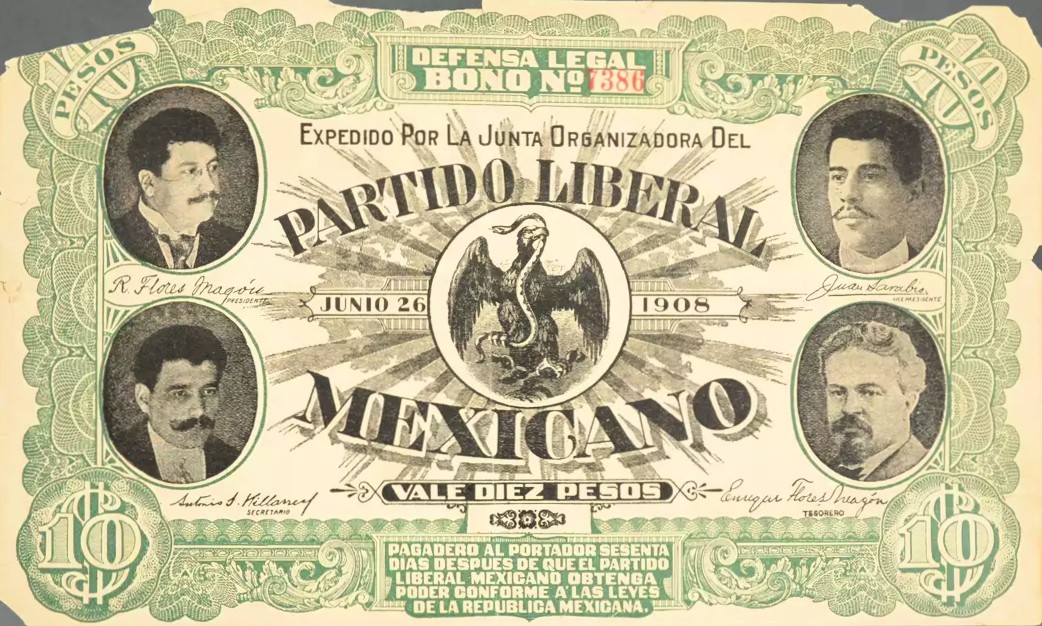
Jay Fox visits Anselm Figueroa, Librado Rivera, Ricardo and Enrique Magón, leaders of the Mexican Liberal Party, at McNeil Island federal penitentiary.
‘In Prison with the Mexican Rebels’ by Jay Fox from The Agitator. Vol. 2 No. 19. August 15, 1912.
In the United States Government prison, on McNeil Island, surrounded by the placid waters of Puget Sound, are confined 220 prisoners, all male, among whom are the four Mexican Revolutionists, the Magon brothers, Rivera and Figueroa.
The principal work in this island home of the “wicked” is farming, so the inmates are occupied in raising potatoes and other vegetables for their own consumption.
I visited our comrades there a few days ago, and came away inspired as never before with the profound impulse Of the Social Revolution. Never were men more intensely imbued with the ideal than these Mexicans.
It is not love of country that inspires them. They are not patriots. They do not love Mexico. They love the World. They are not enraptured with the Mexican peon and think him the noblest and most tyrannized creature on earth* They are in love with Humanity and Want to See it free.
They wish to remove the shackles of physical and mental slavery from the limbs of their fellow men and women the world round.
They would fight as readily to free the United States as Mexico.
Your star-spangled patriot will smile at the suggestion, for he thinks his country’s free. Where is your land, “freeman,” where is the wealth you’ve created? These are the true measures of liberty.
The liberty to move about with the lock of the law on your limbs and gag of the courts in your mouth, and everywhere the sign, “Private property, keep off,” may be liberty enough for you “intelligent” Americans, but the Mexican peon will have none of it.
His mind is clear, he is not muddled by the sophistry of the schools. He don’t know books about life, he knows life. He can’t read your hieroglyphics, he reads nature. He don’t have to go back to first principles, he never left them.
He lives close to the bosom of his mother earth. He knows he cannot live without her, and he cannot understand why he should be driven from her or be compelled to pay Some fellow-worm for what is his by countless ages of experience.
He wouldn’t arbitrate with the exploiters, because there was nothing to arbitrate. He wouldn’t reason with them because their demands were unreasonable.
They used the method of last resort to force him to their terms. He refused to be forced, and met their civilized soldiers on the battlefield—the logical meeting place of all disputants.
When they found they couldn’t lick him they tried a trick that would, under similar circumstances, have swept this country like a hurricane, and be hailed as “a glorious victory.” They displaced medieval Diaz with modern Madero in the seat of power.
“Ho, comrades,” said this three million acre land thief, “I’m a Socialist; lay down your arms now and take tip the ballot, the modern weapon of defence. Turn your regiments into socialist locals and let evolution take its natural course, according to the book.”
He sent old Mother Jones to bribe the men now in jail to advise their friends to lay down their arms.
“Tell them to come home,” said he, “and everything will be all right. They can organize and become the leaders of a Socialist party, and well all work together in harmony.”
“Go back and tell your friend,” said they, in effect, “that false friend of labor, that traitor to the Liberal Party and the cause of Mexican freedom, that we are not for sale, that the Revolution is not based on the right to organize a Socialist Party, that there will be no compromise or slight of hand, that it is Land and Liberty or utter and absolute defeat.”
And these men are now serving 23 months in a United States prison on the charge of “aiding and abetting a war against a friendly government.” But they are happy in the knowledge that Madero cannot suppress the Revolution.
The peon is fighting for his life; for What is life without Land and Liberty?
Only by the intervention of the United States can this land and liberty lover be suppressed? And the United States would have no easy time of it, either.
It took mighty England three years to beat a few thousand Boers. It would take perhaps a longer period for the United States to beat the peon, who has superior natural advantages for carrying on his defence.
Then the cost of invasion might raise a row here at home. The high cost of living would go higher. It would soar out of sight, and the American slave might ask why he is paying the cost of protecting the stolen lands of Mexico, and he might start on a little “Land and Liberty” strike of his own.
Oh, there are great possibilities in intervention, and I agree with the men in jail that it might be the very best thing that could happen for the toilers of both countries.
One thing is sure: We Revolutionists on this side of the line are not giving this Mexican Revolution a tenth of the attention it should receive.
We are Occupied with 49 varieties of side issues, and we are getting so we cannot distinguish the essential from the superficial.
But matters are shaping themselves now so that this issue may be forced upon us, bodily.
How would you feel, fellow fighter for freedom, if one fine morning you were drafted into the army for service in Mexico?
The Syndicalist began as The Agitator by Earl Ford, JW Johnstone, and William Z Foster in 1911. Inspired by the revolutionary syndicalism of the French CGT, they felt they were political competitors to the IWW and in early 1912, Foster and others created the Syndicalist Militant Minority Leagues in Chicago with chapters soon forming in Kansas City, Omaha, Minneapolis, St. Louis, Denver, Seattle, Tacoma, Vancouver, San Francisco, and Los Angeles. They renamed The Agitator The Syndicalist as the paper of the Syndicalist League of North America with Jay Fox as editor. The group then focused on the AFL. The Syndicalist ceased publication in September 1913 with some going on to form the International Trade Union Educational League in January 1915. While only briefly an organization, the SLNA had a host of future important leaders of the Communist movement. Like Foster, Tom Mooney and Earl Browder who were also members.
PDF of full issue: https://www.marxists.org/history/usa/pubs/agitator/v2n19-w43-aug-15-1912-agitator.pdf
 Revolution's Newsstand